Buy-to-let trackers from 4.90%: time to ditch the fix?
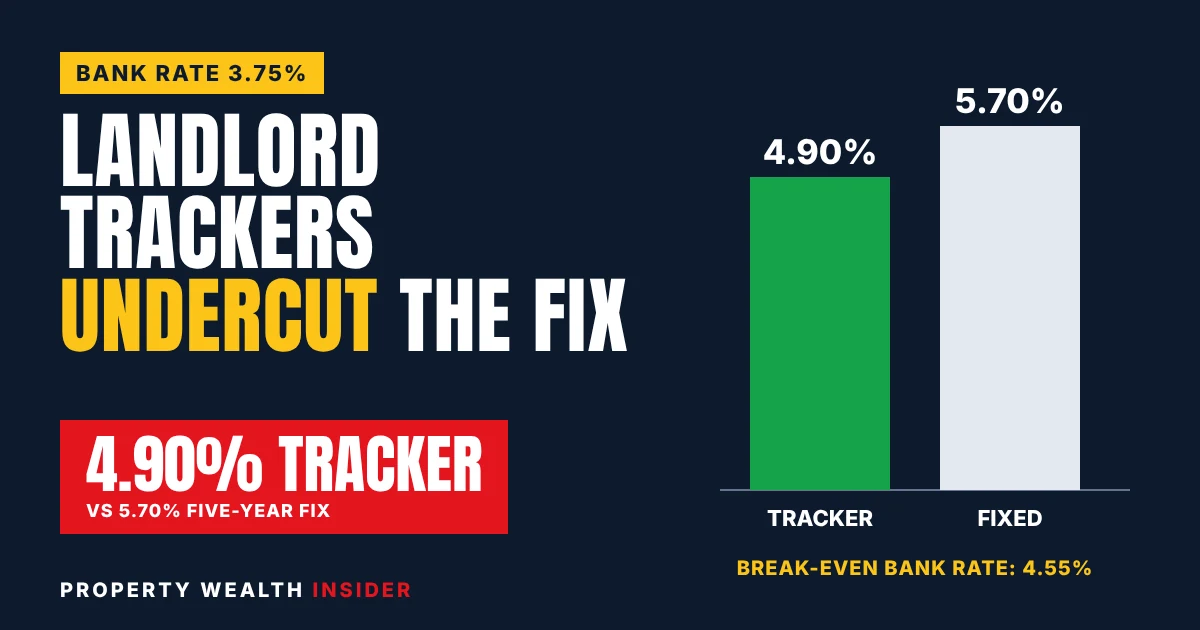
Buy-to-let trackers are back on the menu. In the past week YBS Commercial Mortgages put a five-year tracker live at 4.90%, and LendInvest relaunched its two-year trackers with no early repayment charges at all, including for holiday lets, HMOs and blocks of flats.
That matters because trackers are now pricing well below the equivalent fixes. YBS’s five-year tracker sits 0.80 points under its own five-year fix, and LendInvest’s two-year tracker is around a full point under its two-year fix.
The catch: three of the nine Bank of England rate-setters voted to raise Bank Rate last month. So is a tracker a bargain or a bet? Here is the maths, the stress-test trap and a calculator to run your own numbers.
Key facts
- Bank Rate is 3.75%, held on 17 September 2026 by a 6–3 vote (three members wanted 4%). Next decision: 5 November 2026.
- YBS Commercial’s new five-year buy-to-let tracker is 4.90% (Bank Rate + 1.15%), up to 75% LTV, 2% fee, loans from £300,000.
- YBS’s five-year fix on the same 75% LTV, 2% fee terms is 5.70%, so Bank Rate must average 4.55% before the tracker costs more.
- LendInvest’s two-year trackers now carry 0% early repayment charges, from Bank Rate + 1.50% (3% fee) or + 2.00% (2% fee), up to 75% LTV.
- On a £300,000 interest-only loan the YBS tracker costs £1,225 a month today versus £1,425 on the fix.
What the lenders have launched
We checked each product against the lenders’ own published rate data rather than relying on second-hand reports. YBS’s commercial mortgage rate data carries an effective date of 30 September 2026; LendInvest’s buy-to-let rates guide is dated 1 October 2026.
| Lender and product | Pay rate today | Max LTV | Fee | Early repayment charges |
|---|---|---|---|---|
| YBS Commercial 5-yr BTL tracker | 4.90% (Bank Rate + 1.15%) | 75% | 2% | 3%, 3%, 3%, 2%, 1% |
| YBS Commercial 5-yr MUFB tracker | 5.14% (Bank Rate + 1.39%) | 75% | 2% | 3%, 3%, 3%, 2%, 1% |
| YBS Commercial 5-yr BTL fix (for comparison) | 5.70% fixed | 75% | 2% | 5%, 4%, 3.5%, 2.5%, 2% |
| LendInvest 2-yr tracker, standard BTL | 5.25% (Bank Rate + 1.50%) or 5.75% (+ 2.00%) | 75% | 3% or 2% | None |
| LendInvest 2-yr tracker, small HMO / small MUFB | Bank Rate + 1.60% or + 2.10% | 75% | 3% or 2% | None |
| LendInvest 2-yr tracker, large HMO / large MUFB | Bank Rate + 2.00% or + 2.50% | 75% | 3% or 2% | None |
| LendInvest 2-yr tracker, holiday let | Bank Rate + 1.90% or + 2.40% | 75% (max loan £750,000) | 3% or 2% | None |
| LendInvest 2-yr fix, standard BTL (for comparison) | 6.19% (3% fee) or 6.74% (2% fee) | 75% | 3% or 2% | 2%, 2% |
YBS’s five-year trackers are for bigger borrowers: the minimum loan is £300,000 and the maximum £20 million. LendInvest’s trackers cap at £1 million (£750,000 for holiday lets) and are available in England, Wales and Scotland.
LendInvest’s large MUFB category covers blocks of 7 to 20 units and its large HMO category covers 7 to 15 rooms. After two years, LendInvest’s trackers revert to Bank Rate + 3.99%, a point lower than the Bank Rate + 4.99% reversion on its fixes.
The Bank Rate backdrop
Bank Rate peaked at 5.25% in August 2023, then came down in six quarter-point cuts to 3.75% on 18 December 2025. It has not moved since.
The mood has shifted, though. At the September 2026 meeting the Monetary Policy Committee held by 6–3, with Megan Greene, Catherine Mann and Huw Pill voting for 4%. CPI inflation rose to 3.1% in August as the Middle East conflict pushed up energy prices, and the Committee said risks to inflation are “tilted to the upside”.
Governor Andrew Bailey voted to hold but warned that if the conflict persists “it is likely that policy may have to tighten”. The minutes note that market interest rate curves were upward sloping, peaking at around 4.9% by the end of 2027, while the Bank’s survey of market participants pointed to a long period of no change. Either way, a tracker is a live bet on that question.
The break-even maths: worked examples
The simplest way to compare a tracker with a fix is the break-even rate: the average Bank Rate over the deal at which both cost the same. When the fees are equal, it is just the fixed rate minus the tracker margin.
Example 1: YBS five-year, £300,000 interest-only. The tracker at 4.90% costs £14,700 a year (£1,225 a month). The 5.70% fix costs £17,100 a year (£1,425 a month). Both have a 2% fee of £6,000. Break-even Bank Rate is 5.70% minus 1.15% = 4.55%, which is 0.80 points above today.
| Average Bank Rate over 5 years | Tracker pay rate | Tracker monthly | Tracker 5-yr cost incl. fee | Fix 5-yr cost incl. fee | Tracker saving |
|---|---|---|---|---|---|
| 3.25% (0.5 pts lower) | 4.40% | £1,100 | £72,000 | £91,500 | £19,500 |
| 3.75% (no change) | 4.90% | £1,225 | £79,500 | £91,500 | £12,000 |
| 4.25% (0.5 pts higher) | 5.40% | £1,350 | £87,000 | £91,500 | £4,500 |
| 4.55% (break-even) | 5.70% | £1,425 | £91,500 | £91,500 | £0 |
| 4.75% (1.0 pt higher) | 5.90% | £1,475 | £94,500 | £91,500 | -£3,000 |
Note what break-even means: Bank Rate has to average 4.55% across all five years, not just touch it. A rise to 4.5% in 2027 that later reverses could still leave the tracker ahead overall.
Example 2: LendInvest two-year, £300,000 interest-only. The Bank Rate + 2.00% tracker (2% fee) pays 5.75%, or £1,438 a month. The 2% fee two-year fix at 6.74% is £1,685 a month. Over two years that is £40,500 against £46,440 including fees, a £5,940 gap, with break-even at 4.74%. On the 3% fee versions (5.25% vs 6.19%), break-even is 4.69%.
Calculator: tracker vs fixed
Plug in your own loan, rent and quotes. The defaults use the YBS five-year tracker against YBS’s own five-year fix; swap the fixed rate for whatever your broker quotes. Use the last box to test a scenario, such as Bank Rate averaging half a point higher.
Tracker vs fixed buy-to-let comparator
Guide only, not financial advice. Interest-only, fees paid upfront (not added to the loan), no early repayment charges, valuation or legal costs included. The stress test is an indicative PRA-style test (tracker and 2-year fix: pay rate plus 2 points, minimum 5.5%; 5-year fix: pay rate). Each lender sets its own ICR and stress rate, so check with a broker.
The stress-test trap: why trackers can cut what you borrow
A cheaper monthly payment does not always mean you can borrow more. Under the Prudential Regulation Authority’s buy-to-let underwriting rules (SS13/16), lenders must test affordability against likely rate rises over at least five years, having regard to a minimum 2 percentage point increase, and assume at least 5.5%.
That five-year look-ahead does not apply if the rate is fixed for five years or more. So a five-year fix can usually be tested at its pay rate, while a tracker of any length is stressed higher. The same statement records 125% as the industry-standard minimum interest coverage ratio (ICR); many lenders ask higher-rate taxpayers for more, and LendInvest uses 145% for higher-rate borrowers on HMOs and MUFBs.
Example 3: £300,000 loan, rent £2,200 a month. Stressed at 6.90% (4.90% plus 2 points), the tracker needs £2,156 a month for 125% ICR and £2,501 for 145%. The five-year fix tested at its 5.70% pay rate needs only £1,781 and £2,066. So £2,200 rent passes both tests on the fix but only the 125% test on the tracker.
Lenders set their own stress rates within the PRA rules. LendInvest’s guide, for example, assesses its standard two-year trackers at 6.25% and 6.75%. Always ask what rate and ICR a lender will use before you assume a tracker gets you the loan size you need.
No-ERC trackers: who they suit
An early repayment charge is often the biggest hidden cost of a fix. On LendInvest’s five-year fixes it is 5% in years one and two: £15,000 on a £300,000 loan. Its two-year fix charges 2%, or £6,000.
LendInvest’s trackers now charge nothing to leave. That suits landlords who expect to:
- Sell within a year or two, for example trimming a portfolio or exiting a weaker-yielding property.
- Refurbish and refinance, such as adding value to an HMO or block and then moving to a cheaper deal at a higher valuation.
- Wait for a fix to get cheaper: if rates settle, you can switch to a fix without a penalty.
- Pay down debt from a lump sum, such as a sale elsewhere in the portfolio.
Remember the product fee is a sunk cost. A 3% fee on £300,000 is £9,000, so leaving a no-ERC tracker after a few months still wastes most of it. YBS’s five-year tracker is not ERC-free: it charges 3% in each of the first three years, then 2% and 1%.
What to do now
- Find your break-even. Take the fixed rate you are offered, subtract the tracker margin and adjust for any fee difference. The calculator does this for you.
- Decide if you can live with the upside. Work out the monthly cost if Bank Rate went to 4.75% or 5%. If that payment would wipe out your cash flow, a fix is the safer choice.
- Check the stress rate and ICR. Ask the lender or broker what rate the tracker will be stressed at and whether you need 125% or 145% cover.
- Price your exit plans. If there is a real chance you will sell or refinance early, compare the ERCs in cash, not percentages.
- Read the small print. Check the reversion rate, any collar (a floor below which the rate cannot fall) and whether you can switch to a fix with the same lender without a fee.
- Watch 5 November. The next MPC decision lands then. If you are close to break-even, it may be worth getting a decision in principle on both options before that date.
- Fixed and tracker quotes on the same LTV and fee level
- Break-even Bank Rate worked out
- Monthly cost tested at Bank Rate of 4.75% and 5%
- Stress rate and ICR confirmed with the lender
- ERCs costed in £ for your likely exit date
- Reversion rate, collar and product-switch terms checked
- Cash buffer set aside for rate rises
FAQs
Is a tracker or fixed buy-to-let mortgage better right now?
It depends on where Bank Rate goes. With YBS’s products, the tracker wins unless Bank Rate averages more than 4.55% over five years. Markets in September priced a rise towards around 4.9% by the end of 2027, so it is a closer call than the headline gap suggests.
What happens to my tracker payment if Bank Rate goes up?
Each 0.25 point rise adds £62.50 a month in interest per £300,000 borrowed on an interest-only loan. A full 1 point rise adds £250 a month.
Do buy-to-let tracker mortgages have early repayment charges?
Some do and some do not. LendInvest’s two-year trackers now have none. YBS Commercial’s five-year tracker charges 3% in years one to three, 2% in year four and 1% in year five.
Can I borrow as much on a tracker as on a fix?
Often not. Under PRA rules a five-year fix can be assessed at its pay rate, while a tracker is assessed at a higher stressed rate, so the same rent supports a smaller loan.
When is the next Bank of England interest rate decision?
5 November 2026. Bank Rate is currently 3.75%.
- Bank of England: Bank Rate and next decision date
- Bank of England: Monetary Policy Summary and minutes, September 2026
- Bank of England database: Official Bank Rate (IUDBEDR)
- PRA Supervisory Statement SS13/16: Underwriting standards for buy-to-let mortgage contracts
- YBS Commercial Mortgages: compare commercial mortgage rates
- LendInvest: Buy-to-let rates guide (1 October 2026)
This article is news and general guidance only. It is not financial, legal or tax advice. Rates change often; check current terms with a lender or broker.