£16m Free Eviction Advice For Tenants: Is Your Claim Watertight?
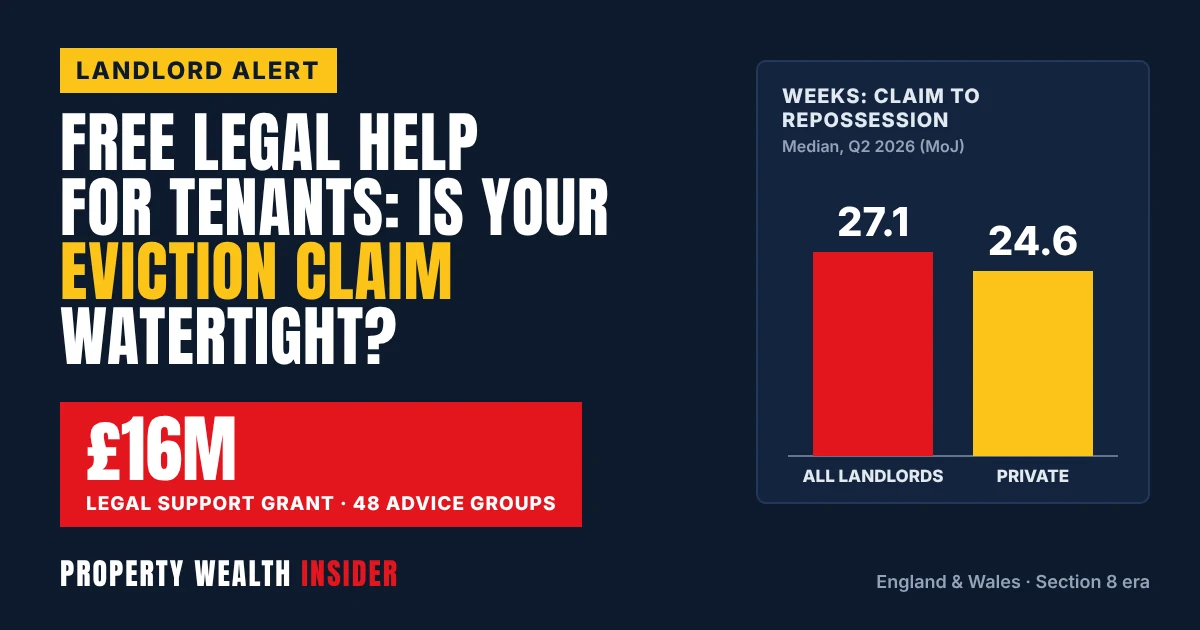
Tenants facing eviction in England and Wales are about to get a lot more free legal help. The Ministry of Justice has launched a £16m Legal Support Grant, running from October 2026 to March 2029, that pays 48 frontline advice charities to step in earlier on eviction, debt, benefit disputes and family breakdown.
For landlords the message is simple. More tenants will have an adviser checking your notice, your deposit paperwork and your rent figures before you reach court. A sloppy claim that might once have gone through could now be thrown out, and you would have to start again.
This lands five months after section 21 was abolished in England, so every private possession claim now rests on a section 8 ground that you have to prove. Below we cover what has changed, how long a possession takes on the latest court figures, what it really costs, and a checklist to get your claim right first time.
Key facts
- The £16m Legal Support Grant runs from 1 October 2026 to March 2029 and funds 48 advice organisations across England and Wales.
- It is part of over £25m the government says it has put into legal support services. The Access to Justice Foundation runs the grant.
- Tenants facing possession can already get free legal advice through the Housing Loss Prevention Advice Service, which has no means test.
- Private landlord claims took a median 24.6 weeks from claim to repossession in April to June 2026. For all landlord claims the figure was 27.1 weeks.
- In England, section 21 ended on 1 May 2026. Claims based on notices served before then had to be issued by 31 July 2026.
- Court fees: £415 to issue a possession claim in the county court, plus £152 for a warrant of possession.
What the government announced
The Ministry of Justice announced the grant on 30 September 2026 and it went live the next day. Courts minister Sarah Sackman KC said: “When people face eviction, mounting debts or family breakdown, getting the right help at the right time can make all the difference.”
The money goes to charities and advice providers such as Citizens Advice and Shelter Cymru. They will offer free legal support in person and online. The stated aim is to help people sort out problems early, avoid homelessness and stay out of court where it isn’t needed.
The Access to Justice Foundation, which runs the programme, describes it as £15 million in funding for the 48 organisations over two and a half years. The government’s headline figure is £16m. The Foundation lists housing, welfare benefits, employment and family law as the areas covered. One example it gives is Shelter Cymru, which helps people in Wales “fight repossession and eviction”.
Why better-advised tenants matter to landlords
Tenants with a possession notice could already get free legal advice. The Housing Loss Prevention Advice Service (HLPAS) started on 1 August 2023. It gives early advice on housing, debt and benefits, and advice and representation on the day of a possession hearing. There is no means test. Tenants only have to show evidence that they are at risk of losing their home.
The new grant funds the community advice organisations tenants usually contact first. Our view: more tenants will reach a hearing with your paperwork already checked. That won’t stop a good claim, but it makes a weak one easier to challenge.
Under gov.uk guidance, a judge can dismiss a case if you haven’t followed the correct procedure, if the tenant has paid the rent owed, or if you don’t attend. If your case is dismissed, you start the court process again and you may be ordered to pay the tenant’s reasonable costs.
Worked example: what a failed claim costs. Rent is £1,200 a month, which is about £277 a week (£1,200 × 12 ÷ 52). Suppose your Ground 8 claim is thrown out at a first hearing about 8 weeks after you issued it, because your notice had a defect. You then serve a fresh 4-week notice, take about 2 weeks to reissue, and pay the £415 court fee again. That is roughly 14 extra weeks of unpaid rent (£3,877) plus £415 in fees, so about £4,292 before any extra legal costs, and you are back at the start of the court queue.
The possession rules now: England and Wales
England. Under the Renters’ Rights Act, from 1 May 2026 landlords can no longer serve section 21 notices on existing or new tenancies. A section 21 or section 8 notice served before that date could only be used if the claim was issued by 31 July 2026, or sooner if the notice ran out first. That window has now closed. Today, every private landlord needs a section 8 notice on form 3A that states the grounds and gives the correct notice period for each one.
Once you have served a section 8 notice on or after 1 May 2026, you will usually have up to 12 months to apply to court. Rent-arrears claims can go through Possession Claim Online. Other claims, such as sale or breach of tenancy, need forms N5 and N119.
| Ground (England, from 1 May 2026) | Type | Notice before you can go to court | Key condition |
|---|---|---|---|
| Ground 8 – serious rent arrears | Mandatory | 4 weeks | At least 3 months’ rent owed (13 weeks if paid weekly or fortnightly), both when the notice is served and at the hearing |
| Ground 10 – any rent arrears | Discretionary | 4 weeks | The court must decide that possession is reasonable |
| Ground 11 – persistent late payment | Discretionary | 4 weeks | A pattern of rent being paid late |
| Ground 1 – landlord or family moving in | Mandatory | 4 months | The notice can’t expire within the first 12 months of the tenancy |
| Ground 1A – selling the property | Mandatory | 4 months | The notice can’t expire within the first 12 months of the tenancy |
| Ground 12 / 13 – breach of tenancy or damage to the property | Discretionary | 2 weeks | Evidence of the breach or damage |
| Ground 14 – antisocial behaviour | Discretionary | None (you can apply straight away) | The court can’t make an order until 14 days after you gave notice |
Two traps to watch. First, the court won’t make a possession order if you took a deposit and can’t show it was protected, with the prescribed information given to the tenant, or returned. Antisocial behaviour grounds 7A and 14 are the exceptions. Second, gov.uk guidance for tenants says that if the arrears exist only because Universal Credit hasn’t been paid yet, they don’t count towards the Ground 8 threshold.
Wales. The Renters’ Rights Act possession changes apply in England only. Wales uses the Renting Homes (Wales) Act 2016, under which tenants are called contract-holders. The Welsh Government’s guidance gives a six-month notice period for a landlord’s no-fault notice under section 173. For a serious rent arrears claim under section 181, the notice period is 14 days. The new Legal Support Grant covers both England and Wales.
How long a possession takes
The latest MoJ possession statistics cover April to June 2026, the first quarter after the Renters’ Rights Act came in. Across all landlord claims, the median time from claim to repossession by county court bailiffs was 27.1 weeks, down from 27.9 weeks a year earlier. For private landlord claims (excluding accelerated claims) the median was 24.6 weeks, while the mean was 33.6 weeks. The gap between the two shows how far slow cases drag out the average.
Landlord claims rose 6% to 23,635 compared with the same quarter of 2025. Accelerated (section 21) claims were up 16%, which is consistent with landlords rushing to use old notices before the 31 July deadline. The MoJ says it isn’t yet clear how far these changes are down to the Act. Remember that all of these figures start the clock when the claim is issued, so your notice period comes on top.
Calculator: possession timeline and cost
Budget for a possession in England before you serve notice. The tool adds your notice period, the time to issue and the MoJ court-stage figures, then totals lost rent, court fees and legal costs.
Possession timeline and cost estimator (England)
Guide only, not legal advice. Court fees are £415 to issue the claim and £152 for a warrant (HMCTS EX50). Timings are MoJ medians and means for England and Wales, and your local court may be faster or slower. The figures assume no rent is paid after notice and do not include re-letting, repairs or interest.
Worked example (the calculator defaults). Rent is £1,200 a month and the tenant owes 3 months (£3,600) when you serve a Ground 8 notice. Add 4 weeks’ notice, 2 weeks to issue the claim and the 24.6-week private landlord median, and you get 30.6 weeks. At about £277 a week that is £8,474 more unpaid rent, so £12,074 lost in total. Add £567 in court fees and £1,000 of legal costs and the total comes to about £13,641, or more than 11 months’ rent.
If the case runs like a slower one (the 33.6-week mean), the total rises by about £2,492. If the tenant is advised to defend and a hearing is adjourned, add each extra week at roughly £277.
Get your claim right first time: checklist
Assume the tenant’s adviser will check every item.
- Talk first. Try a repayment plan. If the tenant claims Universal Credit or Housing Benefit, ask for managed payments, so the rent comes straight to you.
- Deposit. Check it is protected in an approved scheme and that you gave the prescribed information. If not, return it before you go to court.
- Pick the right ground or grounds. For Ground 8, check the arrears reach 3 months’ rent (13 weeks if paid weekly or fortnightly) on the day you serve. Adding Grounds 10 and 11 gives you a fallback.
- Use form 3A. State each ground and the reasons it applies, and give the right notice period for each ground. For Grounds 1 and 1A, the notice can’t expire inside the first 12 months of the tenancy.
- Attach evidence. Include a clear rent statement showing each due date, payment and running balance.
- Prove service. Fill in form N215, or write “served by [name] on [date]” on your copy, and keep it.
- Check for a breathing space. You can’t start a rent-arrears claim while the tenant is in a debt breathing space.
- Issue on time. Issue within 12 months of the notice. Use Possession Claim Online for rent-arrears-only claims, or forms N5 and N119 for anything else. The fee is £415.
- Update the figures for the hearing. Ground 8 arrears must still meet the threshold on the day of the hearing, so bring an up-to-date statement and copies of every document.
- Turn up. If you don’t attend, the case can be dismissed.
- Enforce promptly. If the tenant stays past the date in the order, apply for a warrant using form N325 (fee £152). Return the bailiff forms at least 3 working days before the eviction date.
- Never take matters into your own hands. Harassment and illegal eviction are criminal offences and can lead to fines of up to £40,000.
FAQs
What is the Legal Support Grant?
It is a Ministry of Justice programme, run by the Access to Justice Foundation, that funds 48 advice organisations in England and Wales from October 2026 to March 2029. They give free early legal help on eviction, debt, benefits and family breakdown.
Can tenants get free legal aid to fight an eviction?
Yes. In England and Wales, the Housing Loss Prevention Advice Service offers free legal advice as soon as a tenant gets written notice to leave, and representation on the day of the hearing. There is no means test. The tenant only needs evidence that they are at risk of losing their home.
Can I still use a section 21 notice?
Not in England. New section 21 notices stopped on 1 May 2026, and claims based on older notices had to be issued by 31 July 2026. You now need a section 8 notice and a valid ground. Wales has its own system under the Renting Homes (Wales) Act.
How long does it take to evict a tenant in England?
Start with your notice period (4 weeks for rent arrears, 4 months to sell or move in). Then add the court stage. In April to June 2026 the median for private landlord claims was 24.6 weeks from claim to repossession, and the mean was 33.6 weeks.
How much does it cost to evict a tenant?
Court fees are £415 to issue a county court possession claim and £152 for a warrant of possession. On top of that come your legal costs and, usually the biggest cost, unpaid rent. Use the calculator above to estimate your own figures.
Does the Legal Support Grant apply in Wales?
Yes. It covers England and Wales, and Shelter Cymru is one of the funded organisations. The Renters’ Rights Act possession rules described above apply in England only.
Sources
- GOV.UK – £16m legal lifeline for families facing eviction and hardship (30 September 2026)
- Access to Justice Foundation – Legal Support Grant programme launch (1 October 2026)
- GOV.UK – Housing Loss Prevention Advice Service launch
- Ministry of Justice – Mortgage and landlord possession statistics: April to June 2026
- GOV.UK – Evicting tenants in England
- GOV.UK – Giving notice of possession to tenants before 1 May 2026
- GOV.UK – Grounds for possession: guidance for tenants
- HMCTS – Civil court fees (EX50)
- Welsh Government – Understanding the possession action process
This article is news and general guidance only. It is not financial, legal or tax advice.