Hackney crackdown: £40,000 fines and 2 years’ rent at risk
Hackney Council has put private landlords on notice. On 29 September 2026 the east London borough said it was starting a “zero tolerance” approach to rogue landlords. It will step up property inspections from October and go after the largest fines and penalties the law allows.
The timing matters. Since 1 May 2026, Hackney landlords have had two new licensing schemes to deal with. On the same date the Renters’ Rights Act 2025 raised the maximum civil penalty to £40,000 and doubled rent repayment orders to up to two years’ rent. A single unlicensed shared house can now cost far more than it used to.
This guide covers England only. The penalty rules apply in every English council area. The licensing schemes are specific to Hackney, but plenty of other councils, including many in London, run schemes of their own.
Key facts
- Hackney says it is ramping up inspections from October 2026 and has set up an enforcement team of more than 50 officers.
- Selective licensing in 17 wards and borough-wide additional HMO licensing (3-4 sharers) both took effect on 1 May 2026 and run until 30 April 2031.
- Licence fees are £925 (selective) and £1,400 (additional or mandatory HMO).
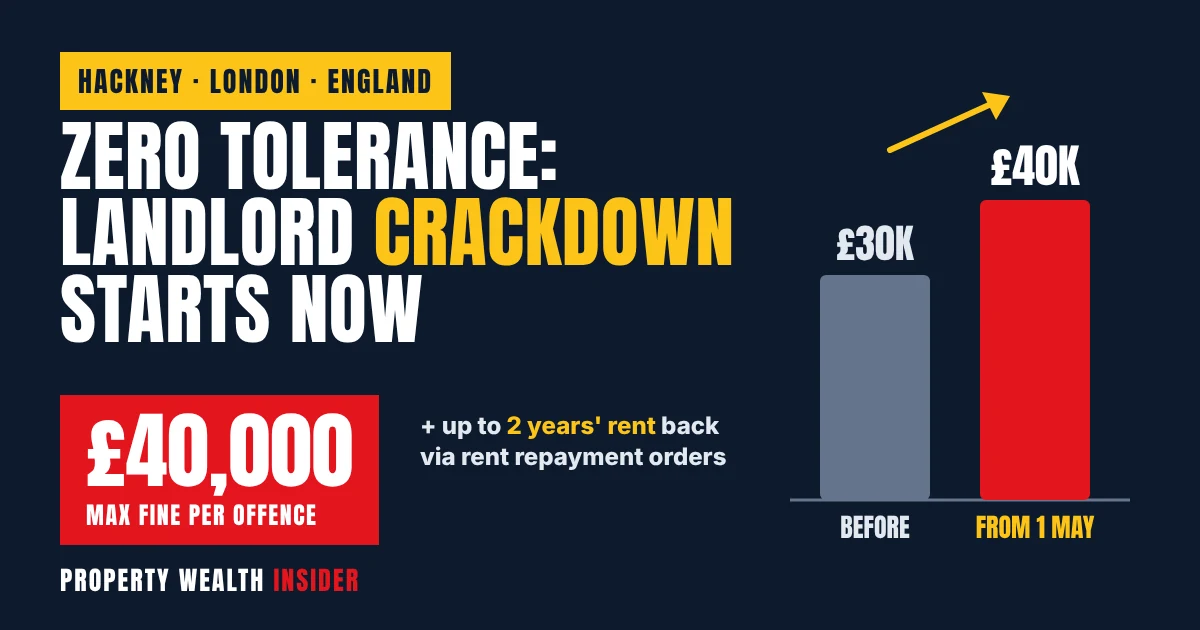
- The maximum civil penalty for housing offences went up from £30,000 to £40,000 for conduct on or after 1 May 2026.
- Rent repayment orders now reach back up to 2 years’ rent (previously 12 months) for offences committed from 1 May 2026.
What Hackney has announced
The council’s press release says it will be “seeking the biggest fines and strongest possible penalties for the worst private landlords in Hackney”. It says the work will combine the Renters’ Rights Act with the licensing schemes it brought in earlier this year.
Mayor of Hackney Zoë Garbett said the council is “ramping up our inspections” from this month. The council opened the drive by announcing a £30,000 fine for a landlord who had not dealt with fire safety concerns. It also said licensing gives its officers the power to inspect properties, and it is asking tenants to report substandard conditions.
For compliant landlords, very little has changed in law. What has changed is how likely you are to be inspected. Expect more visits, more requests for documents and less patience with missing paperwork.
Which licence does your Hackney property need?
Hackney now runs three types of licence. Which one you need depends on how many people live in the property, whether they form more than one household and where the property is. Under the council’s rules, a household is one person or members of the same family living together.
| Licence | Who needs it | Where | Fee (part A + part B) | In force |
|---|---|---|---|---|
| Selective | Lets to a single household, a single tenant or 2 people sharing | 17 wards only: Brownswood, Cazenove, Clissold, Dalston, De Beauvoir, Hackney Central, Hackney Downs, Hackney Wick, Homerton, King’s Park, Lea Bridge, London Fields, Shacklewell, Springfield, Stamford Hill West, Stoke Newington, Victoria | £555 + £370 = £925 | 1 May 2026 to 30 April 2031 |
| Additional HMO | 3 or 4 people from 2 or more households sharing facilities such as a kitchen or bathroom | The whole borough | £840 + £560 = £1,400 | 1 May 2026 to 30 April 2031 |
| Mandatory HMO | 5 or more people from 2 or more households sharing facilities | The whole borough (national rule) | £840 + £560 = £1,400 | National rule; current definition in force since 1 October 2018 |
Discounts come off part B: £100 for an EPC rating of B or above, £50 for a C, and £100 for accredited landlords. Multi-dwelling applications get £100 off part A. The council says you can keep renting the property while your application is processed. Part A is not refunded if the application is rejected or withdrawn.
Purpose-built flats in a block of three or more flats are outside the national mandatory HMO definition. Hackney’s additional licensing designation still covers HMOs of three or more people from two or more households under section 254(1)(a) to (d) of the Housing Act 2004. Section 257 converted-block HMOs are excluded.
The penalties: what changed on 1 May 2026
For housing offences, a council can issue a civil penalty instead of prosecuting. These offences include failing to license, breaching a licence condition, breaching the HMO management regulations and ignoring an improvement notice. Prosecution can lead to an unlimited fine.
Hackney’s own licensing pages still quote the old £30,000 cap. That cap still applies to conduct before 1 May 2026. From that date, the maximum is £40,000 per offence.
| Breach (England) | Maximum before | Maximum now | From |
|---|---|---|---|
| Licensing, HMO management, improvement notice and overcrowding offences (civil penalty) | £30,000 | £40,000 | 1 May 2026 |
| Electrical safety (EICR) duties | £30,000 | £40,000 | 1 November 2025 |
| Category 1 hazard the landlord could reasonably have removed (new penalty) | None | £7,000 | 22 June 2026 |
| Smoke and carbon monoxide alarm remedial notice breach | £5,000 | £5,000 | Unchanged |
| Rent repayment order, look-back period | 12 months’ rent | 2 years’ rent | Offences from 1 May 2026 |
Penalties apply per offence. One inspection can turn up several: an unlicensed HMO, blocked escape routes under the management regulations and a missing EICR could each be penalised separately. These figures are the legal maximums. The council decides the actual amount under its own enforcement policy, and you can appeal to the First-tier Tribunal.
Rent repayment orders: up to two years’ rent back
Running an unlicensed HMO or unlicensed house is a rent repayment order (RRO) offence. Tenants, or the council where universal credit paid the rent, can apply to the First-tier Tribunal. For offences from 1 May 2026, the order can cover up to two years of rent paid while the offence was being committed. That is reduced by any universal credit paid towards the rent where the tenant applies.
Under section 46 of the Housing and Planning Act 2016, the tribunal must order the full maximum once you have been convicted of the offence or received a civil penalty for it that can no longer be appealed. The only exception is exceptional circumstances. Superior landlords, including rent-to-rent head landlords, can now be pursued too.
Worked example 1: Hackney 4-sharer HMO. Four unrelated tenants pay £900 a month each, so £3,600 in total. The house needed an additional HMO licence from 1 May 2026 but the landlord never applied. By 1 October that is 5 months unlicensed. Maximum RRO: 5 x £3,600 = £18,000. Maximum civil penalty: £40,000. Worst case: £58,000, against a £1,400 licence fee.
Worked example 2: single let in Dalston. A couple rents a flat for £2,300 a month. Dalston is a selective licensing ward. The flat has been unlicensed for 5 months, so the RRO is up to 5 x £2,300 = £11,500, plus a civil penalty of up to £40,000. The selective licence costs £925, or £825 with an accredited-landlord discount.
For a mandatory HMO that has been unlicensed for longer, the new two-year cap applies only to the period from 1 May 2026. Any earlier period falls under the old 12-month rules.
Licensing and penalty risk checker
Enter your Hackney property’s details to see which licence probably applies and your maximum exposure if it is unlicensed.
Hackney licensing and penalty risk checker
Guide only, not legal advice. Based on Hackney’s published scheme rules and fees and the maximums in the Housing Act 2004 and Housing and Planning Act 2016 as amended for offences from 1 May 2026. Actual penalties are set case by case and can be appealed. Check your ward and licence type with Hackney Council.
Inspection-readiness checklist
These are the national legal requirements an officer is likely to check, plus what Hackney asks for with a licence application. Print the list and work through it for each property.
- Licence: the correct Hackney licence is held or applied for, and the occupant numbers match it.
- Gas safety: every gas appliance and flue checked by a Gas Safe engineer at least every 12 months. Give a copy of the record to existing tenants within 28 days of the check and to new tenants before they move in.
- Electrical safety (EICR): installation inspected and tested at least every 5 years, or sooner if the last report says so. Give tenants a copy within 28 days and the council a copy within 7 days of a written request.
- Smoke alarms: one on every storey with living accommodation (bathrooms and toilets count), checked as working on the day a new tenancy starts.
- Carbon monoxide alarms: in every room with a fixed combustion appliance other than a gas cooker. Repair or replace faulty alarms as soon as reasonably practicable after a report.
- HMO: manager’s details (name, address, phone) given to every household and clearly displayed.
- HMO: fire safety: escape routes clear and in good repair, fire equipment and alarms working, and fire escape signs displayed (5 or more occupiers).
- HMO: gas certificate and EICR sent to the council within 7 days of a written request.
- HMO: common parts, water supply, drainage and waste maintained in a safe, clean and working condition.
- Licensed HMO room sizes: at least 6.51 sq m for one person over 10, 10.22 sq m for two, and 4.64 sq m for a child under 10. No room under 4.64 sq m used for sleeping.
- Paperwork ready: floor plans, tenancy agreements, and an emergency lighting certificate for mandatory HMOs, all of which Hackney asks for with applications.
- Hazards: damp, mould, broken heating, insecure windows or anything else that could be a category 1 hazard fixed promptly.
What to do now: step by step
- Count heads and households. Write down who actually lives in each property today, not who the tenancy agreement says should be there.
- Check the ward. Use Hackney’s ward checker on its property licensing page to see whether a single let falls in one of the 17 selective wards.
- Apply if you need to. Do it online and pay part A. Hackney says you can keep renting while the application is processed.
- Read the licence conditions. Hackney publishes separate conditions for selective and HMO licences, covering bedroom sizes, kitchens and bathrooms, gas, electrics, fire and carbon monoxide safety. Fix any gaps before an officer finds them.
- Update your safety certificates. Put gas, EICR and alarm checks in a dated log for each property and store copies where you can send them within 7 days.
- Deal with repair reports quickly. Answer complaints in writing and keep a record of what you did and when. The council is actively asking tenants to come forward.
- If you get a notice of intent, you have 28 days to make written representations. If a final notice follows, you have 28 days to appeal to the First-tier Tribunal. Get specialist advice at this point.
If you let outside Hackney
The £40,000 civil penalty cap, the two-year RRO look-back and the new £7,000 category 1 hazard penalty are national rules that apply across England. Mandatory HMO licensing for 5 or more people from 2 or more households also applies everywhere in England.
Additional and selective licensing are set council by council, with their own boundaries, fees and conditions. If you let in any other London borough, check that council’s licensing pages directly rather than assuming Hackney’s rules apply. Wales and Scotland have separate regimes.
FAQ
Do I need a licence to rent out a flat in Hackney?
If it is in one of the 17 selective licensing wards, yes, even if you let it to one household. Anywhere in the borough, a home shared by 3 or more people from 2 or more households needs an additional HMO licence (3-4 people) or a mandatory HMO licence (5 or more).
How much is a Hackney HMO licence?
£1,400 for an additional or mandatory HMO licence, paid as £840 when you apply and £560 on approval. A selective licence costs £925. Discounts are available for good EPC ratings, accreditation and multi-dwelling applications.
What is the maximum fine for an unlicensed HMO?
A civil penalty of up to £40,000 per offence for conduct on or after 1 May 2026, or an unlimited fine if prosecuted. Tenants can also claim up to two years’ rent through a rent repayment order.
Can I keep renting while my licence application is processed?
Yes. Hackney says you can continue to rent the property while your application is being processed. You must have paid part A for the application to be submitted.
Can the council inspect my property without notice?
Councils already had powers of entry under the Housing Act 2004. The Renters’ Rights Act strengthened their investigatory powers from 27 December 2025, including powers to demand information and, in some cases, to enter without a warrant. Licensing also gives Hackney officers a route to inspect licensed properties.
- Hackney Council: New ‘zero tolerance’ crackdown on rogue landlords launches (29 September 2026)
- Hackney Council: Check which property licence you need
- Hackney Council: Apply for a property licence (fees and discounts)
- Hackney selective licensing designation notice and additional HMO licensing designation notice
- Housing Act 2004, s.249A (financial penalties)
- Financial Penalties (Housing Offences and Breach of Banning Orders) Regulations 2026
- Renters’ Rights Act 2025 (Commencement No. 2 and Transitional and Saving Provisions) Regulations 2026
- Renters’ Rights Act 2025 (Commencement No. 3) Regulations 2026
- Housing and Planning Act 2016, s.44 and s.46 (rent repayment orders)
- Housing Act 2004, s.6A (category 1 hazard penalties)
- Electrical Safety Standards in the Private Rented Sector (England) Regulations 2020
- Smoke and Carbon Monoxide Alarm (England) Regulations 2015
- Gas Safety (Installation and Use) Regulations 1998, reg. 36
- Management of Houses in Multiple Occupation (England) Regulations 2006
- Housing Act 2004, Schedule 4 (HMO licence room sizes)
This article is news and general guidance only. It is not financial, legal or tax advice.