Housing Benefit cliff edge axed: workers keep up to £77.81 a week
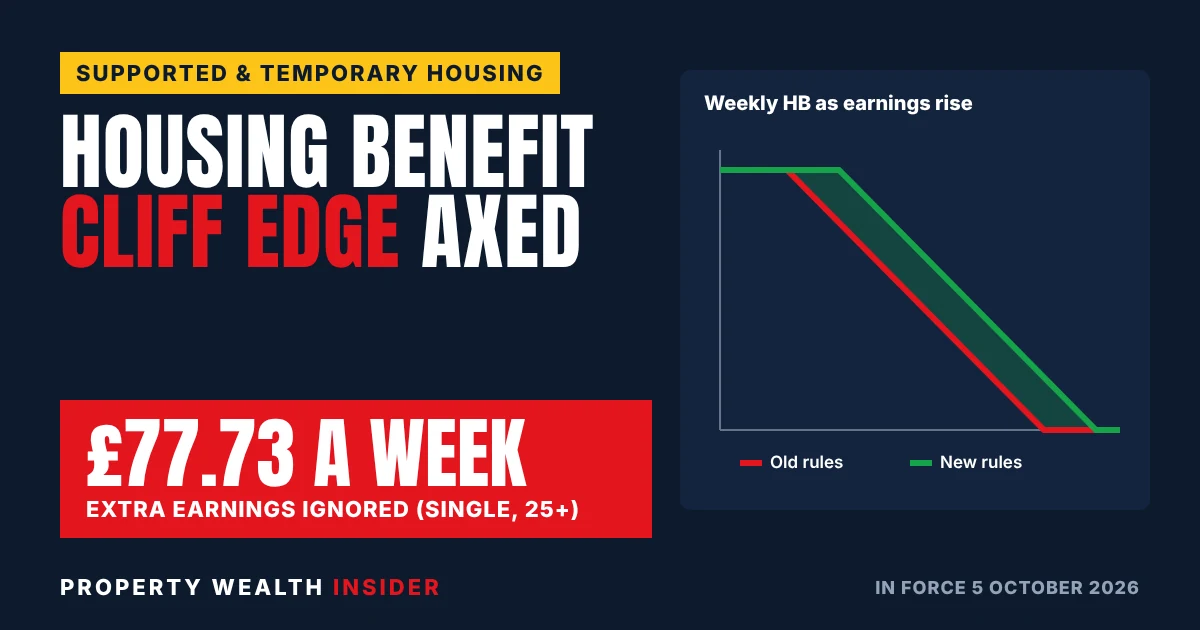
Tenants in supported housing and temporary accommodation across Great Britain can now earn far more before their Housing Benefit starts to fall. New regulations that came into force on Monday 5 October 2026 add a large extra earnings disregard of up to £119.70 a week, ending the “cliff edge” that left some residents worse off for taking on more hours.
The Department for Work and Pensions says more than 325,000 residents are covered. For landlords and providers of exempt and supported accommodation, and for anyone housing homeless households for a council, it should mean fewer sudden rent shortfalls when a tenant gets a job.
Below we explain exactly how the new calculation works, with worked £ examples, a calculator comparing the old and new rules, and a checklist for providers.
Key facts
- In force since 5 October 2026 in England, Wales and Scotland, for working-age Housing Benefit only.
- New weekly earnings disregards: £77.73 single 25+, £61.41 single under 25, £119.70 couple with at least one aged 25+.
- These come on top of the existing £5 / £10 / £25 / £20 disregards. The 65% taper is unchanged.
- A single tenant aged 25+ in work keeps up to £50.52 a week more Housing Benefit (about £2,627 a year).
- DWP says 325,000+ residents of supported and temporary accommodation benefit, including nearly 50,000 young people.
- No minimum hours: anyone employed or self-employed qualifies. Applies to new and existing claims.
What has changed
The change is made by The Housing Benefit (Earned Income Disregards) (Amendment) Regulations 2026 (SI 2026/753), in force from 5 October 2026. It was corrected before taking effect by the (Amendment) (No. 2) Regulations 2026 (SI 2026/978), in force from 2 October 2026.
Together they insert a new paragraph 18 into Schedule 4 of the Housing Benefit Regulations 2006. When a tenant in specified or temporary accommodation (or their partner) is employed or self-employed, an extra fixed sum is ignored from their weekly net earnings before Housing Benefit is worked out.
| Household | Old disregard | New extra disregard | Total ignored |
|---|---|---|---|
| Single, under 25 | £5 | £61.41 | £66.41 |
| Single, 25 or over | £5 | £77.73 | £82.73 |
| Lone parent, under 25 | £25 | £61.41 | £86.41 |
| Lone parent, 25 or over | £25 | £77.73 | £102.73 |
| Couple, both under 18 | £10 | £97.33 | £107.33 |
| Couple, one 18+ but both under 25 | £10 | £61.53 | £71.53 |
| Couple, at least one 25+ | £10 | £119.70 | £129.70 |
Weekly figures. Old disregards are the standard 2026/27 Housing Benefit amounts. Claimants entitled to the higher £20 disregard (for example through a disability or carer premium) get the new sum on top of that instead.
Some other rules have not changed. The Housing Benefit taper stays at 65% of income above the tenant’s applicable amount. The No. 2 regulations also scrapped a planned “remunerative work” test (an average-hours requirement), so any amount of paid work qualifies. They also confirm that lone parents are covered and that a couple share a single disregard.
DWP’s guidance to councils, circular HB A9/2026, says the disregards apply to new and existing claims and will be reviewed each year in line with Universal Credit uprating. Pension-age Housing Benefit is not affected.
Which homes and tenants are covered
The rules use the Universal Credit definitions in Schedule 1 to the Universal Credit Regulations 2013. Rent for these homes is still paid through Housing Benefit, even for tenants on Universal Credit.
- Specified accommodation (para 3A): exempt accommodation; supported homes provided by a housing association, registered charity, voluntary organisation or county council where the tenant receives care, support or supervision; domestic abuse refuges; and council-run hostels that provide support.
- Temporary accommodation (para 3B): homes where rent is paid to the council, or to a social housing provider under arrangements with the council, to house homeless households or prevent homelessness under the Housing Act 1996, Housing (Wales) Act 2014 or Housing (Scotland) Act 1987.
Private landlords take note: the temporary accommodation test looks at who the rent is paid to. If you lease a property to a council and the occupier pays rent to the council, it can qualify. If a homeless household rents directly from you on an ordinary tenancy, it is usually not “temporary accommodation” in this sense, and the household’s rent goes through Universal Credit’s housing element as normal.
Both statutory instruments extend to England, Wales and Scotland. Northern Ireland runs its own Housing Benefit system and is not covered.
Why there was a cliff edge
In these homes, living costs are paid through Universal Credit and rent is paid through Housing Benefit. While a tenant gets any Universal Credit, Schedule 4 paragraph 12 ignores all of their earnings for Housing Benefit, so the full eligible rent is paid.
Universal Credit tapers away at 55p for every £1 earned. A single person aged 25+ with no work allowance gets a standard allowance of £424.90 a month in 2026/27. By our calculation, that runs out at about £178.28 a week in net earnings.
Under the old rules, at that point the tenant lost Universal Credit and their Housing Benefit was suddenly means-tested. Earnings above just £5 were set against an applicable amount of £95.55 a week. That meant an immediate loss of around £50 a week in Housing Benefit, which became rent the tenant had to find themselves.
The new figures close that gap almost exactly. For a single person 25+: £95.55 + £5 + £77.73 = £178.28, the same point at which Universal Credit runs out. The same arithmetic works for singles under 25 (£142.06) and couples (£279.85 where one is 25+). In the simplest cases, Housing Benefit now starts to taper only once Universal Credit has gone.
Worked examples in £
The method is simple. Take weekly net earnings, subtract the disregards, add any other counted income, and compare the result with the applicable amount. Housing Benefit is the eligible rent minus 65% of any excess. All three examples assume the tenant is no longer on Universal Credit and has no premiums.
Example 1: single, aged 30, exempt accommodation, rent £250 a week, earns £250 net. Under the old rules, counted income is £245, which is £149.45 over the £95.55 applicable amount, so Housing Benefit is cut by £97.14 to £152.86. Under the new rules, counted income is £167.27, which is £71.72 over, so the cut is £46.62 and Housing Benefit is £203.38. The tenant’s shortfall falls from £97.14 to £46.62 a week, a saving of £50.52 a week or about £2,627 a year.
Example 2: same tenant, earnings rise to £178 a week as Universal Credit ends. Under the old rules, Housing Benefit dropped straight to £199.66, leaving a £50.34 weekly shortfall. Under the new rules, counted income is below the applicable amount, so the full £250 is paid and there is no shortfall.
Example 3: couple, one aged 25+, temporary accommodation, rent £300 a week, joint net earnings £350. Under the old rules (£10 disregard, £150.15 applicable amount), Housing Benefit is £176.60. Under the new rules (£129.70 ignored in total), it is £254.40. That is £77.81 a week more, about £4,046 a year.
Once a household’s Housing Benefit is tapering, the maximum gain is 65% of the new disregard. That works out at £50.52 a week for a single person 25+, £39.92 for a single person under 25, £39.99 for a couple both under 25 and £77.81 for a couple where one is 25+.
Calculator: old rules vs new rules
Housing Benefit work-earnings calculator
Simplified guide only, not advice. It assumes the tenant is in specified or temporary accommodation, is working age, gets no Universal Credit (while any UC is paid, all earnings are ignored and full eligible rent is covered), has no children, premiums or non-dependants, and has capital under £6,000. It uses 2026/27 applicable amounts and the 65% taper. The council’s assessment is final.
What it means for landlords and providers
Supported and temporary accommodation rents are often well above general-needs levels, so even a modest Housing Benefit cut can create a large weekly shortfall. In Example 1 the tenant’s weekly contribution roughly halves. That is real money to chase, or not chase, every week.
- Fewer arrears at move-on time. The riskiest moment used to be when Universal Credit stopped. For the simplest households, Housing Benefit now stays at the full eligible rent until that point.
- Better tenancy sustainment. Residents can take more hours without being pushed to choose between work and their home, which supports move-on into general-needs or private rented housing.
- Existing awards should change. DWP has told councils the disregards apply to existing claims, but councils also had to update their benefits software. Check that working tenants’ awards have actually been recalculated from 5 October.
- Not a cure-all. The taper is still 65%. Higher earners will still face shortfalls, and ineligible service charges (support, meals, some fuel) are not covered by Housing Benefit at all.
The government links the change to its wider homelessness strategy. In its 5 October announcement, Homelessness Minister Florence Eshalomi said it is investing over £4 billion to end homelessness.
What to do now
- List your working tenants in specified or temporary accommodation who are not on Universal Credit, or whose Universal Credit is close to ending.
- Run each case through the calculator above to estimate the new award and shortfall.
- Compare with the council’s notices. If an award dated on or after 5 October does not show the new disregard, ask the council to revise it.
- Reset rent payment plans for tenants whose shortfall has fallen, and update arrears forecasts.
- Brief support staff so they can tell residents that taking on hours is now much less likely to put their home at risk.
- Confirm each property meets the para 3A (specified) or 3B (temporary) definition
- Check who the rent is paid to for any council-leased or temporary accommodation stock
- Collect up-to-date payslips for working residents
- Check Housing Benefit notices dated 5 October 2026 or later for the new disregard
- Ask for a revision where an award looks wrong
- Update tenant rent statements and payment arrangements
- Note that disregard amounts will be reviewed each year with Universal Credit uprating
FAQ
When did the new Housing Benefit earnings rules start?
Monday 5 October 2026, under SI 2026/753 as corrected by SI 2026/978. They apply to new and existing working-age claims.
How much earnings are ignored for Housing Benefit in supported housing?
The extra disregard is £61.41 or £77.73 a week for single people and lone parents (under 25 or 25+), and £61.53, £97.33 or £119.70 for couples depending on age. This is on top of the usual £5, £10, £20 or £25 disregard.
Does it apply to private rented tenants?
Only if the home is specified accommodation or temporary accommodation as defined in Universal Credit law. Ordinary private tenants on Universal Credit get help with rent through the housing element instead, and are not affected.
Is there a minimum number of hours?
No. The corrected regulations only require the tenant or their partner to be an employed or self-employed earner.
Does it apply in Scotland, Wales and Northern Ireland?
It applies in England, Wales and Scotland. Northern Ireland has a separate Housing Benefit system and is not covered by these regulations.
Can anyone be worse off?
DWP says no group is made worse off. The change only adds to the earnings that are ignored.
Sources
- DWP press release, 5 October 2026: Supported housing residents to keep more of what they earn as new rules come into force
- DWP press release, 6 July 2026: Supported housing residents to keep more of what they earn under new rules
- The Housing Benefit (Earned Income Disregards) (Amendment) Regulations 2026, SI 2026/753
- The Housing Benefit (Earned Income Disregards) (Amendment) (No. 2) Regulations 2026, SI 2026/978
- DWP circular HB A9/2026: New earned income disregards in Housing Benefit
- Housing Benefit Regulations 2006, Schedule 4 and regulation 71 (65% taper)
- Universal Credit Regulations 2013, Schedule 1 (paras 3A and 3B) and regulation 22 (55% taper)
- DWP benefit and pension rates 2026 to 2027
This article is news and general guidance, not financial, legal or tax advice.