Awaab’s Law hits private landlords: 24-hour fix deadlines loom
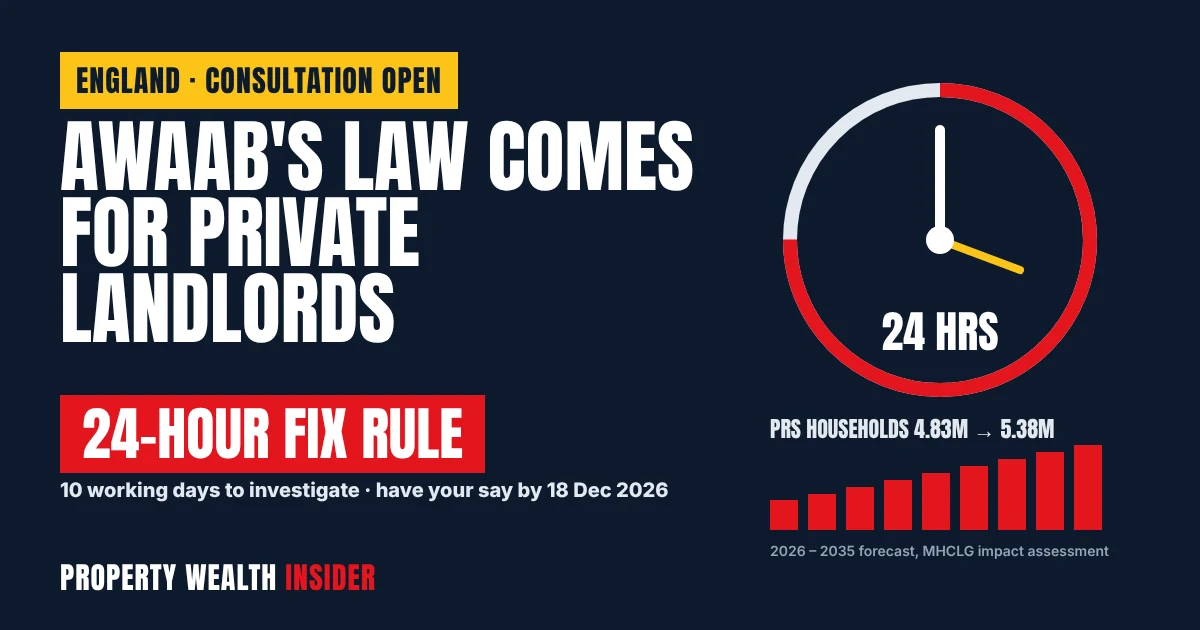
Private landlords in England are a step closer to legal repair deadlines. On 9 October 2026 the government opened a consultation on extending Awaab’s Law to private rented tenancies, and its starting point is the regime social landlords already live with: hazards investigated within 10 working days, and emergencies dealt with within 24 hours.
Nothing changes for private landlords today. The Renters’ Rights Act 2025 gives ministers the power, but the detail has to be set in regulations, and the consultation runs until 18 December 2026. The impact assessment published with it puts the cost at £8.17 per property per year and models the rules starting in 2028.
This affects every landlord letting a home in England on a tenancy, plus anyone using an agent to handle repairs, because the legal duty would stay with the landlord. Below: what is proposed, what it would cost, and a calculator that shows how fast you would have to move.
Key facts
- The consultation on Awaab’s Law for private rented tenancies and licences is open until 18 December 2026 (England only).
- It uses the social housing rules as its starting point: investigate within 10 working days, make safe within 5 working days, emergencies within 24 hours.
- The impact assessment estimates a net cost to landlords of £8.17 per property per year (range £5.64 to £10.69).
- The earliest start the government calls feasible is 2027. The impact assessment assumes phases in 2028, 2029 and 2030, but no start date has been decided yet.
- Private rented households are forecast to grow from 4.83 million in 2026 to 5.38 million in 2035.
What the government is proposing
Awaab’s Law is named after two-year-old Awaab Ishak, who died in December 2020. An inquest found the cause was prolonged exposure to mould in his family’s socially rented home. The law already applies to social housing: the Hazards in Social Housing (Prescribed Requirements) (England) Regulations 2025 came into force on 27 October 2025.
Section 60 of the Renters’ Rights Act 2025 extends the same framework to private tenancies in England. It works as an implied term in the tenancy, so a landlord who misses a deadline could be sued by the tenant for breach of contract. Section 61 allows it to be extended to licences, such as temporary accommodation, supported housing and care leaver accommodation.
The consultation is not about whether this happens. Parliament has already decided that. It asks how it should work: which hazards are covered, how fast landlords must act, whether landlords must rehouse tenants, and when it starts.
Proposed vs law. In force: Awaab’s Law for social landlords (Phase 1 since 27 October 2025, with Phase 2 due on 30 November 2026, subject to Parliament). Law but not yet switched on: the private rented power in the Renters’ Rights Act. Proposed only: every private rented deadline in this article.
The deadlines private landlords could face
For each requirement, the consultation asks whether private landlords should match the social housing timescale or have a shorter or longer one. The table shows the social housing rule, which is the government’s starting point, alongside the alternatives it lists.
| Requirement | Social housing rule (in force) | Options in the PRS consultation |
|---|---|---|
| Investigate a potential significant hazard | 10 working days, starting the day after you become aware | 5, 10 or 15 working days |
| Written summary of findings to tenant | 3 working days after the investigation ends (not needed if the work is already finished) | 1, 3 or 5 working days, or no summary at all |
| Make a significant hazard safe | 5 working days after the investigation ends (temporary fixes allowed) | 3, 5 or 10 working days |
| Preventative works | Begin, or take steps to begin, within 5 working days; physically start within 12 weeks | 3, 5 or 10 working days; asks whether the 12-week fallback should apply |
| Emergency hazards | Investigate and make safe as soon as practicable, and within 24 hours | 24 hours offered as the social housing option |
| Alternative accommodation | Required if the home cannot be made safe in time | Government says it has “concerns about the feasibility” for private landlords |
In the social housing regulations, a “working day” excludes weekends, Christmas Day, Good Friday and bank holidays in England and Wales. Social landlords have a defence if they took all reasonable steps but could not comply for reasons beyond their control. The consultation notes that the same defence would help private landlords.
Worked example. A tenant emails on Wednesday 14 October about black mould in a child’s bedroom. Under the social housing timescales, the investigation must be done by Wednesday 28 October. If it finds a significant hazard that day, the tenant must get a written summary by Monday 2 November and the room must be made safe by Wednesday 4 November. That is exactly three weeks from first report to a safe room.
Awaab’s Law deadline calculator
Enter when you were told about the problem, and when your investigation finished if it has. The calculator uses the social housing timescales, which are the government’s starting point for private landlords, and skips weekends and England and Wales bank holidays up to the end of 2028.
Awaab’s Law deadline calculator
Guide only, not legal advice. These timescales are the social housing rules, which the consultation uses as its starting point for private landlords. Nothing in this calculator applies to private tenancies yet, and the final rules may differ. Bank holidays come from the GOV.UK list for 2026 to 2028; later dates skip weekends only. Each deadline is the end of the day shown.
What the impact assessment says it will cost
The government’s impact assessment, dated 8 October 2026, assumes private landlords get the same rules as social landlords. It counts only two costs: the time spent learning the rules, and more formal letters and emails about repairs. It does not count the repairs themselves, because landlords already have a legal duty to carry them out.
| Item (impact assessment, 2025 prices) | Central estimate | Range |
|---|---|---|
| Familiarisation, per landlord (one-off, present value) | £37.54 | £28.16 to £46.93 |
| Time cost per letter or email | £4.69 | £3.13 to £6.26 |
| Print and postage per letter | £0.90 | £0.86 to £0.96 |
| Communication cost per property: 2028 / 2029 / 2030 onwards | £1.01 / £7.66 / £8.37 | Builds up as phases start |
| Net cost per property per year | £8.17 | £5.64 to £10.69 |
| Total cost to business over 10 years | £422.4m | £291.5m to £553.4m |
Worked example. A landlord with four houses would face about £37.54 once and roughly £8.37 a year per house from 2030, which is about £33 a year. Even if every penny went on rent, the assessment says that is a 0.07% increase.
The real cost sits elsewhere. The assessment says it could not estimate the cost of landlords doing repairs faster than they do now, and it did not price alternative accommodation. A single hotel stay while a hazard is fixed could wipe out years of the paperwork costs above. On the plus side, it puts an avoided 21-day void at £638 of rent, using a median rent of £208 a week.
Your Awaab’s Law admin cost
Guide only, not financial advice. Familiarisation and paperwork figures are the government’s central estimates in 2025 prices. Hotel costs are your own inputs, and it has not been decided whether private landlords will have to rehouse tenants.
5.38 million private renting households by 2035
To size these costs, the assessment forecasts the private rented sector growing by 1.2% a year. On that basis it passes 5 million households in 2029 and reaches 5,378,000 in 2035, about 551,000 more than in 2026.
Landlord numbers are much less certain. The assessment uses HMRC’s figure of about 2.3 million landlords in England in 2019-20, says trends cannot be estimated from that data, and holds the number flat. It also says the sector “may see consolidation”, as landlords get bigger to benefit from economies of scale when doing remediation work.
On exits, the government expects the landlords hit hardest to be those with the worst properties, and says they could be replaced by more professional operators. It also notes that 83% of private landlords own fewer than five properties, and that smaller landlords may find compliance more expensive.
The big questions still open
- Start date. The consultation offers 2027, 2028 or 2029. It says 2027 is the earliest feasible date and asks whether the new Private Rented Sector Landlord Ombudsman, expected in 2028, should affect timing.
- Phasing. It asks whether to copy the social housing approach, with damp and mould plus all emergency hazards first.
- Rehousing tenants. The government points out that 45% of private landlords own just one property, and that alternative accommodation would often mean a hotel or B&B.
- Leasehold flats. One option is to require landlords who own a leasehold flat to take reasonable steps to get the freeholder to fix hazards the freeholder is responsible for.
- Agents. The landlord stays liable even when an agent manages repairs, so management contracts may need rewriting.
Remember that existing duties already apply. According to the impact assessment, councils can already issue a penalty of up to £7,000 for a Category 1 hazard where a landlord has not taken reasonably practicable steps. In 2024-25, 10% of privately rented homes in England had a Category 1 hazard.
What to do now: step by step
- Step 1: Respond to the consultation. Use the online survey on GOV.UK before 18 December 2026, or email awaabslawconsultation@communities.gov.uk. Part 3 asks landlords for real evidence on costs and how fast they currently act.
- Step 2: Time-stamp every report. The deadline would start the day after you become aware, so record exactly when each repair request arrives.
- Step 3: Line up contractors. Make sure you have a damp and mould specialist, a gas engineer and an electrician who can attend at short notice, including out of hours for emergencies.
- Step 4: Check your agent agreement. Set out who investigates, who writes to the tenant, and how quickly.
- Step 5: Deal with damp now. Damp and mould is likely to be in the first phase, and it is already a hazard councils can take action on.
- Single inbox or log for all repair reports, with date and time
- Written template for a summary of investigation findings
- Named contractors for damp, gas, electrics and roofing, with response times
- Agent contract updated for Awaab’s Law-style timescales
- Photos and records of the condition of each property, room by room
- Consultation response submitted by 18 December 2026
FAQ
Does Awaab’s Law apply to private landlords yet?
No. The Renters’ Rights Act 2025 contains the power, but regulations setting the requirements have not been made. The government is consulting until 18 December 2026 and has not set a start date.
When will Awaab’s Law start for private rented homes?
The consultation says 2027 is the earliest feasible date. The impact assessment models a first phase in 2028, but says no decision has been taken.
How long will private landlords have to fix damp and mould?
The starting point is the social housing rule: investigate within 10 working days, then make the home safe within 5 working days. The consultation also asks about shorter and longer options.
Does Awaab’s Law apply in Wales or Scotland?
No. The private rented extension amends section 10A of the Landlord and Tenant Act 1985 to cover dwelling-houses in England only.
How much will Awaab’s Law cost landlords?
The impact assessment estimates £8.17 per property per year, plus about £37.54 per landlord to learn the rules. It excludes the cost of repairing faster and of any rehousing duty.
What happens if a private landlord misses an Awaab’s Law deadline?
Awaab’s Law would be an implied term of the tenancy, so the tenant could sue for breach of contract. Once the landlord ombudsman exists, the tenant could also complain there. Councils would not enforce Awaab’s Law itself, but their existing hazard powers continue.
Sources
- MHCLG: Extending Awaab’s Law to private rented tenancies and to licences (consultation, 9 October 2026)
- MHCLG: Extending Awaab’s Law to private rented tenancies and to licences – impact assessment (8 October 2026)
- GOV.UK press release: Clampdown on dangerous homes to protect more tenants and families
- The Hazards in Social Housing (Prescribed Requirements) (England) Regulations 2025
- Renters’ Rights Act 2025, section 60
- GOV.UK: UK bank holidays
This article is news and general guidance, not financial, legal or tax advice.