Brighton £740 landlord licence scheme paused by legal challenge
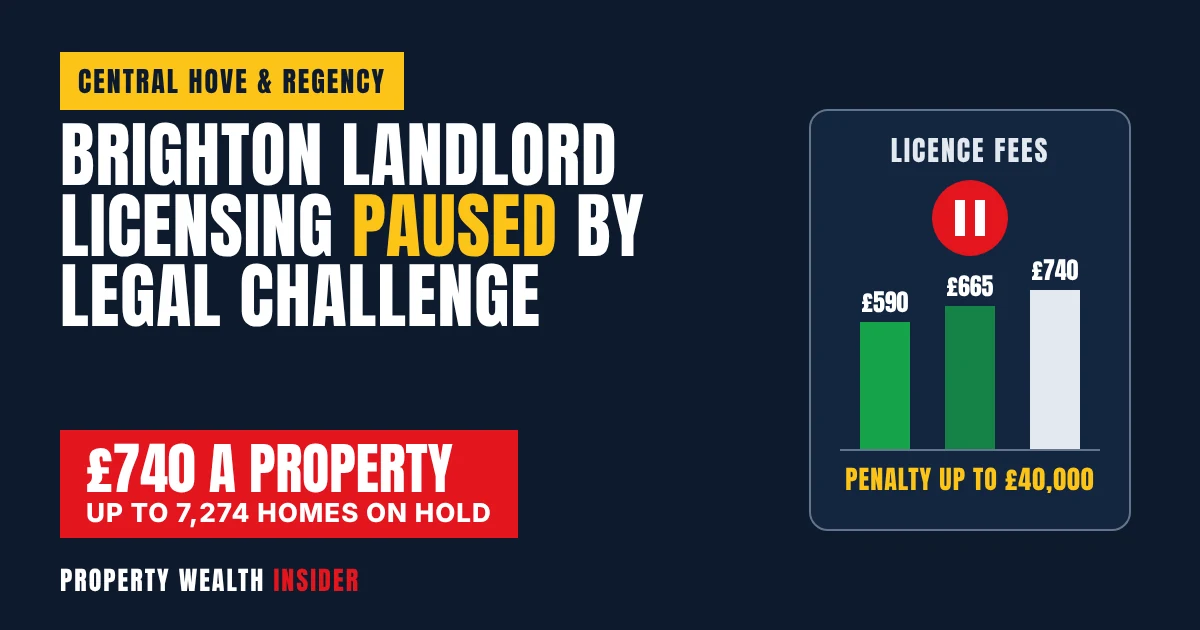
Brighton & Hove City Council has hit the brakes on its plan to force thousands more landlords into paid licensing. The selective licensing scheme for the Central Hove and Regency wards, due to switch on 20 October 2026, has been paused while the council reviews a legal challenge.
On its selective licensing page the council says the expansion “has been paused pending the review of a legal challenge”, and that the landlord engagement events planned for the launch are postponed too. The council estimated that up to 7,274 privately rented homes in the two wards would need a licence, at a standard fee of £740 each.
Brighton is the third council in a matter of weeks to change course after a challenge from landlords. Here is what the pause means, what the scheme would cost you if it goes ahead, and what you face if you get licensing wrong under the tougher penalties that arrived on 1 May 2026.
Key facts
- Brighton & Hove’s Central Hove and Regency selective licensing designation was made on 6 July 2026 and was due to start on 20 October 2026. It is now paused pending review of a legal challenge.
- Up to 7,274 properties were expected to need a licence, according to the council.
- Standard fee: £740 per property (Part A £518 + Part B £222), or £840 for a late application.
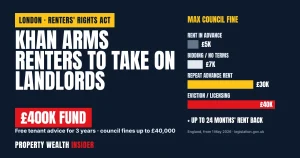
- Operating an unlicensed property in England can now cost a civil penalty of up to £40,000 (up from £30,000 since 1 May 2026), or an unlimited fine on prosecution.
- Tenants or the council can also seek a rent repayment order for up to 2 years’ rent.
- Telford & Wrekin revoked an HMO licensing scheme on 11 September 2026 after an NRLA challenge, and Great Yarmouth has cut back its licence conditions.
What Brighton has actually said
The council’s selective licensing page now states that its plan to expand the scheme to Central Hove and Regency, under a designation made on 6 July 2026, has been paused pending the review of a legal challenge. It adds that the landlord engagement events tied to the launch will be postponed while the review takes place.
That is all the council has said publicly. It has not said who brought the challenge, what the grounds are, or how long the review will take. We could not find a formal revocation notice, so the designation itself has not been cancelled. It is on hold.
The designation notice was signed on 6 July 2026. It was due to take effect on 20 October 2026 and run until midnight on 19 October 2031, the five-year maximum. Because it was made under the government’s 2024 general approval, it did not need sign-off from the Secretary of State.
Why no minister was involved: since 23 December 2024, a new general approval means councils in England are “no longer required to obtain confirmation from the Secretary of State” for a selective licensing scheme, whatever its size (MHCLG guidance). That puts the onus on landlords to challenge schemes in the courts, which is exactly what is now happening.
The pause covers the expansion only. Brighton’s existing selective licensing scheme in Kemptown, Moulsecoomb and Bevendean, Queens Park, and Whitehawk and Marina still runs from 2 September 2024 to 1 September 2029. If you let property there, nothing has changed for you.
Who the scheme would cover
If the designation goes ahead, it applies to almost every privately rented house or flat in the Regency and Central Hove wards that is let under a tenancy or licence. In practice that means homes let to one person, two people or a family.
According to the designation notice, these are excluded:
- HMOs that need a mandatory HMO licence (five or more people forming two or more households)
- HMOs covered by Brighton’s citywide additional HMO scheme (two or more storeys with three or four occupants)
- Homes let by a registered social landlord
- Properties under an interim or final management order, or with a temporary exemption notice
- Tenancies exempted nationally under section 79(4) of the Housing Act 2004
One detail catches HMO landlords out. A single-storey flat with three or four sharers does not fall under the additional HMO scheme, which only covers buildings of two or more storeys. That flat would need a selective licence instead. Flats inside converted blocks (section 257 HMOs) would also need individual selective licences, because Brighton does not license those buildings under its additional scheme.
What a licence would cost you
Brighton charges one fee for each property, paid in two parts. Part A (£518) covers processing and is paid when you apply. It is not refunded if the application is refused or withdrawn. Part B (£222) covers the scheme’s running costs and is due within 10 working days of approval. The licence is only issued once Part B is paid.
| Fee type | Cost per property | Who qualifies |
|---|---|---|
| Standard fee | £740 | Everyone applying on time |
| Single discount | £665 | Accredited (ihowz, NRLA, safeagent), Propertymark agent as licence holder, EPC C or above, or registered charity |
| Double discount | £590 | Two of the above (maximum £150 off) |
| Multi-dwelling (2nd flat onwards) | £690, or £615 with a further discount | Several flats in one block with the same owner or manager and the same licence holder |
| Late application | £840 | Operating a licensable property for more than 28 days without a licence. No discounts. |
Worked example 1, a single flat: you are an NRLA-accredited landlord and the flat has an EPC of C. You pay £590 for a licence lasting the whole five-year scheme. That works out at £9.83 a month. On rent of £1,400 a month, that is about 0.7% of your rent.
Worked example 2, four flats in one block: you own all four and hold every licence. The first flat costs £740 and each of the next three costs £690 with the £50 multi-dwelling discount, so £2,810 in total. If you also meet one of the discount criteria, flats two to four drop to £615 each, bringing the total to £2,585.
One catch: fees are not pro-rated. A licence runs from the date you apply until the scheme ends, so if the start date slips, you would pay the same fee for less cover. And if you sell, the buyer has to apply and pay again.
Cost and risk calculator
Enter your portfolio to see what licensing costs you each month, and how that compares with the maximum you could lose by not licensing.
Selective licensing cost and risk calculator
Guide only, not legal advice. Maximum exposure assumes the top civil penalty of £40,000 per unlicensed property (England, offences from 1 May 2026) plus a rent repayment order for the period selected. Actual penalties depend on the council’s policy and the facts. Most are far lower, but they can be imposed per offence.
The penalties for getting it wrong
Licensing penalties went up on 1 May 2026, when the first phase of the Renters’ Rights Act 2025 came into force in England. If a property needs a licence and does not have one, that is an offence under section 95(1) of the Housing Act 2004. The amended section now covers both the person managing or controlling the property and the landlord.
| Sanction | Maximum | Status |
|---|---|---|
| Civil penalty for a licensing offence (instead of prosecution) | £40,000 per offence (was £30,000) | In force for offences on or after 1 May 2026 |
| Government starting point for an unlicensed selective licensing property | £12,000 | MHCLG civil penalty guidance |
| Prosecution for operating unlicensed | Unlimited fine | In force |
| Rent repayment order (s.95(1) offence) | Up to 2 years’ rent | Extended from 12 months, effective 1 May 2026 |
| Breach of the new tenancy rules (a “breach”, not an offence) | £7,000 | In force from 1 May 2026 |
Worked example 3: a Regency flat let at £1,600 a month runs unlicensed for two years once a scheme is live. The council could impose a civil penalty of up to £40,000. A rent repayment order could claw back up to £38,400 (24 × £1,600). That is a worst case of £78,400, against a £740 fee.
There is a defence if a valid licence application was “duly made” and is still being decided. That is why applying promptly once a portal opens matters more than having every document perfect on day one.
Three councils, three U-turns
Brighton’s pause comes straight after two other councils backed down when landlord groups challenged their schemes. Here is what each council and challenger has confirmed.
| Council | Scheme | Challenge | Outcome |
|---|---|---|---|
| Brighton & Hove | Selective licensing, Central Hove and Regency. Made 6 July 2026, due 20 October 2026. Up to 7,274 homes, £740 fee. | A legal challenge (the council has not said who brought it) | Paused pending review. Landlord events postponed. |
| Telford & Wrekin | Additional HMO licensing for 3 to 4 sharers. Made 14 May 2026, due 25 August 2026. NRLA says fees were over £1,500 per property. | NRLA letter before claim, 19 August 2026, arguing the consultation was unlawfully unfair | Revoked by an instrument dated 11 September 2026, effective 15 September 2026. Applicants are being contacted about refunds. |
| Great Yarmouth | Selective licensing in Nelson, Central and Northgate, Southtown and Cobholm, and parts of Yarmouth North. Runs 1 April 2026 to 31 March 2031, £694 fee. | Eastern Landlords Association legal representations | Scheme continues, but the standard occupancy limit condition has been removed. The council’s conditions page now lists 8 conditions. The ELA says most discretionary conditions have gone. |
The pattern is clear. Councils no longer need ministerial approval for schemes, so a legal challenge has become the main check on them. In all three cases the council changed course before any court ruling. Weak consultations and blanket conditions are the obvious targets.
What Central Hove and Regency landlords should do now
A pause is not a cancellation. The designation still exists and could restart, possibly at short notice. Use the breathing space to get ready.
- Do not assume 20 October still applies. The council says the scheme is paused, so watch its selective licensing page for a new start date or a revocation notice.
- Confirm which licence each property would need. Use the ward map and the rules above, and pay particular attention to single-storey shared flats and flats in converted blocks.
- Line up your discounts now. Accreditation or an EPC of C could save £75 each, but only if you meet the criteria when you apply. Discounts cannot be claimed afterwards.
- Collect your documents. Gas safety certificate, EICR, EPC, smoke and CO alarm records, tenancy paperwork and floor plans.
- Budget for the fee. Plan for £518 at application and £222 within 10 working days of approval for each property.
- Apply quickly if the scheme goes live. A duly made application protects you, and applying after 28 days unlicensed costs £100 more.
- If you are in the existing four wards, carry on. That scheme is unaffected and runs until 1 September 2029.
- Property address checked against the Central Hove and Regency ward map
- Licence type confirmed: selective, additional HMO or mandatory HMO
- Gas safety certificate in date
- EICR in date (within 5 years)
- EPC on file, and noted whether it is C or above for the £75 discount
- Smoke alarm on every storey, CO alarm where required
- Accreditation (NRLA, ihowz or safeagent) in place or booked
- Proposed licence holder agreed (landlord or agent)
- £518 per property ready for Part A, plus £222 for Part B
- Council page bookmarked and alerts set for a restart date
FAQ
Do I need a selective licence in Central Hove or Regency from 20 October 2026?
The council says the scheme has been paused pending the review of a legal challenge, so it is not going ahead as planned for now. Check the council’s selective licensing page for any new start date before you apply.
How much is a selective licence in Brighton?
£740 per property, paid as £518 at application and £222 after approval. It falls to £665 with one discount or £590 with two, and rises to £840 if you apply late.
What is the fine for not having a landlord licence?
In England, a council can now impose a civil penalty of up to £40,000 for offences from 1 May 2026, or prosecute for an unlimited fine. A rent repayment order of up to two years’ rent can be added on top.
Does the pause affect Brighton’s existing licensing scheme?
No. The scheme covering Kemptown, Moulsecoomb and Bevendean, Queens Park, and Whitehawk and Marina still runs from 2 September 2024 to 1 September 2029. Brighton’s citywide additional HMO scheme and national mandatory HMO licensing also still apply.
Do councils still need government approval for selective licensing?
Not in England. Under the general approval in force since 23 December 2024, councils no longer need Secretary of State confirmation for a scheme, whatever its size. They must still consult for at least 10 weeks.
Sources
- Brighton & Hove City Council: Selective licensing (pause notice)
- Brighton & Hove City Council: Notice of Designation of Areas for Selective Licensing 2026
- Brighton & Hove City Council: Selective licence fees, discounts and exemptions
- Brighton & Hove City Council: Selective licensing scheme expanded (7,274 properties)
- Telford & Wrekin Council: Houses in multiple occupation (instrument of revocation)
- NRLA press release: NRLA secures major Telford licensing win (22 September 2026)
- Great Yarmouth Borough Council: FAQs for Selective Licensing
- Great Yarmouth Borough Council: Selective licence conditions
- Eastern Landlords Association: changes to Great Yarmouth’s scheme
- MHCLG: Selective licensing in the private rented sector, a guide for local authorities
- MHCLG: Civil penalties under the Renters’ Rights Act 2025 and other housing legislation
- Housing Act 2004, section 95
- Housing and Planning Act 2016, section 40 and section 44
This article is news and general guidance for landlords in England, not financial, legal or tax advice.