Stoke HMO crackdown: planning permission needed from 23 October
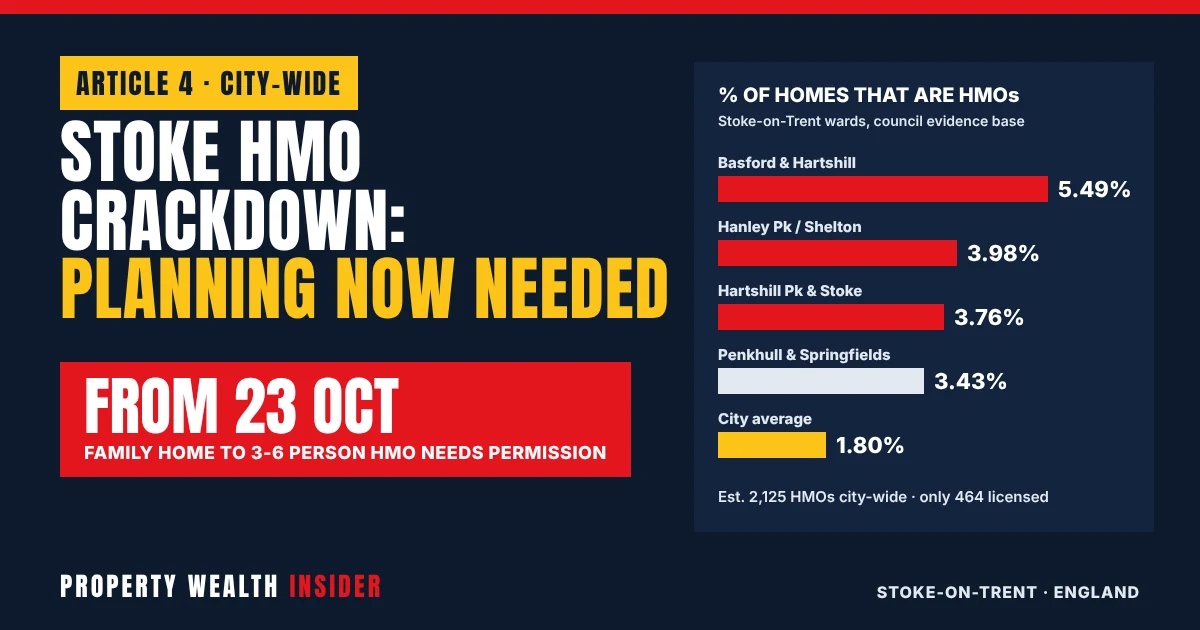
From Friday 23 October 2026, turning a family home anywhere in Stoke-on-Trent into a small HMO will need full planning permission. The city council’s Cabinet signed off a city-wide Article 4 Direction on 6 October and chose to make it take immediate effect, so there is no 12-month warning period.
That removes the permitted development right that has let landlords switch a house from a family let (use class C3) to a shared house for three to six unrelated sharers (class C4) without asking anyone. Stoke has an estimated 2,125 HMOs. Only 28 HMO planning applications were made between January 2020 and November 2025, so almost all of that growth happened without planning permission.
It affects anyone buying, converting or mid-way through converting a house to a shared let in the city, and anyone running an existing small HMO who may one day need to prove it was lawful. This rule applies in England only. The council is also planning additional HMO licensing, which is still subject to consultation.
Key facts
- The Article 4 Direction covers the whole city and is due to come into force on 23 October 2026. Cabinet approved it with immediate effect.
- From that date, a change of use from a family home (C3) to a small HMO for 3 to 6 residents (C4) needs a planning application. The national fee for one is £610 from 1 April 2026.
- Stoke has an estimated 2,125 HMOs, or 1.80% of homes. In Basford & Hartshill the figure is 5.49%.
- Only 464 HMOs hold a mandatory licence, which applies to HMOs with 5 or more people forming more than one household.
- Because the direction has immediate effect, the council must confirm it within 6 months or it lapses. Residents and landlords get at least 21 days to send in comments.
What changes on 23 October
Nationally, Class L of the General Permitted Development Order 2015 allows a house to switch between C3 and C4 without planning permission. Article 4 of the same Order lets a council remove that right in a defined area. In Stoke, that area is now the whole city.
C4 covers a dwelling used by “not more than six residents” as an HMO, as defined in the Use Classes Order. A shared house for seven or more people has never been covered by permitted development and has always needed planning permission. The new direction brings the three-to-six-person tier under planning control as well.
An immediate direction takes effect straight away. To stay in force, it must be confirmed within six months of coming into force, under Schedule 3 to the Order. The council’s own timetable works out like this:
- 23 October 2026: the notice is published and the direction comes into force. Every new C3-to-C4 conversion from then on needs a planning application.
- At least 3 weeks from that date: residents, landlords and businesses can send in representations.
- November 2026: the earliest date the council can confirm the direction, which is 28 days after the last notice.
- April 2027: the latest date for confirmation. If the council has not confirmed it by then, the direction expires.
Cabinet also gave the corporate director power to “approve any minor amendments to the date given”. The council has not yet published the signed direction or its formal notice, so check the exact date on the council’s notice before you rely on it.
Why Stoke went city-wide
The council paid RRR Consultancy to review the evidence. Its report recommended an Article 4 Direction in just three wards: Basford & Hartshill; Hanley Park, Joiner’s Square & Shelton; and Hartshill Park & Stoke. It said plainly that “a city-wide Direction is not recommended at this stage”.
Council officers went further. They argued that controlling only certain wards would push demand into neighbouring areas. Cabinet agreed to a city-wide direction on 11 August 2026 and on 6 October chose to make it immediate. The decision notice says the decision is effective from 15 October, once the call-in period ends.
National policy now supports this kind of move more directly. The new National Planning Policy Framework was published on 17 August 2026. Its policy DM10 names “preventing an over-concentration of uses which could affect the quality of life such as small Houses in Multiple Occupation” as a valid reason for an Article 4 Direction. DM10 also says a direction should be based on robust evidence and cover “the smallest area required to mitigate the evidenced harm”.
Getting planning permission is not a formality. The council’s emerging Local Plan includes a draft Policy H8. It would resist new HMOs where they would make up more than 5% of homes within 50 metres. It would also cap HMOs at 4% of homes in “very high prevalence” wards, 2.5% in high-prevalence wards and 1.5% elsewhere. Basford & Hartshill is already at 5.49%. H8 is a draft and has not been adopted, but it shows which way decisions are likely to go.
Existing HMOs: what you can keep doing
Government planning guidance is clear: “Article 4 directions cannot prevent development which has been commenced, or which has already been carried out.” A small HMO that was lawfully up and running before the direction came into force can carry on as a C4 HMO.
The hard part may be proving it. A house that changed from C3 to C4 under permitted development has no planning record. If a neighbour complains or a buyer’s solicitor asks, the burden of proof falls on you.
You can apply for a Lawful Development Certificate for an existing use. Your evidence must be “sufficiently precise and unambiguous” to show the use is lawful “on the balance of probability”. The fee for a certificate for an existing use is the same as the full planning application fee, which is £610 for a change of use from 1 April 2026. A certificate is optional, but it settles the question.
One trap to avoid: Stoke’s direction targets the C3-to-C4 change. If you let an existing HMO to a single family after 23 October and later want it back as an HMO, our reading is that this would be a new C3-to-C4 change of use and would need permission. Take advice before you change how the property is let.
Article 4 vs HMO licensing
Landlords often mix these up. Planning permission decides whether a property may be used as an HMO. A licence decides whether you may operate it and to what standard. In Stoke, you may need both.
| Article 4 Direction (planning) | Mandatory HMO licence (housing) | |
|---|---|---|
| What it controls | Whether a house can change from a family home (C3) to a small HMO (C4) | Whether the property is safe and well managed and the landlord is a fit and proper person |
| Who it catches | New small HMOs for 3 to 6 residents (7 or more always needed planning permission) | HMOs with 5 or more people forming more than 1 household |
| Existing HMOs | Not affected if the HMO use began lawfully before the direction | Applies to existing and new properties |
| Cost in Stoke | £610 national planning fee, plus drawings and agent fees | Currently £590 to £700 for 5 years. The council proposes significant rises from April 2027 |
| Timing | In force from 23 October 2026 (immediate direction, to be confirmed within 6 months) | Already in force. A city-wide additional licensing scheme for smaller HMOs is proposed, subject to consultation |
| Where | Stoke-on-Trent City Council area (England) | England and Wales, under each nation’s own rules |
The licence figures come from the August Cabinet report. It says 464 HMOs hold mandatory licences and estimates that about 1,500 operate outside licensing. The national threshold is set out on gov.uk.
Checker: do you need permission, and what will it cost?
Enter your property details to see whether you need planning permission or a licence and roughly what the paperwork costs. The tool also shows how many months of extra rent it takes to recover those costs. Every £ figure apart from the statutory planning fee is an assumption you can change.
Article 4 HMO checker & cost planner
This is a guide, not legal or planning advice. It does not cover building regulations, fire safety works, mortgage or insurance consents, or the chance of being refused. Rents and costs are illustrative assumptions. Check your own figures and the council’s notice.
Worked example 1: a new conversion after 23 October. You buy a three-bed terrace let to a family at £800 a month and want to let it to five sharers at £425 a room. Gross rent is £2,125. Take off £600 a month for bills and cleaning and the £800 you would have earned anyway, and the net uplift is £725 a month.
The paperwork costs £610 in planning fees, an assumed £1,500 for drawings and an agent, and £700 for a licence, a total of £2,810. The statutory target for a minor application is 8 weeks. That much waiting costs about £1,338 of lost uplift, so you need roughly 5.7 months of the higher rent to break even. That assumes permission is granted at all.
Worked example 2: an existing four-person HMO. If it has been let to four sharers since 2024, you need no planning application and no mandatory licence. Paying £610 for a Lawful Development Certificate is optional insurance, and is worth weighing up before you sell or refinance.
What to do now
If you are mid-conversion
- Be clear what “started” means. The development here is the change of use itself. Building work alone may not show that HMO use had begun. If sharers are not lawfully living there before the direction takes effect, assume you need permission.
- Do not cut corners on safety to beat the deadline. Moving tenants into a property that is not ready creates licensing and fire safety risks that cost far more than a planning fee.
- Keep every receipt. Compensation is limited to “abortive expenditure or other loss or damage directly attributable” to losing the right. Under section 108 of the Town and Country Planning Act 1990, you can only claim if your application was made within 12 months of the direction taking effect and is then refused or granted with tougher conditions. On a 23 October 2026 start, that means applying by 22 October 2027.
- Check the property against draft Policy H8 before you spend more. That means the 5% limit within 50 metres, the ward caps, the ban on “sandwiching” a family home between two HMOs, and the proposed minimum of 3 parking spaces for a small HMO.
- Have your say. Comments can be sent from the date the notice is published, with a minimum window of three weeks.
If you already run a small HMO in Stoke
- Tenancy agreements or licences for each sharer, with dates, covering the period before 23 October 2026
- Rent records and bank statements showing room-by-room payments
- Council tax records showing the property billed as an HMO, if it is
- Gas safety certificate, EICR, fire risk assessment and alarm test logs bearing the address and dates
- Letting adverts and booking-platform listings for individual rooms
- Utility and broadband bills in the landlord’s name for a shared house
- Dated photographs of the room layout, locks and shared kitchen
- Your HMO licence, if the property has 5 or more occupants
- A note of every period the property was not let as an HMO
Keep originals in one dated folder. If you plan to sell, refinance or face a neighbour who disputes the use, put that evidence into a Lawful Development Certificate application.
FAQs
When does the Stoke-on-Trent Article 4 Direction start?
Cabinet approved making it on 23 October 2026 with immediate effect. The council has to confirm it within six months, which is by April 2027 on its own timetable, or the direction expires.
Do I need planning permission for a 3-bed HMO in Stoke?
Yes, if you are changing a family home into a shared house for 3 to 6 unrelated people and the HMO use starts on or after the direction date. If the house was already lawfully in use as a small HMO before then, you do not.
How much is a planning application for an HMO change of use?
The national fee for a change of use is £610 from 1 April 2026, on the government’s fee schedule. Applications made because of an Article 4 Direction have not been exempt from fees since January 2018.
Does Article 4 mean my HMO needs a licence?
No, they are separate rules. You need a mandatory licence if 5 or more people from more than one household live there. Stoke is consulting on additional licensing that would also cover smaller HMOs.
Can I get compensation if my HMO plans are refused?
Possibly. Because the direction has immediate effect, you can claim for abortive spending and directly linked losses if you apply within 12 months of the direction taking effect and the council refuses permission or adds tougher conditions. Take professional advice before you claim.
Sources
- Stoke-on-Trent City Council: new planning controls for small HMOs (8 October 2026)
- Stoke-on-Trent City Council: measures to limit HMO numbers (4 August 2026)
- Cabinet, 6 October 2026: implementation of the Article 4 Direction, with the RRR evidence base
- Cabinet decision notice, 6 October 2026
- Cabinet, 11 August 2026: proposals for enhanced regulation of HMOs
- GPDO 2015, Schedule 2, Part 3, Class L
- GPDO 2015, Schedule 3 (procedures for Article 4 directions)
- Use Classes Order 1987, Class C4
- Town and Country Planning Act 1990, section 108
- GOV.UK: When is permission required? (Article 4 directions)
- NPPF Chapter 3, policy DM10
- Planning fees from 1 April 2026
- Planning fees amendment regulations 2017 (removal of Article 4 fee exemption)
- GOV.UK: Lawful development certificates
- DMPO 2015, article 34 (time periods for decisions)
- GOV.UK: HMO licensing
This article is news and general guidance only, not financial, legal, tax or planning advice.