Flood EPCs land: 6.3m properties at risk – what landlords need
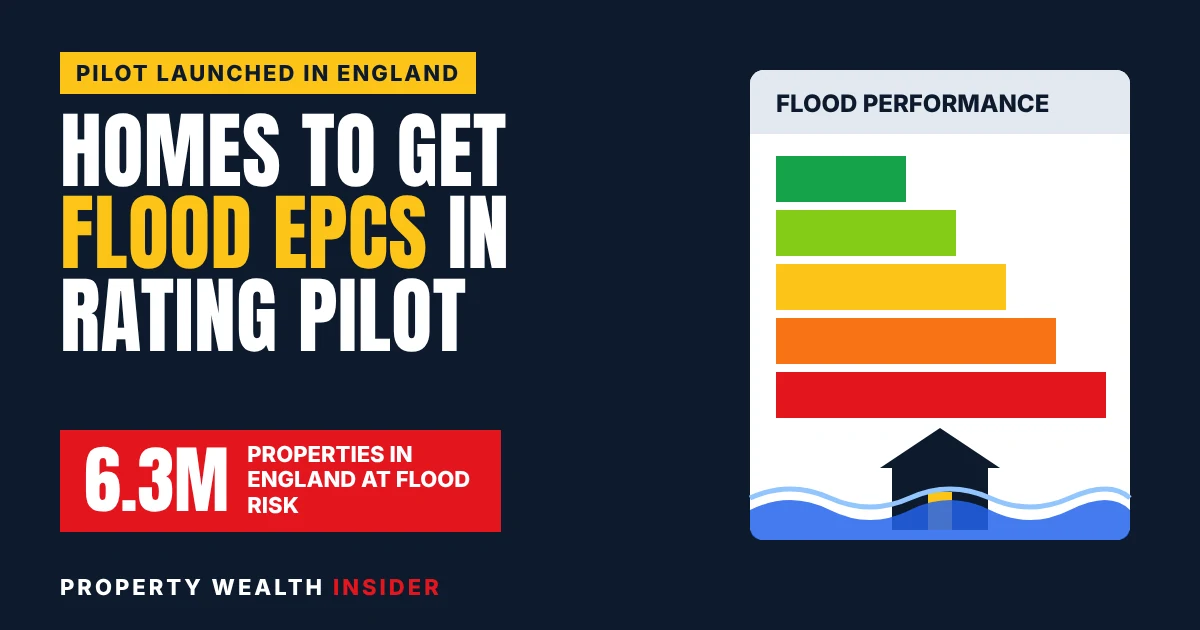
Homes in England are getting an EPC-style flood rating for the first time. Flood Re, backed by the government, is piloting Flood Performance Certificates (FPCs) that score a property on its flood risk and on how well it is protected, with the first certificates issued this year in areas at risk of flooding.
It is a pilot, not a new legal duty. Nothing has been announced that forces landlords to get one or hand one to tenants. But a standard flood score that insurers and lenders can read will shape what flood-exposed rentals cost to insure, finance and sell. It also matters because around 6.3 million properties in England are already at risk of flooding.
There is a sting in the tail for buy-to-let. The Flood Re scheme that keeps flood cover affordable for many homeowners shuts out most tenanted properties. So landlords have more reason than most to look at resilience work, and we have built a payback calculator to show when that work pays for itself.
Key facts
- Flood Performance Certificates are being piloted in England from 2026, with more pilots planned through 2027 and beyond. They are voluntary.
- A pilot Flood Performance Rating splits risk into three parts: exposure, property characteristics and resistance.
- Flood Re will cut what it charges insurers for contents cover in Council Tax Bands A and B from £58 to £25 from April 2027.
- About 6.3 million properties in England are at risk from rivers, the sea or surface water. That rises to around 8 million by mid-century.
- Flood Re only covers homes built before 1 January 2009 where the policyholder or their family lives there some of the time, or the home is unoccupied. Most tenanted buy-to-lets fail that test.
- Flood Re’s Build Back Better scheme pays up to £10,000 for resilience measures as part of a flood claim, but only on policies backed by Flood Re.
What a Flood Performance Certificate is
Defra and Flood Re announced the pilots on 13 October 2026, during Flood Action Week. The idea is to give owners in England one standard source of information on a home’s flood risk, what has already been done to protect it, and what else could be done. Think of it as an Energy Performance Certificate for flooding.
The pilot Flood Performance Rating breaks a home’s risk into three parts:
- Exposure: how likely flood water is to reach the property. This uses the Environment Agency’s existing flood risk data for rivers and surface water.
- Characteristics: features of the building that change how badly it would be hit.
- Resistance: measures already fitted. Self-closing air bricks, flood barriers, water-resilient flooring and flood-resilient kitchens are the examples given, and the government says any such work will be reflected in the assessment.
That last part is what matters for landlords. At the moment, a home that floods is priced on its location, however much has been spent protecting it. A certificate that records resilience work gives you evidence you can show an insurer, lender or buyer. Flood Re’s longer-term aim is for insurers to recognise and reward these measures, and for app-based flood self-assessments to become routine.
Pilot or law? What is actually changing
Here is how each announcement stands today. Unlike EPCs, there is no law requiring an FPC, and the announcement does not mention landlords at all. Nobody yet knows whether landlords will ever have to give tenants a copy.
| Measure | Status | When | Where | What it means for landlords |
|---|---|---|---|---|
| Flood Performance Certificates | Voluntary pilot | Pilots start 2026; more through 2027 and beyond | England | No duty to get one or give one to tenants. Worth watching if your properties are in a flood-risk area. |
| Premium discounts for having an FPC or equivalent self-assessment | Announced by Flood Re, details to come | No date set | Flood Re scheme (UK) | Only helps policies backed by Flood Re, which excludes most tenanted lets. |
| Contents cover: Flood Re charge for Bands A and B falls from £58 to £25 | Confirmed | From April 2027 | Flood Re scheme (UK) | Cheaper flood-risk contents cover for many tenants. Insurers are expected to pass on the saving, but they do not have to. |
| Build Back Better: up to £10,000 for resilience work in a claim | Live, and insurers will be pushed to offer it | Now | Flood Re scheme (UK) | Only for Flood Re-backed policies with a participating insurer. |
| End of Flood Re | Planned | 2039 | UK | The market is expected to price flood risk normally after this, so resilience will count for more. |
The premium cut and the FPC plan were first set out in Flood Re’s tenth-anniversary reform package on 1 July 2026. Flood Re said it had spent more on repairs for Band G and H homes, which are under 4% of UK homes, than for Band A and B homes, which are around 45%, in three of the last four years. The government plans to work with Flood Re and insurers to rebalance this.
The Flood Re catch for landlords
Flood Re is a reinsurance scheme. Insurers can pass the flood part of a high-risk home policy to it for a fixed fee set by Council Tax band. For 2026/27, the buildings fee ranges from £147 to £1,077, and every flood claim carries a £250 excess. But a property only qualifies if it meets all eight of Flood Re’s eligibility criteria. Three of them catch out landlords:
- Occupation: the policyholder or their immediate family must live there some or all of the time, or the property must be unoccupied. A normal let to unrelated tenants fails this test.
- Ownership: the policy must be held by, or on trust for, individuals. Company-owned homes are listed as not expected to qualify, so a limited company buy-to-let is out.
- Age and size: the home must have been built before 1 January 2009 and be a single unit or a building of two or three units. Newer homes and blocks of more than three flats are excluded.
Flood Re lists residential buy-to-let as eligible only if it meets all eight criteria. In practice, that means homes such as a second home you sometimes stay in, or one that is empty between tenancies. Your tenants’ own contents insurance can still be backed by Flood Re, even where the building itself would not qualify.
What this means: if your let is in a flood-risk area, your buildings cover is priced on the open market. Today, resilience measures are your main way to reduce both the damage and the rent you lose. Flood Re’s discounts and Build Back Better money are mostly for owner-occupiers.
How many properties are at risk
The Environment Agency’s National Assessment of Flood and Coastal Erosion Risk, published in December 2024, is the data FPCs will build on. Surface water from heavy rain now puts far more properties at risk than rivers and the sea do: 4.6 million against 2.4 million.
The number in the highest band, meaning at least a 3.3% (1 in 30) chance of flooding in any year, is the one to watch. For rivers and the sea, it rises from 367,900 properties now to 637,600 by mid-century. For surface water, it rises from 1,071,800 to 1,784,300.
These are the Environment Agency’s official risk bands, and the calculator below uses them:
| EA risk band | Chance of flooding in any given year | Odds of flooding at least once over 10 years |
|---|---|---|
| High | 3.3% or more (1 in 30) | About 29% or more |
| Medium | 1% to under 3.3% (1 in 100 to 1 in 30) | About 10% to 29% |
| Low | 0.1% to under 1% (1 in 1,000 to 1 in 100) | About 1% to 10% |
| Very low | Under 0.1% (under 1 in 1,000) | Under 1% |
Does flood resilience pay? Worked examples and calculator
Resilience work pays back through two things: smaller repair bills and a shorter period without rent. To see whether it is worth it, multiply the cost of a flood by the chance it happens each year. This gives the expected annual loss. Then compare that loss with and without the measures.
Example 1: high-risk terrace. A flood would cost £30,000 in repairs plus four months without rent at £1,100 a month, so £34,400 in total. At a 3.3% annual chance, the expected loss is about £1,135 a year. Spending £6,000 on air bricks, a flood door, a non-return valve and raised sockets, and cutting the damage by 60%, brings that down to about £454. That saves £681 a year and pays back in around 8.8 years.
Example 2: same house, low-risk band. At a 0.5% annual chance, the expected loss is only £172 a year and the saving is £103. Payback stretches to about 58 years. On the numbers alone, that work does not pay. You might still do it to protect the property’s value and future insurance terms.
If you are insured, enter only the costs you would pay yourself: the excess, rent not covered by loss-of-rent cover, and any higher premiums afterwards. The figures below are illustrations, not quotes.
Flood resilience payback calculator
Guide only, not financial or insurance advice. It assumes the damage reduction applies equally to repairs and empty months, uses a single annual chance of flooding, and ignores inflation, any premium changes and grants. Find your band with the Environment Agency’s long-term flood risk service.
Grants can change the maths. Following some major floods, councils have offered a government-funded Property Flood Resilience Repair Grant of up to £5,000 to eligible owners of flooded properties. It is only switched on for specific flood events, and each council sets the rules. Some councils exclude second homes and empty homes, for example. Ask your council whether a privately rented home qualifies before you count on it.
What landlords should do now
- Check every address. Use the government’s long-term flood risk service (England only). It covers rivers and the sea, surface water, reservoirs and, where data exists, groundwater, and shows how climate change could raise the risk. Note the band for each source.
- Read your buildings policy. Is flood included? What is the flood excess? Is loss of rent covered, and for how many months? Is the policy backed by Flood Re? If the property is let to tenants, it probably is not.
- Run the payback numbers for any property in the medium or high band, using the calculator above.
- Get a property flood resilience survey before buying any kit, so the measures match how water would actually get in.
- Keep records of every measure you fit, with invoices and photos. The FPC rating gives credit for resistance work, so evidence will count.
- Tell tenants about flood warnings and contents insurance. Contents cover backed by Flood Re should get cheaper for Band A and B homes from April 2027.
- Look again before you buy. Check the flood band and how it changes by mid-century before you offer on a buy-to-let, especially homes built after 2008, which Flood Re never covers.
- Flood risk band checked for each property (rivers and sea, surface water, groundwater)
- Buildings policy flood cover, excess and loss-of-rent limit confirmed
- Whether the policy is backed by Flood Re confirmed with the insurer or broker
- Payback calculation run for medium and high-risk properties
- Flood resilience survey booked where the numbers stack up
- Invoices and photos of fitted measures filed with the property records
- Tenants signed up to flood warnings and reminded about contents insurance
- Flood plan prepared: stopcock, fuse box, emergency contacts, Floodline 0345 988 1188
FAQ
Do landlords need a Flood Performance Certificate?
No. FPCs are a voluntary pilot in England, and there is no legal requirement to get one or give one to tenants. The government has said nothing yet about any future duty for landlords.
What is a Flood Performance Rating?
It is the score on a pilot certificate. It splits a home’s flood risk into exposure (how likely water is to reach it), property characteristics, and resistance (protection already fitted). Exposure uses Environment Agency flood risk data.
Does Flood Re cover buy-to-let properties?
Only if they meet all eight of Flood Re’s criteria. One of these is that the policyholder or their immediate family lives there some of the time, or the property is unoccupied. Homes let to tenants, company-owned homes, homes built from 1 January 2009 and blocks of more than three flats generally do not qualify. Tenants’ contents can still be covered.
When does flood contents insurance get cheaper?
From April 2027, Flood Re will cut what it charges insurers for contents cover in Council Tax Band A and B homes from £58 to £25. Insurers are expected to pass the saving on to customers, but each insurer sets its own final price.
Can landlords get the £10,000 Build Back Better money?
Build Back Better only applies to properties insured under the Flood Re scheme with an insurer that offers it, and each insurer sets its own limit up to £10,000. Most tenanted lets are not backed by Flood Re, although some insurers may fund resilience work on other policies. Ask your insurer.
Does this apply in Wales, Scotland or Northern Ireland?
The FPC pilots and the long-term flood risk service are for England. Flood Re itself covers the whole UK, so the April 2027 contents change applies wherever a policy is backed by Flood Re. Wales, Scotland and Northern Ireland each have their own flood risk maps.
Sources
- Defra and Flood Re: New pioneering certificates to help homeowners cut flood risk (13 October 2026)
- Flood Re: tenth anniversary reform package (1 July 2026)
- Flood Re: Qualifying policies which may be ceded to Flood Re
- Flood Re: Eligibility FAQs, including premiums and excess
- Flood Re: Build Back Better FAQs
- Environment Agency: National assessment of flood and coastal erosion risk in England 2024
- Environment Agency: press release on the national flood risk assessment (17 December 2024)
- Environment Agency: Risk of Flooding from Rivers and Sea, risk band definitions
- GOV.UK: Check the long term flood risk for an area in England
- GOV.UK: Government payments for communities affected by flooding (Property Flood Resilience Repair Grant)
This article is news and general guidance only. It is not financial, legal, insurance or tax advice.