Bank Rate HIKED to 4%: What It Means for Your Buy-to-Let
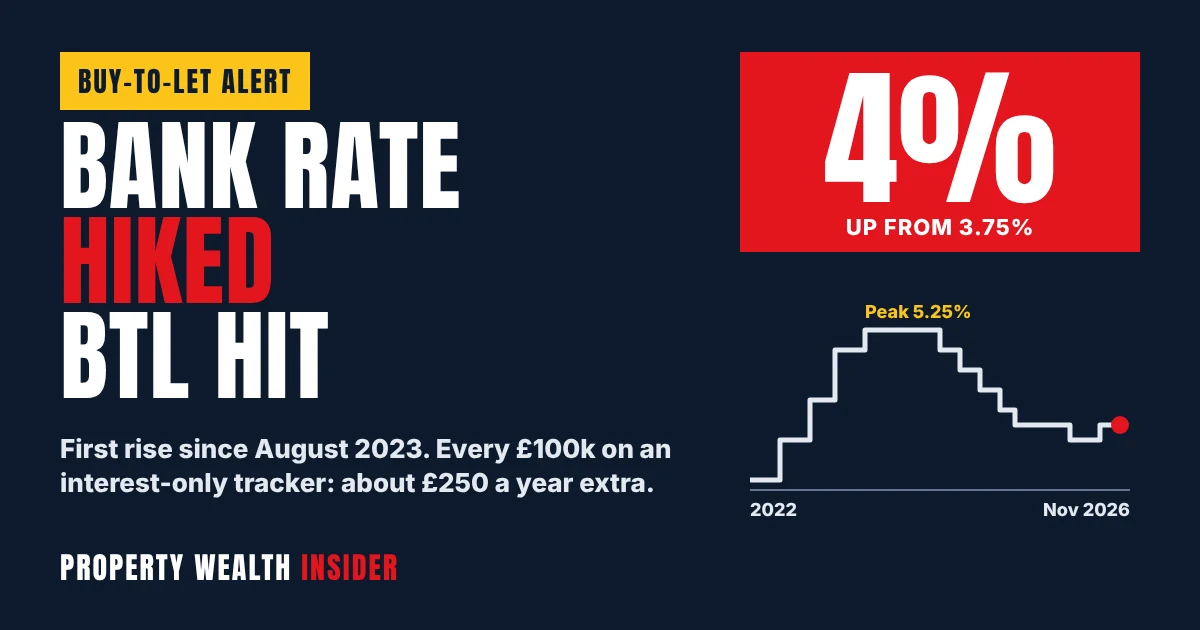
The Bank of England has put interest rates back up. On 5 November 2026 its Monetary Policy Committee raised Bank Rate by 0.25 percentage points to 4%, the first increase since August 2023, as energy prices driven by the conflict in the Middle East push inflation higher.
For landlords this is the moment the rate-cutting cycle went into reverse. Anyone on a tracker or standard variable rate is likely to pay more within weeks, and anyone whose fixed deal ends in the next year now faces tougher lender stress tests on top of higher pricing.
Below we break down exactly what changed, what it costs per £100,000 borrowed, how it squeezes buy-to-let affordability tests, and what to do before your next remortgage. Use our calculator to run your own numbers.
Key facts
- Bank Rate rose by 0.25 points to 4% on 5 November 2026, up from 3.75%.
- The MPC vote was 8–1; the one dissenter wanted a bigger rise to 4.25%.
- CPI inflation hit 3.5% in September 2026, and the Bank expects it to reach around 5% by mid-2027.
- Every £100,000 on an interest-only tracker costs roughly £20.83 a month (£250 a year) more.
- The next rate decision is due on 17 December 2026.
What the Bank decided, and why
At its meeting ending on 4 November 2026, the MPC voted 8–1 to lift Bank Rate from 3.75% to 4%. Eight members, including Governor Andrew Bailey, backed a quarter-point rise. Catherine L Mann voted for a half-point rise to 4.25%.
The trigger is energy. The Bank says the Middle East conflict is now in its ninth month and global energy prices have kept climbing. ONS figures show CPI inflation rose to 3.5% in the 12 months to September 2026, up from 3.1% in August, with motor fuels the biggest upward driver.
The Bank now expects inflation to climb to around 5% by the middle of 2027 before falling back. Its worry is that high energy costs start feeding into wages and other prices. The Governor said the increase “shouldn’t be seen as the first in an inevitable long sequence of hikes”, but added that unless the conflict is resolved, “neither does it seem likely to be the last increase.”
The shift has been fast. Bank Rate peaked at 5.25% in August 2023, was cut in six steps to 3.75% by 18 December 2025, and sat there for over ten months before this rise.
Markets had already moved before the decision. The MPC minutes note that benchmark two-year mortgage rates had risen by nearly 50 basis points since the beginning of September, and the Bank’s November Monetary Policy Report says mortgage approvals for house purchase fell 8% in the three months to September, hitting their lowest monthly level since 2023.
Tracker, fixed or SVR: who pays more and when
How hard this hits you depends entirely on your mortgage type. The rise applies across the UK, so landlords in England, Wales, Scotland and Northern Ireland are all affected the same way.
| Mortgage type | What happens now | When you feel it |
|---|---|---|
| Tracker (Bank Rate + margin) | Rate typically rises by the full 0.25 points | From the date set in your lender’s terms, usually within weeks |
| Standard variable rate (SVR) | Lender decides whether and how much to pass on | After the lender gives notice |
| Fixed rate, mid-deal | No change to your payment | When the fix ends and you remortgage or switch |
| Fixed rate ending within 12 months | New fixed prices already reflect higher market rates | At renewal, plus tighter stress tests |
Here is what a 0.25-point rise adds on interest-only borrowing, which is how most buy-to-let loans are structured. The “after Section 24 credit” column assumes the 20% basic-rate tax credit applies in full (see below).
| Loan balance | Extra per month | Extra per year | Extra per year after 20% credit |
|---|---|---|---|
| £100,000 | £20.83 | £250 | £200 |
| £150,000 | £31.25 | £375 | £300 |
| £200,000 | £41.67 | £500 | £400 |
| £300,000 | £62.50 | £750 | £600 |
| £500,000 | £104.17 | £1,250 | £1,000 |
A portfolio landlord with £1 million of tracker debt is looking at around £2,500 a year more before tax. On a repayment mortgage the monthly rise is slightly smaller, because part of each payment goes to capital.
Rate rise impact calculator
Enter your own loan, rate and rent. The tool shows your new payment, the yearly hit, your rent cover at the new rate, and whether the rent would pass a 125% or 145% ICR test at a stress rate you choose.
Rate rise impact calculator
Guide only, not financial or tax advice. ICR is shown as monthly rent divided by monthly interest on an interest-only basis, which is how lenders usually test it. Real lender tests, stress rates and tax positions vary; Scottish income tax bands differ. Check with your lender, broker or accountant.
How the rise hits lender ICR stress tests
Buy-to-let lending is not only about whether you can afford the payment. Lenders run an interest coverage ratio (ICR) test: the rent must cover the mortgage interest by a set margin, calculated at a “stressed” rate that is usually higher than the rate you will actually pay. The Bank of England’s Prudential Regulation Authority sets expectations for these tests in its supervisory statement SS13/16.
Common benchmarks are an ICR of 125% for basic-rate taxpayers and limited companies and 145% for higher-rate taxpayers, because higher-rate landlords keep less of their rent after Section 24. Exact ratios and stress rates vary by lender, product and whether the rate is fixed for five years or more, so always check the current criteria.
Worked example: rent of £1,200 a month, tested at an illustrative 5.5% stress rate.
- At 125% ICR, the rent supports £960 a month of stressed interest: a maximum loan of about £209,455.
- At 145% ICR, it supports about £827.59 a month: a maximum loan of about £180,564.
- If the lender’s stress rate moves from 5.5% to 6%, the 145% maximum falls to about £165,517, a drop of roughly £15,000 on the same rent.
That is the hidden danger of a rising-rate environment. Stress rates are often linked to the product rate or to market pricing, so as pay rates climb, the amount you can borrow on the same rent shrinks. Landlords who refinanced to the limit when rates were lower may find they cannot borrow the same amount at renewal without paying down debt or raising rent.
Section 24: why the extra interest bites harder
Individual landlords cannot deduct residential mortgage interest from rental income. Instead, HMRC guidance confirms they get a tax reduction worth the basic rate (currently 20%) of their finance costs, limited by property profits and adjusted total income. This has applied in full since 6 April 2020. Limited companies are outside this rule and still deduct interest as a business cost.
So every extra £1 of interest only earns 20p of relief, whatever your tax band. For a higher-rate landlord with £200,000 on a tracker, the £500 a year of extra interest costs £400 after the credit. If that interest were fully deductible at 40%, it would cost £300.
There is a further change coming. The government has announced separate property income tax rates of 22%, 42% and 47% from 6 April 2027 for England, Wales and Northern Ireland, with the residential finance cost credit given at the 22% property basic rate. That is due to take effect from the 2027-28 tax year; it does not apply now. The calculator above lets you switch between the two.
What it means for rents
Rents were already rising before this decision. ONS data shows average UK private rent rose 3.8% to £1,406 a month in the 12 months to September 2026 (provisional). England averaged £1,466 (up 4.0%), Wales £848 (up 4.1%) and Scotland £1,011 (up 0.7%). Northern Ireland averaged £879 (up 1.7%) in the year to July.
Higher borrowing costs give mortgaged landlords a reason to review rents, but what you can charge is set by local demand and tenants’ ability to pay, which is under strain from the same energy bills pushing inflation up. Rent increases must also follow the rules for your nation and tenancy type, so check the correct notice process before you act.
A quick benchmark: on a £200,000 interest-only loan, recovering the £500 a year extra means about £42 a month more rent before tax. Compare that with what similar homes nearby actually let for.
What to do now: a step-by-step plan
- List every mortgage. Note the lender, balance, rate type, current rate and deal end date for each property.
- Price the tracker hit. For tracker and SVR loans, run the calculator above and check your lender’s letter for the date the new rate starts.
- Flag deals ending in the next 6-12 months. Many lenders let you secure a new rate months before your current deal ends. Ask a broker when you can lock in.
- Run your ICR numbers. Test each property at 125% and 145% on a realistic stress rate. If one fails, you may need to put in cash, accept a smaller loan, or compare product transfer terms with your existing lender.
- Weigh tracker vs fixed. The Bank says policy is not on a pre-set path. A fix gives certainty; a tracker could cost more if rates rise again but benefits if they fall. Check early repayment charges either way.
- Update your tax forecast. Extra interest only gets 20% relief for individual landlords. Higher-rate landlords should budget for that, and for the move to a 22% credit from April 2027.
- Review rents properly. Check local comparables and follow the correct legal process for any increase.
- Diary 17 December 2026. That is the next MPC decision.
- All mortgage balances, rates and end dates in one sheet
- Tracker and SVR payment increases calculated
- Lender letters checked for new rate effective dates
- Deals ending within 12 months flagged to a broker
- ICR tested at 125% and 145% on each property
- Early repayment charges checked before switching
- Tax forecast updated for the extra interest
- Rents compared with local listings
- 17 December 2026 MPC date in the diary
FAQs
What is the Bank of England base rate now?
Bank Rate is 4%, after the MPC raised it by 0.25 percentage points on 5 November 2026. It had been 3.75% since 18 December 2025.
Will my buy-to-let tracker mortgage go up?
Almost certainly, if it tracks Bank Rate. Your rate normally rises by the same 0.25 points from a date set out in your mortgage terms. Each £100,000 on interest-only costs about £20.83 a month more.
Does the rate rise affect my fixed-rate mortgage?
Not until your fixed deal ends. Your payments stay the same until then, but the rates and stress tests you face at renewal are likely to be tougher than when you last fixed.
When is the next Bank of England interest rate decision?
The next announcement is due on 17 December 2026. The Bank says it will assess the evidence at each meeting rather than follow a set path.
Why did the Bank of England raise interest rates?
Because energy prices linked to the Middle East conflict pushed CPI inflation to 3.5% in September 2026, and the Bank expects around 5% by mid-2027. It wants to stop that spreading into wider prices and wages.
Can landlords still claim mortgage interest against tax?
Individual landlords get a basic-rate tax credit, currently 20% of finance costs, rather than a deduction. From 6 April 2027 that credit is due to be given at 22% in England, Wales and Northern Ireland. Limited companies can still deduct interest.
Sources
- Bank of England: Monetary Policy Summary and minutes, November 2026
- Bank of England: Interest rates and Bank Rate, our latest decision
- Bank of England: Monetary Policy Report, November 2026
- Bank of England: Official Bank Rate history
- PRA SS13/16: Underwriting standards for buy-to-let mortgage contracts
- ONS: Consumer price inflation, UK, September 2026
- ONS: Private rent and house prices, UK, October 2026
- HMRC: Tax relief for residential landlords, how it’s worked out
- HM Treasury/HMRC: Changes to tax rates for property, savings and dividend income
This article is news and general guidance only, not financial, legal or tax advice.