Minister’s 0.2% rent claim won’t cover landlords’ tax hit
The Housing Minister has told MPs that next April’s landlord tax rise will barely touch rents. The Office for Budget Responsibility’s own Budget report warns of fewer rental homes and higher rents over time. Landlords are caught in the middle, facing a 4-point tax jump from 6 April 2027.
The clash came during ministerial questions in the Commons on Monday 2 November 2026. Matthew Pennycook said the OBR had put the rent effect of last year’s 2-point rise at just 0.2%, and he expects “a comparably small effect” from the extra 2 points Chancellor John Healey added in the 28 October Budget.
So who is right? And if you let property in your own name, how much would rents have to rise just to leave you where you are today? We went back to Hansard, the OBR and HMRC to find out, and built a calculator so you can check your own numbers.
Key facts
- From 6 April 2027, property income rates in England, Wales and Northern Ireland will be 24% / 44% / 49%, up from 20% / 40% / 45% today.
- The Section 24 mortgage interest credit will rise from 20% to 24%, because it stays tied to the property basic rate.
- The minister told MPs the OBR put the rent effect of last year’s rise at 0.2%. We could not find that figure in the OBR’s published November 2025 report.
- The OBR’s October 2026 report says the two rises together are a “material reduction in returns” to landlords and “risk leading to a steady rise in rents”.
- UK rents averaged £1,406 a month in September 2026, up 3.8% in a year (ONS).
- For a typical landlord, the extra tax works out at 4% of profit after mortgage interest, whatever band they are in.
What was said in the Commons
Labour MP Paula Barker raised the OBR’s warning that the Budget’s property tax rise “could feed through into rents”. In reply, Pennycook told the House: “At the Budget last year, the OBR assessed that there would be only a small impact on rental prices of 0.2% as a result of the 2 percentage point increase to property rates from April 2027, and we expect the further increase of 2 percentage points announced in the Budget last week to have a comparably small effect.”
Conservative MP Steve Barclay then quoted page 77 of the OBR’s new report. He said it shows the “4% hike in property income tax will be fewer rental properties and higher rents as landlords pass on those costs”, and asked: “Does the Minister think the OBR is wrong?”
Pennycook stood by the 0.2% figure and said: “The obvious answer to affordability challenges in the private rented sector, as well as everywhere else, is to build more housing supply.” He also repeated that the government does not support rent controls. You can read the full exchange in Hansard for 2 November 2026.
What the OBR actually says
November 2025 (last year’s 2-point rise). The OBR’s Economic and fiscal outlook says the costing “incorporates a small negative impact as a result of the pass-through of the tax increasing rents”. It also expected the rise to cut house price growth by about 0.1 percentage points a year from 2028. In paragraph 3.79 it warned that the steady erosion of landlord returns “will likely reduce the supply of rental property over the longer run”, risking “a steady long-term rise in rents if demand outstrips supply”.
We searched that report for the 0.2% rent figure the minister quoted and could not find it in the published text. It may come from supporting analysis we have not seen. For now, treat 0.2% as the government’s reading of the OBR’s work, not a number the OBR has printed.
October 2026 (this year’s extra 2 points). Paragraph 3.46 of the new outlook, on page 77, goes further. It says the two rises together “represent a material reduction in returns to private landlords”. It warns they “risk leading to a steady rise in rents” in two ways:
- Less supply: fewer new landlords enter the market. The OBR says a long-term rent rise from that is “more likely than not”.
- More pass-through: some landlords leave, giving “more price setting power to remaining landlords”, plus “greater long-run flexibility to raise rents”.
Here is the catch for both sides. The OBR gives no new percentage for rents and treats this as a long-run risk, not a forecast for April 2027. The minister is talking about a small near-term effect. The OBR is warning about a slow squeeze over many years. Both can be true at once.
The OBR rates its costing of the new rise as highly uncertain. It expects the rise to raise £0.4 billion a year on average from 2028-29, after allowing for more landlords incorporating and higher non-compliance, which together cut the yield by £0.1 billion a year.
The new rates, and who pays them
Today, rental profit is taxed at the normal income tax rates. From 6 April 2027 it gets its own rates, set at Budget 2025 and then raised again at Budget 2026. Finance Bill 2026-27 will make this law, so it is announced policy, not yet legislation.
| Band | 2026-27 (now) | 2027-28 as set at Budget 2025 | 2027-28 after Budget 2026 |
|---|---|---|---|
| Basic rate | 20% | 22% | 24% |
| Higher rate | 40% | 42% | 44% |
| Additional rate | 45% | 47% | 49% |
| Section 24 finance cost credit | 20% | 22% | 24% |
- Where: England, Wales and Northern Ireland. Scotland is not covered. The UK government has said it will give the Scottish and Welsh governments the power to set their own property income rates.
- Who: individual and partnership landlords. HMRC’s costing describes the measure as applying to “unincorporated landlords”, so limited companies paying corporation tax are outside it.
- Bands unchanged: the personal allowance stays at £12,570, with higher rate from £50,271 and additional rate above £125,140.
- Section 24: HMRC’s costing says finance cost relief “will continue to be aligned to the property basic rate”, so the mortgage interest credit rises to 24%.
That last point matters more than most landlords realise. You pay 4 points more on your profit before interest, but get 4 points more back on your interest. So the extra tax works out at roughly 4% of your profit after mortgage interest, whether you are a basic or higher-rate taxpayer. What does change by band is how much extra rent you need, because each extra pound of rent is itself taxed at 24%, 44% or 49%.
Calculator: the rent rise that covers your tax
Enter one property, or your whole portfolio added together. The defaults use a rent close to the UK average of £1,406.
How much rent rise would cover your extra tax?
Guide only, not tax advice. Assumes all rental profit falls in one band, 2027-28 rates as announced at Budget 2026 (England, Wales and NI), and a finance cost credit at the property basic rate limited to your property profit. It ignores the further limit linked to your total income, carried-forward interest, and losses. Ask an accountant before acting.
Worked examples: four landlords
These compare 2026-27 rates with the April 2027 rates, assuming each landlord’s rental profit sits in one band. “Rent rise needed” is the extra rent, after tax, that exactly covers the extra tax.
| Landlord | Rent / costs / interest (a year) | Tax now | Tax 2027-28 | Extra tax | Rent rise needed | 0.2% of rent |
|---|---|---|---|---|---|---|
| A: basic rate | £13,200 / £2,500 / £4,000 | £1,340 | £1,608 | £268 | £29.39/month (2.7%) | £2.20/month |
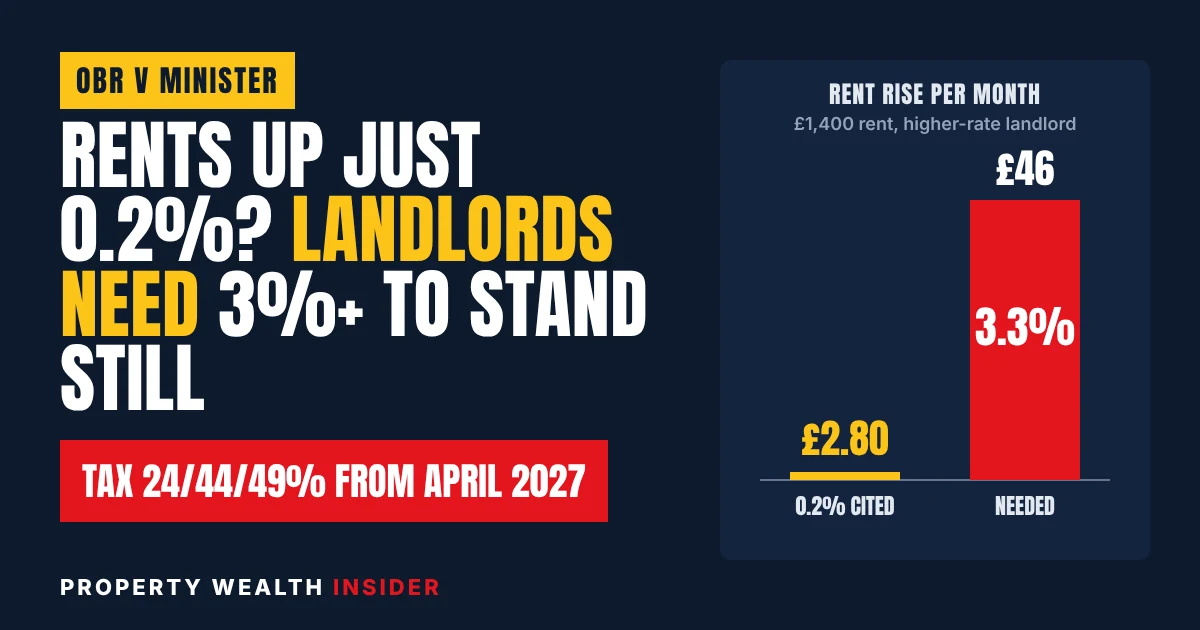
| B: higher rate | £16,800 / £3,000 / £6,000 | £4,320 | £4,632 | £312 | £46.43/month (3.3%) | £2.80/month |
| C: higher rate, heavily geared | £16,800 / £3,000 / £11,000 | £3,320 | £3,432 | £112 | £16.67/month (1.2%) | £2.80/month |
| D: additional rate, London-level rent | £28,056 / £5,000 / £12,000 | £7,975 | £8,417 | £442 | £72.26/month (3.1%) | £4.68/month |
Landlord B, step by step. Profit before interest is £16,800 minus £3,000, which is £13,800. Today: 40% of £13,800 is £5,520, minus a 20% credit on £6,000 interest (£1,200), which leaves £4,320. From April 2027: 44% is £6,072, minus a 24% credit (£1,440), which leaves £4,632. That is £312 more, which is 4% of the £7,800 left after interest.
To earn £312 more after tax at 44%, B needs £557 a year of extra rent, or £46.43 a month. That is a 3.3% rise just to stand still, before any rise in costs or interest rates. A 0.2% rise would add £2.80 a month.
Landlord C shows the twist. With a big mortgage, the higher 24% credit soaks up most of the rise, so the extra tax is only £112. But C is already £520 a year down after interest and tax, so even small rises hurt. Landlord D’s rent matches the ONS London average of £2,338 a month.
One fair caveat: the OBR’s 0.2% is a market-wide average effect on rents, not what any one landlord needs. The gap in this table shows why individual landlords will feel the squeeze far more sharply than the national figure suggests.
Can landlords actually pass it on?
Wanting a 3% rise and getting one are different things. Three forces decide it.
1. The market is cooling. ONS figures show UK rent growth fell from 9.0% in late 2024 to 3.3% in mid-2026, before edging up to 3.8% in September 2026. In Scotland it was just 0.7%, the lowest since the series began in 2016. In England it was 4.0% (average £1,466) and in Wales 4.1% (£848).
2. The rules in England have changed. Under the Renters’ Rights Act, government guidance says you can only raise the rent once a year, using Form 4A (the “section 13 process”) with at least 2 months’ notice. Tenants who think a rise is above open market rent can ask the First-tier Tribunal to decide. In short, tax is not a reason a tribunal will accept. Only the market rent counts.
3. Timing. The new rates start on 6 April 2027. A once-a-year rise means your next review date matters. Plan it around what local rents are doing, not around the tax bill.
That is the real gap in the debate. The OBR thinks the cost reaches renters mainly through fewer homes to rent over the years, not through instant rises. Landlords whose rent is already at market level may find they cannot pass on much at all in 2027.
What to do now
- Run your numbers. Use the calculator with last year’s tax return figures for each property, then for the portfolio as a whole.
- Check your band. If your rental profit straddles the £50,270 line, part is taxed at 24% and part at 44%. Ask your accountant to model it properly.
- Benchmark your rent. Compare it with similar local lets. If you are below market, a fair rise using Form 4A is likely to stand up. If you are at market, a tax-driven rise probably will not.
- Diarise your review dates. Work out when each tenancy’s next once-a-year rise can take effect relative to 6 April 2027, and serve 2 months’ notice.
- Cut leakage first. Make sure every allowable cost is claimed and your mortgage rate is competitive. These often beat a rent rise.
- Get advice before restructuring. The OBR expects some landlords to incorporate. Moving property into a company can trigger stamp duty and capital gains tax, so take professional advice first.
- Last tax return figures gathered per property (rent, costs, mortgage interest)
- Extra 2027-28 tax calculated for each property and the portfolio
- Tax band position checked, including any split across bands
- Local market rents checked against what each tenant pays
- Next rent review date for each tenancy noted, with Form 4A deadlines
- Mortgage rates and remortgage dates reviewed
- Accountant booked to discuss 2027-28 and any restructuring
- Scottish properties flagged separately (UK property rates do not apply)
FAQ
Will rents go up because of the landlord tax rise?
The minister says the effect will be small, citing 0.2% for last year’s rise. The OBR’s October 2026 report says the combined rises risk a steady rise in rents over the long run, mainly through fewer rental homes. Neither gives a firm figure for April 2027.
What is the property income tax rate from April 2027?
24% basic, 44% higher and 49% additional rate, from 6 April 2027, in England, Wales and Northern Ireland. Today rental profit is taxed at 20%, 40% and 45%.
Does the Section 24 tax credit go up to 24%?
Yes, on announced policy. HMRC’s costing says finance cost relief stays aligned to the property basic rate, which will be 24% from 2027-28, up from 20% today.
Does the property income tax rise apply in Scotland?
No. The new property rates cover England, Wales and Northern Ireland. The UK government has said it will give the Scottish Government powers to set its own property income rates, so watch the Scottish Budget.
Do limited company landlords pay the new rates?
No. The measure applies to unincorporated landlords, meaning individuals and partnerships. Companies pay corporation tax on rental profits instead.
Can I raise the rent to cover the extra tax?
In England you can propose a rise once a year using Form 4A with 2 months’ notice. If the tenant challenges it, the tribunal looks at open market rent, not your costs. So a rise only sticks if the market supports it.
Sources
- Hansard, House of Commons, Support for Renters, 2 November 2026
- OBR, Economic and fiscal outlook, October 2026 (paras 3.17, 3.46, Table 3.3)
- OBR, Economic and fiscal outlook, November 2025 (paras 2.59, 3.79)
- HM Treasury, Budget 2026 (para 6.246)
- HM Treasury, Budget 2026 policy costings (property income)
- HMRC, Budget 2026 OOTLAR Annex A: rates and allowances
- HMRC, Change to tax rates for property, savings and dividend income: technical note (26 November 2025)
- HMRC, Changes to tax relief for residential landlords
- ONS, Private rent and house prices, UK (21 October 2026)
- GOV.UK, Rent increases: guidance for landlords (England)
This article is news and general guidance only, not financial, legal or tax advice.