Room-only revolt: 14% of sharer landlords ditch joint tenancies
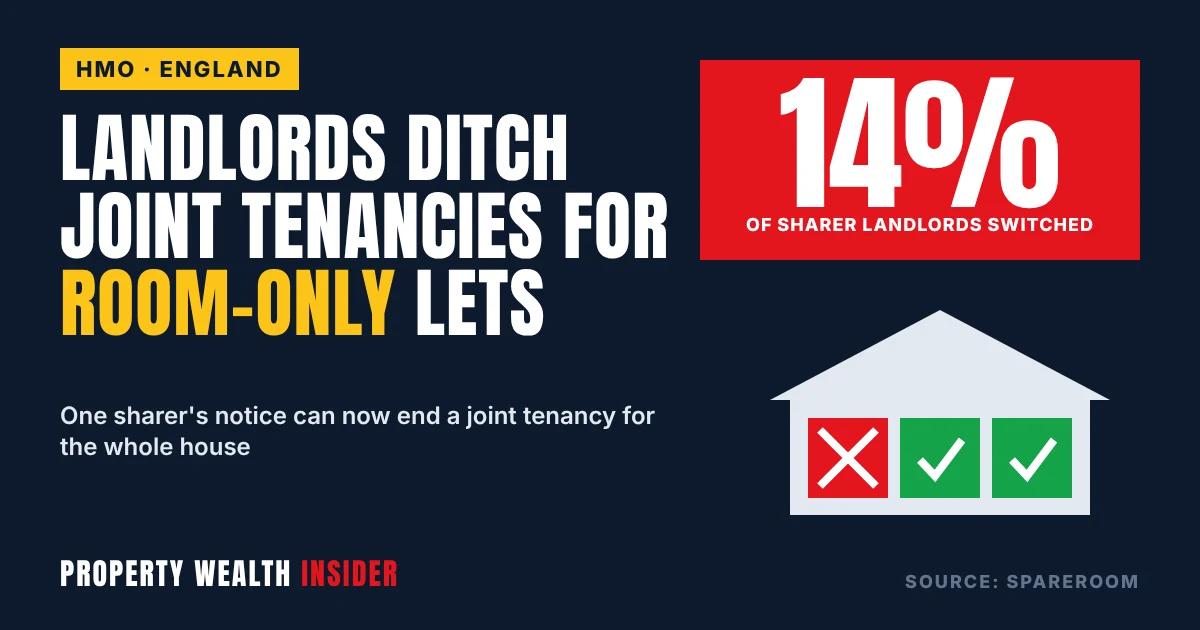
One in every seven landlords in England who let to sharers has scrapped joint tenancies and switched to renting room by room since the Renters’ Rights Act took effect, according to new research from flatshare site SpareRoom.
The reason is simple. Under the new rolling tenancies, one sharer who hands in notice can usually bring the whole tenancy to an end for everyone else in the house. Letting each room on its own agreement means one departure costs you one room, not the whole property.
This affects anyone letting a shared house or HMO in England. Below we set out what the research found, the rules behind it, how the money works each way, and a calculator to test your own house.
Key facts
- 14% of landlords in England who let to flatsharers say they have switched to room-only tenancies since the Renters’ Rights Act took effect. A further 12% are considering it (SpareRoom survey of 668 landlords, September 2026).
- Rooms advertised by landlords and agents rose from 42% to 44% of SpareRoom listings in Q3 2026, compared with a year earlier. Rooms advertised by existing or outgoing flatmates fell from 30% to 26%.
- Of 3,928 tenants surveyed in England, 39.3% rent by the room and 14.1% are on a joint contract.
- Since 1 May 2026, all assured shorthold tenancies in England have become rolling assured periodic tenancies. A tenant can leave by giving 2 months’ written notice.
- On a joint tenancy, one tenant can usually end the tenancy for all of the tenants. Mandatory HMO licensing still applies at 5 or more people from more than one household, whichever type of tenancy you use.
What the SpareRoom research found
SpareRoom surveyed 668 landlords in England in September 2026. Among those letting to flatsharers, 14% said they had moved to room-only tenancies since the Act took effect. Another 12% said they were thinking about it.
The site’s listings data shows the same shift. In Q3 2026, landlords and agents advertised 44% of the rooms on SpareRoom, up from 42% a year earlier. The share advertised by sitting or departing flatmates looking for a replacement dropped from 30% to 26%.
Fewer flatmate-led adverts fits the switch. On a room-by-room let, the landlord fills the empty room, not the sharers. SpareRoom’s tenant survey supports this. Of 3,928 tenants in England, 39.3% rent by the room against 14.1% on a joint contract. Among room renters who had seen a housemate leave, 71% said the landlord did not let them choose the replacement.
SpareRoom’s warning to landlords is that if one bad match drives the others out, the benefit of room-only lets is lost. Its advice is to let existing sharers have a say in who moves in, which it argues should cut turnover.
Why the joint-tenancy notice rule is driving the switch
On 1 May 2026, every assured shorthold tenancy in England automatically became an assured periodic tenancy. Fixed terms have gone and Section 21 can no longer be used. A new assured tenancy cannot have an end date, according to government guidance for landlords.
Tenants can now leave at any time by giving 2 months’ notice in writing, ending on a rent due day or the day before. The gov.uk guidance on tenants leaving says that on a joint tenancy, one tenant will usually be able to end it without the other tenants agreeing.
If the others want to stay, the landlord and the remaining tenants must agree to it, normally by signing a new agreement. Under the old system, a fixed term held a group together for six or twelve months. Now one sharer who wants to move can put the whole house back in play with two months’ notice.
England only. The tenancy reforms described here apply to private tenancies in England. Scotland, Wales and Northern Ireland have their own tenancy laws.
Joint tenancy vs room by room: side by side
Room-by-room letting isn’t free money. You take on bills, council tax and more management. Here are the main trade-offs.
| Joint tenancy (whole house) | Room by room (one agreement per room) | |
|---|---|---|
| One tenant gives notice | Usually ends the tenancy for all | Ends that tenant’s room only |
| Rent liability | All tenants responsible for the whole rent | Each tenant pays for their own room |
| Who finds replacements | Usually the remaining group, then a new agreement | Landlord or agent |
| Council tax | Often paid by the tenants, though some shared houses are still owner-liable | Usually the owner’s liability (Class C, see below) |
| Utilities and broadband | Usually paid by the tenants | Usually included in the rent and paid by the landlord |
| Rent reviews | Once a year for the whole tenancy | Once a year per room, each on its own anniversary |
| HMO licensing | Based on the number of people and households | Same test, so no change |
On council tax, the Council Tax (Liability for Owners) Regulations 1992 make the owner, not the occupiers, liable for “Class C” dwellings. In England, Class C includes homes where each occupier rents only part of the property. That covers a typical room-by-room let, so expect the bill to move to you. Check with your council how it treats your house.
Rent increases are limited to once a year using a Form 4A with at least 2 months’ notice. No increase is allowed in the first 12 months of a tenancy (gov.uk). With room lets, each room’s tenancy has its own start date, so its 12-month clock runs separately.
Calculator: which set-up earns you more?
Enter your house below. The calculator compares annual net income from one joint tenancy with income from letting each room separately with bills included. It also flags when an HMO licence is likely to be needed.
Joint tenancy vs room-by-room income
Guide only, not financial or legal advice. Net figures are before mortgage costs, repairs, insurance and tax. Licensing depends on your council, so always check with it directly.
Worked example: a five-bed shared house
Joint tenancy: £2,400 a month comes to £28,800 a year. Allow 5% for voids and management (£1,440) and £240 a year for a £1,200 five-year HMO licence. That leaves £27,120.
Room by room: five rooms at £650 a month, bills included, bring in £39,000. Allow 12% for voids, re-letting and extra management (£4,680), £6,000 of bills and council tax, and the same £240 licence cost. That leaves £28,080, which is £960 a year more.
The margin is thin. At about £632 a room, the two options are level. For context, SpareRoom’s Q3 2026 rental index put the average UK room rent at a record £769 a month. Use local comparables rather than a national average.
The bigger difference is risk. On the joint tenancy, one notice could leave you looking at a £2,400-a-month empty house, with bills and council tax likely to fall on you while it sits empty. On room lets, the same notice puts £650 a month at risk.
HMO licensing and room sizes don’t change
Switching contract type does not get you out of HMO rules. Gov.uk defines an HMO as a property rented out by at least 3 people who are not from one household and who share facilities such as the kitchen or bathroom. The test looks at the people, not the paperwork.
- Mandatory licence: needed in England or Wales for a large HMO rented to 5 or more people who form more than one household. A licence lasts up to 5 years, and each HMO needs its own.
- Additional licensing: councils can extend licensing to smaller HMOs, or all HMOs, in all or part of their area (Housing Act 2004, s.56).
- Selective licensing: councils can require licences for privately rented homes in designated areas with low housing demand or persistent anti-social behaviour (s.80).
- Penalty: renting out an unlicensed HMO can lead to an unlimited fine.
Licensed HMOs in England must also meet the minimum bedroom sizes in the 2018 mandatory licence conditions. Any part of a room where the ceiling is lower than 1.5 metres does not count towards its floor area.
| Sleeping in the room | Minimum floor area |
|---|---|
| One person aged over 10 | 6.51 m² |
| Two people aged over 10 | 10.22 m² |
| One child under 10 | 4.64 m² |
| Any room under 4.64 m² | Cannot be used for sleeping and must be reported to the council |
That matters if you plan to raise income by letting a box room or the old lounge. Measure first. The same conditions require you to follow your council’s waste storage and disposal scheme.
What to do now: step by step
- Review your current set-up. If you have a joint tenancy that turned periodic on 1 May 2026, you cannot convert it on your own. A switch happens when the tenancy ends or when everyone agrees to new individual agreements.
- Run the numbers. Use the calculator with real bills. Get the council tax band and a realistic energy figure for a full house.
- Check licensing with your council. Confirm mandatory, additional and selective licensing for the address before you advertise.
- Measure every bedroom. Compare each one with the 6.51 m² and 10.22 m² minimums, and leave out any area with a ceiling under 1.5 m.
- Write room-specific agreements. Each agreement should name the room, the shared areas and what bills are included. Make sure they are on assured periodic terms with no end date.
- Set up the council tax and utilities. Tell the council and suppliers about the change of liability.
- Let sharers help choose replacements. SpareRoom’s data suggests most room renters get no say. Involving them could reduce churn.
- Licensing status checked with the council (mandatory, additional, selective)
- Every bedroom measured against the minimum sizes
- Licence application or renewal date in the diary
- Bills budget set: energy, water, broadband, council tax
- Fair-use wording on bills in each agreement
- Individual agreements naming the room and shared areas
- Council and utility suppliers notified of the liability change
- Process for existing sharers to meet new applicants
FAQs
Can one joint tenant end the tenancy for everyone?
Usually, yes. In England, government guidance says one joint tenant will usually be able to end the joint tenancy without the agreement of the others. The remaining tenants can stay only if the landlord agrees, normally on a new agreement.
How much notice does a tenant have to give?
For tenancies under the new system, 2 months in writing, ending on a rent due day or the day before. A shorter period is possible only if it is agreed in writing.
Does letting by the room make my house an HMO?
Not by itself. HMO status depends on whether 3 or more people from more than one household share facilities. Five unrelated sharers on one joint tenancy are already a large HMO.
Who pays council tax on a room-by-room let?
Usually the owner. Where each occupier rents only part of the dwelling, it falls into Class C of the owner-liability regulations. Confirm with your council.
What is the minimum bedroom size in an HMO?
In a licensed HMO in England, 6.51 m² for one person over 10 and 10.22 m² for two. Rooms under 4.64 m² cannot be used for sleeping.
- SpareRoom: More landlords renting by the room risk upsetting flatshare culture
- SpareRoom: UK quarterly rental index Q3 2026
- GOV.UK: Renters’ Rights Act – an overview for landlords
- GOV.UK: If your tenant wants to leave
- GOV.UK: Renters’ Rights Act overview for tenants
- Renters’ Rights Act 2025
- GOV.UK: House in multiple occupation licence
- Licensing of HMOs (Mandatory Conditions of Licences) (England) Regulations 2018
- Housing Act 2004, section 56 and section 80
- Council Tax (Liability for Owners) Regulations 1992, regulation 2
This article is news and general guidance only, not financial, legal or tax advice.