Radon alert: 1 in 3 homes at risk in hotspots – landlords act now
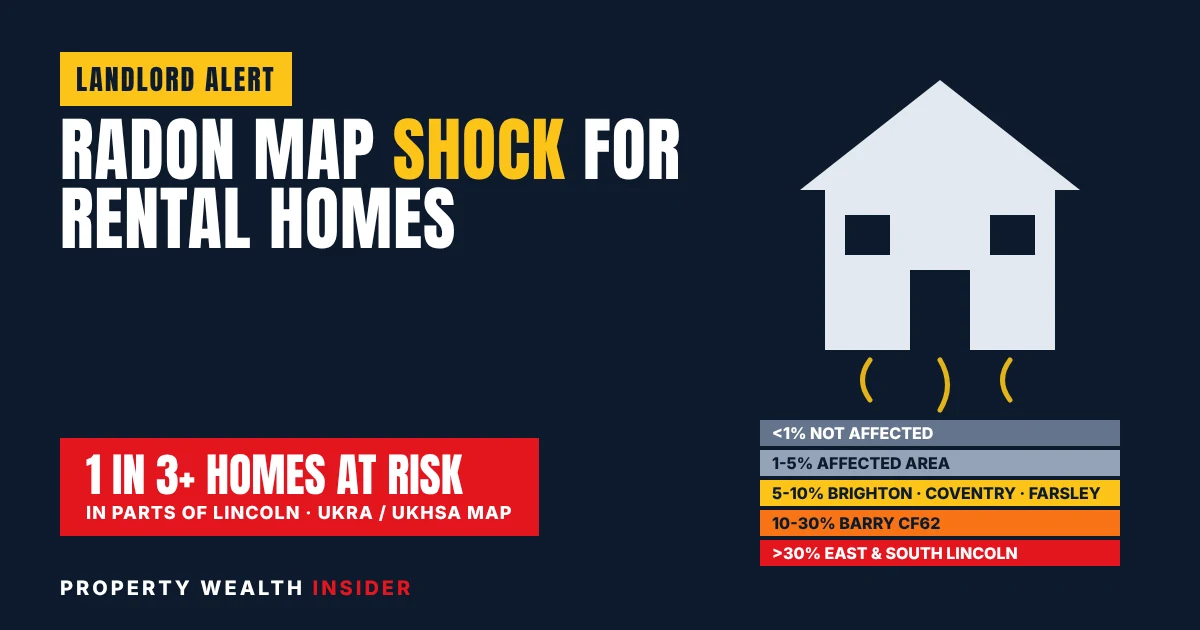
Thousands of landlords could be letting homes in radon hotspots without knowing it. During Radon Awareness Week (2 to 8 November 2026), the UK Radon Association is naming five places where official mapping now puts homes at a much higher risk of the radioactive gas than many owners realise: Brighton & Hove, Barry, Coventry, Leeds and Lincoln.
Radon has no colour, smell or taste. The UK Health Security Agency (UKHSA) links it to around 1,100 lung cancer deaths a year in the UK. The only way to find out whether a property has a problem is to test it, and a test costs less than one week’s rent on most lets.
For landlords this is not only a health issue. Radiation is one of the hazards councils score under the Housing Health and Safety Rating System (HHSRS). In England, that system was overhauled in June 2026, and the new landlord guide includes a radon benchmark. Here is what it means for your lets.
Key facts
- Radon is linked to around 1,100 lung cancer deaths a year in the UK (UKHSA).
- UKHSA advises reducing radon in any home where the annual average is above the 200 Bq/m³ Action Level. The Target Level of 100 Bq/m³ is the ideal result after remedial work.
- In parts of Lincoln, the updated map puts the risk at more than 30%, meaning more than 1 in 3 homes could be above the Action Level.
- In Barry, 83% of the CF62 postcode district’s mapped area is now in the 10-30% band, up from 5-10%.
- A UKHSA home test pack costs £52.80 including VAT. An address search costs £3.90.
- Under England’s HHSRS guidance, the national average score for a home at 400 Bq/m³ is 1,820. That falls in the Category 1 band, where the council must take action.
What has changed and why it matters now
The levels of radon in the ground have not gone up. What has changed is the map. On 2 December 2022, UKHSA and the British Geological Survey published an updated radon potential map for Great Britain, the first update in more than 10 years. It combined new geological mapping with a large database of measurements taken in people’s homes.
The map gives every area a band. Each band is the estimated percentage of homes above the 200 Bq/m³ Action Level. The bands run from less than 1% to more than 30%. Any area with a band of 1% or higher is a “Radon Affected Area”, and in those areas UKHSA recommends that every home is tested.
Four years later, the UK Radon Association (UKRA) says many people still have not caught up with the new map. “Don’t rely on what you think you know about your area – check the latest map and test if you’re at risk,” said UKRA chair Dr Maria Dugdale. Many landlords bought or last checked their properties under the old map, so they are in the same position.
Scope: the 2022 update covered England, Wales and Scotland. The map for Northern Ireland was last updated in 2015 and has not changed.
The five areas where risk has jumped
These are the five locations named in UKRA’s Radon Awareness Week release. All the figures below come from that release.
| Area | Previous band | Band under updated map | What it means |
|---|---|---|---|
| Brighton & Hove | 1-3% | 5-10% in many parts of the city | Up to 1 in 10 homes could be above the Action Level |
| Barry (CF62) | 5-10% | 10-30% across 83% of the district’s mapped area | Up to 3 in 10 homes could be affected |
| Coventry | Not a Radon Affected Area | 5-10% across much of the city and surrounding area; parts at 10-30% | The whole area is now in scope for testing |
| Leeds (Farsley) | Less than 1% | 5-10% | A suburb that used to fall below the threshold now falls well above it |
| Lincoln (east and south) | Not stated in the release | More than 30% | More than 1 in 3 homes could be affected |
Bands apply to areas, not individual houses. Radon can vary a lot between houses on the same street. A home in a 10-30% area may test low, and a home in a 1-3% area may test high. The map tells you whether to test. It does not tell you the result.
UKHSA also says the map should not be used for basements, cellars or underground rooms. Treat these as having a higher chance of high radon wherever the property is. This matters if you let lower-ground-floor flats or basement bedsits.
What the law says landlords must do
No law specifically requires private landlords to test for radon. Unlike gas safety certificates or electrical inspections, there is no statutory radon certificate and no fixed testing cycle. That does not mean you can ignore it.
UKHSA’s guidance for landlords says landlords have a duty of care and a duty under the Housing Act to provide a safe home. Radon is a recognised hazard under the Housing Act 2004. Councils assess it through the HHSRS, and if a hazard scores in Category 1 the council must act. When UKHSA published the updated map, it told renters to speak to their landlord, “who should organise a test for you to carry out”.
England: in June 2026, the HHSRS was updated and the number of hazards cut from 29 to 21. “Radiation” is hazard 10, and it covers radon gas. The new landlord and agent guide (updated 16 September 2026) includes a baseline indicator saying that dwellings “must not have radon concentrations greater than 200 Bq per cubic metre”. Baseline indicators are a self-assessment checklist rather than a separate legal duty. Even so, a home that fails one has a deficiency an assessor will look at.
The operating guidance shows how the score rises with the measured level. At 200 Bq/m³, the national average score is 910, which is Category 2 (medium risk). At 400 Bq/m³ it is 1,820, which is Category 1 (high risk). For a Category 1 hazard, a council can serve an improvement notice. It can also impose a civil penalty of up to £7,000. If you fail to comply with an improvement notice, the penalty can be up to £40,000 for offences committed on or after 1 May 2026.
Wales: councils also use the HHSRS, according to the UK National Radon Action Plan. The June 2026 overhaul and new guide described above apply to England. Welsh landlords, including anyone letting in Barry, should check the Welsh Government’s guidance on housing fitness.
Awaab’s Law: it is in force only in the social rented sector, where it started on 27 October 2025. The government says it will consult on applying it to private rented housing. Until that happens, Awaab’s Law places no radon duty on private landlords.
New builds and extensions: under Building Regulations, new buildings and extensions in higher-radon areas must include basic or full radon protection, following BRE guidance (BR211). UKHSA warns that homes built with protection can still have high levels, so test them too.
Action Level, Target Level and the workplace level
Three numbers matter, and people often mix them up. All three are annual averages, measured in becquerels per cubic metre (Bq/m³).
| Level | Bq/m³ | Applies to | What it means |
|---|---|---|---|
| Average UK home | about 21 | Homes | Typical background level (HHSRS operating guidance) |
| Target Level | 100 | Homes | The ideal result after remedial work. Between 100 and 200, UKHSA says you should consider reducing it, especially if a smoker or ex-smoker lives there |
| Action Level | 200 | Homes | UKHSA recommends reducing radon above this level. This is also the radon benchmark in the new HHSRS guide |
| Workplace reference level | 300 | Workplaces | Above this, the Ionising Radiations Regulations 2017 (IRR17) apply and employers must restrict exposure (HSE) |
Smoking makes radon far more dangerous. UKHSA’s own figures put the lifetime lung cancer risk at 200 Bq/m³ at about 1 in 190 for a non-smoker and 1 in 5 for a current smoker. This is why the operating guidance treats smokers as a higher-risk group.
What testing and fixing radon costs
Testing is cheap. UKHSA’s home measurement pack costs £52.80 including VAT. It contains two detectors, one for a bedroom and one for the living area, which stay in place for three months before you post them back. An address search costs £3.90. It confirms the band for an exact address, which is more precise than reading the map yourself.
One trap for landlords: UKHSA says a test is invalid if the occupier changes during the test. Don’t start a three-month test a month before a tenancy ends.
If a test comes back high, UKHSA’s typical contractor costs are:
- Active radon sump with fan: typically £800, up to £2,000. UKHSA calls this the most effective method.
- Passive sump (no fan): typically £450, up to £1,000.
- Positive ventilation: typically £550, up to £1,000.
- Natural under-floor ventilation: typically £200, up to £600. Active under-floor ventilation: typically £700, up to £1,500.
UKHSA says these averages come from data collected between 2007 and 2017, so expect today’s quotes to be higher.
Worked example: a landlord owns three lets, one in Barry (10-30% band) and two in Coventry (5-10%). Testing all three costs 3 × £52.80 = £158.40. Using the middle of each band (20%, 7.5% and 7.5%), the chance that none of the three is above the Action Level is 0.80 × 0.925 × 0.925 = 68.5%. That leaves a 31.5% chance, nearly 1 in 3, that at least one needs work. If one does need a sump at the £800 typical price, the total outlay is under £1,000. Compare that with a possible £7,000 civil penalty if a council finds a Category 1 hazard you could reasonably have removed.
Portfolio radon risk checker
Look up each property on the UKHSA radon map or buy an address search, then choose its band below. The checker works out how likely it is that at least one of your homes is above the Action Level, what each one needs and what testing will cost.
Portfolio radon risk checker
Guide only, not advice. Each band is the estimated share of homes in that area above the Action Level. The checker uses the middle of each band (0.5%, 2%, 4%, 7.5% and 20%). For the “more than 30%” band it uses 30%, so the real figure there is higher. It assumes the properties are independent and applies 1 − (1 − p1) × (1 − p2)… Only a three-month test tells you a property’s actual level. Prices are UKHSA’s as of November 2026, and sump costs are UKHSA’s 2007-2017 averages.
What to do now: step by step
- Check every address against the current map. Use the UKHSA map, or pay £3.90 per address for an exact report. Ignore what you checked before December 2022.
- Rank your portfolio. Put homes in the 10-30% and 30%+ bands first, then any basement or lower-ground-floor units.
- Time the test around the tenancy. The test takes three months and becomes invalid if the occupier changes. Explain to the tenant why it matters, where the two detectors go and that they shouldn’t be moved.
- Read the result against the levels. Below 100 Bq/m³, you can file it. From 100 to 200, consider reducing it. Above 200, act. Above 400, treat it as urgent, because the HHSRS national average score at that level is Category 1.
- Get quotes from a specialist. UKHSA’s result report suggests the most suitable remedy. A sump is the usual answer for solid floors.
- Re-test after the work, and keep records. Aim for the 100 Bq/m³ Target Level. Keep the results with your safety certificates so you can show a council what you did.
- Every property checked on the post-2022 radon map
- Band recorded in the property file
- Basements and cellars flagged for testing, whatever the band
- Test packs ordered for every home in a 1%+ area
- Tenant briefed on detector placement and the three-month period
- Results compared against 100 and 200 Bq/m³
- Remediation quote obtained for any result above 200 Bq/m³
- Re-test booked after work, with the sump fan checked and serviced
Radon FAQs for landlords
Do landlords have to test for radon?
No law specifically requires private landlords to test for radon. However, radon is a hazard under the Housing Act 2004 and the HHSRS, and UKHSA says landlords should arrange a test where a property is in a Radon Affected Area. If a council finds a high level, it can take enforcement action.
How do I find out if my rental is in a radon area?
Use the free radon map on ukradon.org, or buy UKHSA’s £3.90 address search. The search gives the estimated chance that a specific address is above the Action Level.
What is a safe radon level in a home?
UKHSA recommends reducing radon in any home where the annual average is above 200 Bq/m³. The ideal level after remedial work is 100 Bq/m³ or below. The average UK home is around 21 Bq/m³.
How much does it cost to fix high radon?
According to UKHSA, an active radon sump fitted by a contractor typically costs about £800, and can cost up to £2,000. Ventilation methods are cheaper. These figures are based on 2007-2017 data, so current quotes are likely to be higher.
Sources
- UK Radon Association – Radon Awareness Week 2026 release (2 November 2026)
- UKHSA and BGS – updated radon map for Great Britain (2 December 2022)
- UKradon (UKHSA) – radon Affected Areas map
- UKradon – Action Level and Target Level
- UKradon – landlords’ responsibilities
- UKradon – health risks from radon
- UKradon – how to reduce radon levels and typical costs
- UKradon – home measurement pack
- UKradon – radon address search
- MHCLG – HHSRS operating guidance (June 2026)
- MHCLG – HHSRS landlord and agent guide
- HSE – radon in the workplace and IRR17
- UK National Radon Action Plan
- UKradon – radon and Building Regulations
This article is news and general guidance only. It is not financial, legal or tax advice.