Unlicensed HMO? Tenants Can Now Claw Back 2 Years’ Rent
Bromley Council has told tenants living in unlicensed shared houses that they may be able to get up to two years’ rent back from their landlord. The warning came on 5 November 2026, alongside news that one landlord was hit with a £27,500 penalty for running an unlicensed HMO in Bolton Gardens, Bromley.
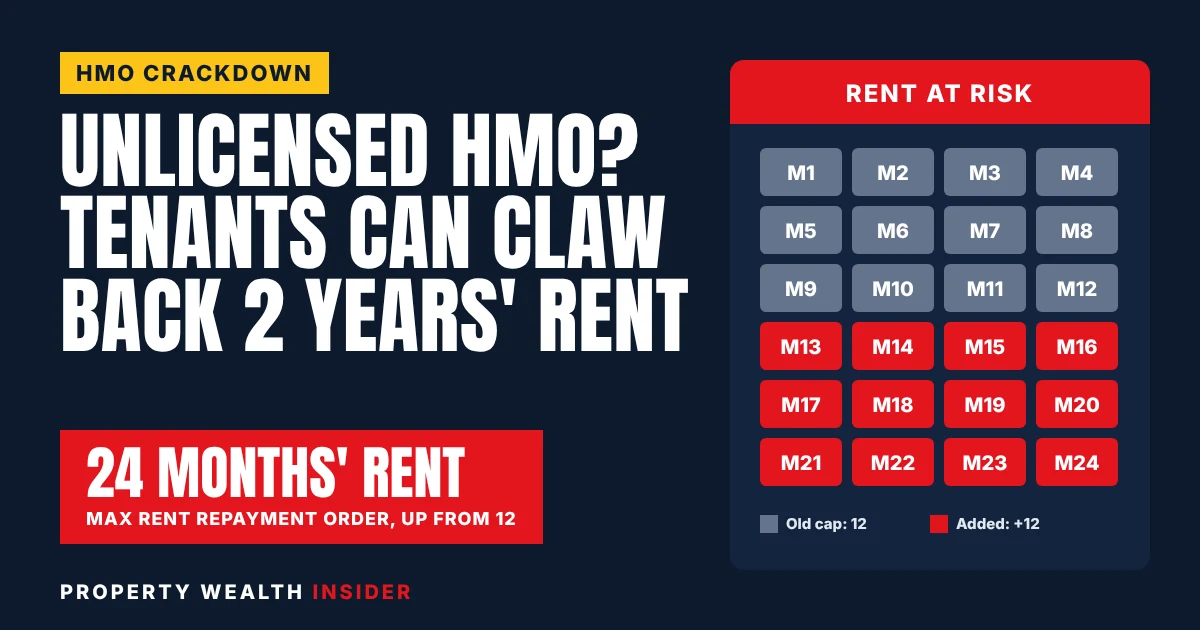
It matters well beyond one London borough. Since 1 May 2026 the Renters’ Rights Act 2025 has doubled the maximum Rent Repayment Order (RRO) in England from 12 to 24 months’ rent. It also lets tenants pursue superior landlords in rent-to-rent chains, and the maximum council civil penalty for offences committed since then has gone up from £30,000 to £40,000.
If you own, manage or sublet a house shared by five or more people from two or more households anywhere in England, this is your exposure. Below we set out what the law now says, how tribunals work out the bill, and a calculator to put a number on your own risk.
Key facts
- Bromley Council issued a £27,500 civil penalty for an unlicensed HMO in Bolton Gardens. The landlord’s appeal was struck out and the council is now recovering the money.
- For offences committed on or after 1 May 2026, tenants can claim up to 2 years’ rent through an RRO (before, the limit was 1 year).
- Tenants now have 2 years from the offence to apply to the First-tier Tribunal (before, they had 1 year).
- The maximum council civil penalty for an unlicensed HMO is now £40,000, up from £30,000, for conduct from 1 May 2026.
- If the landlord has already been convicted or fined for the offence, the tribunal must order the maximum unless there are exceptional circumstances.
- Applies to England. The RRO and civil penalty changes described here are England-only.
What Bromley Council announced
In a press release published on 5 November 2026, the council warned landlords to comply with both HMO licensing and planning rules. It named one case: a landlord fined £27,500 for running a licensable HMO in Bolton Gardens, Bromley, without a licence.
The landlord appealed, but the appeal was struck out and the council says it is now recovering the penalty. The council said its fines were issued under Part 1 (housing conditions) and Part 2 (HMO licensing) of the Housing Act 2004.
The council then spoke directly to tenants. It said they can check whether their home is licensed on its public licence register, and that people living in an unlicensed HMO may be able to recover up to two years’ rent through an RRO.
Bromley also reminded landlords that licensing and planning are separate. Its HMO guidance confirms an Article 4 Direction has removed permitted development rights for HMOs in the borough since 1 September 2022. In practice, a new HMO there needs planning permission, and a licence does not replace it.
Rent Repayment Orders explained
An RRO is an order made by the First-tier Tribunal (Property Chamber) under Part 2, Chapter 4 of the Housing and Planning Act 2016. It makes a landlord who has committed certain housing offences pay rent back to the tenant, or to the council where the rent was covered by universal credit.
Running a licensable HMO without a licence is an offence under section 72(1) of the Housing Act 2004, and it is one of the offences that can lead to an RRO. Other qualifying offences include failing to license under selective licensing, ignoring an improvement notice, illegal eviction or harassment, and breaching a banning order. The Renters’ Rights Act added offences such as misusing a possession ground.
Three points catch landlords out. The tenant does not need a prior conviction or fine to win. The tribunal must still be satisfied beyond reasonable doubt that the offence happened. And tenants cannot claim rent that was paid by universal credit or housing benefit, but the council can apply for that part itself.
What the Renters’ Rights Act changed
The RRO amendments in the Renters’ Rights Act 2025 came into force on 1 May 2026 under SI 2026/421. The higher civil penalty cap came in on the same date under SI 2026/319.
| Rule (England) | Offences before 1 May 2026 | Offences from 1 May 2026 |
|---|---|---|
| Maximum RRO for an unlicensed HMO | 12 months’ rent | 24 months’ rent |
| Time limit for a tenant to apply | Within 1 year of the offence | Within 2 years of the offence |
| Who can be ordered to pay | The landlord | Landlord or any superior landlord (for example the owner in a rent-to-rent chain) |
| Maximum council civil penalty (s249A) | £30,000 | £40,000 |
| Rent counted | Rent paid by the tenant | Rent paid by or on behalf of the tenant |
The transition matters. For an HMO that was unlicensed before 1 May 2026 and stayed unlicensed afterwards, the new rules do not apply to the part of the period before 1 May 2026. The full 24-month window therefore only applies to offending from that date onwards.
Rent-to-rent owners are now in scope. Section 72(1)(b) now makes a superior landlord guilty of the licensing offence too. The defences are that they did not know the property was an HMO and had a reasonable excuse for not knowing, that they took all reasonably practicable steps to get it licensed, or that they had another reasonable excuse. A clause in the contract banning HMO use is not enough on its own.
How the tribunal works out the amount
The cap is not the same as the award. Under section 44(3), the award cannot be more than the rent paid for the period, minus any universal credit paid towards that rent. Under section 44(4), the tribunal must then consider the conduct of the landlord and the tenant, the landlord’s finances, any rent the tenant received from subletting, and the landlord’s history of convictions, fines and RROs.
The Upper Tribunal set out the method tribunals use in Acheampong v Roman [2022] UKUT 239 (LC):
- Work out the whole rent for the relevant period.
- Take off utilities that only benefited the tenant, such as gas, electricity and internet. The landlord has to provide evidence of these costs.
- Decide how serious this offence was, both against other RRO offences and against other cases of the same offence. The proportion of the rent that reflects that seriousness becomes the starting point.
- Adjust that figure up or down for the other section 44(4) factors.
The Upper Tribunal said ordering the whole rent in a case that is “far from the most serious of its kind” suggests something has gone wrong. That is why our calculator has a reduction slider.
Government guidance for tenants lists the conduct that pushes awards up. It includes missing fire doors in an HMO, no smoke alarms, slow repairs to damp, leaks or heating, missing gas or electrical certificates, and harassment. On the other side, quick repairs and the correct paperwork count in the landlord’s favour, while rent arrears, damage and anti-social behaviour count against the tenant.
The trap after a council fine: under section 46, once a landlord has been convicted, or has received a financial penalty for the offence that can no longer be appealed, the tribunal must order the maximum. The only exception is exceptional circumstances. The same applies, under section 46 as it now stands, if the landlord has a previous conviction, fine or RRO for the same type of offence anywhere. Unlicensed HMO and unlicensed selective-licensing offences count as the same offence for this rule. When an appeal against a council fine fails, the RRO bill can go up as well.
Calculator: your RRO exposure
Enter the rent roll and how long the property has been unlicensed. The calculator shows the maximum the tribunal could order, a rough estimate after the tribunal’s reduction, and a worst case that adds a civil penalty.
Rent Repayment Order exposure calculator
Guide only, not legal advice. Tribunals decide each case on its facts. For an HMO unlicensed before 1 May 2026, the period before that date falls under the old rules, which capped awards at 12 months. Get legal advice if you are facing a claim.
Worked example. A five-bed HMO is let to five sharers at £750 a month each, so £3,750 a month. It has been unlicensed for 12 months. The maximum RRO is £45,000. If 20% of the rent came through universal credit, the tenants can claim up to £36,000 and the council up to £9,000.
Suppose the tribunal deducts 10% for bills and then reduces the award by 40% because the house was in good condition. The estimate is then £24,300. Add a £27,500 civil penalty, the same as the Bolton Gardens figure, and the bill is about £51,800. If the penalty is final before the tribunal hearing, section 46 can push the RRO back up to the full £45,000, making a total of £72,500.
Now take the same house left unlicensed for 24 months, with every month falling after 1 May 2026. The RRO ceiling becomes £90,000 before any penalty. On top of that, a prosecution under section 72 can bring an unlimited fine.
Does your property need an HMO licence?
Mandatory HMO licensing in England covers properties described in article 4 of the 2018 Prescribed Description Order. Many councils, though not Bromley, also run additional or selective licensing schemes, so check your own council’s rules too. Use this checklist:
- Five or more people live in the property. Bromley says a resident landlord’s household counts, so four tenants plus a live-in landlord can be enough.
- They form two or more separate households. A single person, a couple or a family each count as one household.
- They share at least one kitchen, bathroom or toilet.
- The property meets the standard, self-contained flat or converted building test. A purpose-built flat in a block of three or more flats is excluded.
- You have searched your council’s public licence register and found no current licence for the address.
- You have checked whether the council runs an additional or selective scheme that covers smaller HMOs or every rental in the area.
- Your licence has not expired. Bromley issues HMO licences for five years.
- Occupancy is within the licence limit. Letting to more people than the licence allows is a separate offence.
- If you are the owner in a rent-to-rent deal, you have seen proof that your tenant licensed the property.
- Planning is covered. In an Article 4 area such as Bromley, you have planning permission for the HMO use.
What to do now: step by step
- Count heads and households today in every shared property, including partners who have moved in and lodgers who have been added.
- If you need a licence, apply now. Under section 72(4), a valid application that is still being decided is a defence to the licensing offence, so the risk stops growing from the date you apply.
- Bring the property up to the council’s HMO standards. Bromley’s standards include fire doors, an alarm system tested every year, emergency lighting, an EICR no more than five years old and a gas safety record no more than one year old.
- Audit any rent-to-rent deals. Superior landlords can now face both the offence and an RRO. Get written proof of licensing, and inspect the property yourself.
- Keep records of repairs, certificates, communications and what the rent covers, such as bills. These records drive the tribunal’s conduct assessment and the utilities deduction.
- If a council notice arrives, take advice before appealing. A penalty that becomes final can trigger the automatic maximum RRO. A failed appeal costs time and can increase the bill.
FAQs
How much rent can a tenant get back from an unlicensed HMO?
For offences from 1 May 2026, up to two years’ rent paid during the period the HMO was unlicensed, minus any universal credit or housing benefit. For earlier offences, the limit was one year. The tribunal decides the final amount.
Can a tenant claim an RRO after moving out?
Yes. They must apply within two years of the offence (one year for offences before 1 May 2026). The landlord does not need to have been prosecuted or fined first.
What is the maximum fine for an unlicensed HMO?
A council civil penalty can be up to £40,000 for conduct from 1 May 2026 (£30,000 before). If the council prosecutes instead, the fine is unlimited. A landlord cannot be both fined and convicted for the same conduct.
Can I get an RRO against the property owner in a rent-to-rent deal?
Since 1 May 2026, yes. An RRO can be made against a superior landlord who committed the offence, even if the tenant paid rent to someone else. Letting and managing agents cannot be named as respondents.
How do I check if a house in Bromley has an HMO licence?
Search Bromley Council’s online public licence register. Other councils in England have their own registers. If there is no entry and the property meets the five-person, two-household test, it may be unlicensed.
Sources
- Bromley Council: Houses in Multiple Occupation housing enforcement results in warning to landlords (5 November 2026)
- Bromley Council: HMO advice for landlords
- MHCLG: Rent Repayment Orders: guidance for tenants
- Housing and Planning Act 2016, s40, s41, s44, s46
- Housing Act 2004, s72 and s249A
- The Financial Penalties (Housing Offences and Breach of Banning Orders) Regulations 2026 (SI 2026/319)
- SI 2026/421, regulation 11 (transitional provision)
- Licensing of Houses in Multiple Occupation (Prescribed Description) (England) Order 2018, art 4
- Acheampong v Roman [2022] UKUT 239 (LC)
This article is news and general guidance only, not financial, legal or tax advice.