Room rents hit record £769 as HMO supply shrinks 4.7%
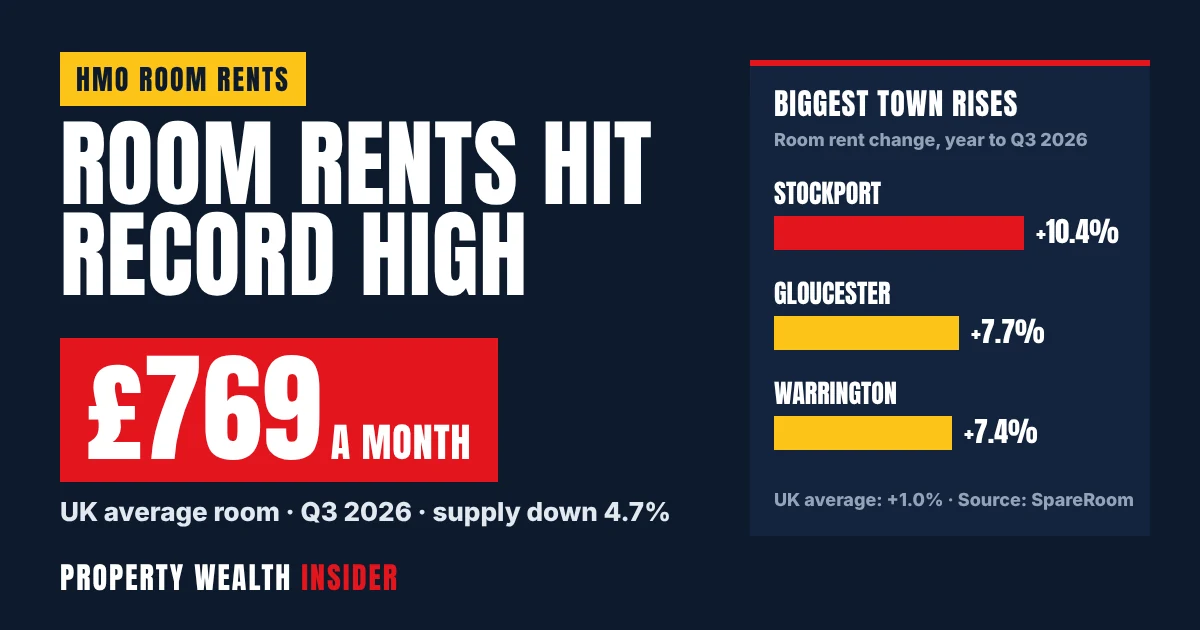
The average room in a UK house share now costs a record £769 a month, according to SpareRoom’s rental index for the third quarter of 2026. At the same time, the number of rooms advertised has fallen 4.7% year on year, the first fall after three years of growth.
For HMO landlords this is a double-edged story. Room rents are at record highs in seven of the UK’s nine regions. But the same figures show supply getting tighter as landlords react to the Renters’ Rights Act in England, and councils taking a harder line on HMOs.
Below we break down the verified numbers, show which towns are moving fastest, and run the yield maths on a typical five-room HMO against a single let. Our calculator lets you test your own deal.
Key facts
- Average UK room rent hit a record £769 a month in Q3 2026, up 1.0% from £762 a year earlier (SpareRoom).
- Room rents hit record highs in 7 of 9 UK regions. Greater London (£932) and the North East (£554) were the exceptions.
- Room rental supply fell 4.7% year on year, after rising 8.2% in Q3 2025 and 20.1% in Q3 2024.
- Stockport led town rent rises at +10.4% (average £717), ahead of Gloucester (+7.7%) and Warrington (+7.4%).
- SpareRoom’s figures are asking rents including bills, so they are not directly comparable with ONS whole-property rents (UK average £1,406, up 3.8% in the year to September 2026).
Record £769: the regional picture
SpareRoom’s Q3 2026 index is based on more than 241,000 UK room ads, with no whole properties included. The rents are mean averages of asking prices, and they include bills.
The national rise is modest at 1.0%. The headline is that it is broad: every region except Greater London and the North East set a new record. South West England had the biggest regional rise at 2.3%.
By nation, England averaged £775 (+1.0%), Scotland £726 (+1.1%), Wales £593 (+0.9%) and Northern Ireland £600 (+7.0%). Belfast was the fastest-rising of the 30 biggest flatshare cities at +6.8%, while Manchester (−2.1%) and Swansea (−3.6%) fell. Inner London rooms now average £1,002.
The towns where room rents jumped
The national average hides much sharper moves in commuter towns. SpareRoom found 21 towns and cities with rent rises of 3% or more in the year to Q3 2026. Several sit within easy reach of a big, expensive city.
| Town | Avg room rent Q3 2026 | Q3 2025 | Change | Enquirers per room |
|---|---|---|---|---|
| Stockport | £717 | £649 | +10.4% | 5.7 |
| Gloucester | £642 | £597 | +7.7% | 4.4 |
| Warrington | £625 | £582 | +7.4% | 4.2 |
| Belfast | £624 | £585 | +6.8% | 3.8 |
| Edgware | £861 | £808 | +6.6% | 7.7 |
| Bracknell | £721 | £681 | +5.9% | 5.5 |
| Rugby | £619 | £587 | +5.4% | 3.9 |
| Exeter | £681 | £651 | +4.5% | 6.3 |
| Whole of UK | £769 | £762 | +1.0% | 2.3 |
Stockport’s average room (£717) now costs more than Manchester’s (£685). Warrington (+7.4%), Preston (+4.0%) and Bolton (+3.1%), all on rail lines into Manchester, are also among the biggest risers. SpareRoom suggests Gloucester may be benefiting from renters priced out of Bristol (£746) and Cheltenham (£651).
Demand is the signal to watch for future rent rises. Enquiries per room nearly doubled in Chesham, Buckinghamshire (+97.6%, to 6.5 per room), rose 87% in Kettering (6.8 per room) and 82.1% in Barnstaple (7.0 per room, average rent £627). The highest demand in the UK is in Bootle, Merseyside, with 16 people enquiring per available room, against a UK average of 2.3.
Worked example: a five-room Stockport HMO let at the 2025 average of £649 a room brought in £38,940 a year at full occupancy. At the Q3 2026 average of £717, it is £43,020. That is £4,080 a year more, before voids and bills, from the same five rooms.
Why room supply is shrinking
Room ads on SpareRoom fell 4.7% in the year to Q3 2026. That ends a run of strong growth: +19.4% in Q3 2023, +20.1% in Q3 2024 and +8.2% in Q3 2025.
SpareRoom director Matt Hutchinson blames the Renters’ Rights Act, saying it “has driven away landlords in England”, and adds that councils “are cracking down on HMOs”. He also argues that the ban on bidding wars means asking rents are being set higher from the start. That is SpareRoom’s view, not an official finding, but the timing lines up.
The first phase of the Act took effect in England on 1 May 2026. Section 21 was abolished, most tenancies became assured periodic tenancies, rent increases are limited to once a year through the section 13 process, and landlords and agents cannot accept offers above the advertised rent or ask for more than one month’s rent in advance. These rules apply in England only.
For context, the ONS measures whole-market private rents differently. Its October 2026 bulletin put the average UK private rent at £1,406 a month, up 3.8% in the year to September 2026. The North West had the fastest growth of any English region at 5.7%. That fits the pressure SpareRoom sees around Manchester, although its North West room average rose only 0.6%.
What £769 a room means for HMO yields
A headline room rent is not your income. SpareRoom’s averages include bills, so the energy, water, broadband and council tax you pay as an HMO landlord come out first. Then come voids, management and the higher running costs of a licensed shared house.
Take a five-room house bought for £250,000, with £15,000 of buying costs. Each room is let at the £769 UK average, with three void weeks a year, £650 a month of bills, 10% management and £4,500 a year of other costs (insurance, licence, repairs, safety checks). These cost assumptions are illustrative. Use your own.
| Line | 5-room HMO | Single let |
|---|---|---|
| Monthly rent | 5 × £769 = £3,845 | £1,406 (ONS UK average) |
| Rent after voids (3 wks HMO / 2 wks single) | £43,478 | £16,223 |
| Bills paid by landlord | −£7,800 | £0 (tenant pays) |
| Management at 10% | −£4,348 | −£1,622 |
| Other running costs | −£4,500 | −£2,500 |
| Net income before finance and tax | £26,830 | £12,101 |
| Gross yield (on £250,000) | 17.4% | 6.5% |
| Net yield (on £265,000 all-in) | 10.1% | 4.6% |
On these numbers the HMO earns about £14,700 a year more before mortgage interest and tax. It also takes far more work, carries licensing risk, and needs a property that suits shared living. A house that would actually let for £1,406 as a single let may not be one you can fill with five sharers at £769.
The more useful number is the break-even. With these costs, room rents could fall to roughly £480 a month before the HMO earns less than the single let. In a town where rooms go for well under £600, such as Hull (£507) or Preston (£534), the gap is much narrower once bills are paid.
Room-by-room HMO yield calculator
Enter your own rooms, rents and costs. The room rent defaults to SpareRoom’s verified Q3 2026 UK average of £769, and the single-let rent to the ONS UK average of £1,406. Swap both for local figures.
HMO vs single-let yield
Guide only, not financial advice. Excludes mortgage interest, income tax, licence fee timing and refurbishment. Room rent default is SpareRoom’s Q3 2026 UK mean asking rent incl. bills; single-let default is the ONS UK average private rent for September 2026.
HMO licensing: the basics before you add rooms
Higher room rents can tempt landlords to convert a family let into a shared house. Check licensing first. Gov.uk guidance for England and Wales says you must have a licence for a large HMO, defined as a property where all of the following apply:
- it is rented to 5 or more people who form more than 1 household
- some or all tenants share toilet, bathroom or kitchen facilities
- at least 1 tenant pays rent (or their employer pays it for them)
Smaller HMOs may still need a licence under a local scheme, so check with your council. A licence lasts up to 5 years, you need one per HMO, the council sets the fee and can add conditions. Renting out an unlicensed HMO can lead to an unlimited fine.
The licence conditions add cost that the calculator should capture: an annual gas safety certificate sent to the council, working smoke alarms, and electrical safety certificates on request. Build the licence fee and any upgrade work into “other costs”.
What HMO landlords should do now
- Benchmark every room. Compare your rents with SpareRoom’s figure for your region and nearest town. If you are well below, plan an increase using the section 13 process (England), which allows one rise a year with at least two months’ notice.
- Separate rent from bills. Work out what each room actually earns after the bills you pay. That is the number to compare.
- Price the advert right first time. In England you cannot accept offers above the advertised rent, so set the asking rent from evidence, not hope.
- Cut voids. In high-demand towns, a week saved per room is worth more than a small rent rise. Re-run the calculator with one fewer void week to see the difference.
- Check licensing before converting. Confirm mandatory and any local licensing, plus planning rules, with your council before buying or converting.
- Stress-test the deal. Use the break-even room rent. If a modest fall in room rents would wipe out the HMO advantage, the extra work may not be worth it.
- Room rents checked against SpareRoom regional and town averages
- Bills per room calculated and deducted from the headline rent
- Next rent review dated and section 13 notice period diarised (England)
- HMO licence in date, with the expiry and renewal date diarised
- Gas safety certificate sent to the council this year
- Smoke alarms tested and electrical certificates on file
- Asking rent for new adverts set from local evidence
- Yield calculator re-run with your real costs and void weeks
FAQ
What is the average room rent in the UK in 2026?
SpareRoom puts the average UK room rent at £769 a month in Q3 2026, a record. It is a mean of asking rents and includes bills.
Where are room rents rising fastest?
Stockport led with a 10.4% annual rise to £717, followed by Gloucester (+7.7%) and Warrington (+7.4%). By region, South West England rose most at 2.3%.
Is an HMO a better yield than a single let?
Often on paper, because several room rents beat one whole-house rent. But you usually pay the bills, face more voids and management, and need a licence for larger HMOs. Use the calculator above with your local figures.
Do I need an HMO licence for 5 tenants?
In England and Wales, yes, if the 5 or more people form more than one household, share a toilet, bathroom or kitchen, and at least one pays rent. Smaller HMOs may need a licence under local rules.
Can I accept a higher offer for a room in England?
No. Since 1 May 2026, landlords and agents in England cannot seek or accept offers above the advertised rent, and cannot ask for more than one month’s rent in advance.
Sources
- SpareRoom: UK room rents hit record highs as supply shrinks (Q3 2026 rental index)
- SpareRoom: town and city rent rises and renter demand, Q3 2026
- ONS: Private rent and house prices, UK (October 2026 release)
- GOV.UK: Implementing the Renters’ Rights Act 2025 roadmap
- GOV.UK: House in multiple occupation licence
This article is news and general guidance only. It is not financial, legal or tax advice.