Tenants Want Right To Fix Repairs And Dock Your Rent
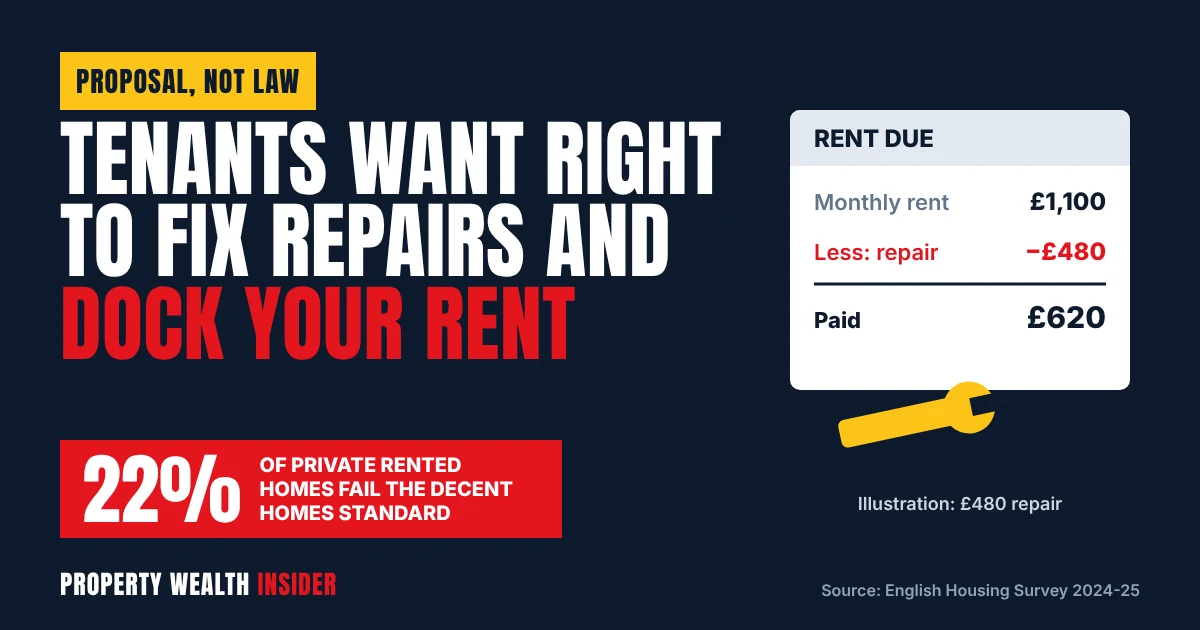
Tenants should get a clear legal right to book repairs themselves and knock the bill off the rent. That is the headline idea from campaign group Generation Rent, which published its wish list on 13 November 2026 in response to Martin Lewis’s call for cheap, practical fixes to everyday problems.
It is a proposal, not law. Nothing has changed today, and no minister has backed it. But it lands on a sore spot, because a version of “repair and deduct” already exists in English case law, and most landlords have never heard of it.
Here is what was proposed, what the law in England says right now, how a rent deduction plays out against the new Ground 8 arrears rules, and a calculator to show what a slow repair could cost you.
Key facts
- Generation Rent wants renters to have a clear legal right to arrange repairs and deduct the cost from rent. It is a proposal only, submitted to Martin Lewis’s Small Ideas Initiative.
- Landlords in England must already keep the structure, exterior, water, gas, electricity, sanitation, heating and hot water in repair under s11 Landlord and Tenant Act 1985.
- Courts already allow tenants, in appropriate circumstances, to recoup money spent on a landlord’s repairs from rent (Lee-Parker v Izzett, approved by the Court of Appeal in 2003).
- Ground 8 now needs at least 3 months’ rent arrears (monthly rent) at notice and at the hearing, with 4 weeks’ notice, and only counts rent “lawfully due”.
- 22% of private rented homes in England failed the Decent Homes Standard in 2024, against 15% of all homes (English Housing Survey).
What Generation Rent proposed
Martin Lewis’s cross-party Small Ideas Initiative asked the public for low-cost changes that are practical, doable and “hard to disagree with”. Generation Rent sent in five ideas of its own and five from its supporters. A cross-party panel will pick a final set to put to decision makers.
The ideas that matter most to landlords:
- Repair and deduct (Generation Rent’s own idea): a clear legal right for renters to arrange repairs and take the cost off the rent, pitched as a quicker route to getting essential work done.
- Fines for inflated deposit claims (its own idea): penalties for landlords and agents who repeatedly have large deposit claims rejected by the protection schemes.
- True cost of renting (its own idea): energy and council tax costs shown in the forthcoming Private Rented Sector Database.
- Mandatory photographic inventories (supporter idea): dated photo inventories at the start of every tenancy.
- A “Home MOT” (supporter idea): a national database of regular, independent condition checks against decent housing standards.
- A repairs app (supporter idea): for tenants to upload photos and videos of disrepair and log every message to the landlord or agent.
None of these has a bill, a consultation or a timetable. They are campaign asks. Even so, the photo inventory and repairs log ideas are things good landlords already do, and they protect you as much as the tenant.
Your repair duties right now
For most residential lettings in England, section 11 of the Landlord and Tenant Act 1985 writes repair duties into the tenancy, whatever the agreement says. You must:
- keep the structure and exterior in repair, including drains, gutters and external pipes
- keep the installations for water, gas, electricity and sanitation in repair and proper working order
- keep the space heating and water heating installations in repair and proper working order
You are not liable for damage the tenant causes by failing to use the home in a “tenant-like manner”, for rebuilding after fire, flood or other inevitable accident, or for items the tenant is entitled to remove.
The gov.uk guidance for tenants tells renters to report faults promptly, to keep paying rent while they wait, and to do repairs only if the tenancy agreement allows it. If you do nothing, the tenant’s next step is the council’s environmental health team, which can assess the home under the Housing Health and Safety Rating System and must act on serious hazards.
Repair and deduct already exists, sort of
Here is the bit many landlords miss. In Lee-Parker v Izzett [1971] 1 WLR 1688, the High Court revived an old common-law right of recoupment. The Court of Appeal relied on it in Smith v Muscat [2003] EWCA Civ 962, saying money a tenant spends doing the landlord’s repairs can “in appropriate circumstances” act as a defence to a claim for rent.
The same judgment confirms a second route. A tenant can set off damages for disrepair against rent arrears where the link between the rent and your breach is close enough.
So what would change? Today the tenant takes the risk. They pay a contractor, hold back rent, and then have to justify it if you sue or seek possession. A “clear legal right” would flip that: the deduction would be the expected route, not a defence argued later in court.
Worked example: rent is £1,100 a month. The boiler packs up in January and you are told in writing. After three weeks of silence, the tenant pays a Gas Safe engineer £480 and pays £620 rent instead of £1,100. If you sue for the £480, the tenant can argue recoupment. They can also counterclaim damages for three weeks without heating. Fixing it in week one would have cost you the same £480 with no argument.
How deductions collide with Ground 8
Since 1 May 2026, Ground 8 (mandatory possession for arrears) needs at least three months’ rent unpaid where rent is monthly, or 13 weeks’ where it is weekly or fortnightly. The arrears must be there both when you serve notice and at the hearing. Section 8 sets the minimum notice for Ground 8 at four weeks.
Two details matter here. Ground 8 only counts “rent lawfully due from the tenant”. Unpaid amounts caused only by a delayed Universal Credit housing payment are ignored.
Take that £1,100 rent. The Ground 8 threshold is £3,300. A tenant who knocked £480 off one month is nowhere near it. Even a tenant with £3,400 of arrears can argue at the hearing that £480 was spent on your repairs and isn’t “lawfully due”. That would leave £2,920, below the threshold, and the mandatory ground fails. You would be left relying on discretionary grounds.
The lesson: an unresolved repair is the easiest way to give a tenant a defence. Any deduction a court accepts is not counted as arrears.
What is in force vs planned
| Rule (England) | Status at 17 November 2026 |
|---|---|
| s11 repair duties (structure, services, heating, hot water) | In force |
| Tenant recoupment and set-off of repair costs (case law) | In force, case by case |
| Statutory right to repair and deduct | Proposed by Generation Rent only |
| Ground 8: 3 months’ arrears, 4 weeks’ notice | In force since 1 May 2026 |
| Deposit protection within 30 days; court award of 1x to 3x the deposit if broken | In force |
| Fines for repeated inflated deposit claims | Proposed by Generation Rent only |
| Private Rented Sector Database | Stage 1 rollout planned from late 2026 |
| Decent Homes Standard for private rented homes | Planned; government proposed 2035 or 2037, not yet confirmed |
| Awaab’s Law for private rented homes | Consultation open until 18 December 2026 |
Sources: the government’s Renters’ Rights Act roadmap, the Awaab’s Law consultation, s214 Housing Act 2004 and gov.uk deposit rules. The Awaab’s Law consultation suggests 10 working days to investigate a significant hazard and 5 to make it safe. Those are proposals, not rules yet.
Private rented homes are the most likely to fail the standard. They are also the most likely to have damp, at 10% in 2024 against 5% of all homes. Those figures are why repair-speed ideas keep getting political traction.
Cost-of-delay calculator
Put in the quote, how long you would realistically take, and the rent. The tool shows what waiting could add if the tenant pays for the repair and deducts it, plus a rough damages claim for the time they lived with the problem. The “loss of use” figure is an assumption you set. Courts decide damages case by case.
Repair response planner
Guide only, not legal advice. The loss-of-use figure is an assumption, not a legal rate. The Awaab’s Law timescales shown are consultation proposals for private landlords, not law.
Worked example: with the defaults (£480 quote, 21 days, £1,100 rent, 20% loss of use), the loss-of-use claim works out at about £152. Your worst case is roughly £632 instead of £480, and the dispute could stall any arrears case. Cut the wait to 5 days and the claim drops to about £36.
What to do now
- Log every report. Record the date and time each repair request arrives and how it arrived. Reply in writing the same day.
- Triage against s11. Structure, exterior, plumbing, wiring, gas, heating and hot water are yours. Damage the tenant caused usually isn’t.
- Set your own deadlines. Emergencies (no heating, no water, gas or electrical danger) the same or next day. Everything else gets a written date. The proposed Awaab’s Law benchmarks are a sensible guide.
- Have contractors lined up. A trusted plumber, electrician and Gas Safe engineer stop a three-day job from becoming three weeks.
- Agree terms if the tenant offers to fix it. If speed matters, agree in writing who the contractor is, the maximum cost and how it will be offset. You keep control of quality and the paper trail.
- Check arrears before serving Ground 8 notice. Strip out anything the tenant can say was spent on your repairs before you rely on the 3-month threshold.
- Do a dated photo inventory anyway. It costs little, and it is your best evidence in any deposit dispute.
- Repair requests logged with date, time and channel
- Written acknowledgement sent within 24 hours
- Emergency contractor numbers saved for gas, electrics, plumbing
- Gas safety record and electrical report in date
- Deposit protected within 30 days and prescribed information served
- Dated photographic inventory signed at move-in
- Arrears ledger checked for repair deductions before any Ground 8 notice
FAQ
Can my tenant deduct repair costs from the rent?
There is no statutory right in England yet. Case law lets tenants recoup money spent on the landlord’s repairs, or set off disrepair damages, “in appropriate circumstances”. If a tenant does it and you dispute it, a court decides.
Is the Generation Rent repair-and-deduct plan law?
No. It is one idea submitted to Martin Lewis’s Small Ideas Initiative. A cross-party panel will choose which ideas go to decision makers. There is no bill or consultation on it.
Can a tenant withhold rent for repairs?
Gov.uk tells tenants to keep paying rent while they wait for repairs. Simply withholding rent is risky for a tenant. Spending money on a repair you failed to do, or claiming damages, is different and can reduce what counts as arrears.
How much rent arrears do I need for Ground 8 now?
Since 1 May 2026, at least three months’ rent (monthly) or 13 weeks’ (weekly or fortnightly), both when you serve notice and at the hearing. The minimum notice is four weeks. Only rent “lawfully due” counts.
Does this apply in Wales and Scotland?
This article covers England. Wales and Scotland have their own tenancy and housing standards laws, and the Renters’ Rights Act changes described here are England-only.
- Generation Rent: What one small change would make life better for private renters? (13 November 2026)
- Landlord and Tenant Act 1985, section 11
- Smith v Muscat [2003] EWCA Civ 962 (The National Archives)
- GOV.UK: Private renting, repairs
- Housing Act 1988, Schedule 2 (Ground 8)
- Housing Act 1988, section 8
- GOV.UK: Renters’ Rights Act, an overview for landlords
- GOV.UK: Renters’ Rights Act implementation roadmap
- GOV.UK: Extending Awaab’s Law to private rented tenancies (consultation)
- GOV.UK: Deposit protection schemes and landlords
- Housing Act 2004, section 214
- English Housing Survey 2024 to 2025: housing quality
This article is news and general guidance, not financial, legal or tax advice.