22 new housing officers hit Manchester as £40,000 fines bite
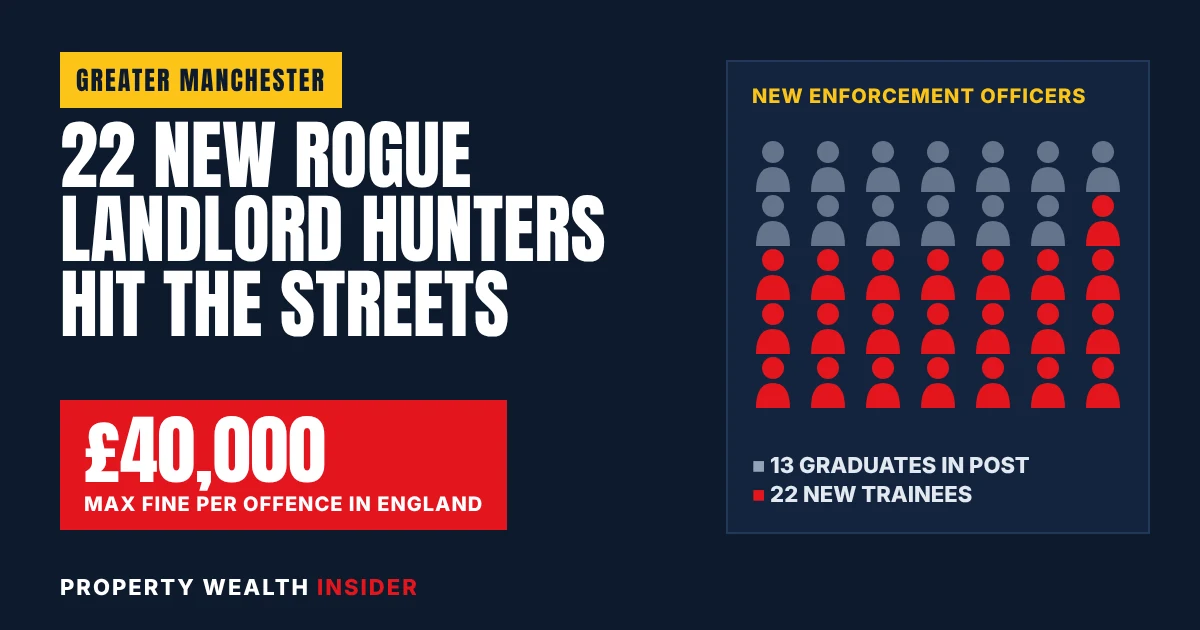
Greater Manchester has put 22 newly trained housing enforcement officers to work across all 10 of its boroughs, with Mayor Bev Craig making clear their job is to enforce the Renters’ Rights Act and go after landlords who let homes fall into disrepair.
It lands five months after the biggest shake-up of private renting in a generation took effect on 1 May 2026, when the maximum civil penalty for the most common housing offences in England rose from £30,000 to £40,000 and rent repayment orders doubled to up to two years’ rent.
If you let property in Bolton, Bury, Manchester, Oldham, Rochdale, Salford, Stockport, Tameside, Trafford or Wigan, the odds of an inspector knocking have just gone up. If you let anywhere else in England, the fines below apply to you too. Here is what has changed, what you could be fined, and how to check your own exposure in two minutes.
Key facts
- 22 new trainee housing enforcement officers are joining council teams in every Greater Manchester borough, GMCA announced on 1 October 2026.
- They follow 13 earlier trainees who have all graduated into housing enforcement jobs, under a scheme launched in 2023.
- Since 1 May 2026, councils in England can fine landlords up to £40,000 (previously £30,000) for offences such as running an unlicensed HMO or ignoring an improvement notice.
- Rent repayment orders can now claw back up to 2 years’ rent, up from 12 months.
- New Renters’ Rights Act breaches, including rental bidding and discrimination against families or benefit claimants, carry fines of up to £7,000.
- Landlord database registration starts regionally from 15 December 2026, beginning in the West Midlands. No North West date has been given yet.
What Greater Manchester announced
The Greater Manchester Combined Authority (GMCA) says the 22 trainees will join council teams checking rental homes, bringing enforcement action and cracking down on illegal practices.
Bev Craig, who took office as Mayor on 3 August 2026, said she wants councils to have the resources to enforce the Renters’ Rights Act, and that she plans to strengthen the city region’s Good Landlord Charter. No detail on those Charter changes has been published yet.
The trainee scheme is not new. When GMCA reported the first cohort in October 2024, 13 apprentices had completed training: 10 funded by GMCA (one per borough), one by Bolton Council and two by Salford City Council. All 13 are now in enforcement jobs. The new 22 take the pipeline to 35 trained officers.
The other half of GM’s approach is the voluntary Good Landlord Charter: free to join, with 21 criteria across seven areas, from affordability to safety. GMCA says landlords of more than half of the city region’s rented homes are now signed up as supporters.
Why it matters outside Manchester: every council in England now has the same higher fines and longer rent repayment orders. GM is training more people to use them, but the rules are national.
The fines councils can now issue
Civil penalties are fines a council imposes instead of prosecuting you. You can appeal them to the First-tier Tribunal, but they are quicker and cheaper for councils than court, so they get used much more often. These are the legal maximums for each breach. The council sets the actual figure using its own enforcement policy.
| Breach (England) | Law | Max civil penalty | Rent repayment order? |
|---|---|---|---|
| Unlicensed HMO | Housing Act 2004 s72 | £40,000 | Yes, up to 2 years |
| Unlicensed property under selective licensing | Housing Act 2004 s95 | £40,000 | Yes, up to 2 years |
| Failing to comply with an improvement notice | Housing Act 2004 s30 | £40,000 | Yes, up to 2 years |
| Breaching HMO management regulations | Housing Act 2004 s234 | £40,000 | No |
| Electrical safety (EICR) duties | Electrical Safety Standards Regs 2020 | £40,000 per breach | No |
| Unlawful eviction or harassment | Protection from Eviction Act 1977 | £40,000 | Yes, up to 2 years |
| Rental bidding, or not stating a rent in an ad | Renters’ Rights Act s56-57 | £7,000 (plus a further £7,000 for a repeat within 5 years) | No |
| Refusing tenants with children or on benefits | Renters’ Rights Act s40 | £7,000 | No |
| Tenancy rule breaches (e.g. no written statement of terms, trying to end a tenancy outside the grounds) | Housing Act 1988 s16I | £7,000 | Only for the related offences |
| Prohibited payment, including taking rent in advance | Tenant Fees Act 2019 s8 | £5,000 (up to £30,000 for a repeat offence) | No |
| Smoke or carbon monoxide alarms, after a remedial notice | Smoke and CO Alarm Regs 2015 | £5,000 | No |
The jump from £30,000 to £40,000 applies only where the offence happened on or after 1 May 2026, under SI 2026/319. The same rise applies to breaching a banning order.
Unprotected deposits work differently. There is no council fine. Instead, the tenant can go to court, which must order you to pay between one and three times the deposit. Gas safety failures are criminal offences under the Gas Safety (Installation and Use) Regulations 1998, prosecuted by the HSE rather than fined by councils.
Rent repayment orders: the bigger risk
A fine is capped. A rent repayment order (RRO) grows with every month you are in breach and every tenant you have. The First-tier Tribunal can order you to repay rent to the tenant, or universal credit to the council.
From 1 May 2026 the Renters’ Rights Act amended the Housing and Planning Act 2016 so that:
- The maximum repayment period doubled from 12 months to 2 years.
- Tenants have 2 years from the offence to apply, instead of 12 months.
- Superior landlords, such as an owner letting to a rent-to-rent operator, can now be pursued as well.
- Repeat offenders face the maximum award, and tribunals must consider any previous civil penalty or RRO.
In an HMO with five tenants each paying £550 a month, two years of rent is £66,000. That is more than the maximum fine, and you can get both.
Enforcement risk checker
Tick any gaps that apply to one property. The checker adds up the legal maximum civil penalties, the maximum rent repayment order, and any deposit award. It shows the worst case, not what a council would usually charge.
Enforcement risk checker
Guide only, not legal advice. Figures are legal maximums in England. Councils set actual penalties using their own policy, and a tribunal decides any rent repayment order based on your conduct and finances. A council cannot both fine and prosecute you for the same conduct.
Worked examples
1. The unlicensed five-bed HMO
Five tenants each pay £550 a month. The landlord never applied for a mandatory HMO licence. The house has been let without one for 18 months, and it is still unlicensed today, so the offence continues past 1 May 2026.
- Maximum civil penalty: £40,000
- Maximum RRO: 5 x £550 x 18 months = £49,500
- Worst case: £89,500. Add another £40,000 if the council also finds HMO management breaches.
2. The bidding war
A flat is advertised at £1,100 a month. Three applicants offer more and the landlord takes £1,250. That breaches the rental bidding ban: up to £7,000. If it happens again within five years, the council can add a further £7,000. The extra £150 a month earns £1,800 a year, far less than the fine.
3. The “quiet” eviction
A landlord changes the locks on a tenant paying £900 a month instead of using the possession grounds. The council can fine up to £40,000 for unlawful eviction, and the tenant can seek an RRO of up to 24 x £900 = £21,600. Worst case: £61,600.
What is in force now, and what is coming
All of this applies in England only. Wales, Scotland and Northern Ireland have their own regimes. Dates come from the government’s implementation roadmap and Housing Hub.
| Date | What happens | Status |
|---|---|---|
| 27 October 2025 | Renters’ Rights Act 2025 gets Royal Assent | Done |
| 27 December 2025 | New council investigatory powers | In force |
| 1 May 2026 | Section 21 abolished, periodic tenancies, bidding and advance-rent bans, discrimination rules, £40,000 fines, 2-year RROs | In force |
| From 15 December 2026 | Landlord database registration rolls out by region, starting in the West Midlands | Coming. No North West date yet |
| 2028 (expected) | Mandatory landlord ombudsman membership | Planned |
| To be confirmed | Decent Homes Standard and Awaab’s Law in private renting | Planned |
When the database applies in your area, failing to register can bring a fine of up to £7,000. Serious or continuing breaches, or giving false information, can bring up to £40,000, and they count towards a rent repayment order.
What to do now
- Step 1: Check licensing. Look up your council’s HMO, additional and selective licensing schemes. Some councils license all private lets in particular areas, so check the property’s exact address.
- Step 2: Audit certificates. Check you have a current gas safety record, an EICR, the EPC, and working smoke and CO alarms for every property.
- Step 3: Check your deposits. Make sure every deposit is protected and the prescribed information was served.
- Step 4: Clean up your lettings process. Every advert needs a fixed rent. Do not invite or accept bids above it, take no more than one month’s rent upfront, and drop any blanket bans on children or benefit claimants.
- Step 5: Give every tenant the written statement of terms that the Act now requires.
- Step 6: Answer improvement notices and council letters quickly. Ignoring one is a £40,000 offence on its own.
- Step 7: Consider joining the Good Landlord Charter if you let in GM. It is free and shows the council you take standards seriously.
- HMO or selective licence checked or held
- Gas safety record in date and given to tenant
- EICR in date and given to tenant
- Smoke alarm on every storey, CO alarm where required
- Deposit protected and prescribed information served
- Adverts show a fixed rent, with no bidding
- No more than one month’s rent taken upfront
- No “no DSS” or “no children” wording
- Written statement of terms given
- Repairs log kept, and council notices answered in time
- Database registration date noted for your region
FAQ
How much can a council fine a landlord in 2026?
In England, up to £40,000 per offence for things like unlicensed HMOs, ignoring improvement notices, electrical safety breaches and unlawful eviction, where the offence happened on or after 1 May 2026. Renters’ Rights Act breaches like rental bidding carry up to £7,000.
Can a tenant get two years’ rent back?
Yes, for qualifying offences such as an unlicensed HMO, unlawful eviction or failing an improvement notice. Since 1 May 2026, a rent repayment order can cover up to two years’ rent, and tenants have two years to apply.
Who is the Mayor of Greater Manchester?
Bev Craig. She took office on 3 August 2026, succeeding Andy Burnham.
Do I need to register on the landlord database yet?
Not yet in Greater Manchester. Registration rolls out region by region from 15 December 2026, starting in the West Midlands. Watch for your region’s date.
Is the Good Landlord Charter compulsory?
No. It is voluntary and free. Supporters commit to working towards its 21 criteria, and members meet all of them. The Mayor says she wants to strengthen it, but no changes have been published.
Sources
- GMCA: Greater Manchester boosts housing enforcement teams (1 October 2026)
- GMCA: The Mayor
- GMCA: first enforcement trainee cohort (October 2024)
- GM Good Landlord Charter: What is the Charter?
- GOV.UK: Renters’ Rights Act implementation roadmap
- GOV.UK: Guide to the Renters’ Rights Act
- GOV.UK Housing Hub: Renting is changing
- Renters’ Rights Act 2025
- Housing Act 2004 s249A
- Financial Penalties (Housing Offences and Breach of Banning Orders) Regulations 2026
- Housing and Planning Act 2016 s40 and s44
- Housing Act 2004 s214 (deposits)
- Electrical Safety Standards Regulations 2020 reg 11
- Smoke and Carbon Monoxide Alarm Regulations 2015 reg 8
- Tenant Fees Act 2019 s8
This is news and general guidance, not financial, legal or tax advice.