Private landlords face Ombudsman with £25,000 payout power
The body that already referees complaints against councils and housing associations is coming for private landlords. The government has confirmed that it intends the Housing Ombudsman Service to set up and run the new private rented sector landlord redress scheme in England, the service ministers call the PRS Landlord Ombudsman.
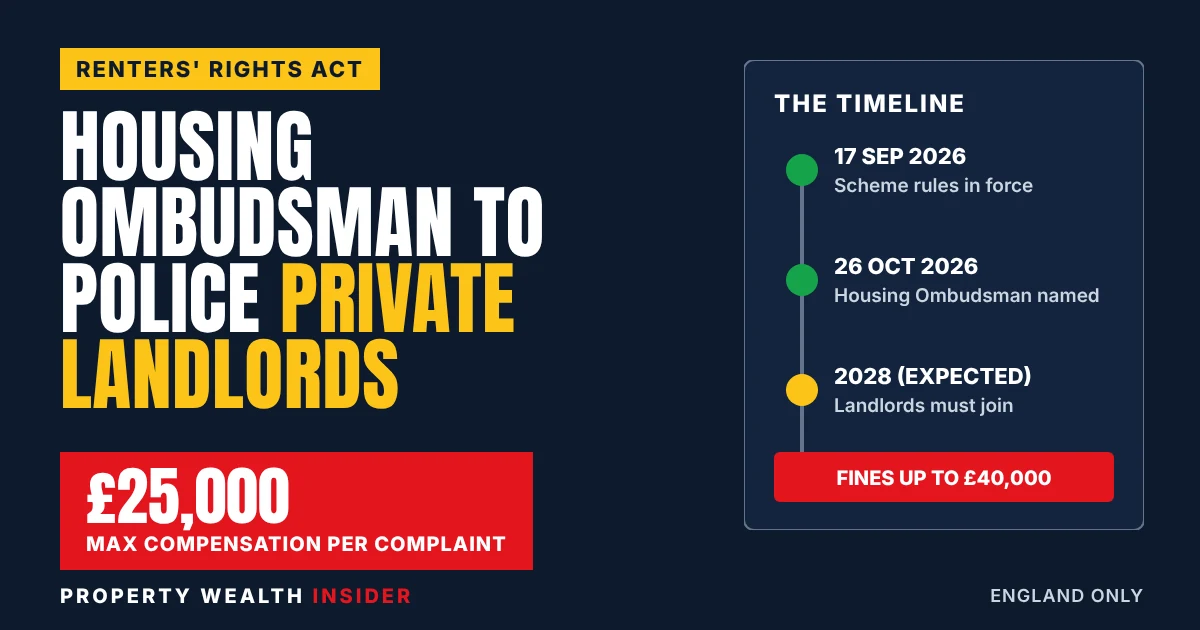
The confirmation came in a written parliamentary answer from housing minister Matthew Pennycook on 26 October 2026. It follows regulations that came into force on 17 September 2026 setting the rules any landlord ombudsman must follow, including the power to order a landlord to pay a tenant up to £25,000 in compensation.
Nobody has to sign up yet. But once membership is switched on, every private landlord in England will need to belong, and fines for not joining are already written into the Renters’ Rights Act 2025. Here is what is law today, what is still to come, and how to get your complaints house in order before the Ombudsman arrives.
Key facts
- The government intends the existing Housing Ombudsman Service to run the private landlord redress scheme (written answer, 26 October 2026).
- The Private Landlord Redress Schemes (Approval and Designation) Regulations 2026 (SI 2026/1033) came into force on 17 September 2026.
- Any approved or designated scheme must be able to order compensation of up to £25,000, plus an apology, explanation or other action.
- Landlords do not have to join yet. Further regulations will say who must join and when; the government roadmap expects mandatory sign-up in 2028.
- Once membership is compulsory, councils can fine a landlord up to £7,000 for not joining, rising to £40,000 for continuing or repeat breaches.
- England only. Tenants will be able to use the service for free.
What has actually changed
Two things. First, the legal framework now exists. The Private Landlord Redress Schemes (Approval and Designation) Regulations 2026 were made on 16 September 2026 and came into force the next day. They let the Secretary of State approve an independent scheme or designate one run on the government’s behalf, and they set the conditions any scheme must meet.
Second, we now know who will run it. Asked by Labour MP Becky Gittins what steps were being taken to appoint a landlord ombudsman, Matthew Pennycook replied that the government’s intention is for the existing Housing Ombudsman Service, which already provides mandatory redress for social housing tenants, to “set up and operate the service”.
The same answer made clear the regulations “do not require landlords to join a scheme immediately”. The scheme will be prepared for designation and its digital systems built first. Only then will further regulations set out which landlords must join and when.
Why it matters: letting agents have had to belong to a redress scheme since 1 October 2014, but there has never been a compulsory route for complaints about the landlord. The minister told MPs in June that the new scheme will “close an important gap” where agent redress is mandatory but nothing equivalent covers the landlord.
In force now vs still to come
There is a lot of noise about this, so here is the status of each piece as of 28 October 2026.
| Measure | Status | Detail |
|---|---|---|
| Letting agent and property manager redress | In force since 1 October 2014 | Agents must belong to The Property Ombudsman or the Property Redress Scheme. Penalty up to £5,000. |
| Renters’ Rights Act 2025, landlord redress powers (sections 64 to 70) | Law, mostly waiting on regulations | Gives ministers power to require landlords to join, and sets the penalties. |
| Scheme approval and designation rules (SI 2026/1033) | In force 17 September 2026 | £25,000 compensation cap, enforcement, expulsion, fees, reviews. |
| Housing Ombudsman Service to run the scheme | Government intention | Confirmed 26 October 2026. Scheme not yet designated. |
| Landlords required to join | Not yet, needs further regulations | Roadmap expects this in 2028. |
| Membership fees | Not set | Landlords will pay; amounts to be confirmed closer to launch. |
| PRS Database | Coming | Roadmap: roll-out from late 2026, mandatory with an annual fee. The Ombudsman follows the Database. |
| Ombudsman decisions enforceable like court orders (section 68) | Power only | Needs regulations after consultation with landlord and tenant bodies. |
The implementation roadmap says the scheme administrator will be chosen at least 12 to 18 months before implementation so it can scale up, with landlords required to join “in 2028, when the Secretary of State is confident the service is ready”. All of this applies to England only.
How the landlord Ombudsman will work
The detailed scheme rules have not been published. But the 2026 regulations fix the minimum every scheme must contain, and they are worth knowing now.
- Who can complain: prospective, current and former tenants, or someone acting for them.
- You get first go: the scheme must set a period for the landlord to resolve the matter before a complaint is accepted. The length is not yet known.
- The test: complaints are decided on what is “fair and reasonable in all the circumstances”, not just strict legal rights.
- Codes of practice: tenants must be able to complain about breaches of any landlord codes of practice issued or approved by the Secretary of State.
- Remedies: an apology or explanation, compensation of no more than £25,000, or any other action the Ombudsman specifies, within a set deadline.
- Teeth: enforcement orders, and expulsion for ignoring orders, unpaid fees, misleading evidence, obstruction or breaching a banning order. An expelled landlord cannot simply join another scheme.
In the Commons committee debate on 22 June 2026, the minister said the £25,000 cap was chosen to match the cap for mandatory property agent redress, and that likely complaints include property standards and repairs, how requests are handled, and inappropriate behaviour. The scheme must review its rules within five years of being approved or designated.
What does the Housing Ombudsman actually award? Its social housing caseload gives the best clue. Determinations have risen sharply while the average compensation per upheld case has fallen.
Repairs dominate. In its 2025-26 review the Ombudsman said responsive repairs featured in 80% of cases and accounted for over 65% of compensation ordered. Damp, mould and leaks are the issues most likely to cost a landlord money.
Fines for not joining
The penalties are already in section 66 and section 67 of the Renters’ Rights Act 2025, but they can only bite once regulations make membership compulsory.
- Breach of the membership rules: a council can impose a financial penalty of up to £7,000.
- Offence: it becomes a criminal offence if the breach continues more than 28 days after a penalty is imposed (or after an appeal ends), or if you commit a further breach within five years.
- Offence-level penalty: instead of prosecuting, the council can impose a penalty of up to £40,000. On conviction in the magistrates’ court the punishment is a fine.
Councils must be satisfied “beyond reasonable doubt” before fining. The Act also lets the government go further: it could require you to join before you market a property, and bar marketing a home to let until you are a member.
Check your readiness
Put in your portfolio details to see how ready you are for an Ombudsman complaint, which properties have any redress cover today, and what is at stake on paper.
Landlord Ombudsman readiness checker
Guide only, not legal advice. The private scheme’s rules, timescales and fees have not been published. The score is our own rule of thumb using the timescales the Housing Ombudsman applies to social landlords. The £703 benchmark is the 2025-26 social housing average per upheld case; the £25,000 ceiling is a legal maximum, not a likely award. Fines assume a £7,000 penalty plus a £40,000 offence-level penalty.
Worked examples
1. One flat, self-managed, broken boiler
Priya lets one flat in Leeds herself. Her tenant has had no heating for three weeks and Priya has no written complaints process. Today the tenant’s options are the council or the courts. Once the scheme is live, the tenant complains to Priya first, then to the Ombudsman if it is not sorted within the time the scheme allows.
The Ombudsman could order her to fix the boiler, apologise and pay compensation. The legal ceiling is £25,000, but for scale, the Housing Ombudsman’s average per upheld social housing case in 2025-26 was £703. Fixing the boiler promptly and keeping a record is far cheaper.
2. Six homes, four with an agent
Mark owns six houses. An agent fully manages four, and that agent belongs to The Property Ombudsman. That only covers complaints about the agent’s own lettings and management work. If a tenant’s real grievance is Mark’s decision not to approve a repair, there is no compulsory redress route against Mark today. Section 64 allows the government to require the residential landlord to join, so Mark should plan to sign up for all six once membership is switched on.
3. Ignoring the requirement
Suppose membership is compulsory and a landlord simply never joins. The council fines him £7,000. He still does not join, and 28 days pass after the penalty is imposed. That is now an offence, and the council can impose a further penalty of up to £40,000 instead of prosecuting. Worst case: £47,000 in penalties, before any compensation a tenant might have won.
Set up a complaints process now: step by step
You have time, but complaints handled well at your end never reach an ombudsman. The Housing Ombudsman’s Complaint Handling Code for social landlords is the best guide to what it will expect, even though the private scheme’s own rules are still to come.
- Define a complaint widely. The Code treats any “expression of dissatisfaction, however made” as a complaint. Tenants do not have to use the word.
- Give one contact point. An email and a postal address, written into your tenancy information. The scheme itself must let tenants complain by post where they need to, so do not rely on an app alone.
- Acknowledge within 5 working days. That is the social-sector standard for logging a stage 1 complaint.
- Reply in full within 10 working days. Say what happened, what you will do, and by when.
- Offer a second look. If the tenant is still unhappy, have someone else review it (a partner, co-owner or your agent) and reply within 20 working days.
- Put it right. An apology, an explanation, the repair, and where you clearly got it wrong, a sensible goodwill payment.
- Keep the paper trail. Dates, messages, contractor invoices, photos. A fair-and-reasonable test rewards landlords who can show what they did.
- Tidy your agency contract. Agree in writing who handles which complaints and how quickly.
- Written complaints procedure sent to every tenant
- One email and postal address for complaints
- Complaints logged and acknowledged within 5 working days
- Full reply within 10 working days
- Second-stage review by a different person within 20 working days
- Open repairs list cleared, damp, mould, leaks and heating first
- Repair and contact log with dates and photos
- Agency contract states who handles complaints
- Gas, electrical and EPC certificates to hand for the PRS Database
- Budget pencilled in for Database and Ombudsman fees
FAQs
Do private landlords have to join the Ombudsman now?
No. The September 2026 regulations only set the rules for approving or designating a scheme. Separate regulations will say which landlords must join and from when, and the government has promised clear guidance and notice first.
When will landlords have to join the PRS Landlord Ombudsman?
The government’s implementation roadmap expects mandatory sign-up in 2028, once the Secretary of State is confident the service is ready. It will follow the launch of the PRS Database.
How much compensation can the landlord Ombudsman award?
Up to £25,000 per redress order, matching the cap for property agent redress. It can also order an apology, an explanation or other action such as carrying out repairs.
What is the fine for not joining a landlord redress scheme?
Once membership is compulsory, up to £7,000 for a breach. Continuing or repeat breaches become an offence, with a civil penalty of up to £40,000 or prosecution.
My letting agent is in a redress scheme. Do I still need to join?
Plan on yes. Agent schemes cover the agent’s work, and the Act lets the government require the landlord to be a member in their own right. Who exactly must join will be confirmed in the membership regulations.
Does the landlord Ombudsman apply in Wales or Scotland?
No. The requirement applies to landlords of private rented homes in England. Wales, Scotland and Northern Ireland have their own systems.
Sources
- The Private Landlord Redress Schemes (Approval and Designation) Regulations 2026, SI 2026/1033
- Written question 36463, answered by Matthew Pennycook, 26 October 2026
- Hansard, First Delegated Legislation Committee, 22 June 2026
- Renters’ Rights Act 2025, section 64
- Renters’ Rights Act 2025, section 66 (financial penalties)
- Renters’ Rights Act 2025, section 67 (offences)
- MHCLG, Implementing the Renters’ Rights Act 2025: our roadmap
- Housing Ombudsman, Annual Complaints Review 2025-26
- Housing Ombudsman, Annual Complaints Review 2024-25
- Housing Ombudsman, Annual Complaints Review 2023-24
- Housing Ombudsman, Complaint Handling Code
- Redress Schemes for Lettings Agency Work and Property Management Work Order 2014
- GOV.UK, Registering with a redress scheme as a property agent
This article is news and general guidance only. It is not financial, legal or tax advice.