EV charger requests: landlords could get a 28-day deadline
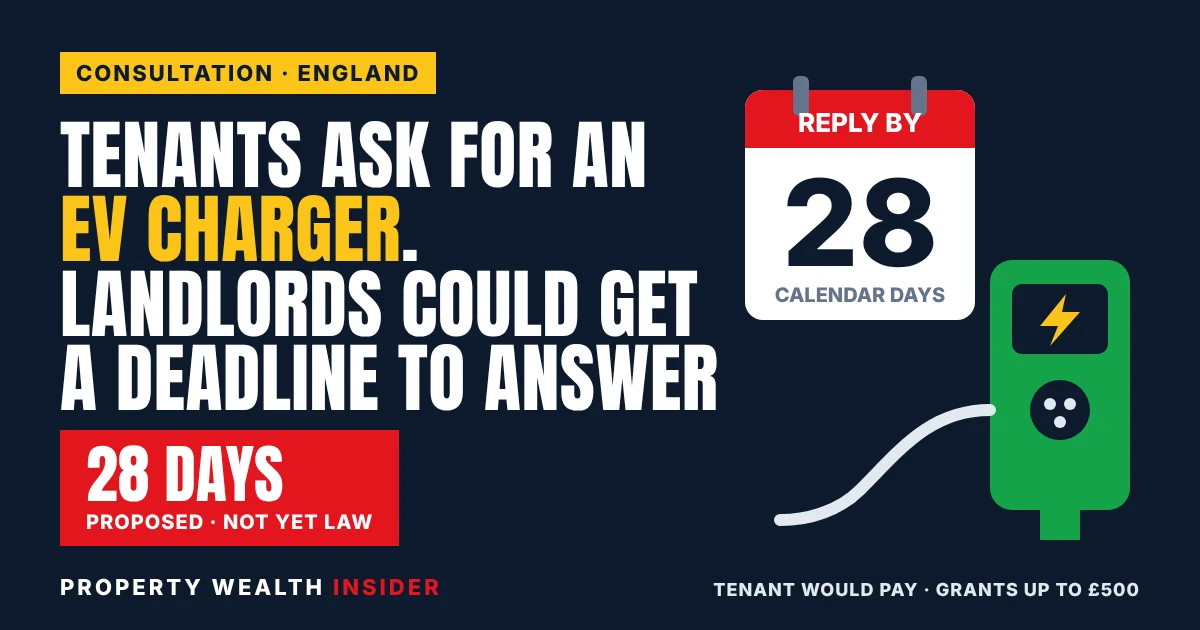
Landlords and freeholders in England could be legally required to answer a tenant’s request for an electric vehicle charger within a set deadline, with 28 calendar days floated as the example, and would not be allowed to say no without a good reason.
The Department for Transport and the Ministry of Housing, Communities and Local Government published the proposals on 21 October 2026. The consultation is open until 11:59pm on 16 December 2026. Under the legislative option the tenant or leaseholder would pay for the charger and the installation, not the landlord.
None of this is law yet. Even if ministers go ahead, it would need new primary legislation and time in Parliament. But tenants can already ask, grants are paying out now, and the grants end on 31 March 2027. So it makes sense to have a policy ready before the requests arrive.
Key facts
- Proposed “ability to charge”: landlords and freeholders must give a timely written decision, for example within 28 calendar days, and must not unreasonably refuse.
- Under the legislation option the tenant or leaseholder pays the up-front cost of the charger, the installation and any fees for consent to alterations.
- The consultation closes at 11:59pm on 16 December 2026. It covers England only and would need primary legislation.
- OZEV grants for renters, flat owners and residential landlords now pay 75% of the cost, up to £500 per socket (up from £350 on 1 April 2026). Funding is confirmed only until 31 March 2027.
- Since 2022, grants have funded 26,504 sockets for people in flats and rented homes and 5,564 through residential landlord grants.
What the government is proposing
The consultation sets out two routes. Ministers have not chosen between them.
- Option 1: non-statutory guidance. This would advise tenants, leaseholders, landlords and freeholders on how to make and handle requests. Landlords would be encouraged to explain and evidence any refusal, but would be under no obligation to agree, follow a set process or give reasons.
- Option 2: legislation. Freeholders and landlords would have to give timely decisions on charger requests and must not unreasonably refuse them. The government notes that France and Norway already have rules of this kind.
The process it describes runs like this. The tenant sends a written request. The landlord acknowledges it, then gives a formal written response “within a period, such as 28 calendar days”, with reasons if the answer is no. If the landlord is itself a leaseholder, it would be expected to pass the request up to the freeholder. How disputes would be escalated is still an open question.
If the request is approved, both sides would agree terms before work starts: who pays for what, and who handles maintenance and decommissioning. The government wants the right to cover as many parking types as possible, including demised and allocated spaces. It accepts that communal parking is harder. Shared owners and people on mixed-tenure estates would also be covered.
It also matters for landlords that the government is asking whether freeholders and landlords would want a formal licence for alterations, and whether they would set conditions on the works.
When you could still say no
The consultation lists six possible reasonable grounds for refusal and asks whether they should be written into law or into guidance. The grounds are quoted from the consultation. The examples are our own illustrations.
| Proposed reasonable refusal ground | What it might look like in practice |
|---|---|
| The request breaches an existing lease term or another statutory obligation | You are a leaseholder landlord and your head lease bans alterations to the exterior or common parts without freeholder consent. |
| Local electricity network upgrades would be needed, including where the property has a looped connection | A terraced house shares a looped supply with next door, so the network operator would have to split it before a charger could go in. |
| No off-street parking is available to the resident | The flat has on-street parking only, or no parking right in the tenancy. |
| In blocks of flats, the freeholder or landlord is adopting a building-wide charging approach | The block’s management company is already procuring communal chargers for the car park. |
| The installation would not comply with BS 7671, the national standard for electrical installations | The installer’s survey shows the existing consumer unit or earthing cannot safely take the extra load. |
| There is insufficient parking space at the building | The bays are too small, or a cable or unit would block a shared access route. |
Notice what is not on the list: “I just don’t want one”. Under the legislative option, a blanket refusal without reasons is exactly what ministers want to stop.
EV charger request planner
Enter the date a request arrived and the quote you have been given. The planner shows the proposed 28-day reply date, what the charger would cost you once the grant is taken off, and how long a rent increase would take to pay it back if you fund it yourself.
EV charger request: deadline and cost-benefit
Guide only, not legal or financial advice. The 28-day deadline is the example given in a consultation and is not law. Grant figures assume 75% of the quote, capped at £500 per socket. The landlord grant also needs Companies House or VAT registration. Under assured periodic tenancies in England, rent can rise only once a year, never in the first year, and only through the section 13 process.
Who pays: grants and worked examples
There are two OZEV grants. The renters and flat owners grant pays 75% of the cost to buy and install one socket, up to £500. To get it, the tenant needs private off-street parking and an eligible vehicle, and must have the landlord’s permission before applying.
The residential landlord grant pays the same 75% up to £500 per socket, for up to 200 sockets a year. But the applicant must be registered at Companies House or registered for VAT. Many individual landlords are neither, so they cannot claim it. Both grants are open across the UK. Neither can be claimed if the charger is installed before OZEV confirms eligibility.
The worked examples below use an illustrative £1,000 quote (£600 unit plus £400 fitting) and £100 of your own admin or legal costs.
- Example 1: tenant pays (the proposed model). The grant is £500 (75% of £1,000 is £750, capped at £500). The tenant pays £500. Your cost is the £100 of admin, and possibly nothing if the consent fee is passed on, as the consultation suggests.
- Example 2: limited-company landlord pays. You claim the £500 grant, so your net cost is £500 plus £100, which is £600. With a £25 a month rent increase it pays back in 24 months. Over a 36-month stay you finish £300 ahead.
- Example 3: individual landlord, no grant. The full £1,000 plus £100 is £1,100. At £25 a month the payback takes 44 months, longer than a 36-month stay, so you end £200 down. Splitting the cost 50/50 with a tenant who claims the grant would leave you paying £350.
- Example 4: a cheaper job. On a £600 quote the grant is £450 (75%), not £500. The cap only applies once a job costs more than about £667.
A word of caution on rent increases. For assured periodic tenancies in England, rent can only rise once a year, not in the first year, using Form 4A with two months’ notice. The tenant can challenge it at the First-tier Tribunal if it is above open market rent. So a charger does not justify an instant increase.
The gap is striking. Renters and flat owners have claimed almost five times as many sockets as landlords through the two residential landlord grants combined. Tenants are already driving demand, and that is part of why ministers now want rules on permission.
The rules that already apply
- Smart charging (Great Britain). Under the Electric Vehicles (Smart Charge Points) Regulations 2021, in force since 30 June 2022, private chargers sold for home or workplace use must have smart functions, pre-set off-peak default hours and security protections. The rules cover England, Wales and Scotland, but not Northern Ireland.
- Part S of the Building Regulations (England). Approved Document S requires charge points or cable routes in new homes, in buildings converted to dwellings and in major renovations. A separate consultation, also closing on 16 December 2026, proposes extending this to covered car parks and reviewing the £3,600 connection-cost cap. Scotland has its own building regulations.
- Electrical safety. Any installation must meet BS 7671, and the grants require an OZEV-authorised installer and an eligible charger model.
- Your lease and mortgage. If you are a leaseholder landlord, the freeholder’s consent is likely to be needed. Check your lender’s and insurer’s terms on alterations, too.
Wales, Scotland and Northern Ireland are not covered by the consultation, because housing is devolved. Landlords there should watch for their own governments’ plans.
How to handle a request now: step by step
You are not legally bound by the 28-day proposal yet. But handling requests as if it applied costs you nothing and leaves you with a paper trail.
- Acknowledge in writing within a few days and log the date the request arrived.
- Check the parking. Is the space demised, allocated or communal, and does the tenancy give the tenant a right to use it?
- Check your title, lease, mortgage and insurance for consent requirements, and ask the freeholder if needed.
- Ask for the installer’s survey and quote. It should come from an OZEV-authorised installer, name the charger model and confirm BS 7671 compliance and the supply arrangements, including any looped connection.
- Decide who pays and run the numbers in the planner above.
- Agree written terms: ownership of the unit, maintenance, electricity costs, insurance, and whether the unit is removed and the area made good when the tenant leaves, or left in place.
- Give written consent so the tenant can apply for the grant. Remember they cannot install until OZEV confirms, which it estimates can take up to 10 working days.
- If you refuse, put your reasons in writing and attach the evidence, such as the lease clause or the installer’s report.
- Date request received logged; proposed 28-day reply date noted
- Parking type and tenant’s right to use it confirmed
- Lease, freeholder, mortgage lender and insurer consents checked
- OZEV-authorised installer quote and survey received (BS 7671, supply type)
- Grant eligibility checked (tenant: permission first; landlord: Companies House or VAT registration)
- Written agreement covers costs, maintenance, electricity, removal and making good
- Decision issued in writing, with reasons if refused
- Charger certificate and details filed with property records
How to respond to the consultation
Landlords can reply as individuals or through an organisation. The online response form lets you save and come back later. You can also email Ability_to_charge@dft.gov.uk or write to the Charging Infrastructure Deployment team, Department for Transport, Great Minster House, 33 Horseferry Road, London SW1P 4DR.
These are the questions most worth a landlord’s time:
- whether 28 days is realistic when consent from a freeholder or lender is needed
- who should pay for maintenance and decommissioning
- what the escalation route for disputes should be
- whether the six refusal grounds are enough
- whether the refusal grounds belong in law or in guidance
Real examples and costs carry more weight than opinion. The deadline is 11:59pm on 16 December 2026.
FAQs
Can my landlord refuse an EV charger?
At the moment, yes. There is no general legal right for tenants in England to install a charger. The proposals would stop landlords unreasonably refusing, but only if legislation is passed.
Do landlords have 28 days to respond to an EV charger request?
Not yet. The consultation gives 28 calendar days only as an example of a period that guidance or legislation could set. The final period, if there is one, has not been decided.
Who pays for a tenant’s EV charger?
Under the legislative proposal, the tenant or leaseholder would pay the up-front cost, including installation and any consent fees. Who pays for maintenance, electricity and removal is still being consulted on.
How much is the EV charger grant for landlords?
The grant is 75% of the cost, up to £500 per socket, for up to 200 sockets a year. Applicants must be registered at Companies House or for VAT. Funding is confirmed only until 31 March 2027.
Can I put the rent up after installing a charger?
Only through the normal rules. For assured periodic tenancies in England, that means once a year, not in the first year, with two months’ notice on Form 4A. The tenant can challenge it at tribunal if it is above market rent.
Does this apply in Wales or Scotland?
No. The consultation covers England only. The OZEV grants are UK-wide, and the smart charge point rules apply across Great Britain.
Sources
- DfT and MHCLG: Expanding electric vehicle charging access for tenants and leaseholders (consultation page)
- Full consultation document
- OZEV: Changes to electric vehicle chargepoint grant schemes from 1 April 2026
- EV chargepoint grant for renters and flat owners
- EV chargepoint grant for residential landlords
- DfT: Grant schemes for EV charging infrastructure statistics, 1 July 2026
- DfT and MHCLG: Amending the building regulations: EV charging infrastructure
- Approved Document S: infrastructure for charging electric vehicles
- The Electric Vehicles (Smart Charge Points) Regulations 2021
- Regulations: electric vehicle smart charge points (guidance)
- GOV.UK: Assured periodic tenancies, rent increases
This article is news and general guidance, not financial, legal or tax advice.