EPC G Homes Hit £6,379 Bills: Tenants Now Check Your EPC
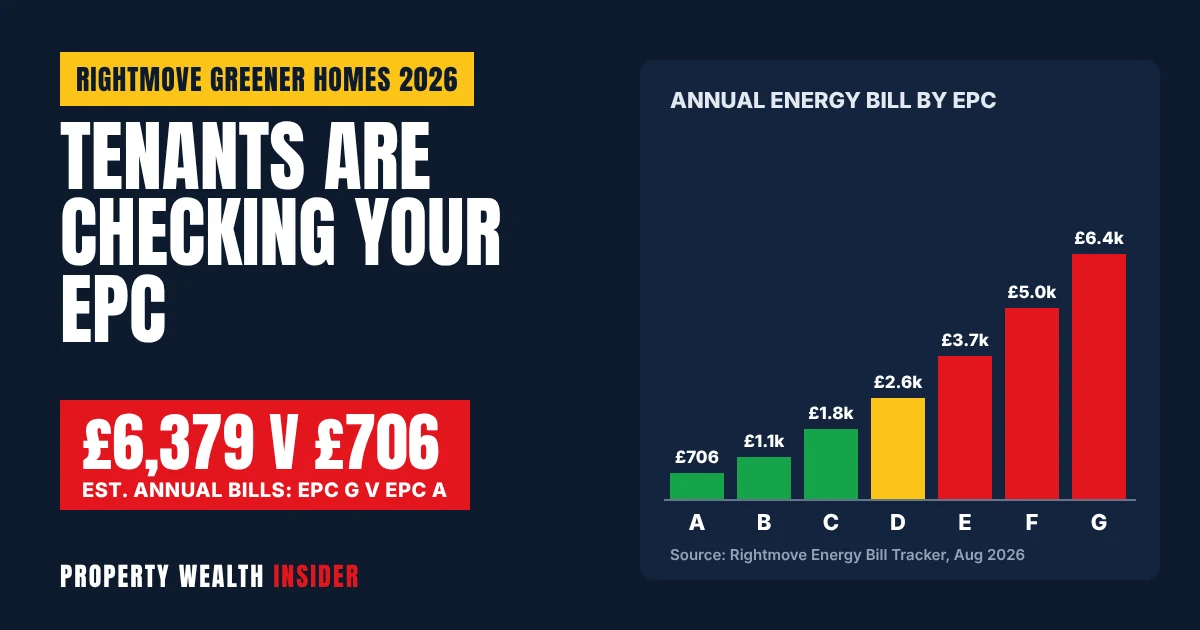
A tenant in an EPC G-rated home faces estimated energy bills of £6,379 a year. Move them into an EPC A home and that figure drops to £706. That is the headline gap in Rightmove’s 2026 Greener Homes Report, published today, Thursday 22 October 2026.
The report also shows renters and buyers paying far closer attention to how a home performs: 63% of movers want a home that generates most or all of its own energy, and Rightmove says it is rolling out EPC filters across all its listings this year. For landlords, a poor rating is about to become much easier for tenants to screen out.
It lands as the government’s tougher rental energy rules for England and Wales move towards a 1 October 2030 deadline. Here is what the data says, what is law today versus what is planned, and a calculator to test whether an upgrade pays for itself.
Key facts
- Estimated annual energy bills: £706 for an EPC A home, £2,337 across all homes and £6,379 for EPC G (Rightmove Energy Bill Tracker, August 2026).
- 63% of movers want a home that generates most or all of its own energy; 53% say recent price rises increased their interest in solar and batteries.
- 61% of rental homes on Rightmove are now EPC C or above, up from 52% five years ago.
- In force now (England and Wales): rentals must be at least EPC E, with a £3,500 (inc VAT) spending cap before an exemption.
- Confirmed plan: EPC C (on new metrics) for all private tenancies by 1 October 2030, with a £10,000 per-property cost cap. Still needs legislation.
What Rightmove found
This is the fifth annual Greener Homes Report. Rightmove says it draws on more than 17 million EPC certificates, almost 30 million listings and a survey of 1,062 UK consumers and landlords carried out in August 2026.
The big theme is energy independence. Nearly two-thirds of movers (63%) would ideally like a home that is fully or mostly self-sufficient for energy. Just 8% would rather stay fully reliant on the grid.
- Green kit is showing up in adverts: since 2022, mentions of heat pumps in newly listed homes are up 151%, solar panels up 94% and EV chargers up 79%.
- Heat is the new worry: 45% say their current home copes badly in hot weather and 87% say a home’s ability to stay cool matters when choosing their next one.
- Air-con searches doubled: searches for homes for sale with air conditioning rose 104% this summer compared with the same period last year.
- Ambition outruns action: 74% of movers think more should be done to help households go greener, yet only 5% of homeowners rank green improvements as their top priority.
The bill gap by EPC band
Rightmove’s Energy Bill Tracker puts an estimated annual energy bill against every EPC band. The G-rated figure is more than nine times the A-rated one.
Treat these as modelled averages, not quotes. A small flat and a large detached house in the same band will have very different bills, and Rightmove’s figures pre-date the 4% rise in Ofgem’s price cap from 1 October 2026, which took a typical dual-fuel bill to £1,723 a year (England, Scotland and Wales).
What matters for landlords is the step between bands. On Rightmove’s numbers, here is what a one or two-band jump is worth to the tenant paying the bills:
| Upgrade | Est. bill before | Est. bill after | Tenant saving a year | Per month |
|---|---|---|---|---|
| D to C | £2,641 | £1,842 | £799 | £67 |
| E to D | £3,724 | £2,641 | £1,084 | £90 |
| E to C | £3,724 | £1,842 | £1,883 | £157 |
| F to C | £4,984 | £1,842 | £3,143 | £262 |
| G to E (today’s legal minimum) | £6,379 | £3,724 | £2,655 | £221 |
What it means for lettability and rents
Renters are the most energy-conscious group in the report. Rightmove found 78% of renters support action to make homes greener and 36% are concerned about rising energy bills. They also have the least control, because insulation, heating and solar are the landlord’s call.
The practical change is visibility. Rightmove says it is launching EPC filters across all property listings this year. Once tenants can tick “C or above” in a search, a D, E or F-rated flat may simply not appear for a chunk of applicants.
The rental stock is already moving. 61% of rental homes on Rightmove are now rated EPC C or above, up from 52% five years ago. That leaves roughly four in ten below C, and those properties will increasingly be compared against better-rated neighbours.
Worked example: a two-bed let at £1,000 a month is rated E. On Rightmove’s averages, lifting it to C cuts the tenant’s estimated bills by about £157 a month. If you added £40 a month to the rent after the work, the tenant would still be around £117 a month better off overall. Whether the market will pay that £40 is your local judgement: there is no official data on EPC rent premiums.
The rules: in force now vs 2030
The Minimum Energy Efficiency Standard (MEES) rules below apply to private rented homes in England and Wales. Scotland and Northern Ireland have separate regimes and are not covered here.
| In force now | Confirmed plan (not yet law) | |
|---|---|---|
| Minimum rating | EPC E (all tenancies since 1 April 2020) | EPC C equivalent on new EPC metrics: a fabric standard plus either a heating system or smart readiness standard |
| Deadline | Already applies | 1 October 2030, for all tenancies (no earlier date for new lets) |
| Cost cap | £3,500 inc VAT per property | £10,000 per property; spend since 1 October 2025 counts |
| Low-value homes | No separate rule | Below £100,000 value: cap is 10% of the property’s value |
| Cost cap exemption length | 5 years | 10 years |
| Maximum fine | £5,000 per property in total | £30,000 per property, per breach |
| Existing C ratings | – | A C on an EPC issued before 1 October 2029 counts as compliant until that EPC expires or is replaced |
The 2030 package was set out in the government response published in January 2026. It still needs Parliament: ministers plan new primary powers, then regulations they aim to bring into force in 2027.
Two details matter for budgeting. Third-party grants generally count towards the £10,000 cap, but Boiler Upgrade Scheme money does not. So an £11,000 heat pump with a £7,500 BUS voucher uses only £3,500 of the cap.
The low-value rule cuts the bill for cheaper stock. A terrace worth £80,000 would face a cap of £8,000 rather than £10,000. The government estimates average spend for homes below the standard at £5,400.
EPC upgrade payback calculator
Pick your current and target band, enter the cost and any grant, and the tool uses Rightmove’s band bill estimates to show the tenant’s saving, how long a rent rise would take to repay you, and how the spend sits against today’s and the proposed caps.
EPC upgrade payback calculator
Guide only, not financial or legal advice. Bills are Rightmove Energy Bill Tracker averages by EPC band (August 2026); your property’s real bills will differ. The 2030 cap and rules are confirmed policy but not yet law and apply in England and Wales only.
With the defaults (E to C, £6,000, no grant, £40 a month rent rise) the tenant saves an estimated £1,883 a year, stays about £117 a month ahead, and you recover the cost in 12.5 years. That spend is well inside the proposed £10,000 cap, and it would count towards it if done after 1 October 2025.
The cheapest EPC points
Not every upgrade is a heat pump. Rightmove’s analysis ranks the improvements that buy EPC points most cheaply:
| Improvement | Typical cost | EPC points gained | Cost per point |
|---|---|---|---|
| Hot water cylinder insulation | £15-£30 | 7.9 | £2.87 |
| Draughtproof single-glazed windows | £80-£120 | 7.1 | £14.17 |
| Low energy lighting, all fixed outlets | Around £38 | 2.3 | £16.60 |
| Loft insulation topped up to 270mm | £100-£345 | 6.6 | £33.71 |
| Hot water cylinder thermostat | £200-£400 | 8.3 | £36.27 |
On Rightmove’s figures the five add up to around 32 points for under £1,000, though real gains will not simply stack. On a property sitting near a band boundary, that can be enough to move up a band before you price anything bigger. Note the 2030 standard will be measured on new EPC metrics, so check how points translate once reformed EPCs arrive.
What landlords should do now
- Check every EPC. Look up each property’s band, score and expiry date on the register. Anything F or G is a problem today, not in 2030.
- Find your C-ready homes. If a property is already C, keep that EPC valid. A C on a certificate issued before 1 October 2029 counts as compliant until it expires or is replaced.
- Do the cheap points first. Cylinder jackets, draughtproofing, lighting and loft top-ups cost little and can tip a borderline D into C.
- Keep every invoice. Spend on relevant measures since 1 October 2025 is set to count towards the £10,000 cap.
- Time works to voids. Insulation and heating jobs are far easier between tenancies, and you get a fresh EPC to advertise.
- Sell the saving in your advert. With EPC filters arriving on Rightmove, put the band and likely running costs up front.
- Watch for the legislation. The 2030 rules still need new powers and regulations. Plan on them, but budget on what is law.
- EPC band, score and expiry noted for every rental
- Any F or G property improved to E or a valid exemption registered
- Recommended measures on each EPC listed and priced
- Invoices for energy works since 1 October 2025 filed by property
- Grant eligibility checked (and whether it counts towards the cap)
- Works pencilled in for the next void
- Listings updated with EPC band and running-cost selling points
FAQ
What is the minimum EPC rating to rent out a property?
In England and Wales it is currently EPC E for all private tenancies, unless a valid exemption is registered. The government plans to raise this to EPC C (on new metrics) by 1 October 2030, but that still needs legislation.
How much will landlords have to spend to reach EPC C?
The plan caps required spend at £10,000 per property, or 10% of value for homes worth under £100,000. The government estimates the average spend for homes below the standard at £5,400.
How much more does an EPC G home cost to run than EPC A?
Rightmove’s Energy Bill Tracker estimates £6,379 a year for EPC G against £706 for EPC A, more than nine times as much. The average across all homes is £2,337.
Can I charge more rent for a better EPC?
You can set the rent the market will pay, subject to the usual rules on rent increases for existing tenants. There is no official figure for an EPC rent premium, so use the calculator with your own local estimate.
Do the 2030 EPC rules apply in Scotland?
No. The regulations covered here apply to England and Wales. Scotland and Northern Ireland set their own standards for rented homes.
- Rightmove press release: Nearly two-thirds of movers want homes that generate their own energy (22 October 2026)
- Rightmove Greener Homes Report 2026
- GOV.UK: Domestic private rented property minimum energy efficiency standard, landlord guidance
- GOV.UK: Improving the energy performance of privately rented homes, government response
- Ofgem: Energy price cap will rise by 4% from October 2026
This article is news and general guidance only, not financial, legal or tax advice.