Selling a rental? The 12-month re-let ban and £40,000 fine trap
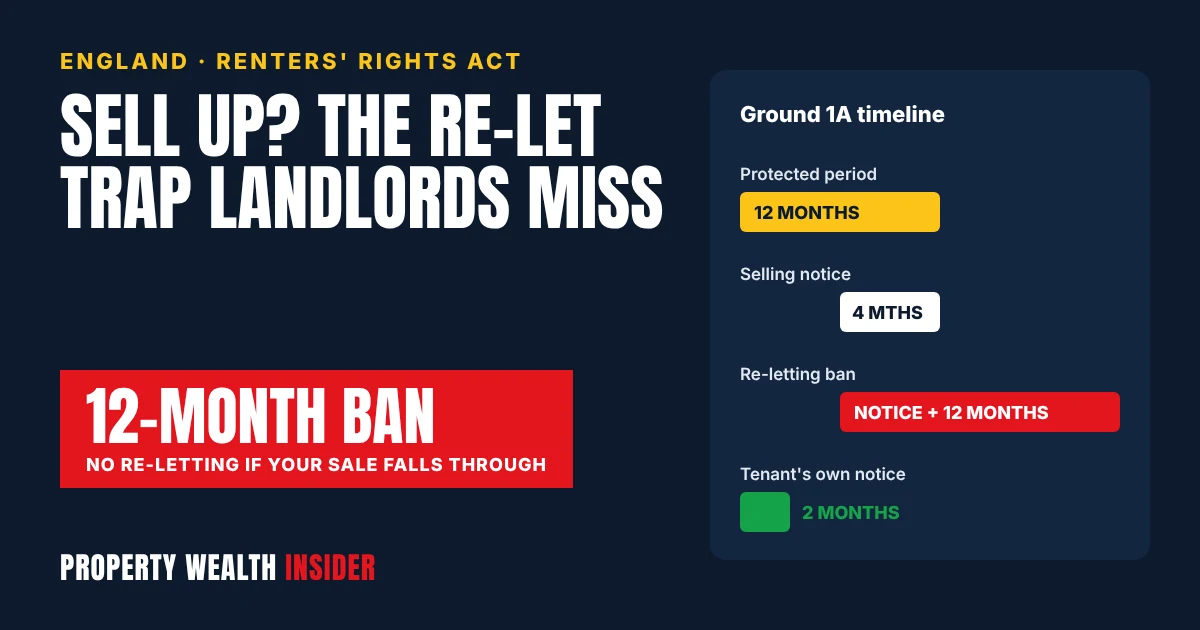
Landlords in England who are thinking about selling are discovering that the old playbook of “let it again and sell later” now comes with strings attached. Under the Renters’ Rights Act, a new tenancy cannot be ended for a sale in its first 12 months, the selling notice is four months, and if you use the selling ground and then change your mind, you cannot re-let or even advertise the property to rent for up to a year.
The tenancy reforms came into effect on 1 May 2026, so the autumn is the first full lettings season under them. In prime central London, Winkworth says more than three tenants registered for every buyer in its latest autumn market update. Plenty of those homes are owned by landlords who have not decided whether to hold or sell, and the timing rules below decide what each choice costs.
This guide covers England only. Wales and Scotland have their own tenancy laws.
Key facts
- The Renters’ Rights Act tenancy reforms took effect in England on 1 May 2026, and all assured shorthold tenancies became rolling periodic tenancies that day.
- The selling ground, Ground 1A, needs 4 months’ notice, and the date in the notice cannot fall before the tenancy has run for 1 year.
- Once you rely on Ground 1A, you must not let or market the property to rent from the day the notice is served until 12 months after the earliest court date in the notice.
- Breaking the re-letting ban is a criminal offence. A council can impose a penalty of up to £40,000 instead of prosecuting.
- Tenants can leave on 2 months’ notice. Lets at more than £100,000 a year are not assured tenancies, so these rules do not apply to them.
What changed for landlords who want to sell
Section 21 “no-fault” notices are gone in England. Since 1 May 2026, every assured shorthold tenancy has been a rolling periodic tenancy with no fixed end date. To get a property back, a landlord now has to rely on one of the grounds for possession in Schedule 2 to the Housing Act 1988.
For a sale, that ground is Ground 1A. It is a mandatory ground: if you meet its conditions and serve a valid notice, the court must grant possession. But it has three timing rules that interact, and getting them wrong can cost months of rent or lead to a criminal charge.
Tenants have more flexibility. A tenant can end the tenancy with 2 months’ notice, at any point. With no fixed terms left, a landlord who re-lets after a tenant leaves is giving the next tenant a year of protection from a sale. That is why the question to ask is “should I re-let at all?” rather than “when should I sell?”
Ground 1A: the selling ground, rule by rule
Ground 1A applies where the landlord intends to sell the freehold or leasehold, or to grant a lease of more than 21 years. The table sets out how it works, taken from the legislation and government guidance.
| Rule | What the law says | What it means in practice |
|---|---|---|
| Protected period | The current tenancy must have begun at least 1 year before the “relevant date”, which for Ground 1A is the date specified in the notice | You can serve notice during the first year, but the date in it cannot fall before the tenancy has run for 12 months |
| Notice period | 4 months, beginning with the date the notice is served | You cannot start court proceedings until the date in the notice |
| Deadline to go to court | Proceedings must not begin later than 12 months from the date the notice was served | Serve too early and the notice can go stale |
| Re-letting ban | No letting or marketing to rent from the day the notice is served until the last day of the 12 months that begin on the earliest court date in the notice | If the sale falls through, the property could sit empty for a year |
| Who cannot use it | Most social landlords. It also cannot be used for assured tenancies created before 1 May 2026 that were not assured shortholds | Check what kind of tenancy you have before relying on it |
| Tenant’s notice | Tenants can end the tenancy with 2 months’ notice | If the tenant leaves on their own notice, Ground 1A is not used and the re-letting ban does not apply |
One detail matters for the protected period. The law counts both the day the tenancy began and the date in the notice. To be safe, many landlords will simply use the first anniversary of the tenancy as the earliest date, and our calculator does the same.
You also have to genuinely intend to sell. Relying on a ground when you know, or don’t care whether, you can actually get possession on it is an offence if the tenant then leaves within four months without a court order.
The 12-month re-letting ban
This is the rule that catches people. Once you rely on Ground 1A in a notice, the landlord must not let the property on a tenancy of 21 years or less, or take money from anyone to occupy it under a licence, during the “restricted period”. Nobody connected with the tenancy may market it to rent during that time either, and that includes your letting agent.
The restricted period starts on the day the notice is served. It ends on the last day of the 12 months that begin on the earliest court date specified in the notice. The ban applies whether or not the tenant actually leaves.
Put simply, serving a Ground 1A notice can stop you letting the home for around 16 months or more from the day you serve it. If the buyer pulls out, you cannot simply find a new tenant.
The penalties are serious. Breaching the letting or marketing ban is a criminal offence. As an alternative to prosecution, a council can impose a financial penalty of up to £40,000. Government guidance says a prosecution can lead to an unlimited fine.
Exceptions are narrow. The ban does not stop you giving a licence to the person who is buying the property, if they are moving in ahead of the sale. Shared owners who are selling have a separate exemption. Nothing lets you re-let to a new tenant just because a sale fell through.
Worked example: timing a sale
Say a landlord re-let a flat on a new tenancy starting 1 August 2026 at £2,500 a month. In November they decide to sell and serve a Ground 1A notice on 2 November 2026.
- Four months from 2 November 2026 would allow a date of 2 March 2027. But the tenancy has not run for a year by then, so the notice has to give a date of 1 August 2027.
- The landlord cannot start court proceedings before 1 August 2027, and must start them by 2 November 2027, 12 months after serving.
- The re-letting ban runs from 2 November 2026 to 31 July 2028.
- If the tenant moves out on 1 August 2027 and the sale then collapses, the flat cannot be let for 12 months. At £2,500 a month that is £30,000 of lost rent, before council tax and other costs of an empty property.
Now compare a landlord who decides not to re-let at all. If the last tenant gave 2 months’ notice and left, no Ground 1A notice was ever served and there is no ban. They can sell with vacant possession straight away, or re-let later if the market disappoints. The cost is the rent lost while the property is marketed for sale, usually far less than £30,000.
Calculator: when can I sell with vacant possession?
Enter your tenancy start date and the date you plan to serve a Ground 1A notice. The tool works out the earliest date the notice can give, the window for going to court, and how long the re-letting ban lasts. It also shows the rent you would lose if the tenant leaves and the sale then falls through.
When can I sell with vacant possession?
Guide only, for tenancies in England. For safety it treats the 12-month protected period as ending on the first anniversary of the tenancy and the notice period as four calendar months, and it does not allow extra time for serving notice by post. The rent lost figure assumes the property stays empty from the day the tenant leaves until the ban ends. This is not legal advice. Check your notice with a solicitor or a qualified letting agent before serving it.
The £100,000 exception and prime London
Under Schedule 1 to the Housing Act 1988, a tenancy entered into on or after 1 April 1990 is not an assured tenancy if the rent is more than £100,000 a year. That works out at about £8,333 a month, or roughly £1,923 a week.
These top-end lets sit outside the new system, so the grounds for possession, the 12-month protected period and the re-letting ban do not apply to them. The tenancy is governed by its contract, so fixed terms and break clauses still work in the usual way. The Renters’ Rights Act did not change that threshold.
Just below the line, it is a different story. A flat at £1,800 a week (£93,600 a year) is fully inside the new rules. Its tenant can leave on 2 months’ notice, and its landlord faces the full Ground 1A timetable if they want to sell. For owners close to the threshold, setting the rent can change which set of rules applies.
What to do now
If there is a realistic chance you will sell in the next two years, work through these steps before you agree a new tenancy.
- Decide before you re-let. When a tenant gives notice, get a sales valuation and a lettings valuation at the same time. Once a new tenancy starts, you are tied to it for at least a year plus four months’ notice.
- Check your tenancy type. Find out when the current tenancy began and whether it was an assured shorthold before 1 May 2026. Ground 1A cannot be used against older assured tenancies that were not shortholds.
- Run the dates. Use the calculator above to find the earliest date your notice can give, and the latest date you can start court proceedings.
- Budget for the worst case. Assume the sale could fail. Make sure you can carry the mortgage, insurance and council tax on an empty home until the ban ends.
- Brief your agent. Tell your letting agent in writing to stop all rental marketing from the day you serve. The ban applies to anyone marketing on your behalf, not just to you.
- Keep evidence of your intention to sell. Instructions to an estate agent, valuations and correspondence show the ground was relied on genuinely.
- Sales and lettings valuations obtained before agreeing any new tenancy
- Tenancy start date and tenancy type confirmed
- Earliest date for the notice and the latest court date worked out
- Notice served on the correct form, with proof of service kept
- Letting agent told in writing to stop rental marketing
- Estate agent instructed and records kept of the sale process
- Cash reserve covering costs until the re-letting ban ends
FAQs
Can I evict a tenant to sell my house in England?
Yes, using Ground 1A of Schedule 2 to the Housing Act 1988. You must give 4 months’ notice, the tenancy must have run for at least a year by the date in the notice, and you must genuinely intend to sell.
Can I re-let my property if the sale falls through?
Not straight away. You cannot let or market it to rent from the day you serve the notice until 12 months after the earliest court date in that notice. Breaking this rule is an offence, and a council can impose a penalty of up to £40,000.
Can I serve a selling notice in the first year of a tenancy?
Yes. Government guidance says you can give notice in the first 12 months, but the notice cannot expire before that period ends. Bear in mind that court proceedings must begin within 12 months of serving.
How much notice does a tenant have to give?
Two months. If your tenant leaves on their own notice, you have not used Ground 1A, so the re-letting ban does not apply.
Do the Renters’ Rights Act rules apply to rents over £100,000 a year?
No. A tenancy with rent above £100,000 a year is not an assured tenancy, so the grounds for possession and the re-letting ban do not apply. These lets are governed by the tenancy contract.
Sources
- GOV.UK: Guide to the Renters’ Rights Act
- GOV.UK: Renters’ Rights Act, an overview for landlords
- GOV.UK: Grounds for possession, guidance for landlords and letting agents
- legislation.gov.uk: Housing Act 1988, Schedule 2 (Ground 1A and “relevant date”)
- legislation.gov.uk: Housing Act 1988, section 8 (notice periods)
- legislation.gov.uk: Housing Act 1988, Schedule 1 (£100,000 rent threshold)
- legislation.gov.uk: Renters’ Rights Act 2025, section 13 (new section 16E)
- legislation.gov.uk: Renters’ Rights Act 2025, section 15 (penalties and offences)
- legislation.gov.uk: Renters’ Rights Act 2025, section 17 (restricted period)
- Winkworth: Prime Central London Market Update, Autumn 2026
This article is news and general guidance only. It is not financial, legal or tax advice.