North East rents soar 14% as tenants pay £888 a year more
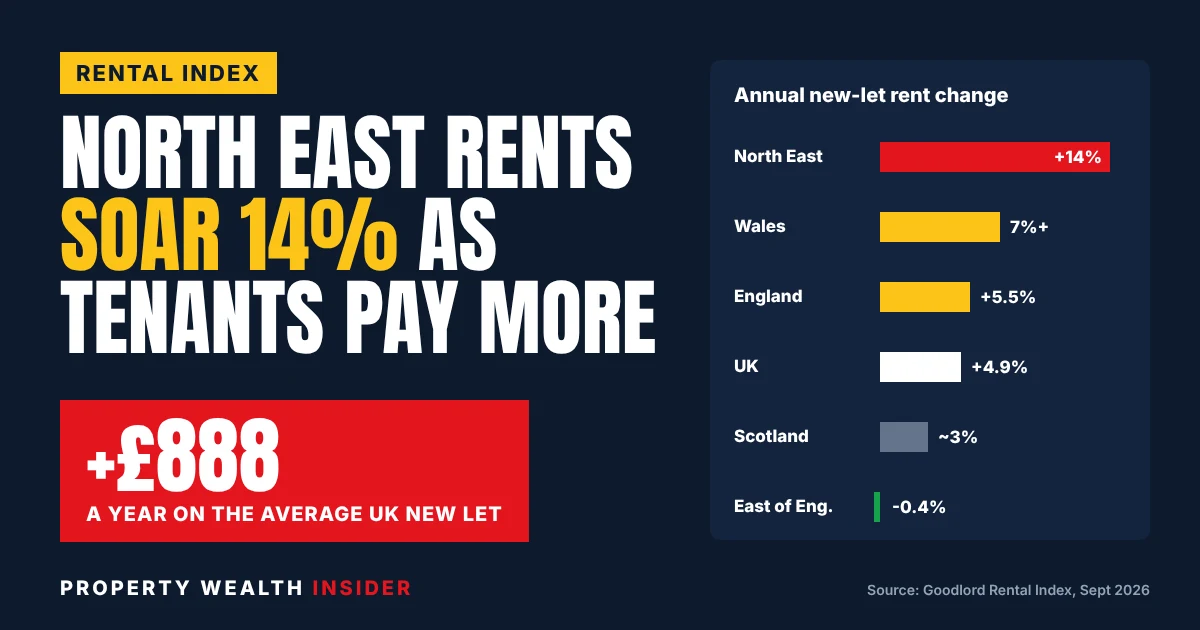
Tenants signing up to a new let in the UK are now paying an average of £1,581 a month, according to Goodlord’s Rental Index for September 2026, published on 1 October. That is 4.9% more than a year ago, or £888 extra a year on the average home.
The bigger story for landlords is regional. New-let rents in the North East jumped 14% to £1,000 a month, while the East of England went slightly backwards. Official ONS figures covering every tenancy show the same north-south split, just in a gentler form.
If you own buy-to-lets, these numbers help you price a re-let, set a fair rent increase under the new rules in England, and check whether your yield is keeping up with your local market. Scroll down to put your own figures into our regional rent and yield checker.
Key facts
- Goodlord average UK new-let rent: £1,581 a month in September 2026, up 4.9% from £1,507 (£888 a year more).
- North East new-let rents up 14% in a year, from £878 to £1,000 a month, and up 5.6% in September alone.
- East of England was the only region where Goodlord recorded a fall: -0.4% year on year.
- ONS (all tenancies): UK average rent £1,400, up 3.8% in the 12 months to August 2026. North East and North West top the table at 5.8%.
- In England, rent can be raised only once a year using Form 4A with at least 2 months’ notice, under rules in force since 1 May 2026.
The headline numbers
Goodlord’s index puts the average UK new-let rent at £1,581 in September 2026, up from £1,507 in September 2025. That is £74 a month more, which works out at £888 a year for a tenant.
Rents also rose 0.9% between August and September. Every region Goodlord tracks rose month on month except Yorkshire and the Humber, which dipped 0.2%. The North East (+5.6%) and North West (+3%) saw the biggest monthly rises.
By nation, Wales rose the most at over 7%. England was up 5.5% and Scotland just under 3%. Goodlord also says East Midlands growth has now slowed for two years in a row. Average void periods fell to 20 days, from 21 in August. They were shortest in the North East (11 days) and longest in Yorkshire and the Humber (29 days).
Worked out from Goodlord’s own regional figures, the North East’s rise from £878 to £1,000 a month is £122 a month, or £1,464 a year, for a tenant moving into an average new let. Goodlord says it switched to a new methodology this month, so be careful comparing these figures with its older reports.
Goodlord vs ONS: why the figures differ
Goodlord’s index comes from tenancy data supplied by more than 3,000 letting agencies that use its platform. In practice, it tracks what new and recently agreed lets are achieving. That is the live market price.
The ONS Price Index of Private Rents measures rents across the whole privately rented stock, including sitting tenants whose rent may not have changed for a year or more. That is why it moves more slowly and sits lower. In Northern Ireland, and historically in Scotland, the ONS figures rely mainly on advertised new lets.
| Area | Goodlord: new lets, year to Sept 2026 | ONS: all tenancies, year to Aug 2026 |
|---|---|---|
| UK | +4.9% (£1,581) | +3.8% (£1,400) |
| England | +5.5% | +4.0% (£1,459) |
| Wales | over +7% | +4.3% (£846) |
| Scotland | just under +3% | +1.1% (£1,013) |
| North East | +14% (£1,000) | +5.8% (£788) |
| East of England | -0.4% | +3.5% (£1,289) |
What this means for you: the Goodlord figure is closer to what a new tenant will pay when you re-let. The ONS figure is the better benchmark for the rent an existing tenant is paying. When the new-let figure is well ahead of the ONS figure, as it is in the North East, your sitting tenants are probably paying below today’s market rate.
Region by region: rents and yields
Official ONS data shows rents rising fastest in the north and slowest in the South East and Scotland. Pair those rents with HM Land Registry’s average house prices and you get a rough benchmark gross yield for each region.
| Region / nation | Average rent (Aug 2026) | Annual change | Extra per year vs Aug 2025 | Average house price (Jul 2026) | Benchmark gross yield |
|---|---|---|---|---|---|
| North East | £788 | +5.8% | £516 | £166,943 | 5.7% |
| North West | £969 | +5.8% | £636 | £221,445 | 5.3% |
| Yorkshire and The Humber | £865 | +4.9% | £480 | £209,116 | 5.0% |
| West Midlands | £982 | +4.9% | £564 | £250,880 | 4.7% |
| South West | £1,245 | +4.4% | £636 | £302,298 | 4.9% |
| East Midlands | £922 | +3.7% | £396 | £242,274 | 4.6% |
| East of England | £1,289 | +3.5% | £528 | £337,518 | 4.6% |
| London | £2,332 | +3.5% | £948 | £550,037 | 5.1% |
| South East | £1,426 | +3.0% | £504 | £380,878 | 4.5% |
| Wales | £846 | +4.3% | £420 | £215,037 | 4.7% |
| Scotland | £1,013 | +1.1% | £132 | £196,349 | 6.2% |
Rents and annual change are from the ONS. The £ per year column is our calculation from the ONS monthly averages for August 2025 and August 2026. House prices are from the UK House Price Index for July 2026. The benchmark yield is annual average rent divided by average sale price. It is a rough guide only, because the typical rented home is not the same as the typical home sold.
The pattern is clear. Cheaper northern markets are getting the fastest rent growth on top of the highest benchmark yields. In the South East and East of England, rent growth is slower and yields are thinner.
Worked example, North East: you let a house for £750 a month and it is worth £150,000, a 6.0% gross yield. If your rent rose by the region’s 5.8%, it would be £793.50, an extra £522 a year, and your gross yield would rise to 6.3%. Goodlord’s £1,000 new-let average suggests there may be more room on a re-let, but check comparable properties first.
Worked example, South East: £1,400 a month on a £375,000 flat is a 4.5% gross yield. A 3.0% rise takes it to £1,442, which is £504 a year more and lifts the yield to only 4.6%. Here, cutting costs and voids will probably do more for your returns than the rent.
Worked example, East of England: the ONS shows rents across all tenancies up 3.5%, but Goodlord shows new-let rents slightly down. If you re-let this winter, do not assume the next tenant will pay more than the last one. Price the property against what similar homes have actually let for.
Check your rent and yield against your region
Pick your region, enter your current rent and what the property is worth. The checker compares you with the official ONS regional average and shows your rent and yield if your rent rose in line with the regional rate.
Regional rent and yield checker
Guide only, not advice. Average rents and annual growth: ONS Price Index of Private Rents, August 2026 (Northern Ireland June 2026). Benchmark yield uses UK House Price Index average prices for July 2026 (Northern Ireland Q2 2026). In England, any increase must not exceed open market rent for your property and must follow the Form 4A process.
Is falling migration cooling rents?
Goodlord chief executive William Reeve said the overall pace of rent growth appears to be slowing in some regions. He linked part of that to the sharp drop in net migration, which he said is likely to be easing some of the imbalance between supply and demand.
The official numbers back up the scale of that drop. The ONS estimates long-term net migration was 171,000 in the year ending December 2025, nearly half the 331,000 recorded a year earlier and far below the 944,000 peak in the year to March 2023. The next update, covering the year to June 2026, is due on 26 November 2026.
Rents are still rising faster than inflation, so demand has not fallen away. But fewer new arrivals means less pressure on rented homes in cities, which is where landlords should expect any slowdown to show first. The ONS shows London’s annual rise at 3.5%, below the England average.
Reviewing your rent this autumn
In England, the rules changed on 1 May 2026 under the Renters’ Rights Act. Government guidance says you can increase rent only once a year, not in the first year of a tenancy, and only by serving Form 4A at least two months before the new rent starts. Rent review clauses in tenancy agreements can no longer be used to put the rent up.
Tenants who think a proposed rent is above open market rent can ask the First-tier Tribunal to decide. The government’s guide to the Act says tenants will never pay more than you asked for, the new rent will not be backdated, and the tribunal can defer an increase by up to two more months in cases of undue hardship. Wales, Scotland and Northern Ireland have their own rules, so check the rules for your nation.
Step by step, for a landlord in England:
- Check the date. Find when the tenancy started and when the rent last changed. You cannot serve for a new rent that starts less than a year after the last increase took effect.
- Get evidence. Collect 3 to 5 comparable lets of the same size, type and condition nearby, using achieved rents where your agent has them. Regional averages such as the ONS figures are useful context, but they are not proof of what your property is worth.
- Set a defensible figure. Stay at or below what the evidence supports. A tribunal decides the open market rent, so an inflated figure could go against you.
- Talk first. The guidance encourages you to discuss the increase with your tenant before serving notice. Keeping a good tenant usually beats a void: Goodlord’s average void was 20 days.
- Serve Form 4A properly. Use the current form, give at least two months’ notice, and keep proof of service. Email counts only if the tenancy agreement allows it.
- Update your numbers. Re-run your yield, mortgage stress test and tax estimate at the new rent.
- Tenancy start date and last rent increase date noted
- At least 12 months since the last increase took effect (England)
- 3 to 5 local comparables saved, with dates and sources
- Rent compared with ONS regional average and growth rate
- Proposed rent at or below open market rent
- Conversation with tenant before serving notice
- Current Form 4A completed with at least 2 months’ notice
- Proof of service kept (post, hand delivery or email if the agreement allows it)
- Gross yield and mortgage affordability recalculated at the new rent
- Different rules checked if the property is in Wales, Scotland or Northern Ireland
FAQs
How much have UK rents gone up in 2026?
It depends which measure you use. Goodlord’s new-let index shows a 4.9% rise to £1,581 a month in the year to September 2026. The ONS, which covers all tenancies, shows a 3.8% rise to £1,400 in the year to August 2026.
Which region has the highest rent increases?
The North East. Goodlord recorded a 14% annual rise in new-let rents there, and the ONS puts the North East joint top of the English regions with the North West, both at 5.8%.
Why are Goodlord’s rent figures higher than the ONS?
Goodlord tracks lets processed by letting agents, which reflect current market prices. The ONS index covers the whole rented stock, including sitting tenants whose rents change less often, so it rises more slowly and averages lower.
How often can a landlord increase rent in England?
Once a year, using Form 4A with at least two months’ notice, under rules in force since 1 May 2026. You cannot raise the rent in the first year of a tenancy, and the tenant can challenge an increase above open market rent at the First-tier Tribunal.
What is a good rental yield in the North East?
Using ONS average rent (£788) and the Land Registry average price (£166,943), the regional benchmark gross yield is about 5.7%, the highest of any English region. Use the checker above to compare your own property.
Is falling net migration bringing rents down?
Not yet. Rents are still rising, but Goodlord’s chief executive links slower growth to lower net migration, which the ONS estimates fell to 171,000 in the year to December 2025.
Sources
- Goodlord Rental Index, September 2026 (published 1 October 2026)
- Goodlord Rental Index: about the data
- ONS: Private rent and house prices, UK: September 2026
- UK House Price Index summary: July 2026
- ONS: Long-term international migration, provisional, year ending December 2025
- GOV.UK: Assured periodic tenancies, a guide for landlords: rent increases
- GOV.UK: Assured tenancy forms from 1 May 2026 (Form 4A)
- GOV.UK: Guide to the Renters’ Rights Act
This article is news and general guidance only, not financial, legal or tax advice.