Scottish landlords: 10-day mould deadline and 36x rent payouts
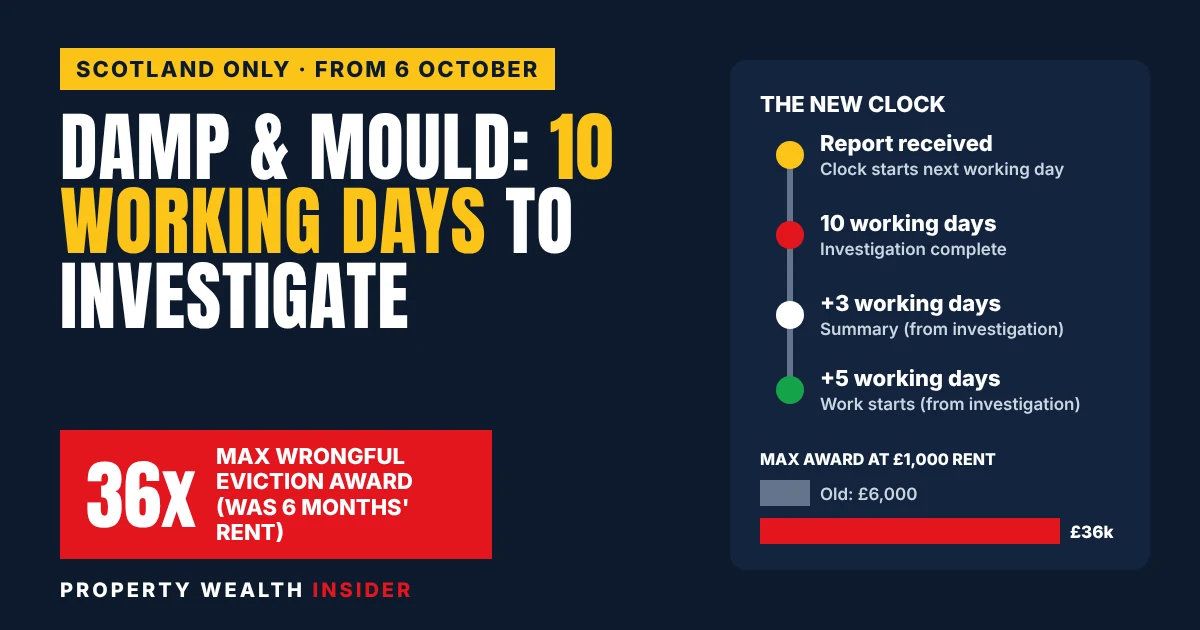
Private landlords in Scotland are now on the clock. From today, Tuesday 6 October 2026, a report of damp or mould triggers a legal countdown: a competent person must complete an investigation within 10 working days, the tenant must get a written summary within three working days after that, and any safety work needed must start within five working days of the investigation ending.
The same date brings a big jump in what a tribunal can order a landlord to pay for a wrongful eviction, and a shorter qualifying period for family members and carers to take over a tenancy when the tenant dies.
These rules apply in Scotland only. They come from the Investigation and Commencement of Repair (Scotland) Regulations 2026 and the Housing (Scotland) Act 2025. Landlords in England, Wales and Northern Ireland are not covered by them.
Key facts
- Damp or mould reports must be investigated by a competent person within 10 working days, starting the day after you are told or become aware.
- The tenant must receive a written summary within 3 working days of the investigation finishing.
- Any required safety work must start within 5 working days of the investigation finishing; “substantially free from damp and mould” is now part of the repairing standard.
- Wrongful termination orders rise from a cap of 6 months’ rent to 3 to 36 times the “relevant sum”: one month’s rent, or £840 if higher.
- The new awards apply where the tenancy ends on or after 6 October 2026.
- Succession qualifying periods for unmarried partners, family members and carers fall from 12 months to 6 where the tenant dies on or after 6 October 2026.
What changes from 6 October 2026
Three separate changes start on the same day. The damp and mould duties come from new regulations that amend the Housing (Scotland) Act 2006. The wrongful termination and succession changes come from sections 34 and 48 of the Housing (Scotland) Act 2025, switched on by the Commencement No. 3 Regulations.
| Area | Before 6 October 2026 | From 6 October 2026 | Legal source |
|---|---|---|---|
| Damp and mould | General duty to complete repairs within a reasonable time | Investigate within 10 working days; written summary within 3; start safety work within 5 | 2006 Act s.14(5)-(11), inserted by SSI 2026/173 |
| Repairing standard | No specific damp and mould item | House must be “substantially free from damp and mould” | 2006 Act s.13(1)(ha) |
| Wrongful termination order | Up to 6 months’ rent | 3 to 36 times the relevant sum (rent or £840, whichever is higher) | 2016 Act s.59, amended by 2025 Act s.34 |
| Succession qualifying period | 12 months | 6 months | 2016 Act ss.67-69, amended by 2025 Act s.48 |
The new damp and mould deadlines
The trigger is simple: the tenant tells you, or you otherwise become aware, that the home “is or may be” affected by damp or mould. That includes something your letting agent or contractor spots on a routine visit.
You must then make sure a competent person completes an investigation within 10 working days, starting with the day after you were notified. The investigation must decide whether the home is substantially free from damp and mould and, if not, what “relevant safety work” is needed.
A competent person is someone who, in your reasonable opinion, has the skills and experience to make that call. The Scottish Government’s landlord guidance says investigations should be done in person unless an alternative is justified.
Working days exclude Saturdays, Sundays and Scottish bank holidays. The law sets no fixed deadline for finishing the work: the existing rule that repairs must be completed within a reasonable time still applies, and the guidance says “as soon as reasonably practicable”.
Bank holidays push the dates back. A report received on Monday 23 November 2026 skips St Andrew’s Day (Monday 30 November), so the investigation deadline is Tuesday 8 December 2026. A report on Friday 18 December 2026 runs through Christmas and New Year, giving an investigation deadline of Thursday 7 January 2027.
Damp and mould deadline calculator (Scotland)
Guide only, not legal advice. Counts working days excluding weekends and Scottish bank holidays published on gov.uk up to the end of 2028. Local holidays are not excluded. If circumstances beyond your control cause a delay, you must notify the tenant in writing (see below).
Step by step: when a tenant reports damp
- Log it the same day. Record the date and how you heard (text, email, agent, inspection). Day one of the 10 working days is the next working day.
- Book a competent person. A damp specialist, surveyor or experienced maintenance contractor. Note why you consider them competent.
- Arrange access early. Confirm the visit with the tenant in writing so you have a record if access is refused or delayed.
- If you cannot meet a deadline, say so in writing. Where circumstances beyond your control stop you completing the investigation or starting work in time, you must tell the tenant you cannot comply, why, and when you expect to. Until then, take reasonable practicable steps to reduce the damp or mould, such as a dehumidifier.
- Get a clear finding. The investigation must state whether the home is substantially free from damp and mould and, if not, what safety work is needed and the likely cause.
- Send the written summary within 3 working days. The guidance says it should name who investigated, summarise findings, confirm whether the home is substantially free from damp and mould, and give a target start date for any work (or reasons if none is needed).
- Start the work within 5 working days of the investigation finishing, then finish it within a reasonable time. The aim is that the home stays substantially free from damp and mould so far as reasonably practicable.
- Keep the file. Photos, reports, invoices and messages. A tribunal deciding a repairing standard case must now consider whether you met these deadlines.
What happens if you miss them? Tenants can apply to the First-tier Tribunal for Scotland (Housing and Property Chamber). It can issue a Repairing Standard Enforcement Order, and the Scottish Government’s guidance notes that failing to comply with one without reasonable excuse is a criminal offence. The tribunal can also make a rent relief order restricting the rent until the work is done.
Wrongful termination: awards up to 36 times the relevant sum
A former tenant can ask the tribunal for a wrongful termination order if they were evicted, or left after a notice to leave, on the basis of a ground that turned out not to apply. A common example is a landlord who says they are selling or moving in, then re-lets.
Until now the maximum award was six months’ rent. Under the amended section 59 of the Private Housing (Tenancies) (Scotland) Act 2016, the tribunal must set an award of between 3 and 36 times the “relevant sum”, taking into account how the termination happened and its impact on the tenant. It can go below the 3x floor if it thinks that is appropriate in all the circumstances.
The relevant sum is one month’s rent under the tenancy, or £840 if that is higher. The new rules apply where the tenancy was brought to an end by an eviction order, or by the tenant leaving after a notice to leave, on or after 6 October 2026.
Worked example 1: rent £700 a month. The old maximum was 6 x £700 = £4,200. Because £840 is higher than the rent, the relevant sum is £840: the new range is £2,520 to £30,240.
Worked example 2: rent £1,200 a month. The old maximum was £7,200. The new range is £3,600 to £43,200, six times the old ceiling.
Wrongful termination award estimator (Scotland)
Guide only, not legal advice. The tribunal decides the amount within the range based on how the tenancy was ended and its impact, and can award less than 3x. Applies to tenancies ended on or after 6 October 2026. Joint landlords and joint tenants can change the calculation.
The message is blunt: if you serve a notice to leave on a ground such as selling, moving in or refurbishment, keep the evidence that the intention was genuine, and think hard before changing plans and re-letting.
Succession: six months instead of 12
When the sole tenant of a private residential tenancy dies, certain people can inherit the tenancy. Where the tenant dies on or after 6 October 2026, the minimum continuous period of living in the property falls from 12 months to six for:
- a partner who was not married to or in a civil partnership with the tenant (spouses and civil partners had no minimum period);
- another family member aged 16 or over who lived there as their only or principal home;
- a resident carer aged 16 or over who gave up a previous home.
The time generally only counts from when the tenant told the landlord in writing that the person was living there. Keep any such notifications on file; they may decide who becomes your tenant.
How this compares with England
In England, Awaab’s Law applies to social landlords only so far. Phase 1 came into force on 27 October 2025, covering emergency hazards and significant damp and mould, with phase 2 extending to a wider range of hazards due on 30 November 2026, according to gov.uk.
For private landlords in England, the government has committed to extending Awaab’s Law through the Renters’ Rights Act 2025, but its implementation roadmap lists the start date as “TBC – subject to consultation”. Scotland’s private landlords are therefore under fixed damp and mould deadlines before England’s.
Your compliance checklist
- Tell tenants how to report damp and mould, and check that every channel (email, phone, agent portal) is monitored.
- Set up a log that records the date each report arrives or each issue is spotted.
- Line up at least one competent damp investigator and a back-up, with agreed response times.
- Prepare a written summary template: who investigated, findings, whether the home is substantially free from damp and mould, work needed and target start date.
- Prepare a “delay notice” template giving the reason and a revised timescale.
- Check your agent’s terms cover the 10/3/5 working-day deadlines.
- Add Scottish bank holidays to your diary so deadlines are counted correctly.
- Before serving any notice to leave, file evidence that the ground is genuine.
- Keep written notices from tenants about who lives in the property, for succession purposes.
FAQ
Does Awaab’s Law apply to private landlords in Scotland?
Yes. From 6 October 2026, private landlords whose properties are covered by the repairing standard must meet the damp and mould investigation and repair start deadlines. Social landlords in Scotland have parallel duties under the right to repair rules.
How long does a Scottish landlord have to fix damp and mould?
The investigation must be completed within 10 working days and any safety work must start within 5 working days of that. The work must then be completed within a reasonable time; there is no fixed completion deadline for private landlords.
Do weekends and bank holidays count?
No. A working day excludes Saturdays, Sundays and Scottish bank holidays, and the count starts the day after you are notified or become aware.
What is the “relevant sum” for a wrongful termination order?
One month’s rent under the tenancy, or £840 if that is higher. The tribunal normally awards between 3 and 36 times that figure, but can go lower. Where there were joint tenants, the section still defines rent by dividing it between them, so take advice on joint tenancies.
Does the higher award apply to tenants who left before 6 October 2026?
No. It applies where the tenancy was ended by an eviction order, or by the tenant leaving after a notice to leave, on or after 6 October 2026. Earlier cases stay under the old cap of six months’ rent.
Do these rules apply in England or Wales?
No. These are Scottish rules. England’s Awaab’s Law currently covers social housing, and its start date for private landlords is still subject to consultation.
- The Investigation and Commencement of Repair (Scotland) Regulations 2026 (SSI 2026/173)
- The Housing (Scotland) Act 2025 (Commencement No. 3) Regulations 2026 (SSI 2026/115)
- Housing (Scotland) Act 2025, sections 34 and 48
- Private Housing (Tenancies) (Scotland) Act 2016, section 59
- Housing (Scotland) Act 2006, section 14
- Scottish Government: Awaab’s Law guidance for landlords in Scotland
- gov.uk: UK bank holidays (Scotland)
- gov.uk: Awaab’s Law in the social rented sector
- gov.uk: Renters’ Rights Act 2025 implementation roadmap
This article is news and general guidance only, not financial, legal or tax advice.