Landlords face 40% IHT hit as £325k allowance frozen to 2031
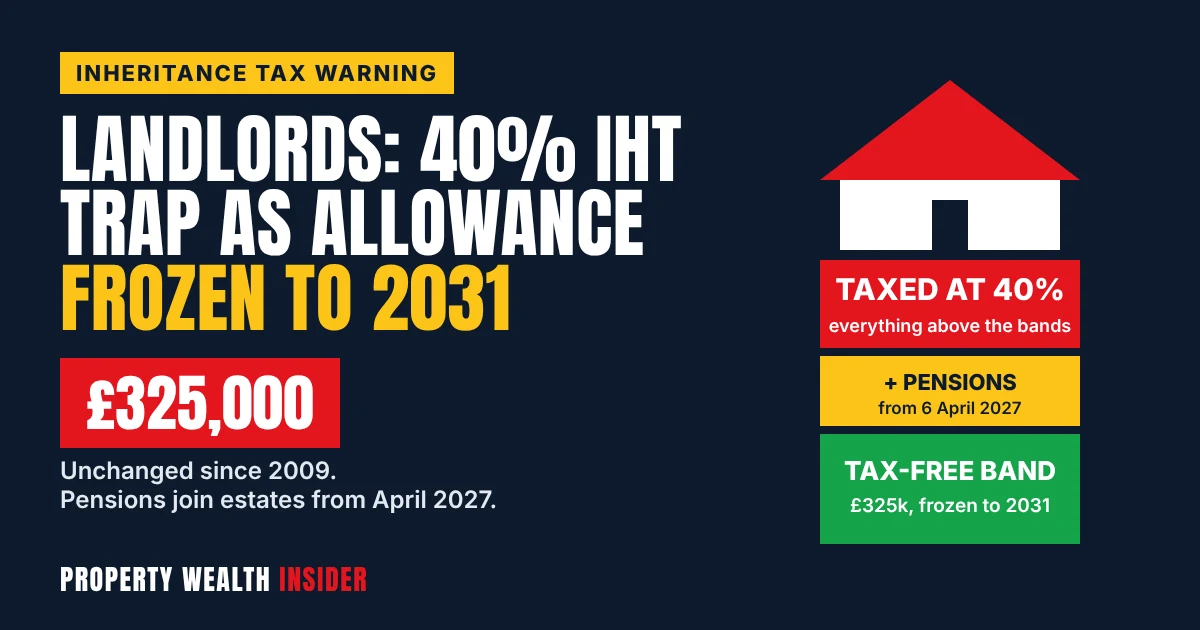
Landlords are being told to check what their estate could owe in inheritance tax, and the warning is well founded. The tax-free nil-rate band has been stuck at £325,000 since April 2009, the government has now written a freeze into law until 5 April 2031, and from 6 April 2027 most unused pension pots will be pulled into the IHT net for the first time.
For a landlord, that is a nasty combination. Rental property tends to rise in value over decades, buy-to-let homes do not get the extra residence allowance, and a pension that used to pass outside the estate will soon be taxed at 40% on top.
Inheritance tax applies across the whole UK, so this affects landlords in England, Wales, Scotland and Northern Ireland alike. Below we explain exactly how the bill is worked out, run the numbers on three typical landlord estates, and give you an estimator to test your own.
Key facts
- The IHT nil-rate band is £325,000 and has been since 6 April 2009. It is now frozen until 5 April 2031 (Finance Act 2026, section 72).
- Anything above your allowances is taxed at 40% (or 36% if at least 10% of the net estate goes to charity).
- The extra residence nil-rate band of £175,000 only covers a home you lived in, left to children or grandchildren, and it shrinks by £1 for every £2 the estate is worth above £2 million.
- From 6 April 2027, most unused pension funds and death benefits count as part of your estate. HMRC estimates 38,500 estates will pay more and 10,500 will pay IHT for the first time.
- HMRC collected £8.47bn in inheritance tax in 2025-26, up from £2.38bn in 2009-10.
What is changing, and what is not
Two things have moved from “announced” to “law” this year. Both were in the Finance Act 2026.
- The freeze is extended to 2030-31. The nil-rate band (£325,000), the residence nil-rate band (£175,000) and the £2 million taper threshold stay where they are until 5 April 2031. HMRC’s policy paper of 26 November 2025 confirms it, and section 72 of the Act puts it into law. In force now.
- Pensions join the estate. For deaths on or after 6 April 2027, most unused pension funds and pension death benefits will be counted in the estate (sections 66 to 71). Legislated, but it does not bite until April 2027.
What has not changed: the 40% rate, the 7-year rule on gifts, the spouse and civil partner exemption, and the ability to pass unused allowances to a surviving spouse. Ideas you may see floated online, such as replacing IHT with a different levy, are speculation. None of them has been announced by the government.
How inheritance tax hits a landlord’s estate
IHT is charged on the net value of everything you own when you die (property, cash, investments and, from April 2027, most pensions) after deducting debts such as buy-to-let mortgages. Only the slice above your allowances is taxed.
| Allowance or rule | Amount | What it means for landlords |
|---|---|---|
| Nil-rate band | £325,000 | Everyone gets it. Frozen until 5 April 2031. |
| Residence nil-rate band | Up to £175,000 | Only for a home you lived in at some point, left to direct descendants. A buy-to-let you never lived in does not count. |
| Taper threshold | £2,000,000 | The residence band falls by £1 for every £2 the estate is worth above this, so it disappears entirely at £2.35m for a single person. |
| Transfer from late spouse or civil partner | Up to double both bands | Unused allowances pass to the survivor, giving up to £650,000 plus up to £350,000. |
| Rate above the allowances | 40% | 36% if at least 10% of the net estate goes to charity. |
| Business relief | Not usually available | A business that mainly deals in land or buildings, or holding investments, does not qualify. |
The residence rule is the one that catches landlords out. HMRC’s manual defines a residence as a dwelling “owned, or had owned, and occupied at some stage as their home while they owned it”. A portfolio of flats that you only ever let out gets the basic £325,000 and nothing more.
The taper also hits landlords hard because portfolios push estates over £2 million quickly. HMRC measures the taper on the estate “after liabilities, but before taking into account any exemptions or reliefs”, so mortgages help but reliefs do not.
On business relief: since 6 April 2026, 100% relief on qualifying business and agricultural property is capped at £2.5 million, with 50% relief above that. But gov.uk is clear that a business which “mainly deals with… land or buildings, or in making or holding investments” does not qualify, which rules out an ordinary letting portfolio.
Worked examples: three landlord estates
These use the current rules and allowances. They are simplified and ignore funeral costs, lifetime gifts and reliefs.
| A: Widowed landlord | B: Single, no children | C: Surviving spouse, big portfolio | |
|---|---|---|---|
| Main home | £500,000 (to children) | £400,000 (to nephew) | £800,000 (to children) |
| Buy-to-lets | £600,000 | £1,200,000 | £2,000,000 |
| BTL mortgages | -£250,000 | -£500,000 | -£600,000 |
| Savings and other assets | £150,000 | £100,000 | £200,000 |
| Net estate | £1,000,000 | £1,200,000 | £2,400,000 |
| Nil-rate band | £650,000 (inc. late spouse’s) | £325,000 | £650,000 (inc. late spouse’s) |
| Residence band | £350,000 | £0 (nephew is not a direct descendant) | £150,000 (£350,000 tapered by £200,000) |
| IHT bill | £0 | £350,000 | £640,000 |
| Effective rate | 0% | 29.2% | 26.7% |
Landlord A sits exactly on the £1,000,000 combined allowance, so owes nothing today. But give her a £200,000 pension and let her die after 6 April 2027: the estate becomes £1,200,000 and the bill jumps from £0 to £80,000.
Landlord B shows the cost of having no direct descendants. Leaving the home to a nephew means no residence band, so £875,000 is taxed at 40%.
Landlord C is £400,000 over the taper threshold, so £200,000 of the £350,000 residence band is lost. Every extra £1 of value between £2m and the point where the band runs out effectively costs 60p in tax.
Landlord inheritance tax estimator
Plug in today’s values. Use current market values (not what you paid) and the outstanding mortgage balances.
Landlord inheritance tax estimator
Guide only, not tax advice. Uses the 2026-27 allowances (£325,000 nil-rate band, £175,000 residence band, £2m taper, 40% rate), which are frozen until 5 April 2031. Assumes nothing goes to a spouse or charity on this death, no lifetime gifts in the last 7 years and no reliefs. Spouse option assumes 100% of both allowances transfer. We count the pension towards the £2m taper test once it is part of the estate. Ignores funeral costs and income tax on inherited pensions. Take advice before acting.
With the defaults (three rentals worth £750,000 with £300,000 of mortgages, a £450,000 home, £100,000 of savings and a £250,000 pension, single), the estimate is £300,000 of IHT, of which £100,000 comes from the pension once the April 2027 rule applies.
The April 2027 pension change
Until now, many landlords have treated a self-invested pension as the “last thing to spend” because it usually sat outside the estate. That changes for deaths on or after 6 April 2027, under section 71 of the Finance Act 2026.
- What is in: most unused pension funds and pension death benefits.
- What is out: death-in-service benefits from a registered pension scheme, and dependants’ scheme pensions from defined benefit or collective money purchase arrangements.
- Spouse exemption still applies: a pension left to a spouse or civil partner remains exempt.
- Who pays: personal representatives are responsible for reporting and paying the IHT. Beneficiaries can ask the scheme to pay it directly where the bill is at least £1,000.
HMRC’s own impact assessment says that of around 213,000 estates with inheritable pension wealth in 2027-28, 10,500 will pay IHT for the first time and 38,500 will pay more, by around £34,000 on average. The Treasury expects it to raise £1,665m a year by 2030-31.
There is a knock-on effect for bigger estates. HMRC measures the £2m taper on the estate after debts, and pensions will now count as part of the estate. So a large pension could tip an estate over £2m and start eroding the residence band as well.
Why the Treasury is happy: record receipts
A frozen allowance plus rising asset values means more estates paying, every year. HMRC took £8.47bn in inheritance tax in 2025-26, a record, and £3.78bn in the first five months of 2026-27 (April to August), slightly ahead of the £3.72bn in the same months of 2025.
Receipts have more than tripled since 2009-10 while the allowance has not moved a penny. With the freeze locked in until April 2031 and pensions joining in 2027, the trend only points one way.
What to do now: step by step
1. Get realistic valuations. Your executors will need market values at the date of death. A rough desktop valuation of each property today, minus the mortgage balance, tells you whether you have a problem at all.
2. Write or update your will. The residence band only works if your home goes to children, stepchildren, grandchildren or their spouses. Siblings, nephews and nieces do not count. A will that leaves everything to a spouse uses the exemption and preserves both allowances for the second death.
3. Think about gifting, but understand the 7-year clock. Gifts are free of IHT if you survive 7 years. Die sooner and the gift is added back against your £325,000 band first.
Worked example: you give your son a £200,000 buy-to-let and die four years later, leaving a £900,000 estate including a home left to your children. The gift uses £200,000 of your nil-rate band, leaving £125,000. The estate pays 40% on £600,000 = £240,000, exactly what it would have paid had you kept the flat. Survive the full 7 years and the bill falls to £160,000, saving £80,000.
Taper relief (32% down to 8%) only helps where total gifts in the 7 years before death exceed £325,000. And it only reduces tax on the gift itself.
4. Watch the capital gains tax trap. Giving a property away counts as a disposal for CGT, valued at market value on the date of the gift, even though no money changes hands. HMRC’s 60-day deadline to report and pay CGT on UK property may apply, so get figures before you sign anything. Gifts to a spouse or civil partner are generally CGT-free.
5. Do not keep the benefit. If you give a property away but keep living in it or keep the rent, HMRC can treat it as still yours (a “gift with reservation of benefit”).
6. Review your pension before April 2027. Check who your nominated beneficiaries are, and model the bill with the pension included. Get regulated advice before drawing down large sums, because withdrawals have their own income tax cost.
7. Plan how the bill will be paid. IHT is due by the end of the sixth month after death. Tax on land and buildings can be paid in 10 equal annual instalments, but the balance becomes due in full when the property is sold, and interest runs on later instalments.
- Value every rental property and note each outstanding mortgage
- List savings, investments and other debts
- Get pension fund values and check beneficiary nominations
- Check if a late spouse’s nil-rate and residence bands are available to transfer
- Confirm who inherits your main home (direct descendants or not)
- Check if your estate is near or over the £2m taper threshold
- Make or update a will
- Record any gifts made in the last 7 years, with dates and values
- Get CGT figures before gifting any property
- Book advice from a solicitor or tax adviser before 6 April 2027
FAQ
Do buy-to-let properties qualify for the residence nil-rate band?
No, unless you lived in the property as your home at some point while you owned it. A property you have only ever let out gets the standard £325,000 nil-rate band and nothing extra.
Are buy-to-let mortgages deducted for inheritance tax?
Yes. IHT is charged on the net value of the estate after debts, so outstanding mortgage balances reduce the taxable value. They also count when testing the £2m taper threshold.
How long is the inheritance tax threshold frozen?
The £325,000 nil-rate band, £175,000 residence band and £2m taper threshold are frozen until 5 April 2031. The nil-rate band has been £325,000 since 6 April 2009.
Will my pension be subject to inheritance tax?
For deaths on or after 6 April 2027, most unused pension funds and death benefits will be included in the estate. Death-in-service benefits and dependants’ scheme pensions are excluded, and anything left to a spouse or civil partner stays exempt.
Can I give my rental property to my children to avoid inheritance tax?
You can, and it falls out of your estate if you survive 7 years and do not keep the rent or use of it. But the gift is a disposal for capital gains tax at market value, so there may be a CGT bill now. Take advice first.
Does inheritance tax apply to landlords in Scotland?
Yes. Inheritance tax is a UK-wide tax run by HMRC, with the same allowances and rates in Scotland, England, Wales and Northern Ireland. Succession law differs in Scotland, so get a Scottish solicitor to draft your will.
Sources
- GOV.UK: Inheritance Tax (thresholds, rates, spouse and charity rules)
- HMRC policy paper: Inheritance Tax thresholds (26 November 2025)
- HMRC: Inheritance Tax thresholds and interest rates
- Finance Act 2026 (sections 65 to 72)
- HMRC policy paper: Inheritance Tax on unused pension funds and death benefits
- HMRC: Technical note 2, Inheritance Tax and pensions
- GOV.UK: Inheritance Tax residence nil rate band
- HMRC Inheritance Tax Manual IHTM46031: meaning of residence
- HMRC Inheritance Tax Manual IHTM46023: the taper threshold
- GOV.UK: Inheritance Tax on gifts and taper relief
- GOV.UK: What qualifies for Business Relief
- GOV.UK: Capital Gains Tax, market value for gifts
- GOV.UK: Tax when you sell property (60-day reporting)
- GOV.UK: Paying Inheritance Tax in yearly instalments
- HMRC: Tax receipts and National Insurance contributions for the UK
This article is news and general guidance only. It is not financial, legal or tax advice.