27% of landlords heading for the exit: should you sell or stay?
More than a quarter of landlords in England say they are already on their way out of the rental market, five months after the Renters’ Rights Act scrapped section 21 and rewrote the rules on tenancies.
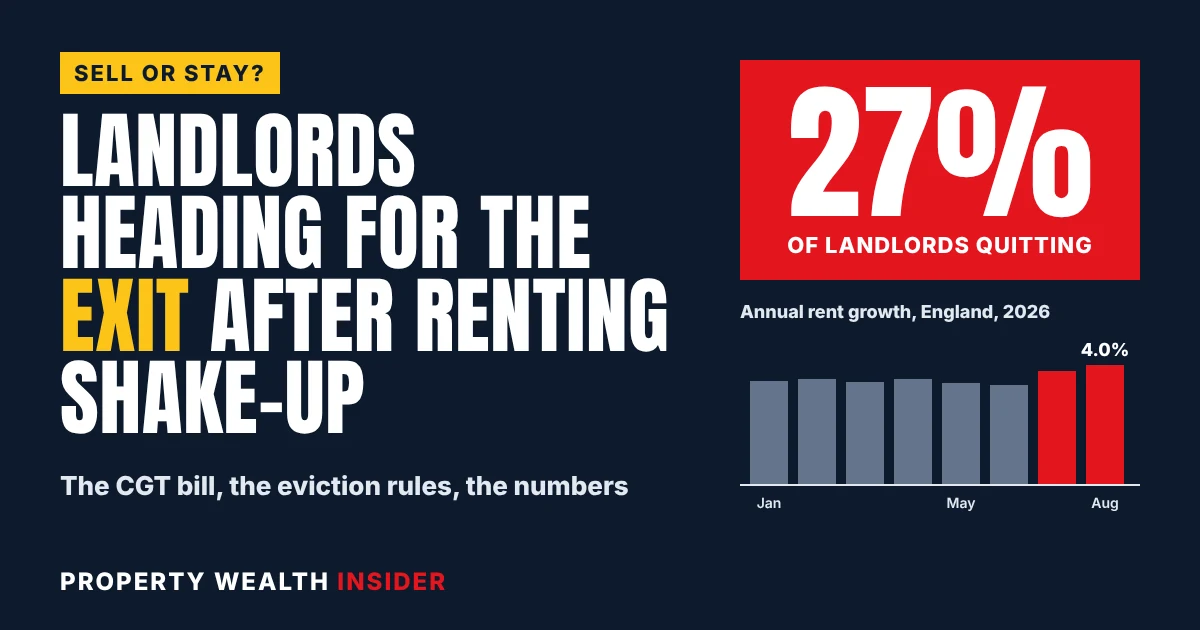
New research from flatshare site SpareRoom, based on a September 2026 survey of 668 landlords, found 27% are leaving altogether and 36% are cutting back. Among landlords with just one property, the exit figure jumps to 44%.
If you are one of the landlords weighing it up, the headline numbers matter less than your own. Below we set out what changed, what selling would cost you in Capital Gains Tax, how to get a property back if you sell with vacant possession, and a calculator that puts selling now side by side with holding on.
Key facts
- 78% of landlords in England have no confidence in the post-Renters’ Rights Act market, according to SpareRoom (668 landlords surveyed, September 2026).
- 27% are leaving the market altogether, rising to 44% of single-property landlords. 36% are reducing portfolios and fewer than 4% are expanding.
- The main tenancy reforms took effect in England on 1 May 2026. Section 21 can no longer be used.
- Rents are still rising: average private rent in England was £1,459 a month in August 2026, up 4.0% in a year (ONS, provisional).
- Selling a buy-to-let? CGT on residential property is 18% or 24%, the tax-free allowance is £3,000, and you must report and pay within 60 days of completion.
What the landlord survey found
SpareRoom asked 668 landlords whose rental properties are mostly in England how they feel about the market since the Act took effect. A large majority, 78%, said they have no confidence in it.
The split by portfolio size is the telling part. Small landlords are more likely to leave outright, while bigger landlords are trimming rather than quitting.
| Landlord group | No confidence | Leaving the market | Reducing portfolio | Expanding |
|---|---|---|---|---|
| All landlords | 78% | 27% | 36% | Under 4% |
| Single-property landlords | 79% | 44% | 9% | 2% |
| Five or more properties | Not published | 22% | 53% | Not published |
SpareRoom director Matt Hutchinson said it is “still early days” and that landlords are “still reacting to the changed landscape”, with some planning not to re-let once current tenants move on. SpareRoom also reports that room supply has entered negative growth.
Remember what a survey like this measures: intentions and sentiment, not completed sales. It is a strong signal, but it is not proof that a quarter of homes will leave the sector.
What changed on 1 May 2026
The government’s implementation roadmap confirms the core tenancy reforms took effect on 1 May 2026, and they apply to England only. Wales, Scotland and Northern Ireland have their own rules.
- No more section 21. Landlords can no longer use section 21 to seek possession.
- Periodic tenancies. Tenancies now roll on rather than running for fixed terms.
- Rent rises once a year. Increases go through a section 13 notice with at least two months’ notice, and tenants can challenge above-market rises at the First-tier Tribunal.
More is still to come. The landlord database starts rolling out from late 2026, and mandatory ombudsman membership is expected in 2028. The Decent Homes Standard timetable is still subject to consultation.
Rents are rising again, not falling
For landlords who stay, there is a counterweight to the gloom. Official figures show rent growth in England, after cooling steadily from its late-2024 peak, has picked up since the reforms took effect.
The ONS puts average private rent in England at £1,459 a month in August 2026, up 4.0% in a year. Annual growth had slowed to 3.4% in May. Across the UK the average was £1,400, up 3.8%.
House prices are moving much more slowly. The average home in England cost £293,000 in July 2026, up just 1.1% in a year. That gap matters to the sell-or-stay maths: income is growing faster than capital values right now.
Room rents tell the same story. SpareRoom’s own rental index put the average UK room at £761 a month in Q2 2026, with six of the UK’s nine regions hitting record highs.
The CGT bill if you sell
Capital Gains Tax is usually the biggest single cost of getting out, and it applies UK-wide. Here are the current rules from HMRC guidance on gov.uk for the 2026 to 2027 tax year.
| Rule | What it means for a buy-to-let sale |
|---|---|
| Tax-free allowance | £3,000 of gains per person per tax year |
| Basic rate taxpayer | 18% on gains that fit inside your unused basic rate band, 24% on the rest |
| Higher or additional rate taxpayer | 24% on all taxable gains |
| Basic rate band (not Scotland) | Taxable income from £12,571 to £50,270 |
| Costs you can deduct | Estate agent and solicitor fees, improvement works such as an extension |
| Costs you cannot deduct | Normal maintenance such as decorating |
| Deadline | Report and pay within 60 days of completion, or face interest and penalties |
Worked example: higher rate landlord
Sam bought a flat for £200,000 and it is now worth £300,000. Agent and legal fees on the sale come to 2%, or £6,000. The gain is £94,000. Take off the £3,000 allowance and £91,000 is taxable.
At 24%, the CGT bill is £21,840. After clearing a £150,000 interest-only mortgage, Sam walks away with £122,160.
Worked example: basic rate landlord
Priya has the same £91,000 taxable gain but has £20,000 of her basic rate band unused. The first £20,000 is taxed at 18% (£3,600) and the remaining £71,000 at 24% (£17,040).
Her bill is £20,640, only £1,200 less than Sam’s. On a large gain, most of it ends up at 24% whatever your income band.
Joint owners: each owner has their own £3,000 allowance and their own basic rate band, so a property held jointly can carry a noticeably smaller total bill. Get advice before moving ownership around ahead of a sale, as transfers can have their own tax consequences.
Sell or stay calculator
Put in your own numbers. The calculator works out the cash you would keep if you sold today, and compares it with holding for a set number of years, collecting rent, and then selling. Your sell-now cash is assumed to earn a return in the meantime so the comparison is fair.
Sell now or hold on?
Guide only, not financial or tax advice. Uses 2026 to 2027 CGT rates (18% and 24%) and the £3,000 allowance for both sales, and assumes they stay the same. Rent and costs are held flat. Rental profit is taxed at 20% or 40% of rent minus costs, which understates the bill for many mortgaged landlords because of the restriction on mortgage interest relief. Ignores the tax on interest earned on cash. Scottish income tax bands differ.
With the default numbers, holding for five years comes out ahead by around £18,000, mostly thanks to £21,600 of after-tax rent. Cut the rent to £1,000 a month and assume no price growth, and selling now wins by roughly £19,000. Your margin, not the national mood, decides this.
Getting the property back to sell
Most buyers pay more for an empty home, so sellers usually want vacant possession. With section 21 gone, a landlord in England who wants to sell now uses the new sale ground, Ground 1A. The government’s grounds for possession guidance sets the rules.
- Four months’ notice before you can apply to court.
- Not in the first 12 months of a tenancy. You can serve notice early, but it cannot expire before the tenant has been in for 12 months.
- No re-letting for 12 months. If you use the selling ground and the sale falls through, you cannot market or re-let the property for 12 months.
- Heavy penalties for misuse. Civil penalties of up to £7,000 for a first breach and up to £40,000 for serious or repeat breaches, and tenants can claim up to 24 months’ rent back.
- Older assured tenancies are excluded. Ground 1A cannot be used if the tenant has an assured tenancy created before 1 May 2026 that was not an assured shorthold tenancy.
Add it up and an exit can take six months or more from decision to empty property, then a sale on top. That delay should go into your calculation: rent keeps coming in, but so do costs, and prices can move.
The alternative is selling with the tenant in place, usually to another landlord. That avoids the notice period and the 12-month no-let risk, but investor buyers typically expect a discount, so test both routes with an agent.
What to do now: step by step
- Get two or three valuations, both with vacant possession and with the tenant in situ.
- Pull together your base cost. Find the completion statement from your purchase and receipts for any improvement works. These reduce your gain.
- Run the calculator with realistic rent, costs and growth, then try a cautious version too.
- Check the tenancy dates. If the tenant moved in less than 12 months ago, your earliest possession date under Ground 1A is later than four months from now.
- Think about timing across tax years. A completion after 5 April falls into a new tax year with a fresh £3,000 allowance and a fresh basic rate band.
- Set the CGT money aside on completion. You have 60 days to report and pay through HMRC’s online service.
- If you stay, review your rent against the market and plan any increase through a section 13 notice, no more than once a year.
- Vacant possession and tenant-in-situ valuations
- Purchase completion statement and improvement receipts
- Current mortgage redemption figure, including any early repayment charge
- Tenancy start date and tenancy type checked
- Ground 1A notice dated so it expires after the first 12 months
- Estimate of CGT and income band for the tax year of completion
- Diary note: report and pay CGT within 60 days of completion
- Accountant or tax adviser booked before you exchange
FAQs
Are landlords really leaving because of the Renters’ Rights Act?
SpareRoom’s September 2026 survey found 27% of landlords with mostly English properties are leaving the market and 36% are reducing their portfolios. These are stated plans, not completed sales, but they point to shrinking supply.
How much Capital Gains Tax will I pay selling a buy-to-let?
After deducting the £3,000 allowance and allowable costs, gains are taxed at 24% for higher rate taxpayers. Basic rate taxpayers pay 18% on the part of the gain that fits in their unused basic rate band and 24% above it.
How long do I have to pay CGT after selling a rental property?
You must report and pay within 60 days of completion. Late reporting or payment can mean interest and a penalty.
Can I evict my tenant to sell now section 21 has gone?
In England you use Ground 1A. You must give four months’ notice, cannot end the tenancy within its first 12 months on this ground, and cannot re-let the property for 12 months afterwards.
Are rents going up or down after the Renters’ Rights Act?
Up. ONS figures show rents in England rose 4.0% in the year to August 2026, faster than the 3.4% recorded in May 2026, although the latest months are provisional.
Does the Renters’ Rights Act apply in Wales or Scotland?
No. The tenancy reforms covered here apply to England. CGT rates and the 60-day rule apply across the UK.
Sources
- SpareRoom: landlord confidence after the Renters’ Rights Act (September 2026)
- SpareRoom Rental Index, Q2 2026
- ONS: Private rent and house prices, UK: September 2026
- ONS: Price Index of Private Rents, UK: monthly price statistics
- GOV.UK: Renters’ Rights Act 2025 implementation roadmap
- GOV.UK: Guide to the Renters’ Rights Act
- GOV.UK: Grounds for possession guidance for landlords
- GOV.UK: Repossessing your privately rented property after 1 May 2026
- GOV.UK: Capital Gains Tax rates
- GOV.UK: Capital Gains Tax allowances
- GOV.UK: Work out your gain on property
- GOV.UK: Report and pay CGT on UK property
- GOV.UK: Income Tax rates and bands
This article is news and general guidance only, not financial, legal or tax advice. Take professional advice before selling or serving notice.