Empty lets now cost £1,097 a time as void bills soar 58%
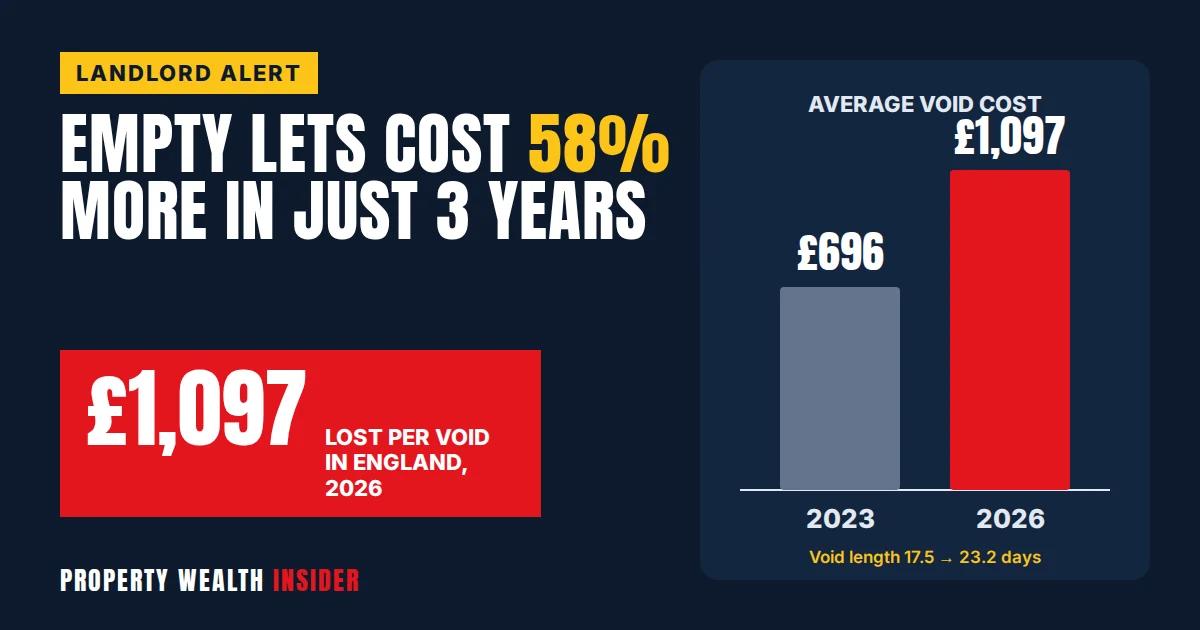
Every empty week between tenants is now costing landlords far more than it did three years ago. New research from property management firm Rushbrook puts the average rent lost during a void period in England at £1,097 in 2026, up from £696 in 2023, a rise of almost 58%.
Two things are driving it. Voids are getting longer, stretching from 17.5 days to 23.2 days on average, and every one of those days is worth more because rents have kept climbing. The North East has been hit hardest in percentage terms, while London remains the most expensive place to have a property standing empty.
This matters most to landlords in England, where tenants on the new periodic tenancies can now hand in two months’ notice at any time. Below we break down the numbers, show what a void really costs once council tax and bills are added, and set out a week-by-week plan for getting the next tenant in faster.
Key facts
- Average rent lost per void in England: £1,097 in 2026, up from £696 in 2023 (Rushbrook).
- Average void length has risen from 17.5 days (2023) to 23.2 days (2026).
- Biggest rise: the North East, up 92.4% from £318 to £612.
- Most expensive: London, at £1,357 per void (up 61.9%).
- Average England rent is £1,459 a month (ONS, August 2026), so each empty day costs about £48 in lost rent.
- Since 1 May 2026, tenants on periodic tenancies in England can leave on 2 months’ notice.
The void figures region by region
Rushbrook’s analysis looks at average void lengths and rental values across England. Its figures measure lost rent only, not the other bills that land on a landlord when a property is empty.
We have only included regions where the figures were published in direct coverage of Rushbrook’s release. For the West Midlands, London and the South East, the 2023 figure is calculated from Rushbrook’s reported 2026 cost and percentage rise, so treat it as approximate to within a pound or two.
| Area | Void cost 2023 | Void cost 2026 | Change | ONS average rent, Aug 2026 | Rent per day* |
|---|---|---|---|---|---|
| England | £696 | £1,097 | +57.6% | £1,459 | £48 |
| North East | £318 | £612 | +92.4% | £788 | £26 |
| West Midlands | £529 (derived) | £859 | +62.5% | £982 | £32 |
| London | £838 (derived) | £1,357 | +61.9% | £2,332 | £77 |
| South East | £658 (derived) | £1,053 | +60.1% | £1,426 | £47 |
*Monthly rent x 12 / 365. Rent data: ONS Price Index of Private Rents, August 2026.
The length of the average void is the other half of the story. After dipping slightly in 2023, it has risen every year since.
The rent data lines up. The ONS says average England rent was £1,459 in August 2026, up 4.0% on a year earlier. That is about £48 a day, so 23.2 days empty works out at roughly £1,113, very close to Rushbrook’s £1,097 headline.
Why voids cost more than the headline
Lost rent is only the start. When nobody lives in the property, bills that the tenant normally covers fall back on you.
- Council tax. In England you will usually have to pay council tax on an empty home, though your council can choose to give a discount. If a property stays empty for a year or more, an empty homes premium can apply, rising to up to four times the normal bill after 10 years.
- Utilities and standing charges. Even with the heating low, you pay standing charges on gas and electricity, plus any water bill.
- Re-letting costs. Agent tenant-find fees, referencing, inventory and check-in, cleaning and any refresh work.
- Mortgage interest. You pay this whether the property is let or not, so it is not an extra cost of the void. But during a void nothing covers it, so you fund it from your own cash.
The calculator below separates these, so you can see both the true cost of the void and the cash you need to have in reserve to get through it.
Void period cost calculator
What do your empty days really cost?
Guide only, not financial advice. Daily figures use monthly cost x 12 / 365. Mortgage interest is shown as a cash-flow figure only, because you pay it whether or not the property is let.
With the default figures (England average rent of £1,459, a 23-day void, £170 council tax, £60 bills and £500 re-letting costs), the true cost is about £1,777 a year, or 10.2% of the annual rent. That knocks the gross yield on a £250,000 property from 7.00% to about 6.29%.
Worked examples in £
These use ONS August 2026 average rents and the 23.2-day national average void. Rushbrook’s own regional figures reflect its regional void lengths, which were not published in the coverage, so our sums are illustrations, not a recalculation of its data.
North East two-up two-down: £788 a month
Daily rent is £788 x 12 / 365 = £25.91. A 23.2-day void loses about £601 in rent. Add £130 a month council tax and £50 of bills for those 23 days (about £137) and the void costs roughly £738 before any agent fees.
London flat: £2,332 a month
Daily rent is £76.67. The same 23.2-day void loses about £1,779. Every extra week empty costs another £537 in rent alone, which is why the London figure is the highest in cash terms.
Portfolio landlord with five England-average lets
At £1,459 a month, each property loses about £48 a day. If every property has one 23-day void a year, that is roughly £5,516 of lost rent across the portfolio. Cut each void by a week and you keep about £1,679 more.
How the Renters’ Rights Act changes the void timeline
The tenancy reforms in the Renters’ Rights Act came into force in England on 1 May 2026. Most existing assured shorthold tenancies automatically became assured periodic tenancies that day. These rules apply to England only; Wales, Scotland and Northern Ireland have their own systems.
For voids, the key rule is simple: a tenant can end the tenancy by giving two months’ notice. There is no fixed term to wait out, so a tenancy can end at any point in the year, including the slow winter months.
Other rules shape how fast you can re-let:
- You must state an asking rent in any written advert and cannot accept or encourage offers above it. Price it right first time.
- You can ask for no more than one month’s rent in advance.
- Rent can only be increased once a year, using a section 13 notice (Form 4A) with at least two months’ notice, so the starting rent matters more than ever.
- You must consider pet requests and cannot unreasonably refuse them. Being open to pets can widen your pool of applicants.
- If you regain possession to sell or move in (grounds 1 or 1A, four months’ notice), you cannot market or re-let the property for 12 months.
Step-by-step: cutting your next void
Two months’ notice is roughly eight weeks. Used well, that is enough time to have a new tenant ready to move in the day after the old one leaves.
| When | What to do |
|---|---|
| Day notice arrives (week 0) | Confirm the end date in writing. Ask the tenant about access for viewings, giving the notice your tenancy agreement requires. |
| Weeks 1-2 | Do a pre-exit inspection. List repairs, decorating and cleaning, and book trades for the changeover days now. |
| Weeks 1-2 | Check your safety certificates and EPC will still be in date for the new tenancy. Set your asking rent using local comparables. |
| Week 2 | Take fresh photos and go live with the advert, stating the asking rent clearly. |
| Weeks 3-5 | Run viewings (block-book them to limit disruption). Start referencing as soon as you accept an applicant. |
| Weeks 5-7 | Agree the start date, issue the tenancy paperwork, take no more than one month’s rent in advance, and book check-out and check-in. |
| Week 8 (end date) | Check-out, then trades and clean on a tight 1-3 day turnaround. |
| Week 8+ | New tenant moves in. Take meter readings and notify the council and suppliers on both changeovers. |
The aim is to have the next tenant chosen before the keys come back. Most avoidable void days come from starting the search after the old tenant has left.
- Notice date and end date confirmed in writing
- Viewing access agreed with the outgoing tenant
- Pre-exit inspection done and works list written
- Trades and cleaner booked for changeover
- Safety certificates and EPC checked
- Asking rent set from local comparables and stated in every advert
- Photos and listing live within two weeks of notice
- Pet requests considered on their merits
- Referencing started as soon as an applicant is chosen
- Rent in advance capped at one month
- Check-out and check-in booked
- Council tax and utility accounts updated on both changeovers
- Cash reserve covers at least one void’s mortgage, council tax and bills
FAQ
How much does an empty rental property cost a landlord?
Rushbrook estimates the average void in England cost £1,097 in lost rent in 2026. Add council tax, utilities and re-letting fees and the true figure is often well above that. Use the calculator above for your own numbers.
How long is the average void period in England?
23.2 days in 2026, according to Rushbrook, up from 17.5 days in 2023 and 20.3 days in 2025.
Do landlords pay council tax when a property is empty between tenants?
Usually, yes. In England you will usually have to pay council tax on an empty home, but your council can decide to give a discount. Check your own council’s policy, and note that a premium can apply after a year empty.
How much notice does a tenant have to give under the Renters’ Rights Act?
Two months. Since 1 May 2026, tenants in England on assured periodic tenancies can end the tenancy by giving two months’ notice.
Can I ask for a higher rent to make up for void periods?
You can set the asking rent for a new tenancy, but you must state it in your advert and cannot accept offers above it. After that, rent can only rise once a year by section 13 notice. An over-ambitious asking rent that leaves the property empty for an extra fortnight can easily cost more than it gains.
- The Intermediary: Rushbrook void cost research (29 September 2026)
- ONS: Private rent and house prices, UK, September 2026
- ONS: Price Index of Private Rents, monthly price statistics
- GOV.UK: Renters’ Rights Act overview for tenants
- GOV.UK: Guide to the Renters’ Rights Act
- GOV.UK: Council Tax on second homes and empty properties
This article is news and general guidance only. It is not financial, legal or tax advice.