LHA freeze: tenants £324 a month short as rent gap hits record
The housing support paid to low-income private renters has now been frozen in cash terms for two and a half years, and the gap between what it covers and what rents actually cost is about to hit a record. That is the warning from the Resolution Foundation in a new report, “Saving private renters”, published four weeks before the Chancellor’s Budget on 28 October 2026.
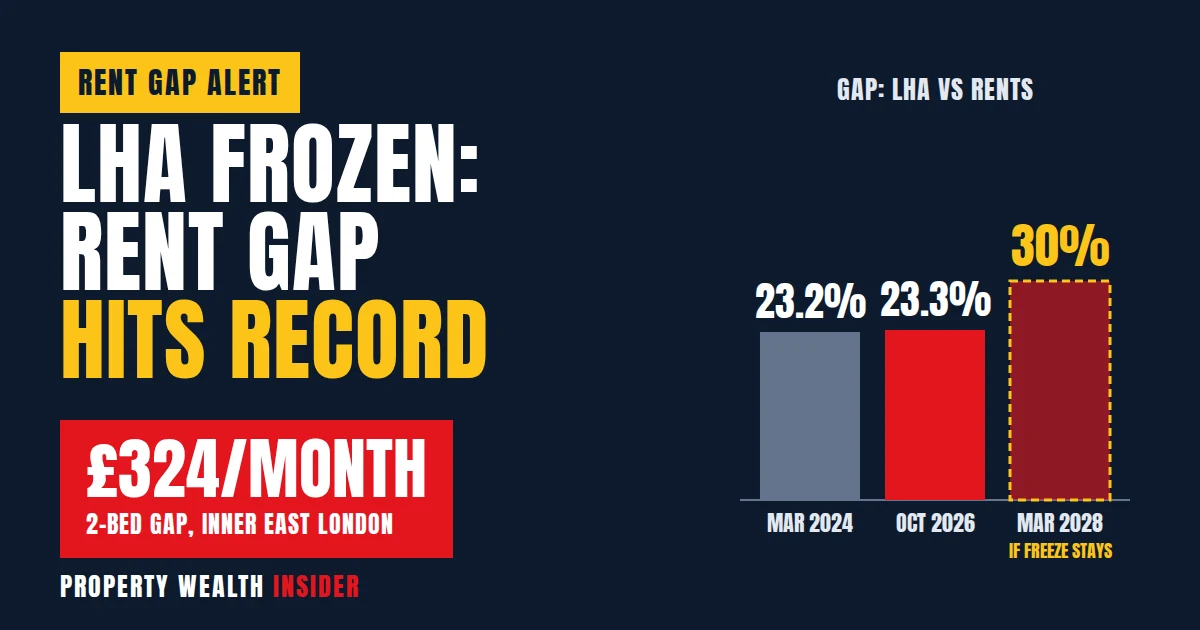
Local Housing Allowance (LHA) caps how much rent Universal Credit or Housing Benefit will cover. It was last reset to the 30th percentile of local rents in April 2024 and has not moved since. The think tank says the gap between LHA and rents is on course for a record 23.3% this month, and 30% by March 2028 if nothing changes.
For landlords who let to tenants on benefits, that gap is not abstract. It is the slice of every month’s rent the tenant has to find from somewhere else, and it is where arrears start.
Key facts
- LHA rates for April 2026 to March 2027 are the same rates that came into force on 1 April 2024: the freeze is now in its third year.
- The Resolution Foundation says the gap between LHA and rents will hit a record 23.3% in October 2026, rising to 30% by March 2028 if the freeze continues.
- A 2-bed home at the 30th percentile in Inner East London costs £324 a month more than the LHA rate; the average 2-bed gap across England is £158 a month.
- Crisis and Citizens Advice estimated in July 2026 that fewer than 2% of homes listed for rent in Great Britain could be covered by LHA alone.
- Relinking LHA to the 30th percentile from April 2027 and keeping it linked would cost around £2bn a year by 2029-30, the think tank estimates.
- Nothing has changed yet: any decision would come at the Budget on 28 October 2026.
What the Resolution Foundation found
LHA sets the maximum housing support for the 1.9 million privately renting households in Great Britain on Universal Credit or Housing Benefit, according to the report. It is set for each property size in each of 192 Broad Rental Market Areas (BRMAs).
When LHA started in 2008 it was set at the median local rent. It was cut to the 30th percentile in 2011, the automatic link to rents ended a year later, and rates have been frozen in nine of the past 14 years. The think tank’s press release says around 1.1 million low-income families face the resulting “cost of housing” crunch.
The pattern is a saw-tooth. By March 2020 LHA had fallen 14% behind rents; the April 2020 reset closed that gap. By March 2024 it had widened to a record 23.2%. The April 2024 relink only brought it down to about 9%, because the new rates were based on rents to September 2023 and rents had risen another 9% before they took effect.
The think tank’s ask for the Budget is twofold: relink LHA to the 30th percentile in April 2027, then restore the automatic annual link so the gap cannot build up again. It puts the cost at £2bn a year by 2029-30 and suggests one way to fund it would be raising the Universal Credit taper from 55% to 58%.
To be clear about status: this is a proposal. The freeze is the law for 2026-27, set by the Rent Officers (Housing Benefit and Universal Credit Functions) (Modification) Order 2026.
How big is the gap where you let?
The Valuation Office Agency publishes both the frozen LHA rates and what the 30th percentile of local rents actually was in the 12 months to September 2025. DWP publishes the monthly Universal Credit versions of the rates. Put them side by side and the frozen gap is easy to see.
| Area (BRMA), 2-bed | UC LHA rate a month (2026-27) | 30th percentile rent a month* | Monthly gap | Share of rent covered |
|---|---|---|---|---|
| Inner East London | £1,750 | £2,069 | £319 | 85% |
| Central Greater Manchester | £875 | £1,047 | £172 | 84% |
| Bristol | £1,095 | £1,247 | £152 | 88% |
| Birmingham | £750 | £893 | £143 | 84% |
| Leeds | £775 | £823 | £48 | 94% |
*VOA 30th percentile 2-bed rent from lettings in the 12 months to September 2025 (weekly figure x 52 / 12). Market rents have risen since, so today’s gaps are likely bigger. The Resolution Foundation’s £324 for Inner East London uses the weekly LHA rate (£402.74) rather than DWP’s rounded monthly figure.
Two things stand out. First, the gap is not just a London problem: the report says more than half of BRMAs have a 2-bed gap above £100 a month, and every English region has at least one. Second, these are gaps against the cheapest 30% of the market. If your rent sits at the local median, the shortfall your tenant faces is larger.
LHA covers England, Scotland and Wales, with rates published separately for each nation; Scotland’s 2026-27 rates are also frozen at the levels last determined in January 2024. Northern Ireland runs its own system, with LHA rent levels set by the Housing Executive, and is outside the report’s figures.
LHA shortfall calculator for landlords
Find your tenant’s rate on the official LHA-Direct lookup (postcode plus bedroom entitlement), or in DWP’s monthly Universal Credit LHA rates. The defaults below use a 2-bed in Central Greater Manchester.
How much rent does LHA leave uncovered?
Guide only, not financial or legal advice. LHA is the maximum housing support, not a guarantee: the benefit cap, earnings, deductions and bedroom entitlement can all cut what a tenant actually receives. A relink is a proposal, not policy.
Worked examples for landlords letting to UC tenants
Example 1: the everyday top-up
You let a 2-bed in Central Greater Manchester at £1,000 a month. The tenant’s UC LHA rate is £875. Even with full entitlement, UC covers at most £875, so the tenant tops up £125 a month, or £1,500 a year, from their standard allowance or wages.
For context, the UC standard allowance for a single person aged 25 or over is £424.90 a month. A £125 top-up is almost 30% of it.
Example 2: when arrears let you apply for a managed payment
Under DWP’s alternative payment arrangements guidance, a landlord can request a managed payment (housing costs paid direct to you) when arrears equal or exceed two months’ rent, or when the tenant has continually underpaid for more than two months and built up arrears of at least one month’s rent.
On that £1,000 let, if the tenant pays only the £875 LHA, the arrears grow by £125 a month. It would take 8 months to reach one month’s rent (£1,000), which then meets the “continual underpayment” test. The two-months route needs £2,000 of arrears. The tenant gets 7 days to object, and their UC is paused until a decision is made.
Example 3: the benefit cap squeeze
The cap outside Greater London is £1,835 a month for a single parent whose children live with them (£2,110.25 inside London). Take an out-of-work single parent aged 25 or over with two children, renting that £875-LHA flat. Simplified: standard allowance £424.90 + child elements 2 x £303.94 + Child Benefit about £194.78 + housing £875 = £2,102.56.
That is £267.56 over the cap, so UC is cut by that amount, leaving about £607 effectively towards a £1,000 rent. The cap does not apply if the household earns £881 a month or more after tax, or gets certain disability or carer benefits, so check before you assume the worst.
Would landlords just pocket an LHA rise?
The usual objection to unfreezing LHA is that landlords would simply put rents up. The report tests this against the April 2024 relink, which raised 2-bed rates in English areas by between £5 and £62 a week.
Its central estimate is that about 10p of every £1 of extra LHA showed up as higher rents at the bottom of the market. Meanwhile, the share of UC private renters whose rent exceeded LHA fell from 67% just before the uplift to 46% a year later; it had crept back to 58% by May 2026.
For landlords the practical read is simple: a relink would mostly reduce tenants’ top-ups, which cuts arrears risk on existing lets, rather than create a windfall.
| Item | Status | Where |
|---|---|---|
| LHA frozen at April 2024 rates for 2026-27 | In force | England, Scotland, Wales |
| Relink to 30th percentile from April 2027, then annually | Proposal (Resolution Foundation) | Great Britain |
| Ban on refusing tenants because they get benefits | In force since 1 May 2026 (Renters’ Rights Act) | England |
| Budget decision on LHA | Due 28 October 2026 | Great Britain |
Letting to tenants on benefits: what to do now
In England, the Renters’ Rights Act overview for landlords is blunt: you cannot discriminate against potential tenants who are on benefits or who have children. So the job is not avoiding benefit tenants; it is setting up lets that work.
- Look up the rate. Check the LHA for the postcode and the tenant’s bedroom entitlement on LHA-Direct before you agree terms.
- Run the shortfall. Use the calculator above. Assess affordability the same way you would for any applicant, on total income including benefits.
- Check the cap. Ask whether the household is working or exempt; a capped household may receive far less than LHA.
- Agree the payment set-up. UC is paid monthly, usually 7 days after the assessment period ends. Agree a rent date that follows it. The tenant can ask for an alternative payment arrangement themselves.
- Watch arrears early. Track underpayments monthly so you know when the managed payment thresholds are met.
- Apply online. Use DWP’s Apply for a Direct Rent Payment service to request a managed payment or rent arrears deduction.
- Follow the Budget. Any LHA change would be announced on 28 October 2026; the earliest a relink could bite, on the report’s timetable, is April 2027.
- LHA rate checked on LHA-Direct for the right BRMA and bedroom category
- Monthly shortfall worked out and discussed with the tenant
- Benefit cap position confirmed (earnings of £881+ a month or exemption)
- Rent due date aligned with the UC payment date
- Tenant’s consent sought to deal with DWP/UC on rent issues where appropriate
- Arrears log kept month by month
- Managed payment thresholds noted: 2 months’ arrears, or 1 month after 2+ months of underpaying
- No “No DSS” wording in adverts or referencing criteria (England)
- Budget on 28 October 2026 diarised
FAQ
Is Local Housing Allowance still frozen in 2026?
Yes. The rates from 1 April 2026 are the same as those that came into force on 1 April 2024, and they run until March 2027 unless the Government changes them.
Will LHA go up in the Autumn Budget 2026?
Nobody knows yet. The Budget is on 28 October 2026. The Resolution Foundation wants a relink from April 2027, but the Government has made no commitment.
How do I find a tenant’s LHA rate?
Use LHA-Direct on the VOA website with the property postcode, or DWP’s monthly Universal Credit LHA rate tables for England, Scotland and Wales. The right category depends on the tenant’s bedroom entitlement, not the size of your property.
Can I get Universal Credit rent paid directly to me?
Yes, through a managed payment, if arrears reach two months’ rent or the tenant has underpaid for more than two months and owes at least one month. Apply through DWP’s online direct rent payment service.
Can I refuse a tenant on benefits?
Not in England: since the Renters’ Rights Act changes from 1 May 2026, landlords cannot discriminate against applicants because they receive benefits. You can still assess affordability fairly.
- Resolution Foundation: Saving private renters (report)
- Resolution Foundation: press release
- VOA: LHA rates applicable from April 2026 to March 2027
- DWP: Universal Credit LHA monthly rates 2026 to 2027
- Scottish Government: LHA rates 2026 to 2027
- Northern Ireland Housing Executive: current LHA rent levels
- VOA: LHA-Direct rate lookup
- GOV.UK: Benefit cap amounts
- GOV.UK: Universal Credit, what you’ll get
- GOV.UK: Child Benefit rates
- DWP: Alternative payment arrangements
- DWP: Landlord request for a managed payment
- GOV.UK: Renters’ Rights Act overview for landlords
- HM Treasury: Budget 2026 date
This article is news and general guidance, not financial, legal or tax advice.