Right to Rent rules change today: £20,000 per tenant fine risk
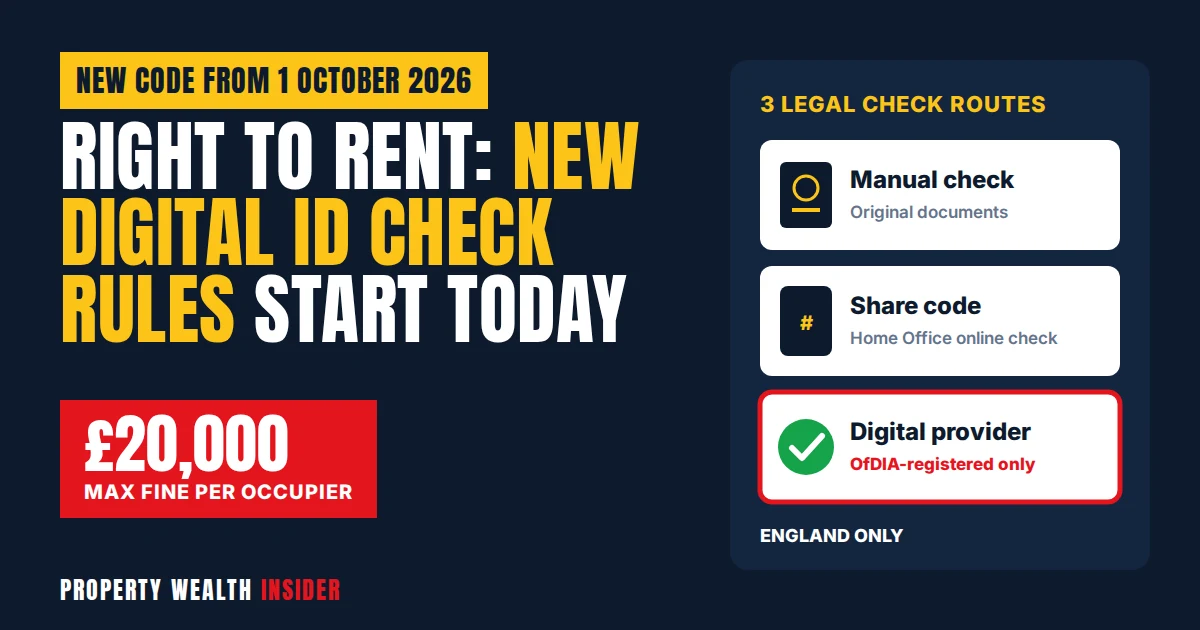
From today, Thursday 1 October 2026, landlords in England who use an app or online provider to run Right to Rent checks on British and Irish passport holders must use a provider that is officially registered with the government for Right to Rent. Use an unregistered one and the check gives you no legal protection at all.
The change arrives with a new Home Office code of practice, the seventh version, which also tightens the wording on when checks must be done and adds digital versions of documents to the acceptable list. The fines behind it are not small: up to £20,000 per occupier for a repeat breach.
It affects every private landlord and letting agent in England, including anyone taking in a lodger or subletting. Right to Rent does not apply in Wales, Scotland or Northern Ireland.
Key facts
- A new Right to Rent code of practice came into force on 1 October 2026 (England only).
- Digital ID checks must now be done by a provider on the government OfDIA register with a note confirming it can do Right to Rent checks.
- Digital provider checks cover British and Irish passports (and the Irish passport card) up to six months past expiry.
- Civil penalties: £10,000 per occupier for a first breach and £20,000 for a repeat; £5,000 and £10,000 for lodgers.
- Pay a first penalty within 21 days and it drops by 30%.
- Keep check records for the whole tenancy plus one year, then securely destroy them.
What changed on 1 October 2026
The Home Office published the updated Right to Rent code of practice on 30 June 2026, with a start date of 1 October 2026. It replaces the version that applied from February 2024.
The headline change is about digital checks. Since 2022, landlords have been able to use digital identity providers to verify British and Irish passports remotely. The new code makes it mandatory that, if you choose a provider, it is listed on the digital verification services register run by the Office for Digital Identities and Attributes (OfDIA), and that its entry carries a note confirming it can do Right to Rent checks.
The code calls these firms “RtR DVSPs” (Right to Rent digital verification service providers). It also says:
- Using a provider is optional. You can still do a manual check or a Home Office online check instead.
- If you want to use facial recognition to match the tenant to the document, it must be done through a registered provider.
- You are still responsible for satisfying yourself that the photo and date of birth returned match the person in front of you, whether in person, by video call or by the provider’s facial matching.
- Checks done properly under the old code before today are judged against the code that applied when they were done. You do not need to re-check existing tenants because of this change.
The three legal ways to check a tenant
To get a “statutory excuse” (your legal defence against a fine), you must use one of three prescribed checks before the tenancy is agreed. Which one fits depends on what the tenant holds.
| Route | Who it is for | What you do | Excuse you get |
|---|---|---|---|
| Manual document check | Anyone with original List A or List B documents, e.g. a British passport (current or expired) or Irish passport or passport card | See the original, check it is genuine with the holder present (in person or by video link), copy it in an unalterable format, record the date | Continuous (List A) or time-limited (List B) |
| Home Office online check | Anyone with an eVisa, including EU Settlement Scheme status. eVisa holders can only prove their right to rent this way | Get a share code from the tenant, use the gov.uk checking service, check the photo matches, keep a dated copy of the result | Continuous or time-limited, depending on the status shown |
| Registered digital provider (DVSP) | British or Irish passport or Irish passport card holders (up to six months past expiry), plus List A or B documents supplied digitally by the issuer | Use a provider on the OfDIA register flagged for Right to Rent, confirm the match, keep the result and any face-match comparison | Continuous for British and Irish citizens |
If someone has no acceptable documents and no share code but you believe they have an outstanding Home Office application or appeal, you use the Landlord Checking Service. It replies within two working days. A “yes” (a Positive Right to Rent Notice) protects you for 12 months.
Note the passport nuance. A manual check accepts a British passport whether current or expired. A digital provider check only works if the passport is valid or no more than six months out of date. A long-expired passport means a manual check.
Which check do I need? Use our checker
Pick what the prospective tenant holds, fill in the dates and how many adults will live there. The checker shows the right route, when you can do it, when a follow-up is due and your maximum fine exposure if it goes wrong.
Which Right to Rent check do I need?
Guide only, based on the Home Office Right to Rent code of practice in force from 1 October 2026 (England). Penalties shown are the maximum figures in the code; the Home Office decides the actual amount. Not legal advice.
Timing, follow-up checks and record keeping
Timing trips up more landlords than documents do. For someone with an unlimited right to rent, the check can be done at any time before the tenancy agreement is made. For someone with time-limited permission, it must be done and recorded no earlier than 28 calendar days before the tenancy starts.
A time-limited excuse lasts until the latest of three dates: 12 months from your check, the end of the tenant’s permission, or the expiry of the document used. You must do a follow-up check before then. If the tenant can no longer show a right to rent, or will not cooperate, you must report it to the Home Office before your excuse runs out.
| Step | When | What to do | What to keep |
|---|---|---|---|
| 1. Identify all adults | At application | List everyone over 18 who will live there as their only or main home, named on the agreement or not | Names and dates of birth |
| 2. Choose the route | Before booking the check | Manual, Home Office share code, or registered DVSP | Note of method used |
| 3. Initial check | Unlimited right: any time before the agreement. Time-limited: no earlier than 28 days before start | Complete the check and match the person to the photo | Dated copy of documents or online result |
| 4. Diary the follow-up | Day of check | Latest of: check + 12 months, permission expiry, document expiry | Follow-up date in your diary |
| 5. Follow-up check | Before the excuse expires | Re-check; if no right to rent, report to the Home Office | New dated record, report confirmation |
| 6. Tenancy ends | Tenancy end + 1 year | Securely destroy the records | Nothing after that date |
Worked example: a tenant with an eVisa valid until 30 June 2027 is checked on 1 October 2026. Twelve months from the check is 1 October 2027, which is later than the permission expiry, so the follow-up must happen before 1 October 2027. If the tenant extends their visa sooner, you can re-check at any time.
The fines: what getting it wrong costs
The maximum civil penalty rose from £3,000 to £20,000 under the Immigration Act 2014 (Residential Accommodation) (Maximum Penalty) Order 2024. The current code sets the amounts per occupier, depending on whether the person is a lodger in your home or an occupier of a let property, and whether you have had a penalty in the last three years.
Because the fine is per occupier, it multiplies fast in shared houses.
- Single let, couple: two adults with no right to rent and no valid check, first breach: 2 x £10,000 = £20,000. Paid within 21 days: £14,000.
- Five-bed HMO: three unchecked occupiers found without the right to rent, first breach: 3 x £10,000 = £30,000, or £21,000 with the 30% fast payment discount.
- Same HMO, second penalty within three years: 3 x £20,000 = £60,000. The fast payment discount is only available on a first penalty.
- Lodger in your home: £5,000 for a first breach, or £3,500 paid within 21 days.
Civil penalties are not the ceiling. GOV.UK warns that knowingly renting to someone without the right to rent, or having reasonable cause to believe they lack it, is a criminal offence carrying up to five years in prison or a fine.
Using an agent? If your letting agent agrees in writing to carry out the initial and follow-up checks, liability for the civil penalty transfers to the agent. Without that written agreement, it stays with you.
What to do now: step by step
- Step 1: Audit your provider. If you or your agent use an ID app, search for it on the OfDIA register and confirm its entry says it can do Right to Rent checks. If it does not, stop using it for new checks today.
- Step 2: Check your agency terms. Find the written agreement that says who does initial and follow-up checks. No agreement means the liability is yours.
- Step 3: Update your process. Use share codes for every eVisa holder, manual checks for long-expired passports, and the Landlord Checking Service where there is an outstanding application.
- Step 4: Check every adult. Apply the same checks to all applicants, British citizens included, so you stay on the right side of the separate anti-discrimination code.
- Step 5: Diary every follow-up. Go through current tenants with time-limited permission and set reminders well before each excuse expires.
- Step 6: Tidy your records. Keep dated copies for the tenancy plus one year, then securely destroy them.
Printable Right to Rent checklist
- All adults over 18 who will live in the property identified
- Route chosen: manual, Home Office share code, or registered DVSP
- Any digital provider confirmed on the OfDIA register with a Right to Rent note
- Passport over six months expired? Manual check, not digital
- eVisa holders checked only via share code on GOV.UK
- Photo and date of birth matched to the person (in person, video or provider face match)
- Time-limited checks done no earlier than 28 days before the tenancy start
- Dated, unalterable copies or online results stored securely
- Follow-up date diarised for every time-limited tenant
- Written agreement with agent on who does checks
- Records destroyed one year after the tenancy ends
Right to Rent FAQs
Do I have to use a digital provider for Right to Rent checks?
No. The code says using a provider is not mandatory. You can still do a manual check of original documents or a Home Office online check. But if you do use a provider, it must be on the OfDIA register with a Right to Rent note.
Do I need to re-check existing tenants after 1 October 2026?
No. Checks carried out correctly before the new code took effect are assessed against the code in force at the time. You only need follow-up checks for tenants with time-limited permission, as before.
How much is the fine for not doing a Right to Rent check?
Up to £10,000 per occupier for a first breach and £20,000 for a repeat breach within three years. For lodgers it is £5,000 and £10,000. A first penalty paid within 21 days is cut by 30%.
Does Right to Rent apply in Wales or Scotland?
No. The scheme applies to residential tenancy agreements in England only.
Can I do a Right to Rent check over video call?
Yes. For a manual check you can verify the holder in person or by video link, but you must still hold the original document. For a provider check, the photo match can be done in person, by video call or by the provider’s facial recognition.
How long must I keep Right to Rent records?
For the whole tenancy and one year after it ends. After that, the code says the records must be securely destroyed.
Sources
- Home Office: Code of practice for landlords and their agents, 1 October 2026
- GOV.UK: Right to rent immigration checks, landlords’ code of practice
- GOV.UK: Penalties for illegal renting
- GOV.UK: Find registered digital identity and attribute services (OfDIA register)
- GOV.UK: Check a tenant’s right to rent in England (share code)
- Home Office: Landlord’s guide to right to rent checks
- legislation.gov.uk: Immigration Act 2014 (Residential Accommodation) (Maximum Penalty) Order 2024
- legislation.gov.uk: Immigration Act 2014, Part 3 Chapter 1
This article is news and general guidance, not financial, legal or tax advice.