1.5m Renters Paid Rent Upfront: What You Can Legally Take Now

The government has corrected its own figures on how much rent private tenants in England hand over before they move in. On 30 September 2026 the Ministry of Housing, Communities and Local Government (MHCLG) fixed a table in the English Housing Survey 2024-25 because the original version measured rent paid in advance in renters’ previous tenancies, not their current ones.
The corrected figures show more than 1.5 million private rented households paid rent in advance on top of a deposit in 2024-25. Most of them (81%) paid one month or less, but a significant minority paid four months or more upfront.
These figures describe the market before the Renters’ Rights Act took effect. Since 1 May 2026, landlords and agents in England can’t take any rent before the tenancy agreement is signed, and they’re capped at one month’s rent before the tenancy starts. Below we explain what the data shows, exactly what you can and can’t take upfront now, and how to deal with applicants who used to offer six or 12 months in advance. We’ve also built a move-in money checker for you to use.
Key facts
- MHCLG corrected English Housing Survey Annex Table 3.1 on 30 September 2026. The old data covered renters’ previous tenancies, not their current ones.
- More than 1.5 million private rented households paid rent in advance on top of a deposit in 2024-25. 81% of them paid one month or less.
- 9% of households that paid rent in advance paid more than four months upfront.
- Since 1 May 2026 (England), no rent can be taken before the tenancy agreement is signed. After signing, the maximum is 1 month’s rent (or 28 days’ rent if rent isn’t paid monthly) before the tenancy starts.
- Deposit caps are unchanged: holding deposit up to 1 week’s rent, tenancy deposit up to 5 weeks (6 weeks if annual rent is £50,000 or more), and the deposit must be protected within 30 days.
What the government corrected, and why it matters
The figures come from MHCLG’s English Housing Survey 2024 to 2025: private rented sector – pre-Renters’ Rights Act overview, first published on 14 May 2026. The report is meant to give a “before” picture of renting so the effect of the reforms can be measured later.
The department’s correction note is short: “Previous data referred to rent in advance paid during the household’s previous tenancy rather than their current tenancy.” In other words, the first version answered the wrong question. The corrected Annex Table 3.1 now shows what households paid upfront for the home they were living in.
For landlords, the revised figures show how common rent in advance was. Upfront rent was a routine part of letting for well over a million households, so the new one-month cap affects mainstream lets, not just a few unusual ones.
The corrected figures in full
MHCLG’s commentary says more than one and a half million private rented households (1,550,000) paid rent in advance on top of the deposit in 2024-25, and that 81% of them paid one month of rent or less. These are the figures from the corrected annex table:
| Amount of rent paid in advance (band as published) | Households | Share |
|---|---|---|
| One month of rent or less | 1,550,168 | 80.8% |
| More than 1 and up to 2 months | 131,615 | 6.9% |
| More than 3 and up to 4 months | 72,987 | 3.8% |
| More than 4 months | 163,715 | 8.5% |
| Total (all who paid rent in advance) | 1,918,486 | 100% |
Read the table carefully. In the corrected spreadsheet, the 1,550,168 figure is in the “one month of rent or less” row, and the four bands add up to about 1.92 million households. The published table also has no “more than 2 and up to 3 months” band. We’ve reported the figures exactly as MHCLG published them. Whichever way you read the table, more than 1.5 million households paid rent upfront. The sample was 1,436 households, so treat the smaller bands as approximate.
The same report found that 22% of private renters (just over one million households) were asked to provide a guarantor before moving in. Guarantors are still allowed, and they matter more now that large upfront rent payments have been banned.
What you can take upfront now (England)
These rules apply to assured tenancies of housing in England. Wales, Scotland and Northern Ireland have separate regimes. The rent-in-advance changes were made by sections 8 and 9 of the Renters’ Rights Act 2025, which came into force on 1 May 2026 (S.I. 2026/421).
| Payment | When | Legal maximum | Source |
|---|---|---|---|
| Holding deposit | Before the agreement is signed | 1 week’s rent (one per tenancy at a time) | Tenant Fees Act 2019, Sch 1 para 3 |
| Rent | Before the agreement is signed | £0, banned | Tenant Fees Act 2019, Sch 1 para 1(1A) and s.5A |
| Rent | After signing, before the tenancy starts | 1 month’s rent (28 days’ rent if not paid monthly) | Housing Act 1988, s.4B |
| Tenancy deposit | At or before the start | 5 weeks’ rent (6 weeks if annual rent is £50,000+) | Tenant Fees Act 2019, Sch 1 para 2 |
| Rent during the tenancy | Once it has started | Terms requiring rent before the rent period it covers have no effect | Housing Act 1988, s.4B |
No rent before signing. Rent payable before an assured tenancy is entered into is now a prohibited payment. Landlords and agents must not invite, encourage or accept it, including when the tenant offers it. Government guidance says a landlord can still be reported even if the tenant offered the money or has already moved in.
One month after signing. Between signing and the start date (the “permitted pre-tenancy period”), the Act allows “initial rent”, which means rent for the first rent period or for any period ending within the first 28 days. Government guidance puts this as up to one month’s rent, or 28 days’ rent if rent isn’t paid monthly. There are exceptions for homelessness lets and social or supported housing.
No rent in advance after that. For tenancies entered into from 1 May 2026, any term that makes rent due before the rent period it pays for has no effect. The rent is treated as due on a “substitute rent day” during that period. So a clause asking for six or 12 months upfront can’t be enforced.
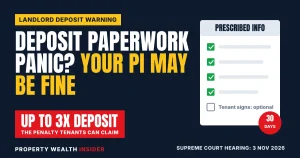
Deposits. One week’s rent is the annual rent divided by 52, so for a monthly let it’s monthly rent × 12 ÷ 52. Within 30 days of receiving a tenancy deposit, you must protect it in an approved scheme and give the tenant the prescribed information. If you don’t, a court can order you to repay it or pay it into a scheme, and also order you to pay the tenant up to three times the deposit. You don’t have to protect a holding deposit, but if it’s converted into the tenancy deposit, it must be protected.
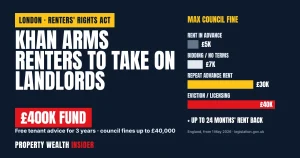
Penalties. A council can fine a landlord or agent up to £5,000 for breaching the rent-in-advance ban (Tenant Fees Act s.8). Councils can also require the prohibited rent to be repaid. The usual defence of having put the money towards rent or the deposit doesn’t apply to rent taken before signing.
Worked examples in £
Example 1: £1,200 a month flat. One week’s rent is £1,200 × 12 ÷ 52 = £276.92. The maximum holding deposit is £276.92 and the maximum tenancy deposit is 5 × £276.92 = £1,384.62. After signing you can ask for up to £1,200 of rent. The most a tenant can be asked to pay before move-in is £2,584.62, and the holding deposit (with the tenant’s consent) goes towards that total rather than on top of it. Before 1 May 2026, a landlord asking for six months upfront would have collected £7,200 in rent plus the deposit.
Example 2: £4,500 a month family house. Annual rent is £54,000, which is above the £50,000 threshold, so the deposit cap rises to six weeks. One week’s rent is £1,038.46, giving a maximum deposit of £6,230.77. With the first month’s £4,500, the maximum move-in total is £10,730.77.
Example 3: £950 a month, and the agent wants £1,100 deposit. The five-week cap is £1,096.15, so the extra £3.85 is a prohibited payment. Even a small rounding-up like this breaks the cap, so always calculate the exact figure.
Move-in money checker
Enter the monthly rent and what you plan to ask for. The checker works out the legal maximums for a monthly-paid assured tenancy in England and flags any amount over the limit. Leave a planned amount at 0 to skip checking it.
Move-in money checker (England)
This is a guide only, not legal advice. It assumes a monthly-paid assured tenancy in England from 1 May 2026. If rent isn’t paid monthly, the pre-tenancy cap is 28 days’ rent. No rent may be taken before the agreement is signed. The holding deposit is normally refunded, or with consent put towards the first rent or the deposit, so it isn’t added on top. Check the current gov.uk guidance before acting.
Overseas tenants and tenants without a UK guarantor
Before the new rules, international students, people relocating for work and applicants with no UK credit history often offered six or 12 months’ rent to secure a property. For new assured tenancies in England, landlords can no longer require or enforce that. You’ll need other ways to manage the risk.
- Ask for a guarantor. Government guidance confirms you can make a suitable rent guarantor a condition of the tenancy. Write down what counts as suitable, for example a UK-based guarantor who passes referencing.
- Let the tenant choose a guarantor service. If the applicant has no UK guarantor, they can choose to use a commercial guarantor service. You can’t require them to buy a particular product, because requiring a tenant to take out insurance or enter a contract with a service provider is a prohibited payment.
- Buy rent guarantee insurance yourself. A landlord’s own policy covers you without charging the tenant anything. Check the insurer’s referencing criteria before you accept an applicant, because many policies won’t cover tenants who fail standard checks.
- Use the full deposit. A deposit at the five- or six-week cap plus one month’s rent is the most security you can take upfront, so make sure the figures are exact.
- Do Right to Rent checks properly. If a tenant fails a Right to Rent check, you can keep the holding deposit only in the limited circumstances set out in the Tenant Fees Act.
Existing guarantor agreements signed before 1 May 2026 may be affected by the tenancy reforms. MHCLG advises landlords to review them and get the guarantor’s consent to any changes that are needed.
What to do now: step by step
- Check your adverts and application forms. Remove any wording such as “6 months upfront considered” or “rent in advance accepted”. Asking or encouraging is a breach in itself.
- Calculate the exact caps for each property. Use monthly rent × 12 ÷ 52 to get weekly rent and use the checker above. Don’t round up.
- Take payments in the right order. The holding deposit can be taken before signing. Rent can’t. Take up to one month’s rent only after both sides have signed, and before the start date.
- Protect the deposit within 30 days and serve the prescribed information within the same 30 days.
- Update your tenancy template. Rent should fall due during each rent period it pays for, not before.
- Brief your agent. Letting agents are bound by the same ban as landlords. Make sure your agent’s process doesn’t take rent before signing.
- Adverts and forms don’t mention rent in advance
- Holding deposit is no more than 1 week’s rent, with one holding deposit per tenancy
- Deadline for agreement noted (15 days unless agreed otherwise in writing)
- No rent taken before the tenancy agreement is signed
- Pre-tenancy rent is no more than 1 month (or 28 days)
- Tenancy deposit is within the 5- or 6-week cap
- Deposit protected and prescribed information served within 30 days
- Guarantor requirement set out in writing; any guarantor service is the tenant’s own choice
- Rent guarantee insurance criteria checked before accepting the applicant
FAQs
Can a landlord ask for 6 months’ rent in advance in England?
Not for an assured tenancy entered into from 1 May 2026. No rent can be taken before signing, and the most you can ask for between signing and the start date is one month’s rent (or 28 days’ rent).
What if the tenant offers to pay rent upfront?
You must not accept rent offered before the agreement is signed. Government guidance says you can still be reported even if the tenant made the offer. Any term requiring rent before the period it covers has no effect.
How do I calculate 5 weeks’ rent for a deposit?
Multiply the monthly rent by 12, divide by 52 to get one week’s rent, then multiply by five. For £1,200 a month that’s £1,384.62. If annual rent is £50,000 or more, the cap is six weeks.
Can I still ask for a guarantor?
Yes. You can make a suitable rent guarantor a condition of the tenancy. The tenant can choose a professional guarantor service, but you can’t require them to pay for a particular one.
How many renters paid rent in advance before the new rules?
MHCLG’s corrected English Housing Survey figures put it at more than 1.5 million private rented households in England in 2024-25, on top of a deposit. 81% of them paid one month or less, and about 9% paid more than four months.
Do these rules apply in Wales or Scotland?
No. The Renters’ Rights Act rent-in-advance rules and the Tenant Fees Act 2019 apply to England. Wales and Scotland have their own legislation on fees and deposits.
Sources
- MHCLG – English Housing Survey 2024 to 2025: private rented sector, pre-Renters’ Rights Act overview (updated 30 September 2026)
- MHCLG – Annex Tables, Chapter 3: Renting barriers (corrected Table 3.1)
- Renters’ Rights Act 2025, section 8 (Housing Act 1988 s.4B)
- Renters’ Rights Act 2025, section 9 (pre-tenancy rent ban)
- Tenant Fees Act 2019, Schedule 1 (permitted payments)
- Tenant Fees Act 2019, section 8 (financial penalties)
- GOV.UK – Assured periodic tenancies: rent in advance and deposits
- GOV.UK – Fees you can charge as part of a tenancy
- GOV.UK – Deposit protection schemes and landlords
This article is news and general guidance only. It is not financial, legal or tax advice.