Scrap £1,000 landlord licences, says Propertymark
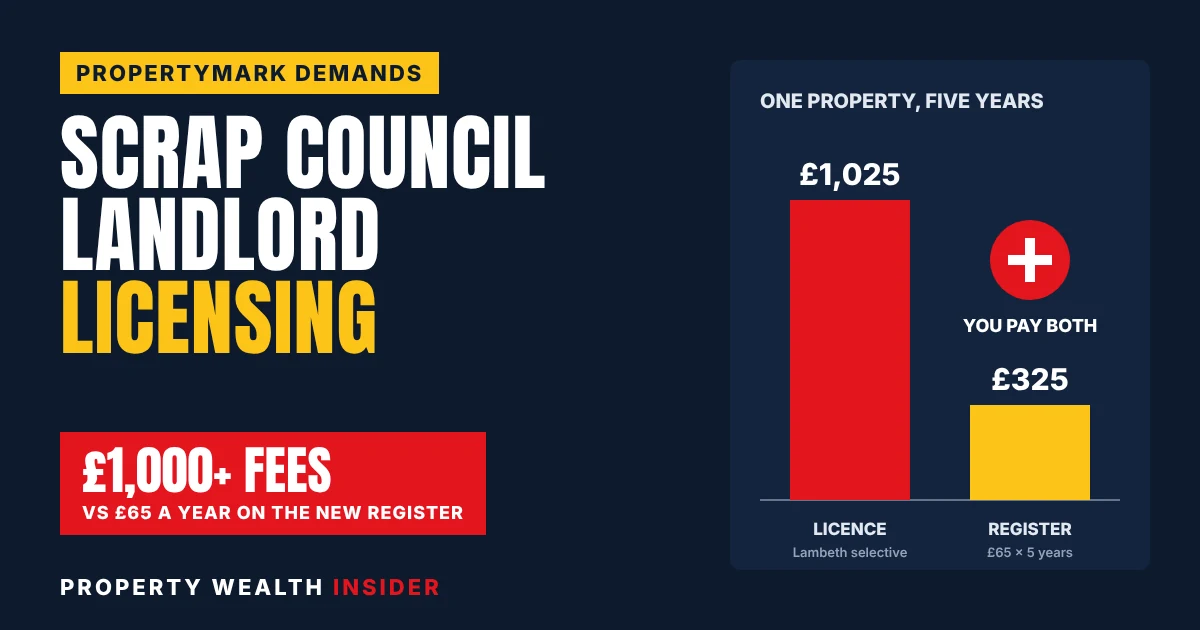
Propertymark wants council landlord licensing scrapped. The trade body for letting agents says the government should commit to removing selective licensing schemes once the national Private Rented Sector Database is up and running, because landlords will soon be paying twice to hand over the same paperwork.
The timing matters. The government’s “Register your rental property” service opens on 15 December 2026 and costs £65 a year per property. Some councils already charge more than £1,000 per property for a licence. If you let in a licensing area, you are about to pay both.
This is a proposal from a trade body, not a change in the law. Licensing stays in force and the database is coming regardless. This applies to England only. Here is what is law, what is just being called for, and what it costs you.
Key facts
- Propertymark’s September 2026 position paper says the government should commit to removing selective licensing once the PRS Database is operational. That is a proposal, not law.
- The “Register your rental property” service rolls out region by region from 15 December 2026, starting in the West Midlands. The last regional deadline is 14 November 2027.
- Registration costs £65 a year per property, renewed annually. It is pro-rated during the rollout.
- Letting or advertising without registering can mean a civil penalty of up to £7,000, rising to £40,000 or prosecution for repeat or serious breaches.
- Licence fees verified on council websites include £1,025 (Lambeth selective) and £1,507 (Wandsworth additional HMO).
- Propertymark wants a 20% cap on the admin share of licence fees and a sunset clause of at most two consecutive five-year terms.
What Propertymark is calling for
On 22 September 2026, Propertymark published a position paper called The effectiveness of local authority landlord licensing schemes. Its central argument is that the PRS Database “will fulfil the function of licensing schemes”, so the government should commit to removing them once the database is operational.
The paper argues that councils already have plenty of enforcement tools, including HHSRS hazard ratings, improvement notices, prohibition orders, civil penalties, banning orders and rent repayment orders. Licensing, it says, uses up officer time on paperwork instead of inspections.
To back this up, Propertymark cites press Freedom of Information research reporting that about two-thirds of councils in England had not prosecuted a single landlord in three years, despite an estimated 300,000 complaints a year about property conditions. It also says more than 84% of councils report difficulty recruiting environmental health staff. These are Propertymark’s figures, drawn from third-party sources, and are not government statistics.
Until licensing is removed, Propertymark wants:
- The database as the primary source of information. Councils would be legally required to use it, so landlords upload gas, electrical and EPC documents once.
- A 20% cap on “Stage One” admin. At most 20% of a licence fee could go on processing, with the rest spent on inspections and enforcement.
- Full cost transparency. Councils would publish the total projected five-year cost of a scheme, plus annual figures for inspections and penalties collected.
- A sunset clause. Schemes would be limited to a maximum of two consecutive five-year terms, with an independent audit before any renewal.
- Fee discounts. These would apply for multiple units in one block and for landlords who use a Propertymark Protected agent. The paper also wants Build to Rent exempted and a “lead authority” model so agents’ fit-and-proper checks are done only once.
What the law actually says today
Nothing has changed yet. Selective licensing comes under Part 3 of the Housing Act 2004, and additional HMO licensing under Part 2. Section 84 says a designation must end no later than five years after it comes into force. However, councils can, and do, make a new designation afterwards.
Since 23 December 2024, councils in England no longer need the Secretary of State’s confirmation for a selective licensing scheme of any size. This is set out in the government’s selective licensing guidance. Before that, schemes covering more than 20% of an area or its private rented homes needed central approval. They still have to consult for at least 10 weeks.
Penalties for getting licensing wrong have gone up. Under section 249A of the Housing Act 2004, as amended by the Renters’ Rights Act 2025, the maximum civil penalty for relevant housing offences, including failing to license, is now £40,000.
The government has not signalled any plan to scrap licensing. Its guide to the Renters’ Rights Act directly answers whether the database means the end of selective licensing. It says selective licensing “remains a valuable tool when used appropriately”.
| Item | Status | Applies to |
|---|---|---|
| Selective and additional HMO licensing | In force (Housing Act 2004) | Designated council areas, England |
| No Secretary of State sign-off for large schemes | In force since 23 December 2024 | England |
| Civil penalty up to £40,000 for licensing offences | In force (s249A, as amended) | England |
| PRS Database registration, £65 per property per year | Rolling out from 15 December 2026 | England, assured and regulated tenancies |
| Scrap licensing once the database is live | Proposal only (Propertymark) | – |
| 20% admin cap, sunset clause, database as primary source | Proposal only (Propertymark) | – |
PRS Database: your registration deadline
According to the government’s “Get ready to register” page, landlords of assured and regulated tenancies must register themselves and each property. You will need a GOV.UK One Login. You will also need to upload your gas safety record, your EICR and your EPC, and give details of any HMO, additional or selective licence.
Your deadline depends on where the property is, not where you live. Each region has a three-month window to register. After that, councils in that region can start enforcement. You can register early from 15 December 2026, and for now only let properties need registering.
| Region | Requirement starts | Deadline to register |
|---|---|---|
| West Midlands | 15 December 2026 | 14 March 2027 |
| East of England | 15 January 2027 | 14 April 2027 |
| East Midlands | 15 February 2027 | 14 May 2027 |
| South East | 15 March 2027 | 14 June 2027 |
| Yorkshire and Humber | 15 April 2027 | 14 July 2027 |
| North West | 15 May 2027 | 14 August 2027 |
| North East | 15 June 2027 | 14 September 2027 |
| London | 15 July 2027 | 14 October 2027 |
| South West | 15 August 2027 | 14 November 2027 |
Source: MHCLG, “Get ready: Register your rental property service”.
Under the Renters’ Rights Act, letting or advertising a property without registering can lead to a civil penalty of up to £7,000. Repeated breaches or false information can mean up to £40,000 or prosecution. Landlords who are not registered also cannot get a possession order, except on the anti-social behaviour grounds.
Licence fees vs the £65 register
Most councils split the licence fee into two parts. Part A is paid on application and covers processing. Part B is paid on grant and covers compliance and enforcement. That split is exactly what Propertymark’s 20% cap targets. The chart uses fees taken directly from council websites.
Look at the dark sections. In Lambeth, Part A is £717.50 of £1,025, or 70% of the fee, before any enforcement money is invoiced. In Wandsworth, it is about 60% for both selective and additional licences. In Brent, it is about 52%. Under Propertymark’s proposed 20% cap, Lambeth’s processing element would be no more than about £205.
Discounts can bring the headline fee down. Wandsworth offers up to 30% off Part A for early applications and money off for good EPC ratings. Lambeth knocks £100 off Part A for each extra flat in the same block. These discounts are often conditional, though, so budget for the full fee.
Calculator: licensing vs register costs
Enter your own portfolio. The defaults are three single lets in a £1,025 selective scheme and one HMO in a £1,040 additional scheme, each on a five-year licence, plus the £65 database fee.
Licensing vs register cost calculator
Guide only. It spreads each licence fee evenly over the licence term and ignores discounts, late fees, pro-rated first-year database fees and renewals. Check your council’s current fee schedule. This is not financial or legal advice.
Worked examples
One flat in Lambeth. A £1,025 selective licence spread over five years is £205 a year. Add £65 for the database and the total is £270 a year, or £22.50 a month. About three-quarters of that is licensing.
Ten flats in Lambeth, all in different streets. You pay £10,250 upfront in licence fees, which is £2,050 a year over five years. Add £650 a year to the register and the total is £2,700 a year. If all ten were in one block, Lambeth’s £100 Part A discount on flats two to ten would cut the upfront bill by £900.
A three-bedroom HMO in Wandsworth. The additional licence is £1,507, which is £301.40 a year over five years. With £65 for the database, the total is £366.40 a year. You would also give much the same certificates to both the council and the register, which is the duplication Propertymark objects to.
What to do now
Don’t stop paying for licences because of this proposal. Until Parliament changes the law, both regimes apply. Here are the steps to take:
- Find your region’s deadline in the table above for every property you let. West Midlands landlords have until 14 March 2027.
- Check each property’s licensing status on your council’s website. Councils can now bring in large selective schemes without Whitehall’s approval.
- Gather your documents in one folder: gas safety record, EICR and its expiry date, EPC, licence numbers, rent and occupancy details.
- Set up a GOV.UK One Login now. You, not your agent, must start the registration.
- Budget for £65 per property each year on top of any licence fees, and diarise the annual renewal.
- Respond to licensing consultations in your area. Each one runs for at least 10 weeks, and the evidence and fee breakdowns are open to challenge.
- Registration deadline noted for each property’s region
- Council licensing status checked for every address
- Licence numbers and expiry dates recorded
- Current gas safety record on file
- EICR or EIC on file, with expiry date
- Valid EPC on file, plus any MEES exemption
- GOV.UK One Login created
- Agent told what they may upload on your behalf
- £65 per property per year added to your budget
FAQs
Is selective licensing being scrapped?
No. Propertymark has called for it to be removed once the PRS Database is operational, but no law has changed. The government says selective licensing remains a valuable tool when used appropriately.
Do I need a licence and to register on the PRS Database?
Yes, if your property is in a licensing area. The two systems are separate. The database even asks you for your licence numbers.
How much is the landlord register fee?
It is £65 per property per year, renewed annually. The government says the fee will be pro-rated during the rollout so that early registrants don’t pay more.
When do I have to register my rental property?
It depends on the property’s region. The rollout starts with the West Midlands on 15 December 2026 (deadline 14 March 2027) and finishes with the South West (deadline 14 November 2027). Empty properties don’t need registering yet.
What is the fine for not registering?
It is up to £7,000 for letting or advertising an unregistered property. For repeat breaches or false information, it is up to £40,000 or criminal prosecution. You also can’t get a possession order on most grounds until you register.
Does this apply in Wales or Scotland?
No. The PRS Database and the licensing rules covered here apply to England. Wales has its own Rent Smart Wales registration, and Scotland has its own landlord register.
Sources
- Propertymark: The effectiveness of local authority landlord licensing schemes (position paper, 22 September 2026)
- Propertymark: Authorities must shift to transparent and evidence-led licensing
- MHCLG: Get ready for the “Register your rental property” service
- The Private Rented Sector Database Regulations 2026 (legislation.gov.uk)
- GOV.UK: Guide to the Renters’ Rights Act
- GOV.UK: Selective licensing in the private rented sector: a guide for local authorities
- Housing Act 2004, section 84 and section 249A
- Lambeth Council: Selective licensing scheme fees
- Wandsworth Council: Property licence fees and discounts
- Brent Council: Property licensing
This article is news and general guidance only. It is not financial, legal or tax advice.