Greens’ 2% Rent Cap Plan: What It Would Cost Landlords
Green Party leader Zack Polanski has called for a three-year “emergency brake” on private rents that would stop any rise above CPI inflation, wage growth or 2%, whichever is lowest. On today’s official figures, that means a hard 2% ceiling on rent increases.
The pledge is the centrepiece of his speech to the party’s annual conference in Brighton on Friday 2 October 2026, according to extracts released to the Press Association. It is a party proposal, not law, and nothing changes for landlords today. But with ONS data showing rents in England rising at 4.0% a year, a 2% lid would roughly halve the typical annual increase.
Below we explain exactly what has been proposed, what it would cost a landlord in pounds region by region, how rent rises work under the Renters’ Rights Act right now, and what Scotland’s experience of capping rents tells us. Use our calculator to run the numbers on your own tenancy.
Key facts
- The Greens want rent rises capped at the lowest of CPI, wage growth or 2% for three years, as a step towards a permanent “fair rents guarantee”.
- With CPI at 3.1% (August 2026) and regular pay growth at 3.5% (May to July 2026), the cap would currently be 2%.
- Average private rent in England is £1,459 a month, up 4.0% in a year (ONS, August 2026). UK: £1,400, up 3.8%.
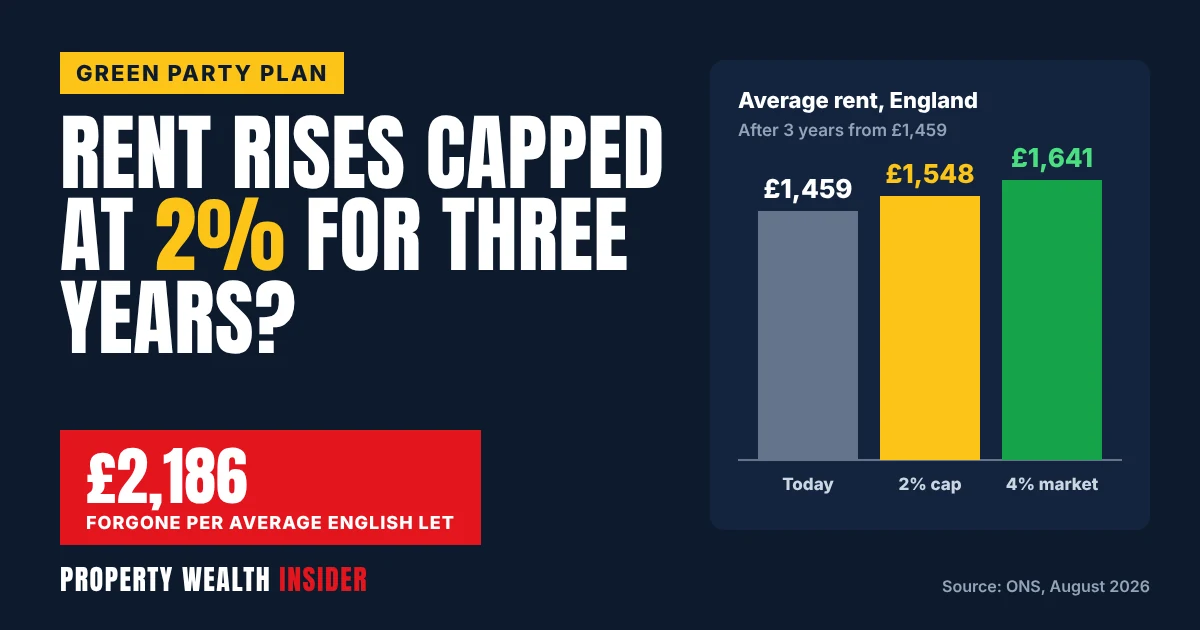
- On an average English tenancy, a 2% cap allows a £29.18 monthly rise against £58.36 at today’s market pace: about £2,186 forgone over three years if rents kept growing at 4%.
- This is a proposal only. In England, landlords can currently raise rent once a year by section 13 notice, and tenants can challenge at the First-tier Tribunal.
What the Greens are proposing
In the pre-released text of his speech, Polanski says: “Today I’m calling for a three-year emergency brake on private rents – no rent rises above CPI, wage growth or 2% – whichever is lower.”
He pitches it as temporary breathing space for tenants while government designs “a national fair rents guarantee”, which he says would keep rents fair and affordable “forever”. In other words, the three-year brake is billed as the first step, not the end point.
The formula is a mirror image of the state pension triple lock. The pension rises by the highest of inflation, earnings growth or 2.5%. The Green rent lock would let rents rise by the lowest of inflation, earnings growth or 2%.
Two details have not been published, so we have not guessed at them: whether the cap would apply to new lettings as well as existing tenancies, and how it would be enforced. Polanski is also the Green candidate in the Holborn and St Pancras by-election on Thursday 8 October 2026, where the party says he will “fight for rent controls”.
In force or proposed? Proposed. This is a policy call from an opposition party. The government’s own guide to the Renters’ Rights Act states that it “does not support the introduction of rent controls”.
What a 2% cap would cost landlords in £
Because the cap takes the lowest of three numbers, the 2% floor does the work almost every time. CPI was 3.1% in August 2026 and regular pay growth 3.5% in May to July 2026, so 2% would bite today.
The table uses the latest ONS average rent and annual growth for each English region, and compares one year’s rise at that pace with a 2% capped rise.
| Area (England) | Average rent, Aug 2026 | Annual rent growth | Monthly rise at that pace | Monthly rise under a 2% cap | Year-one gap per tenancy |
|---|---|---|---|---|---|
| North East | £788 | 5.8% | £45.70 | £15.76 | £359 |
| North West | £969 | 5.8% | £56.20 | £19.38 | £442 |
| Yorkshire and The Humber | £865 | 4.9% | £42.38 | £17.30 | £301 |
| East Midlands | £922 | 3.7% | £34.11 | £18.44 | £188 |
| West Midlands | £982 | 4.9% | £48.12 | £19.64 | £342 |
| East of England | £1,289 | 3.5% | £45.12 | £25.78 | £232 |
| London | £2,332 | 3.5% | £81.62 | £46.64 | £420 |
| South East | £1,426 | 3.0% | £42.78 | £28.52 | £171 |
| South West | £1,245 | 4.4% | £54.78 | £24.90 | £359 |
| England | £1,459 | 4.0% | £58.36 | £29.18 | £350 |
Source: ONS Price Index of Private Rents, August 2026. Regional growth is an average across all private tenancies, not a guide to what any single property can achieve.
Worked example: the average English tenancy over three years
Take the England average of £1,459 a month and assume market rents keep rising at 4% a year, with one increase each year.
- Year 1: market £1,517 vs capped £1,488. Gap £29 a month, £350 over the year.
- Year 2: market £1,578 vs capped £1,518. Gap £60 a month, £721 over the year.
- Year 3: market £1,641 vs capped £1,548. Gap £93 a month, £1,114 over the year.
That is about £2,186 of rent forgone per tenancy across the three years, and the property ends the brake £93 a month below market. A landlord with five average tenancies would be looking at roughly £10,900. If market growth slows towards 2%, the gap shrinks towards zero.
Green rent cap calculator
Guide only, not financial advice. Assumes one rent increase at the start of each year and that CPI, wage growth and market growth stay at the figures entered. The Green proposal is not law and its final design, if ever legislated, could differ.
Rents vs inflation vs wages: the data
The Greens’ central claim is that rents have outrun pay. The ONS numbers back that up for 2024 and early 2025, when annual rent growth peaked at 9.0% against pay growth of under 6%. Since then the gap has closed sharply.
Three things stand out for landlords:
- Rent growth has more than halved. UK rents rose 9.0% a year at the end of 2024. By August 2026 it was 3.8%, with a small uptick since June.
- Rents and pay are now close. Rent growth of 3.8% sits just above regular pay growth of 3.5%, far narrower than the gap of three to four points in late 2024. In January and February 2026, pay actually grew faster than rents.
- The 2% floor would almost always bind. In the 25 months shown, CPI dipped below 2% just once (1.7% in September 2024). Every other month the cap would have been exactly 2%.
The rules today: rent rises under the Renters’ Rights Act
There is no cap on rent increases in England. What there is, since the Renters’ Rights Act 2025 tenancy reforms came into force on 1 May 2026, is a strict process for private assured periodic tenancies:
- Once a year only. You can increase the rent once a year, and not in the first year of the tenancy.
- Section 13 notice. Use Form 4A (“Landlord’s notice proposing a new rent”) and give it at least two months before the new rent starts.
- No rent review clauses. Increases by any other route are not allowed. An increase agreed before 1 May 2026 under a rent review clause that would take effect after that date does not apply.
- Tenant challenge. A tenant who thinks the proposed rent is above the open market rent can apply to the First-tier Tribunal, which decides what you could expect to get if you relet on the open market.
- No upside for the landlord. Tenants never pay more than the landlord asked for, the new rent applies from the date of the tribunal’s decision rather than being backdated, and the tribunal can defer an increase by up to a further two months for undue hardship.
So the current system already limits how often and by what process rent goes up, with market rent as the ceiling. The Green plan would replace market rent as the ceiling with a fixed percentage. These rules cover England only; Wales, Scotland and Northern Ireland have their own tenancy laws.
Scotland’s rent cap and the wider debate
Scotland is the nearest UK test case. The Cost of Living (Tenant Protection) (Scotland) Act 2022 brought in temporary rent restrictions for existing tenants, which the Scottish Government says applied from September 2022 to March 2024, with the cap set at 3% from 1 April 2023. A modified rent adjudication process followed from April 2024 to March 2025.
Crucially, those limits applied to existing tenancies only. New-let rents were not directly restricted. Scotland has now moved to a permanent framework under the Housing (Scotland) Act 2025: ministers can designate rent control areas where increases are limited to CPI plus 1%, up to a maximum of 6%. Councils’ first assessments are due by 31 May 2027.
Even Scotland’s permanent model is looser than the Green brake. At August’s 3.1% CPI it would allow 4.1%, more than double the 2% the Greens propose.
The arguments on each side
For: Polanski argues landlords have been able to “hike prices way beyond wages” and that a brake would let pay catch up, giving tenants certainty and ending “evictions under the guise of rent rises”.
Against: the UK government says it does not support rent controls. In comments reported in April 2026, housing minister Matthew Pennycook said they “could make life more difficult for renters”, citing evidence from Sweden, Germany, San Francisco and “the recent Scottish experience”, and adding that controls typically help settled, better-off tenants more than people looking for a home. The National Residential Landlords Association argues controls cut supply as landlords sell up; a YouGov survey it commissioned in 2023 found 37% of landlords said they would sell if strict rent controls with an outside body setting rents were introduced.
For landlords, the practical point is cost. Mortgage interest, insurance, repairs and compliance do not rise by a maximum of 2% a year. A cap below inflation is a real-terms rent cut.
What landlords should do now
Nothing changes legally today, but the direction of political debate matters for long-term planning. A sensible five-step response:
- Don’t panic or rush increases. This is an opposition party proposal with no route into law as things stand. An unjustified jump also risks a tribunal challenge.
- Know each tenancy’s review date. Note when the tenancy started and when the rent last changed, since you get one section 13 increase a year and none in year one.
- Keep market evidence on file. Save comparable listings and agent valuations. If a tenant challenges, the tribunal decides on open market rent.
- Stress-test at 2%. Rerun your cash flow assuming rents rise just 2% a year for three years while costs rise with inflation. Our calculator gives the income side.
- Watch the politics. Track the Holborn and St Pancras result on 8 October and any rent control commitments from other parties, and respond to consultations when they come.
- List every tenancy with its start date and last rent change date
- Check any rent increase uses Form 4A with at least two months’ notice
- Remove reliance on rent review clauses in your planning
- Save three or more local comparables for each property
- Run the rent cap calculator for each property
- Model cash flow with 2% rent growth and current-inflation costs
- Set a diary note for the 8 October by-election result
FAQ
Is the Green Party rent cap law?
No. It is a proposal set out by Green Party leader Zack Polanski at the party’s conference in Brighton on 2 October 2026. The government says it does not support rent controls.
How much could rent go up under the Green Party plan?
By the lowest of CPI inflation, wage growth or 2%. With CPI at 3.1% and regular pay growth at 3.5%, that is 2%: £29.18 a month on England’s £1,459 average rent.
How often can a landlord increase rent in England?
Once a year, and not in the first year of the tenancy, using a section 13 notice (Form 4A) with at least two months’ notice. Rent review clauses can no longer be used.
Can a tenant challenge a rent increase?
Yes. In England a tenant can ask the First-tier Tribunal to decide the open market rent. The tenant will never pay more than the landlord proposed, and the new rent starts from the tribunal’s decision date.
Does the Renters’ Rights Act cap rents?
No. It controls the process and frequency of increases, but landlords can still raise rent in line with the market. It also bans accepting bids above the advertised rent.
Is there rent control in Scotland?
Scotland’s temporary cap on existing tenancies has ended. Under the Housing (Scotland) Act 2025, ministers can designate rent control areas where rises are limited to CPI plus 1%, up to 6%, with councils’ first assessments due by May 2027.
Sources
- Press Association report of Zack Polanski’s conference speech (via Nation.Cymru), 2 October 2026
- Green Party: Zack Polanski selected for Holborn and St Pancras by-election
- ONS: Private rent and house prices, UK: September 2026
- ONS: Price Index of Private Rents, monthly price statistics
- ONS: CPI annual rate (D7G7)
- ONS: Average weekly earnings, regular pay growth (KAI9)
- The Renters’ Rights Act 2025 (Commencement No. 2 and Transitional and Saving Provisions) Regulations 2026
- GOV.UK: Renting out your property – rent increases
- GOV.UK: Guide to the Renters’ Rights Act
- Scottish Government: Rent controls
- Scottish Government: Scottish Housing Market Review Q3 2025 – private rental sector
- Scottish Government: Cost of Living (Tenant Protection) (Scotland) Act 2022 – statement of reasons
- NRLA: Government cites international evidence against rent controls
- NRLA: YouGov research on rent controls
This article is news and general guidance only. It is not financial, legal or tax advice.