£7,500 Heat Pump Grant Faces Budget Axe: What Landlords Must Do
The £7,500 heat pump grant that thousands of landlords have been eyeing could be trimmed in the Budget on Wednesday 28 October 2026. The Guardian reported on 12 October that ministers are preparing to cut “hundreds of millions of pounds” from the Boiler Upgrade Scheme to help pay for higher defence spending.
Nothing has been announced. The grant is open today, at the same rates, and the reports say the scheme will not be scrapped. But demand has never been higher, the scheme is first come, first served, and the money behind it is now openly in play.
This matters to any landlord in England or Wales whose boiler is near the end of its life, and to anyone planning how to hit the proposed EPC C rules for rented homes by 1 October 2030. Here is what is confirmed, what is only reported, and the sums to run before the Chancellor stands up.
Key facts
- The Boiler Upgrade Scheme (BUS) currently pays £7,500 towards an air source or ground source heat pump, £2,500 for air-to-air and £5,000 for biomass, in England and Wales only.
- Off-gas homes switching from oil or LPG can get £9,000 for applications made between 21 July 2026 and 31 March 2027.
- The Warm Homes Plan gives BUS £2.7bn to 2030, including £400m in 2026/27. The Guardian reports hundreds of millions could be cut. This is not confirmed.
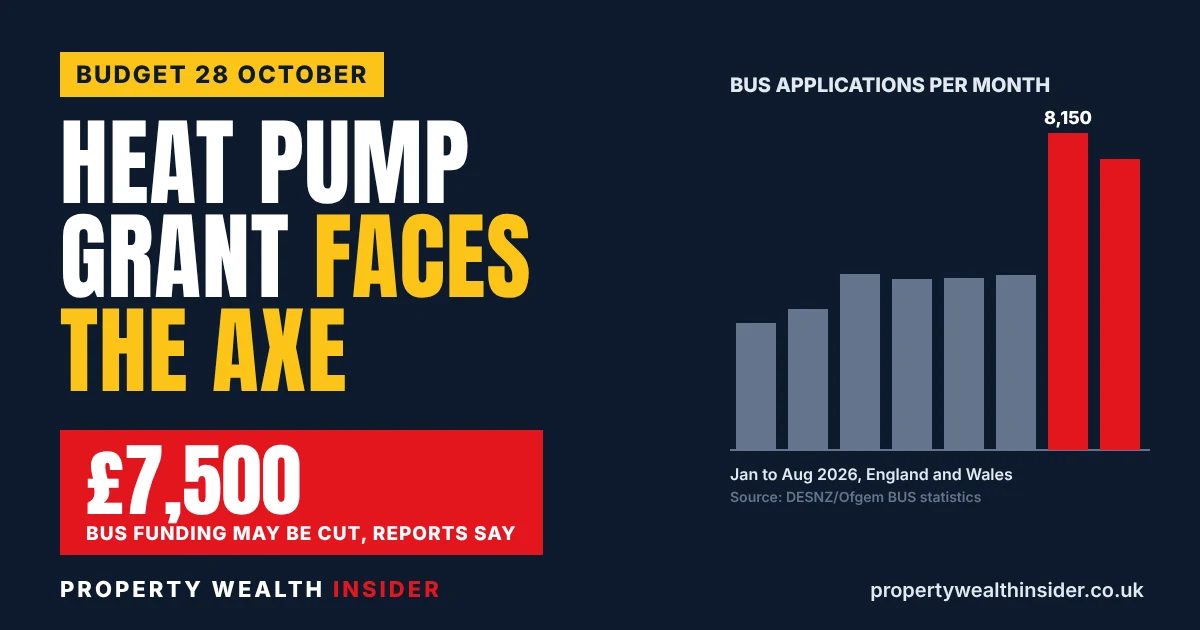
- Voucher applications hit a record 8,150 in July 2026 and 7,486 in August, with 151,136 since launch.
- The Budget is on Wednesday 28 October 2026. The proposed rented-home standard is EPC C by 1 October 2030, with a £10,000 cost cap, and BUS money does not count towards that cap.
What has been reported, and what has not
According to The Guardian, energy secretary Miatta Fahnbulleh has been asked to find more than £2bn of savings from her department to help fund the defence investment plan. Sources told the paper that part of this will come from BUS, though the scheme itself will survive.
The Department for Energy Security and Net Zero (DESNZ) has not confirmed a cut. A spokesperson told the Guardian the department “will set out how we will fund essential investment in our national security this autumn.”
The detail that matters most to landlords is still unknown. A cut could mean smaller grants, a lower yearly budget cap, tighter eligibility, or the money running out sooner each year. Treat every version as possible until the Budget documents are published.
| Item | Status | Source |
|---|---|---|
| £7,500 ASHP/GSHP grant, £2,500 air-to-air, £5,000 biomass | Live now | GOV.UK |
| £9,000 for off-gas oil/LPG homes | Live to 31 March 2027 | Ofgem guidance v5.1 |
| BUS budget: £295m (2025/26), £400m (2026/27), £600m (2027/28), £683m (2028/29), £709m (2029/30) | Published plan | Warm Homes Plan |
| “Hundreds of millions” cut from the £2.7bn five-year budget | Reported, not confirmed | The Guardian, 12 Oct 2026 |
| Budget day | Wednesday 28 October 2026 | HM Treasury |
| EPC C for private rented homes by 1 October 2030 | Policy decided; needs new law | DESNZ government response |
What the grant pays landlords today
Landlords qualify. GOV.UK says you must own the property, and that includes a property you rent out to tenants. You must be replacing a fossil fuel system: oil, gas, LPG or electric. You get one grant per property.
- Air source (air-to-water) heat pump: £7,500.
- Ground or water source heat pump: £7,500.
- Air-to-air heat pump: £2,500. This is new from 28 April 2026.
- Biomass boiler: £5,000, but only for rural properties off the gas grid.
- Off-gas homes heated by oil or LPG: £9,000 towards an air or ground source heat pump, for applications made by 31 March 2027.
The rules exclude social housing, most new builds, hybrid systems (a gas boiler with a heat pump), and properties that have already had government money for a heat pump. Capacity is capped at 45kWth for a single system. Your installer must be MCS certified and belong to a consumer code (RECC or HIES), and they apply to Ofgem for you.
Two changes from 28 April 2026 help landlords. First, a valid EPC is no longer required, although an existing EPC number must be given. Second, the installer has to take the grant off your bill up front. Ofgem’s property owner guidance also says landlords must tell their tenant about the installation. Ofgem will ask you to confirm you have done so.
Loft and cavity insulation are no longer a condition. That requirement was removed in May 2024. Ofgem still recommends insulating where it is practical, because a heat pump costs less to run in a warmer home, and your tenant pays those bills.
Worked example: The official median cost of an air source installation in April to June 2026 was £12,908, including the grant. With the £7,500 grant, a landlord pays about £5,408. On an off-gas oil property with the £9,000 rate, that drops to about £3,908. If the grant fell by £2,500, the standard bill would rise to £7,908. That is a 46% jump in your cash outlay.
Record demand: the numbers behind the scheme
The latest official statistics run to the end of August 2026. They show 151,136 voucher applications since the scheme opened in May 2022 and 93,364 grants paid. 55% of the paid installs replaced gas systems.
Applications jumped when the £9,000 off-gas rate began in July. Across July and August, 5,351 applications were for the higher grant. That is 34% of all applications in those two months.
Why that matters: vouchers are issued “on a first come, first served basis… until the budget cap for the financial year is reached,” according to the official release. Record demand is spending a fixed £400m pot faster. A smaller pot would run out faster still.
Calculator: heat pump vs new gas boiler
Put in your own quotes. The defaults use the official median install cost, the current £7,500 grant and Ofgem’s price cap unit rates for 1 October to 31 December 2026: 26.32p/kWh for electricity and 7.97p/kWh for gas, both GB averages paid by direct debit. The boiler quote, heat demand, efficiency and SCOP figures are illustrative assumptions, so change them to match your property.
Heat pump vs gas boiler: landlord cost check
This is a guide only, not financial advice. Running costs are unit-rate estimates. Standing charges are included only where you remove the gas supply (29.68p/day). Real-world performance depends on the property, the design and the tariff. Get MCS installer quotes before you decide.
With the defaults, the heat pump costs £5,408 after the grant, which is £2,408 more than a £3,000 boiler. The two running costs are almost level at the cap rates: about £886 a year for gas against £877 for the heat pump. Raise the SCOP to 3.5 and the heat pump falls to about £752, roughly £134 a year cheaper. Insulation and the design of the system decide which result you get.
Who gains? On most tenancies the tenant pays the energy bills, so lower running costs help the tenant, not your cash flow. The landlord’s return comes indirectly: an easier route to EPC C, a more lettable home and fewer void periods. Do not count the tenant’s bill savings as your own payback.
How BUS fits the EPC C 2030 plans
Today the legal minimum for most private lets is EPC E. In January 2026 the government confirmed its decisions on a tougher standard for England and Wales: EPC C, measured on new-style EPCs, with one compliance date of 1 October 2030. It still needs new powers in an Act of Parliament and regulations, which ministers aim to bring into force in 2027. It is not law yet.
- Two tests: first a fabric (insulation) standard, then the landlord chooses either a heating system standard or a smart readiness standard (for example solar and batteries).
- Cost cap: £10,000 per property, with a lower cap where £10,000 is 10% or more of the property’s value. Exemptions last 10 years.
- Spend counts from 1 October 2025: eligible work done now counts towards the cap later.
- Already at C? A current EPC rated C or above, lodged before 1 October 2029, counts as compliant until it expires.
Here is the key link. BUS money does not count towards the £10,000 cap. The government’s own example is an £11,000 heat pump that uses only £3,500 of the cap once the £7,500 grant is deducted, leaving £6,500 for insulation. If the grant shrinks, more of your cap goes on the heat pump, or the heat pump route stops making sense and you take the solar and battery route instead.
Tax may help too. The government response says that where a heat pump replaces an existing heating system, the installation can be an allowable expense against rental income, because a heat pump does the same job as the boiler it replaces. Ask your accountant how that applies to your property. Energy-saving materials, including low-carbon heating, also carry 0% VAT until March 2027.
What to do before 28 October
You cannot apply yourself. The installer applies, so the clock starts with getting quotes. A voucher is valid for 3 months for an air source heat pump and 6 months for a ground source one. You cannot lock in a grant now and decide next year.
- Shortlist properties. Pick lets with a boiler over 10 years old, a poor EPC, or oil or LPG heating. Off-gas oil and LPG homes get the £9,000 rate.
- Get two or three MCS quotes now. Ask each installer to confirm eligibility, the heat loss figures, the SCOP, any radiator upgrades, and that the grant is shown off the price.
- Talk to your tenant. You must tell them about the work. Agree access, the time without heating, and where the outdoor unit and cylinder will go.
- Check permissions. Leasehold flats may need freeholder consent. Listed buildings and conservation areas may need planning approval.
- Run the numbers above with your real quotes, then decide whether to go ahead before the Budget or wait.
- Read the Budget on 28 October. Look for any change to grant rates, the yearly cap or start dates, and when it takes effect.
- Property is in England or Wales, owned by me and not social housing
- Current heating is gas, oil, LPG or electric (not already low-carbon)
- No previous government heat pump or biomass funding at this address
- Installer is MCS certified and a RECC or HIES member
- Quote shows the BUS grant deducted up front
- Tenant told about the installation, and access agreed
- EPC number (if any) and recent energy bills ready for the installer
- Freeholder or planning consent checked where needed
- Works and invoices filed for the 2030 cost-cap record and your tax return
FAQ
Is the Boiler Upgrade Scheme being scrapped?
No. The reports say ministers plan to cut its funding, not close it, and the government has not confirmed any change. The scheme is open now and is funded to 2029/30 under the Warm Homes Plan.
Can landlords get the £7,500 heat pump grant?
Yes, for a property you own in England or Wales that you rent to tenants, as long as you are replacing a fossil fuel system. Social housing is excluded. Your MCS installer applies to Ofgem for you.
Do I need an EPC or insulation to get the BUS grant?
Not any more. Since 28 April 2026 a valid EPC is not required, though an existing EPC number must be supplied. The insulation condition was dropped in May 2024. Insulating first is still sensible for your tenant’s running costs.
Does the heat pump grant count towards the £10,000 EPC C cost cap?
No. Under the government’s plans, BUS funding is excluded from the cap, so only your own spend counts. Those 2030 rules are not yet law.
Will a heat pump cost my tenant more to run than a gas boiler?
It depends on the system’s seasonal efficiency (SCOP) and the tariff. At the October to December 2026 cap rates, a heat pump with a SCOP of about 3 costs roughly the same to run as a 90% efficient boiler. Higher efficiency or a heat pump tariff tips the balance in its favour.
When is the Autumn Budget 2026?
Wednesday 28 October 2026, confirmed by the Chancellor, John Healey.
Sources
- GOV.UK: Apply for the Boiler Upgrade Scheme
- Ofgem: BUS guidance for property owners v5.1
- Ofgem: Summary of updates to BUS installer guidance v5
- DESNZ: Boiler Upgrade Scheme statistics, August 2026
- DESNZ: BUS budget for 2026 to 2027
- DESNZ: Warm Homes Plan
- DESNZ: Improving the energy performance of privately rented homes, government response
- HM Treasury: Budget date confirmed
- Ofgem: Energy price cap unit rates and standing charges
- The Guardian: report of planned BUS cut (12 October 2026)
This article is news and general guidance only. It is not financial, legal or tax advice.