Southend landlord licensing ends 30 Nov as £40k fines loom

Southend-on-Sea’s selective licensing scheme switches off on 30 November 2026, and the replacement the council wants to bring in is unlikely to start before 1 April 2027. That leaves roughly four months when no selective licensing designation will be in force across parts of Milton, Kursaal, Victoria and Chalkwell.
The council opened a consultation on a new, wider scheme on 23 October 2026. It closes on 31 December 2026. Council leader Daniel Cowan said his administration wants to “extend its reach so more residents benefit from better housing standards”.
If you let homes in central Southend, this affects you twice: what you must do during the gap, and what the next scheme could cost you. Penalties for getting licensing wrong are now much tougher than they were in 2021.
Key facts
- The current designation ends on 30 November 2026. It came into force on 1 December 2021.
- The council is aiming for a new scheme from 1 April 2027, subject to consultation and approvals. Nothing has been decided yet.
- The proposed area covers 12 neighbourhoods (LSOAs) with 5,685 privately rented homes, which is 50.96% of households there. The current scheme covers nine LSOAs.
- The current licence fee is £830 (Part A £208 plus Part B £622). Fees for the new scheme have not been published yet.
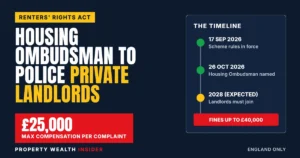
- Since 1 May 2026 the maximum civil penalty for an unlicensed property in England is £40,000, up from £30,000. Tenants can also claim up to 2 years’ rent back through a rent repayment order.
- The consultation closes on 31 December 2026.
What is happening and when
Under section 84 of the Housing Act 2004, a selective licensing designation can last no more than five years. Southend’s public notice confirms the scheme was made on 18 March 2021, started on 1 December 2021 and “shall cease to have effect on 30th November 2026”.
Councils can’t simply roll a scheme over. A new designation needs fresh evidence, a consultation lasting at least 10 weeks and a formal decision. It also cannot come into force until three months after it is made.
Southend’s consultation runs to 31 December 2026, so the earliest start is spring 2027. The council’s own announcement says plainly: “There will be a gap between the existing scheme ending and any replacement beginning.”
What the council is proposing
The 2026 proposal document sets out a designation covering 12 Lower Layer Super Output Areas (LSOAs). These are small census neighbourhoods. All 12 are in Milton, Kursaal, Victoria and Chalkwell wards, compared with nine LSOAs in the current scheme.
Together they hold 11,155 households, and 5,685 of those rent privately. That is 50.96% of households, against 26.5% across Southend as a whole. The full street list is in the consultation pack, so check your address before assuming you are in or out.
Fees. The council is proposing a two-stage fee: an application fee that is the same for everyone, then a second “scheme management and compliance” fee charged on a sliding scale. A licence granted in year 1 would pay more than one granted in year 4, because it runs for longer. The proposal document does not give amounts, so we don’t know the new fees yet. The current fee is £830.
What the current scheme achieved. The council’s evaluation says 4,394 licences had been issued by August 2025. It also found that 1,896 properties had initial compliance inspections, which turned up 1,689 hazards that tenants had never reported. Formal enforcement actions went from 5 in 2021 to 48 in 2024. Expect the council to use these figures to make its case.
The four-month gap: what changes and what does not
A house only has to hold a selective licence while it is in an area “for the time being designated” (section 79). So from 1 December 2026 until any new scheme starts, failing to hold a selective licence in these streets is not an offence. Almost everything else carries on as normal.
| Rule | During the gap (1 Dec 2026 to new start) |
|---|---|
| Selective licence needed for a single-household let | No. There is no designation in force. |
| Mandatory HMO licence (5 or more people, more than 1 household, sharing facilities) | Yes, still required. This is national and does not depend on the designation. |
| Gas safety, electrical (EICR), EPC, smoke and CO alarms | Yes, all still apply. |
| Council enforcement (improvement notices, civil penalties for other offences) | Yes. The council says its wider powers “will remain in place”. |
| Existing licence conditions | Unclear. Check your licence’s end date and ask the council. See below. |
| Licence under the new scheme | Likely to need a fresh application and fee if your street is included. |
Watch the small print on existing licences. Section 91(5) of the Housing Act says a licence continues for its stated period even if the house “ceases to be a Part 3 house”. Southend’s own pages say a licence lasts five years from the date it is issued. Many licences issued from December 2021 will run out around the same time as the scheme anyway. If yours was issued later, it may still be in date, and the council says it is considering “transitional arrangements”. Treat your conditions as binding until the council tells you in writing that they are not.
The penalties are bigger now
When the first scheme launched in 2021, the maximum civil penalty for an unlicensed property was £30,000. Since 1 May 2026, section 249A caps it at £40,000 per offence in England. Prosecution is the alternative to a civil penalty, and it can lead to an unlimited fine.
The Renters’ Rights Act 2025 also doubled rent repayment orders. For an unlicensed house, the First-tier Tribunal can now order up to 2 years’ rent to be repaid for the period the offence was being committed (Housing and Planning Act 2016, s44). The limit used to be 12 months. Both changes took effect on 1 May 2026.
The Act also widened who can be prosecuted under section 95. Superior landlords can now be liable as well, although they have new “reasonable excuse” defences. Landlords who let through rent-to-rent arrangements should take note.
Worked example. Say you rent a flat for £1,100 a month and miss the new scheme’s start date by 12 months. You could face a civil penalty of up to £40,000 plus a rent repayment order of up to £13,200 (12 x £1,100), which is up to £53,200 in total. The licence would have cost £830 at today’s fee, or £166 a year over five years.
Calculator: licence cost against penalty risk
Selective licence cost vs penalty calculator
Guide only, not legal advice. This calculator uses the legal maximums. Councils set actual penalties using their own enforcement policy, and the tribunal decides rent repayment amounts. It assumes one penalty per unlicensed property and ignores any universal credit deductions.
Change the fee once Southend publishes its proposed charges. The gap between the two numbers is the point: a licence costs a few hundred pounds a year, while being caught without one can cost tens of thousands.
What to do now: step by step
- Check both maps. Look up your address on the current designated area map and in the proposed street list (Appendix B of the consultation pack). Some streets may be added and some dropped.
- Find your licence end date. It is on the first page of the licence, next to your SOU reference. Diary it.
- Keep complying through the gap. Keep your gas certificate, EICR and EPC in date and your alarms working. Keep managing anti-social behaviour and rubbish as your licence conditions require. Hazards found now still lead to enforcement.
- Check whether any property is an HMO. Five or more people from more than one household need a mandatory HMO licence, gap or no gap.
- Respond to the consultation by 31 December 2026. Comment on the boundary, the conditions and the two-stage sliding-scale fee. Ask the council to publish the actual fee figures it has promised.
- Get your documents ready for a new application. Have a floorplan with room sizes, current certificates, details of everyone with an interest in the property (including your mortgage lender) and an agent declaration if you use one.
- Apply as soon as any new scheme opens. Under section 95(3), a properly made application is a defence to the unlicensed offence. On the proposed sliding scale, applying early may not cost more.
How to respond: complete the survey on Your Say Southend. You can also email consultations@southend.gov.uk, phone 01702 215408, or write to Southend-on-Sea City Council, Big Sparks Project, PO Box 6, Civic Centre, Victoria Avenue, Southend-on-Sea, SS2 6ER.
- Address checked against the current map and the proposed street list
- Licence end date and SOU reference noted
- Gas safety certificate in date (renewed every 12 months)
- EICR and EPC in date and copies saved
- Smoke and carbon monoxide alarms tested
- HMO status checked for each property
- Floorplan with room sizes in square metres ready
- Consultation response submitted before 31 December 2026
- Reminder set to apply as soon as any new scheme opens
FAQs
When does Southend selective licensing end?
The current designation ends on 30 November 2026, according to the council’s public notice. It started on 1 December 2021.
Do I need a licence in Southend between December 2026 and April 2027?
Not a selective licence, because no designation will be in force. You still need a mandatory HMO licence if the property is a large HMO, and all the usual safety rules still apply.
How much is a Southend selective licence?
The current fee is £830 per property, paid as Part A (£208) and Part B (£622). The new scheme would use a two-stage fee with a sliding second stage, but the amounts have not been published.
What is the fine for not having a selective licence?
In England, a council can impose a civil penalty of up to £40,000 for offences from 1 May 2026, or prosecute instead, which can mean an unlimited fine. Tenants can also seek a rent repayment order of up to 2 years’ rent.
Will my current Southend licence carry over to the new scheme?
The council has not confirmed this. It says it will “consider the appropriate transitional arrangements”. Plan on needing a new application if your street is in the new area.
Does this apply in Wales or Scotland?
The Southend scheme only covers its designated streets. The £40,000 civil penalty and the rent repayment order rules described here apply in England.
Sources
- Southend-on-Sea City Council: Have your say on plans to renew and expand landlord licensing (23 October 2026)
- Your Say Southend: Selective Licensing Consultation and Scheme Proposal 2026
- Southend Borough Council: Public notice, designation of an area for selective licensing (2021)
- Southend-on-Sea City Council: Selective licensing applications and fees
- Housing Act 2004, s84 (duration of designations)
- Housing Act 2004, s91 (licence duration)
- Housing Act 2004, s95 (licensing offences)
- Housing Act 2004, s249A (civil penalties)
- Housing and Planning Act 2016, s44 (rent repayment orders)
- GOV.UK: Selective licensing in the private rented sector, a guide for local authorities
- GOV.UK: House in multiple occupation licence
This article is news and general guidance only. It is not financial, legal or tax advice.