London flat prices crash 8.1%: worst fall since 2009
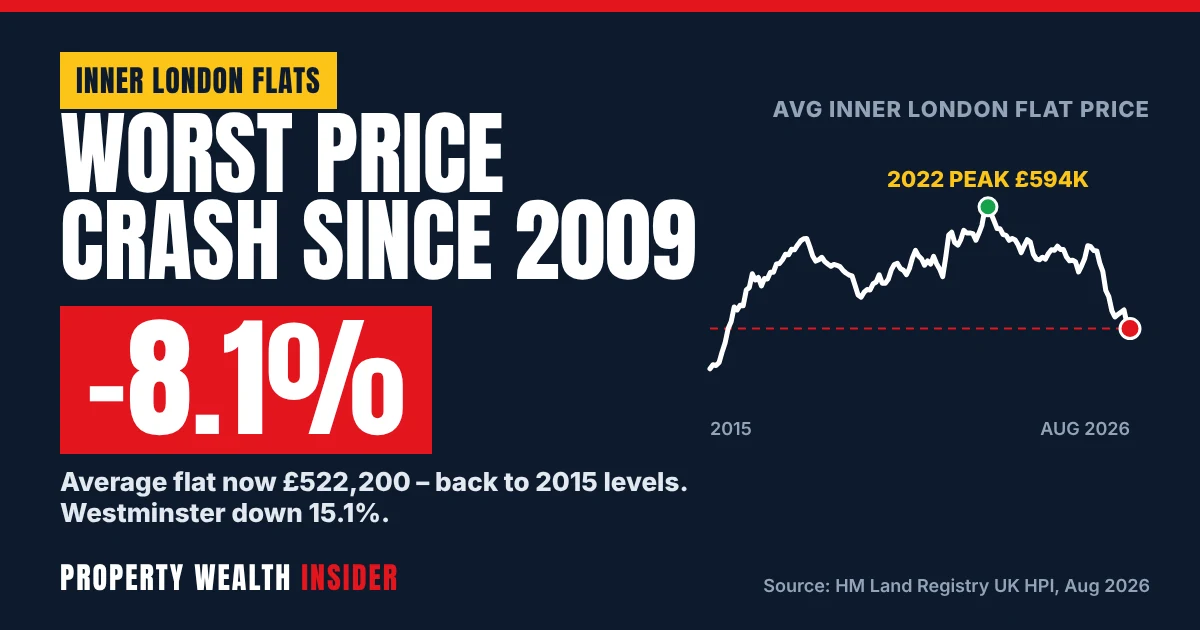
Flats in inner London have just had their worst year since the financial crisis. Official UK House Price Index figures for August 2026 put the average inner London flat or maisonette at £522,200, down 8.1% in a year.
That is the steepest annual fall for inner London flats since August 2009, and it drags prices back to where they were in the summer of 2015. Anyone who bought at the September 2022 peak is, on average, about £72,000 under water on paper. The data comes from HM Land Registry’s UK HPI data downloads for August 2026, published on 21 October 2026.
This matters most to landlords with central London flats who are coming up to a remortgage, thinking of selling, or weighing up whether this is a buying opportunity. Below we break down the borough numbers, show what the fall does to your equity and loan-to-value, and work through the stamp duty on a purchase today.
Key facts
- Inner London average flat price: £522,200 in August 2026, down 8.1% year on year (UK HPI).
- Biggest annual fall for inner London flats since August 2009 (-9.6% then); prices are back to July 2015 levels (£522,051).
- Down £71,935 (12.1%) from the September 2022 peak of £594,135, and £48,968 since June 2025.
- Westminster flats down 15.1% in a year to £784,694; Kensington and Chelsea down 15.3%.
- Across the UK, flats fell just 1.6% (England: 2.9%), so this is a central London problem.
- A buy-to-let buyer pays £42,220 stamp duty on an average inner London flat in England, versus £16,110 for a home mover.
What the official figures show
The UK HPI splits prices by property type. For flats and maisonettes in the inner London region (the 13 central boroughs plus the City), the August 2026 figure is £522,200. A year earlier it was £568,254.
Prices fell 1.5% in July and another 0.5% in August, so the slide was still going in the latest month. The annual fall of 8.1% is the deepest since August 2009, when inner London flats were down 9.6%.
The peak came in September 2022 at £594,135. The latest figure is barely above July 2015’s £522,051, which wipes out more than a decade of nominal growth, before inflation is even counted.
Health warning on the data: the UK HPI is built from completed sales registered with HM Land Registry, so the latest months are based on fewer transactions and are routinely revised as more sales are logged. Borough-level flat figures are noisier still. Treat single-month moves with caution; the trend since 2022 is the real story.
Borough by borough: where flats fell hardest
The pain is concentrated in prime central London. Westminster, Kensington and Chelsea, the City and Tower Hamlets all show double-digit annual falls. Hackney and Southwark held up far better.
| Area | Avg flat price, Aug 2026 | Change in 12 months | Avg flat price, Sep 2022 | Change since Sep 2022 |
|---|---|---|---|---|
| City of Westminster | £784,694 | -15.1% | £1,015,139 | -22.7% |
| Kensington and Chelsea | £947,855 | -15.3% | £1,327,222 | -28.6% |
| City of London | £726,060 | -14.6% | £899,457 | -19.3% |
| Tower Hamlets | £429,851 | -13.6% | £538,333 | -20.2% |
| Camden | £656,955 | -11.4% | £714,030 | -8.0% |
| Islington | £542,886 | -9.1% | £595,251 | -8.8% |
| Lambeth | £441,815 | -7.2% | £501,654 | -11.9% |
| Wandsworth | £532,028 | -6.5% | £589,775 | -9.8% |
| Hammersmith and Fulham | £579,711 | -6.4% | £650,045 | -10.8% |
| Southwark | £466,671 | -2.9% | £497,553 | -6.2% |
| Hackney | £535,923 | -2.3% | £550,803 | -2.7% |
| Inner London | £522,200 | -8.1% | £594,135 | -12.1% |
| Outer London | £334,010 | -2.4% | £351,605 | -5.0% |
| England (all flats) | £218,563 | -2.9% | £232,246 | -5.9% |
| United Kingdom (all flats) | £194,148 | -1.6% | £199,792 | -2.8% |
Source: UK HPI full file, August 2026, flat/maisonette series. September 2022 is the inner London peak, not necessarily each borough’s own peak.
Note the gap between the headline and flats. All property types in London fell just 2.2% over the year, according to HM Land Registry’s August 2026 release. Houses are holding up; flats are taking the hit.
What the fall means for your equity and LTV
Falling values hit leveraged landlords twice. Your equity shrinks by the full amount of the fall, and your loan-to-value (LTV) rises, which can push you into a pricier rate band at remortgage.
Worked example: bought at the 2022 peak
Say you paid £550,000 for an inner London flat in September 2022 with a 75% interest-only mortgage of £412,500. Apply the UK HPI inner London flat index (102.2 then, 89.9 now) and the flat is worth roughly £483,800 today.
That is a paper loss of about £66,200 (12.0%). Your equity has dropped from £137,500 to around £71,300, and your LTV has climbed from 75% to roughly 85%. Many buy-to-let lenders cap at 75% LTV, so a like-for-like remortgage may need a cash top-up of around £50,000 to get back under 75%.
Try your own figures below. Pick your borough and when you bought; the tool scales your purchase price by the official flat index for that area.
London flat: what is my equity now?
Guide only, not advice. Uses HM Land Registry UK HPI flat/maisonette index values for each area (August 2026 release). An index tracks the average flat; your flat’s value depends on its condition, floor, lease length and service charges. Get a proper valuation before acting.
Why central London flats are falling
HM Land Registry publishes prices, not reasons. But three pressures on flat buyers and owners are easy to see in the official data and rules.
1. Mortgage rates jumped in spring 2026
Bank of England data for the average quoted two-year fixed rate at 75% LTV (series IUMBV34) shows 3.97% in February 2026, 4.45% in March and 5.14% in April. It was 4.92% in August and 5.13% in September 2026.
On a £400,000 interest-only buy-to-let loan, moving from 3.97% to 4.92% adds about £3,800 a year in interest (£15,880 to £19,680). Expensive flats on modest rental yields feel that first.
2. Landlord tax and regulation
Since April 2020, individual landlords can only get a basic-rate (20%) tax credit on mortgage interest, the Section 24 rule. A higher-rate landlord paying £19,680 interest gets a £3,936 credit, against the £7,872 a full 40% deduction would have been worth.
In England, Section 21 “no fault” possession ended on 1 May 2026 when Part 1 of the Renters’ Rights Act 2025 came into force. Some smaller landlords are selling up, and flats are the classic first or only buy-to-let, so more stock is coming to market.
3. Stamp duty on additional properties
Since 31 October 2024, the higher rates for additional dwellings in England and Northern Ireland have been 5 percentage points above the standard rates. On a central London flat that is a five-figure bill, which shrinks the pool of investor buyers.
Stamp duty on an inner London flat today
Stamp Duty Land Tax applies in England and Northern Ireland. Scotland has Land and Buildings Transaction Tax and Wales has Land Transaction Tax, with their own rates and surcharges. The figures below are the current England SDLT residential rates.
| Portion of price | Standard rate | Additional property rate |
|---|---|---|
| Up to £125,000 | 0% | 5% |
| £125,001 to £250,000 | 2% | 7% |
| £250,001 to £925,000 | 5% | 10% |
| £925,001 to £1.5 million | 10% | 15% |
| Above £1.5 million | 12% | 17% |
Worked example: buying the average inner London flat
At £522,200, a landlord buying an additional property pays 5% on the first £125,000 (£6,250), 7% on the next £125,000 (£8,750) and 10% on the remaining £272,200 (£27,220). Total: £42,220.
A home mover pays £16,110 on the same flat, so the surcharge costs the investor £26,110. A non-UK resident landlord adds a further 2%, taking the bill to £52,664. First-time buyer relief does not apply, because the price is over £500,000.
Put another way, an investor’s stamp duty alone is about 8.1% of the price, roughly the same as the fall in values over the past year.
Stamp duty on a London flat (England)
Guide only, not tax advice. England and Northern Ireland SDLT rates from gov.uk. Ignores reliefs, company purchases over £500,000 (17% rate may apply), leases and mixed-use property. Not for Scotland or Wales. Check with HMRC’s SDLT calculator or your conveyancer.
What to do now: a step-by-step plan
- Check your real LTV. Run your numbers through the equity tool above, then get a desktop valuation from your broker. Index figures are averages, not your flat.
- Diary your deal expiry. If your fix ends in the next 6-9 months, start talking to a broker now. Many lenders let you secure a new rate months in advance.
- Stress-test the rent. Work out whether the rent covers interest at today’s rates (around 5% on a two-year fix at 75% LTV) plus service charge and ground rent.
- Plan a top-up if you are over 75%. Decide whether to pay down capital, accept a higher-LTV product, or move to a longer fix.
- Do not panic-sell at the bottom of a falling market without the maths. Compare sale proceeds after agent fees and any capital gains tax with holding costs over two to three years.
- If you are buying, price in the surcharge. Use the stamp duty calculator and negotiate hard: sellers in prime central boroughs are facing double-digit falls.
- Know my flat’s purchase price, date and current mortgage balance
- Calculated my LTV against today’s estimated value
- Checked my fixed-rate end date and any early repayment charges
- Spoken to a broker about remortgage options and LTV bands
- Checked rent covers interest, service charge and ground rent
- Reviewed my Section 24 tax position with an accountant
- Budgeted stamp duty at the additional-property rates before any purchase
FAQs
Are London flat prices falling?
Yes, in central London. The UK HPI shows inner London flats down 8.1% in the year to August 2026, to £522,200. Outer London flats fell only 2.4% and UK flats overall fell 1.6%.
How much have Westminster flat prices dropped?
The average flat in the City of Westminster was £784,694 in August 2026, down 15.1% on a year earlier and 22.7% below September 2022, according to the UK House Price Index.
Are London flat prices back to 2015 levels?
For inner London, yes. The August 2026 average of £522,200 is almost exactly where it stood in July 2015 (£522,051), so the past 11 years of growth have gone in cash terms.
How much stamp duty does a landlord pay on a London flat?
In England, a landlord buying an additional property at the inner London average of £522,200 pays £42,220 under the current rates, including the 5% surcharge. Non-UK residents pay 2% more.
Is now a good time to buy a London flat to let?
Prices are well below the 2022 peak, but mortgage rates are higher and the 5% surcharge adds a big upfront cost. Run the yield at today’s rates before buying; this article is not advice.
Does the stamp duty surcharge apply in Scotland and Wales?
No. SDLT covers England and Northern Ireland. Scotland charges LBTT with its own Additional Dwelling Supplement, and Wales charges LTT with its own higher rates.
- HM Land Registry: UK House Price Index data downloads, August 2026
- HM Land Registry: UK House Price Index for August 2026 (press release, 21 October 2026)
- Bank of England Database: IUMBV34, 2-year fixed rate mortgage (75% LTV)
- GOV.UK: Stamp Duty Land Tax residential property rates
- GOV.UK: SDLT higher rates for additional residential property
- GOV.UK: Changes to tax relief for residential landlords
- GOV.UK: Repossessing your privately rented property after 1 May 2026
This article is news and general guidance, not financial, legal or tax advice.