Savills: House Prices to Fall 1.5% in 2027 as Recovery Delayed
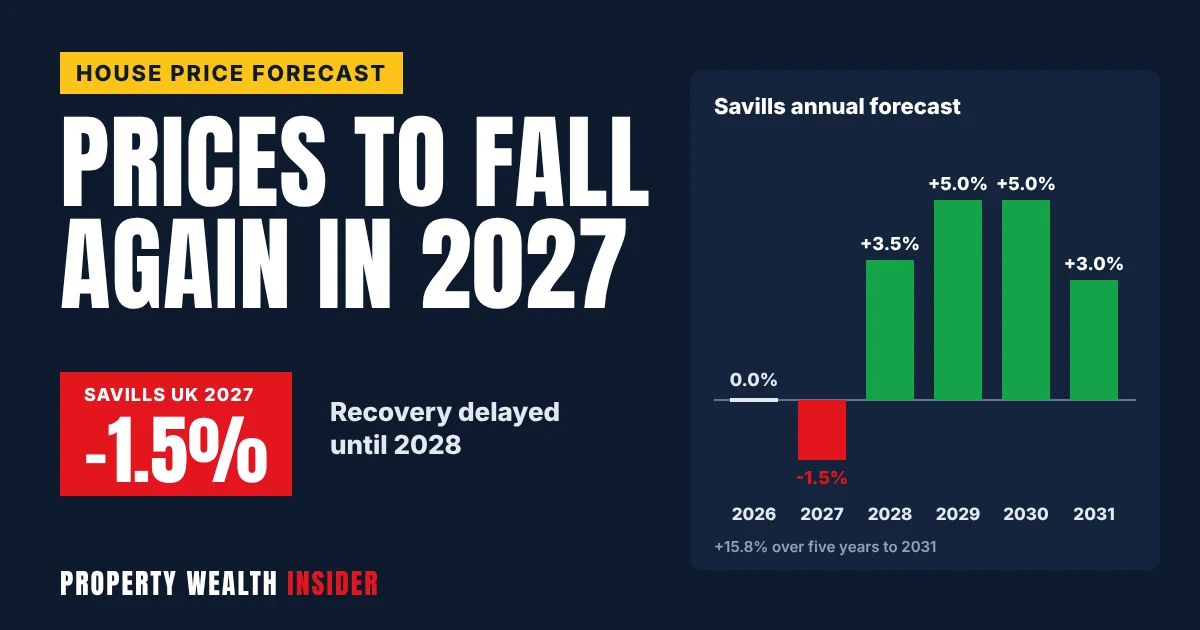
Savills now expects UK house prices to fall again in 2027, by 1.5%, and has pushed the start of any real recovery back to 2028. The estate agent’s new five-year forecast, published on 4 November 2026, blames the drawn-out Middle East conflict for keeping mortgage rates higher for longer.
It is a sharp U-turn. Five months ago Savills was pencilling in a 2.5% rise for 2027. Now it says average mortgage rates will not drop below 5% until early 2028, and that prices will slide over the rest of 2026 and through 2027, a total peak-to-trough fall of around 3%.
For landlords the headline matters less than the detail: values that dip just as fixed rates end can push loan-to-value ratios over lender limits. Below we break down the numbers region by region, and our calculator shows what the forecast means for your own property’s equity and LTV each year to 2031.
Key facts
- Savills forecasts UK mainstream prices 0.0% in 2026 and -1.5% in 2027, a peak-to-trough fall of about 3%.
- Growth then returns: +3.5% in 2028, +5.0% in 2029 and 2030, +3.0% in 2031.
- Over five years to 2031 prices rise 15.8%, or £56,500, on Savills’ numbers.
- Average mortgage rates are not expected to fall below 5% until early 2028. Savills assumes Bank Rate of 4.25% at the end of 2027, against 3.75% today.
- London, the South East and East of England fall 3.5% in 2027; the North West rises 23.3% over five years, London just 8.1%.
Savills’ forecast, year by year
The forecast covers the mainstream market, meaning homes mostly bought with a mortgage, and average second-hand prices. Savills notes new-build values may not move at the same rate. Prime property has a separate forecast.
| Year | UK price change | Change in £ | Bank Rate (year end) | Avg mortgage rate (year end) |
|---|---|---|---|---|
| 2026 | 0.0% | – | 4.00% | 5.32% |
| 2027 | -1.5% | -£5,500 | 4.25% | 5.09% |
| 2028 | +3.5% | +£12,500 | 3.25% | 4.23% |
| 2029 | +5.0% | +£18,500 | 3.00% | 4.00% |
| 2030 | +5.0% | +£19,000 | 3.00% | 4.00% |
| 2031 | +3.0% | +£12,000 | 3.00% | 4.00% |
| 5 years to 2031 | +15.8% | +£56,500 | – | – |
Source: Savills Research, using Oxford Economics and Bank of England data. The 2026 figure of 0.0% is the change across the whole year. Savills still expects prices to drift lower between now and the end of 2027.
Savills says growth should pick up in the second half of 2028 and reach 5% a year in 2029 and 2030. That is partly because incomes will have outpaced house prices for six years running, so buyers can afford more. Over the five years it expects prices to beat CPI inflation (9.8%) and nominal income growth (14.4%).
Why Savills cut its forecast
Interest rates. In its June 2026 forecast Savills had 2026 at -2.0%, 2027 at +2.5% and five-year growth to 2030 of 18.5%. Since then the rate outlook has got worse, and the Middle East conflict has pushed back any meaningful cut in mortgage rates.
Bank Rate is 3.75% today, and the Bank of England’s next decision is due on 5 November 2026. Savills’ assumptions, based on Oxford Economics, have Bank Rate rising to 4.00% by the end of 2026 and 4.25% by the end of 2027, then falling to 3.25% in 2028. Its assumed average mortgage rate is 5.32% at the end of 2026 and only drops to 4.23% by the end of 2028.
Why not a crash? Savills gives two reasons. Relatively few owners still have to refinance straight off sub-2% deals, because most have already absorbed higher costs since late 2022. And the labour market remains resilient. Together, it says, those should keep forced sales low.
Buy-to-let warning in the small print: Savills expects lower returns, more regulation and higher taxation to keep buy-to-let activity below its long-term average and to speed up the shift towards larger, professional landlords. First-time buyers, helped by the best deposit affordability since 2008, are tipped to overtake cash buyers as the largest buyer group by 2029.
Regional forecasts: North up, South down
The split is stark. Savills has the North West, North East and Scotland still rising 1% in 2027 while London and the wider South fall 3.5%. Over five years the North West outperforms London almost three to one.
| Region | 2027 | 2028 | 2029 | 2030 | 2031 | 5 yrs to 2031 |
|---|---|---|---|---|---|---|
| North West | +1.0% | +5.0% | +6.0% | +6.0% | +3.5% | +23.3% |
| North East | +1.0% | +5.0% | +5.5% | +5.5% | +3.5% | +22.2% |
| Scotland | +1.0% | +4.5% | +5.5% | +5.5% | +3.5% | +21.6% |
| Yorkshire and the Humber | +0.5% | +4.5% | +5.5% | +5.5% | +3.5% | +21.0% |
| Wales | +0.5% | +4.5% | +5.5% | +5.5% | +3.5% | +21.0% |
| West Midlands | -1.5% | +4.0% | +5.0% | +5.0% | +3.0% | +16.3% |
| East Midlands | -2.0% | +4.0% | +5.0% | +5.0% | +3.0% | +15.7% |
| South West | -3.0% | +3.0% | +5.0% | +5.0% | +3.0% | +13.5% |
| East of England | -3.5% | +2.0% | +4.5% | +4.5% | +3.0% | +10.7% |
| South East | -3.5% | +2.0% | +4.0% | +4.0% | +2.5% | +9.1% |
| London | -3.5% | +2.0% | +3.5% | +3.5% | +2.5% | +8.1% |
| UK | -1.5% | +3.5% | +5.0% | +5.0% | +3.0% | +15.8% |
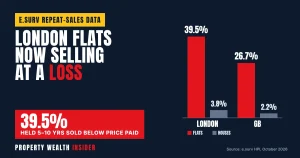
Affordability explains it. In the three northern English regions average prices are below six times average earnings; in London the ratio is 11.3. Savills names Manchester, Leeds, Liverpool and Bristol as likely outperformers, and expects houses to keep beating flats, which face building safety concerns and more supply.
Savills vs Connells
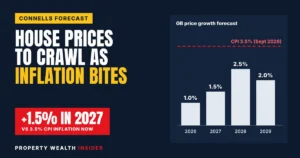
Not everyone is so gloomy. Connells Group, publishing two days earlier, forecasts prices across Great Britain up 1.0% in 2026, 1.5% in 2027, 2.5% in 2028 and 2.0% in 2029. It expects home moves to start recovering in 2027, a year earlier than Savills.
The gap for 2027 is three percentage points: Savills -1.5%, Connells +1.5%. Connells points out the average mortgage rate paid by homebuyers rose from 4.14% at the start of 2026 to 5.22% in October, and says the hit so far has shown up in fewer sales rather than widespread price falls.
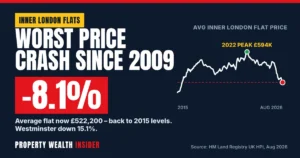
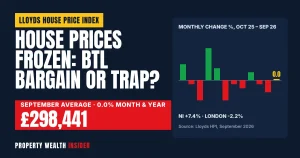
Where the market sits now: the official UK House Price Index put the average UK price at £273,000 in August 2026, up just 0.9% on a year earlier. London averaged £554,430, down 2.2%.
Calculator: what Savills’ forecast means for your property
Enter today’s value and your mortgage balance, pick your region, and the tool applies Savills’ annual figures to show your value, equity and LTV at the end of each year to 2031. It assumes an interest-only loan, so the balance stays the same. Add an extra fall to stress-test a worse 2027.
What Savills’ forecast means for your property
| Year end | Forecast | Value | Equity | LTV |
|---|
Guide only. Applies Savills’ 4 November 2026 annual mainstream forecasts to the value you enter (treated as the end-2026 value, as Savills forecasts 0.0% for 2026). Annual figures smooth out moves within a year, and forecasts are often wrong. Lenders use their own valuations and criteria. This is not financial advice.
The LTV trap: worked examples
A small fall in value has an outsized effect on LTV when you borrow heavily. These examples assume interest-only loans and apply Savills’ regional figures to end-of-year values.
Example 1: UK average. A £273,000 property with a £200,000 mortgage is at 73.3% LTV. Savills’ -1.5% for 2027 takes it to £268,905 and 74.4% LTV, so equity drops from £73,000 to £68,905. By the end of 2031 the value is £316,049 and LTV is 63.3%.
Example 2: South East at the limit. A £350,000 house with a £262,500 loan is exactly 75%. A 3.5% fall leaves it worth £337,750 at the end of 2027 and pushes LTV to 77.7%, wiping £12,250 off equity. On Savills’ path it is still 76.2% at the end of 2028 and only gets back under 75% (73.3%) at the end of 2029.
Example 3: North West. A £200,000 property gains 1% in 2027 to £202,000, and reaches £246,657 by the end of 2031. No LTV squeeze here, which is why Savills’ regional gap matters as much as the national number.
What landlords should do now
This is a step-by-step framework to work through with your broker or adviser, not a recommendation to buy, sell or refinance.
- List every fixed-rate end date. Note which deals expire in 2027, the year Savills expects prices and mortgage rates to be least helpful.
- Run each property through the calculator. Use a realistic value for today, not the price you paid, and add a stress-test fall to see how close you get to your lender’s LTV limit.
- Check remortgage timing. Ask your broker how far ahead of your deal ending you can secure a new rate, and whether a valuation now could beat one taken after further falls.
- Re-test the rent cover. With Savills assuming average mortgage rates above 5% until early 2028, ask your broker to re-run each property’s rental affordability stress test at current product rates and criteria.
- Plan for an LTV breach. If a property could cross the limit, options to discuss include a capital repayment, a product transfer with your existing lender, or cross-checking whether a different lender’s criteria fit.
- Watch for buying opportunities, carefully. If you are cash-rich, a softer 2027 in London and the South may bring motivated sellers. Savills’ highest growth forecasts are in the North West, North East and Scotland, but its numbers are averages, not a guide to any single street.
- Re-check after each rate decision. Savills’ assumptions are tied to Oxford Economics’ Bank Rate path. The Bank’s next decision is on 5 November 2026; a different path changes the picture.
- Fixed-rate end dates listed for every property
- Current value estimate for each property (recent comparables, not purchase price)
- LTV today and at Savills’ projected 2027 low point
- Lender’s maximum LTV and rental stress test noted
- Broker asked how early a new rate can be secured
- Cash buffer set aside in case a capital top-up is needed
- Region-specific forecast checked before any purchase
FAQs
Will house prices fall in 2027?
Savills forecasts a 1.5% fall in average UK mainstream prices in 2027, with falls of 3.5% in London, the South East and East of England. Connells, by contrast, forecasts a 1.5% rise across Great Britain. Forecasts differ and can be revised.
When will mortgage rates fall below 5%?
Savills does not expect average mortgage rates to drop below 5% until early 2028. Its assumed average rate is 5.32% at the end of 2026, 5.09% at the end of 2027 and 4.23% at the end of 2028.
How much will house prices rise by 2031?
Savills forecasts a 15.8% rise over the five years to 2031, or about £56,500 on the average home. The range runs from 8.1% in London to 23.3% in the North West.
Is now a good time to buy a buy-to-let property?
That depends on your finances, the area and the deal. Savills expects buy-to-let activity to stay below its long-term average due to lower returns, regulation and tax. Use the calculator to test values, and take regulated advice before committing.
What happens if my LTV goes above 75% when I remortgage?
You may be offered fewer products, a higher rate or a lower loan, which could mean paying down some capital. Limits vary by lender, so check yours. A product transfer with your existing lender may have different requirements; ask your broker.
- Savills: UK housing market recovery expected to be delayed until 2028 (4 November 2026)
- Savills: previous forecast (1 June 2026)
- Connells Group: House price growth to remain modest (2 November 2026)
- Bank of England: Bank Rate
- HM Land Registry / ONS: UK House Price Index summary, August 2026
This article is news and general guidance only. It is not financial, legal or tax advice.