Deposit row: 38% of tenants don’t know they can fight deductions
Nearly four in ten tenants don’t know they can formally challenge deposit deductions through their scheme’s free dispute service, according to new research from lettings group LRG, owner of Leaders. More than one in five landlords didn’t know tenants had that right at all.
The findings were published on 27 October 2026 and come from LRG’s latest Lettings Report, which surveyed 717 landlords and 860 tenants in England and Wales. Only about one in nine landlords said the five-week deposit cap gives them enough protection.
This matters because the deposit is usually a landlord’s only security when a tenancy ends badly. A landlord who takes too much, protects it late or deducts without evidence is taking a legal risk. Below we cover the cap, the protection rules as they stand after the Renters’ Rights Act, how disputes really work, and a calculator to check your own figures.
Key facts
- 38.2% of tenants surveyed by LRG didn’t know they can formally challenge deductions through a government-backed scheme, and a further 25% were only partly aware.
- 21.8% of landlords didn’t know tenants have that right, and 31.5% only partly understood the process.
- Only 11.4% of landlords said the five-week cap gives sufficient protection. 29.6% said it isn’t enough in any circumstances.
- Just 1% of protected deposits (46,950 cases) went to formal adjudication in the 12 months to March 2025, according to the Tenancy Deposit Scheme (TDS).
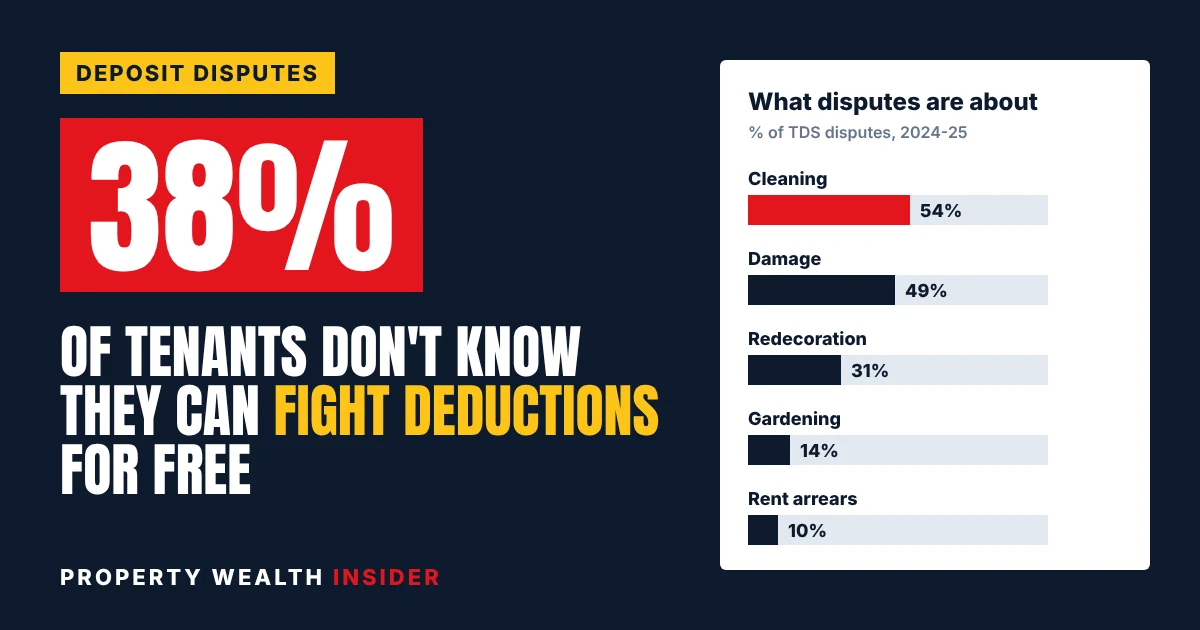
- Cleaning was the most common issue, raised in 54% of TDS disputes.
- In England a deposit is capped at 5 weeks’ rent (or 6 weeks’ if annual rent is £50,000 or more). If you don’t protect it, a court must order you to pay the tenant 1 to 3 times the deposit.
What the LRG research found
LRG asked tenants how much they knew about challenging deposit deductions. 38.2% were unaware they could formally challenge them through a government-backed scheme, and 25% had only partial awareness. That leaves well under half fully informed about a free service that every protected deposit comes with.
Landlords weren’t much better. 21.8% didn’t know tenants had the right to challenge, and 31.5% knew only part of the process. A landlord who doesn’t know how adjudication works is unlikely to be collecting the evidence an adjudicator will ask for.
Raising a deposit is still a strain for many tenants. 21.3% said they borrowed money or delayed other spending to pay their last deposit, and 11% said it nearly stopped them moving. On the other side, landlords were split on whether the cap is enough:
| Landlord view of the five-week cap (LRG survey) | Share |
|---|---|
| Provides sufficient protection | 11.4% |
| Covers most tenancies, but not all | 33.5% |
| Not enough in any circumstances | 29.6% |
| Falls particularly short when a pet is involved | 13.9% |
| Rely more heavily on rent guarantee insurance as a result | 11.6% |
LRG hasn’t published its fieldwork dates or weighting, so treat these as a snapshot of its own landlords and tenants rather than a national statistic. Allison Thompson, Chief Lettings Officer at Leaders, said tenants often don’t know they can challenge deductions, and that agents are well placed to close that gap.
The deposit cap: how much you can legally take
In England the cap comes from Schedule 1 of the Tenant Fees Act 2019. A tenancy deposit can’t exceed five weeks’ rent if the annual rent is under £50,000, or six weeks’ rent if it’s £50,000 or more. Anything above the cap is a prohibited payment.
The Act defines one week’s rent as the annual rent divided by 52. For a monthly rent, that means monthly rent × 12 ÷ 52. Don’t take a month’s rent and divide by four, because that overstates the weekly figure and pushes you over the cap.
| Monthly rent | Weekly rent (×12 ÷ 52) | Cap | Maximum deposit |
|---|---|---|---|
| £800 | £184.62 | 5 weeks | £923.07 |
| £1,000 | £230.77 | 5 weeks | £1,153.84 |
| £1,200 | £276.92 | 5 weeks | £1,384.61 |
| £1,500 | £346.15 | 5 weeks | £1,730.76 |
| £2,000 | £461.54 | 5 weeks | £2,307.69 |
| £4,500 (£54,000 a year) | £1,038.46 | 6 weeks | £6,230.76 |
Maximum deposits are rounded down to the penny so they stay inside the cap. The six-week cap starts at an annual rent of £50,000, which is about £4,167 a month.
Worked example: a landlord lets a flat at £1,200 a month and asks for a “round” £1,500 deposit. The cap is £1,384.61, so £115.39 is a prohibited payment. Under section 15 the tenant can apply to the First-tier Tribunal to recover the excess. Trading Standards can also impose a financial penalty of up to £5,000, or up to £30,000 where the breach amounts to an offence.
Protection rules after the Renters’ Rights Act
Assured periodic tenancies replaced assured shorthold tenancies in England on 1 May 2026, and the deposit rules carried over. According to gov.uk, you must place the deposit with one of the three approved schemes (Deposit Protection Service, MyDeposits or the Tenancy Deposit Scheme) within 30 days of receiving it.
Within the same 30 days you must give the tenant the prescribed information. That covers the property address, the deposit amount, how it’s protected, the scheme’s contact details and dispute service, your contact details, any third party who paid, why you might keep some or all of it, how to get it back, and what to do in a dispute.
If you get this wrong, the penalty is serious. Under section 214 of the Housing Act 2004, if a court finds the deposit wasn’t protected or the information wasn’t given, it must order you to pay the tenant between one and three times the deposit within 14 days. It can also order the deposit itself to be repaid or paid into a custodial scheme. Tenants can bring this claim after the tenancy has ended.
Section 21 has been abolished, so the old rule that an unprotected deposit blocked a no-fault notice no longer applies in England. It has been replaced with something stricter. From 1 May 2026, the new section 215 says a court can make a possession order on an assured tenancy only if the deposit is held in an authorised scheme and the scheme’s requirements and the prescribed information rules have been met.
This applies to Section 8 grounds in general. The only exceptions are Ground 7A and Ground 14 (serious antisocial behaviour and nuisance), or cases where the deposit has been returned, or a section 214 claim has been decided or settled. In practice, a landlord who gets the deposit wrong may be unable to recover the property on grounds such as selling or moving in until it’s fixed.
Worked example: a £1,384 deposit that was never protected exposes the landlord to an award of between £1,384 and £4,152, on top of handing back the deposit. On top of that, the landlord can’t get a possession order on most grounds until the deposit position is resolved.
How deposit disputes actually play out
Disputes are rarer than the survey headlines might suggest. Writing for the NRLA, Sandy Bastin, Director of Resolution at TDS, said 4.7 million deposits are protected in England and Wales, with an average deposit of £1,175. Only 1% (46,950 cases) needed formal adjudication in the 12 months to March 2025.
When a dispute does reach adjudication, cleaning is the most common issue. One dispute can involve several issues, which is why the shares below add up to more than 100%.
The process is the same across schemes. You propose deductions at the end of the tenancy. If the tenant agrees, gov.uk says the deposit must be returned within 10 days of agreeing the amount. If not, either side can use the scheme’s free dispute resolution service. Both parties must agree to use it, and the adjudicator’s decision is final.
TDS says adjudicators can only decide on the evidence provided, and its own guidance warns that a landlord without key documents is unlikely to win a deduction claim. TDS’s advice is consistent. Photo or video inventories, signed and dated by both sides, are the most effective evidence. Check-out photos should match check-in shots in lighting and angle. Landlords must also allow for fair wear and tear and “betterment”, which means the tenant can’t be charged for making something better than it was.
Worked example: a landlord holds £1,384 and proposes £150 for cleaning, £120 to replace a carpet stained in one corner, and £0 for arrears. The tenant disputes the carpet charge. If the carpet was eight years old with little life left, an adjudicator may award only a fraction of the £120, or nothing. The cleaning claim will stand only if the check-in report shows the property was professionally clean to begin with.
Deposit cap and deduction checker
Enter your rent, the deposit you took and the deductions you plan to make. The tool shows the legal maximum in England, whether you’re over it, what you’d return, and your exposure if the deposit wasn’t protected.
Deposit cap and deduction checker (England)
Guide only, not legal advice. It applies the Tenant Fees Act 2019 cap for England and assumes every deduction is justified by evidence. Adjudicators may award less. The cap is rounded down to the penny. Wales has no statutory cap on security deposits.
What’s different in Wales
The LRG survey covered Wales too, but the rules there are different. Under the Renting Homes (Fees etc.) (Wales) Act 2019, a security deposit is a permitted payment up to a “prescribed limit” that would be set by regulations. Welsh Government guidance says there is currently no limit on the deposit amount. Holding deposits in Wales are capped at one week’s rent.
Welsh landlords still have to protect deposits with an approved scheme. Rent Smart Wales says you have 30 days to protect the deposit and give the required information to the contract-holder. A court can award an additional 1 to 3 times the deposit if you fail. Wales has its own possession regime under the Renting Homes (Wales) Act 2016, so the England-only Section 21 and section 215 changes described above don’t apply there.
What landlords should do now
- Recalculate every deposit using monthly rent × 12 ÷ 52 × 5 (or × 6 if the annual rent is £50,000 or more). Refund any excess straight away and keep proof that you did.
- Check protection on every live tenancy. Log in to your scheme and confirm each deposit is registered and that the prescribed information was served within 30 days.
- Fix any gaps before you need possession. Under the new section 215, a court can’t make a possession order on most grounds until the deposit position is right. Take legal advice before serving a Section 8 notice if there’s any doubt.
- Upgrade your inventory. Use a photo or video check-in, signed and dated by the tenant, with a clear cleanliness standard written down.
- Tell tenants about the dispute service yourself. It’s already part of the prescribed information. A tenant who understands the process is more likely to negotiate than escalate.
- Price deductions fairly. Use invoices or quotes, allow for the age of items and fair wear and tear, and itemise every claim in writing.
- Return undisputed money quickly. Once you and the tenant agree an amount, the deposit must go back within 10 days.
Printable deposit compliance checklist
- Deposit at or below 5 weeks’ rent (6 weeks if annual rent is £50,000+)
- Protected with DPS, MyDeposits or TDS within 30 days
- Prescribed information served within 30 days, with a copy kept
- Signed and dated photo or video inventory at check-in
- Mid-tenancy inspection records kept
- Check-out report with matching photos
- Itemised deductions with invoices or quotes
- Agreed balance returned within 10 days
FAQs
How much deposit can a landlord charge in England?
Up to five weeks’ rent if the annual rent is under £50,000, or six weeks’ rent if it’s £50,000 or more. One week’s rent is the annual rent divided by 52, so a £1,200-a-month tenancy has a cap of £1,384.61.
Can tenants challenge deposit deductions for free?
Yes. Each of the three government-approved schemes offers a free dispute resolution service. Both sides must agree to use it, both submit evidence, and the decision is final.
What happens if a landlord doesn’t protect a deposit?
The tenant can go to the county court, even after the tenancy has ended. If the court finds the deposit wasn’t protected or the prescribed information wasn’t given, it must order the landlord to pay between one and three times the deposit, and it can order the deposit to be repaid.
Can I evict a tenant if the deposit wasn’t protected?
In England, Section 21 no longer exists. Since 1 May 2026 a court can make a possession order on an assured tenancy only if the deposit has been properly protected and the information given, unless you rely on Ground 7A or 14, or the deposit has been returned or a deposit claim settled.
What is the most common reason for deposit disputes?
Cleaning. TDS says it appeared in 54% of its disputes in 2024-25, followed by damage (49%) and redecoration (31%).
How long does a landlord have to return a deposit?
Within 10 days of you and the tenant agreeing how much is going back. If there’s a dispute, the money stays protected in the scheme until it’s resolved.
Sources
- LRG: Deposits – only one in nine landlords thinks the five-week cap is enough (27 October 2026)
- NRLA / TDS: What 2025 taught us about deposit disputes (Sandy Bastin, TDS)
- Tenancy Deposit Scheme: Tenancy deposit disputes in 2025
- Tenant Fees Act 2019, Schedule 1 paragraph 2 (deposit cap)
- Tenant Fees Act 2019, section 8 (financial penalties)
- Housing Act 2004, section 214
- Housing Act 2004, section 215 (as substituted by the Renters’ Rights Act 2025)
- gov.uk: Deposit protection schemes and landlords
- gov.uk: Tenancy deposit protection
- Renting Homes (Fees etc.) (Wales) Act 2019, Schedule 1
- Welsh Government: Fees Act guidance for landlords and agents
- Rent Smart Wales: Landlord Licence Training Handbook 2025
This article is news and general guidance only. It is not financial, legal or tax advice.