Holiday let squeeze: council tax premiums sway 72% of owners
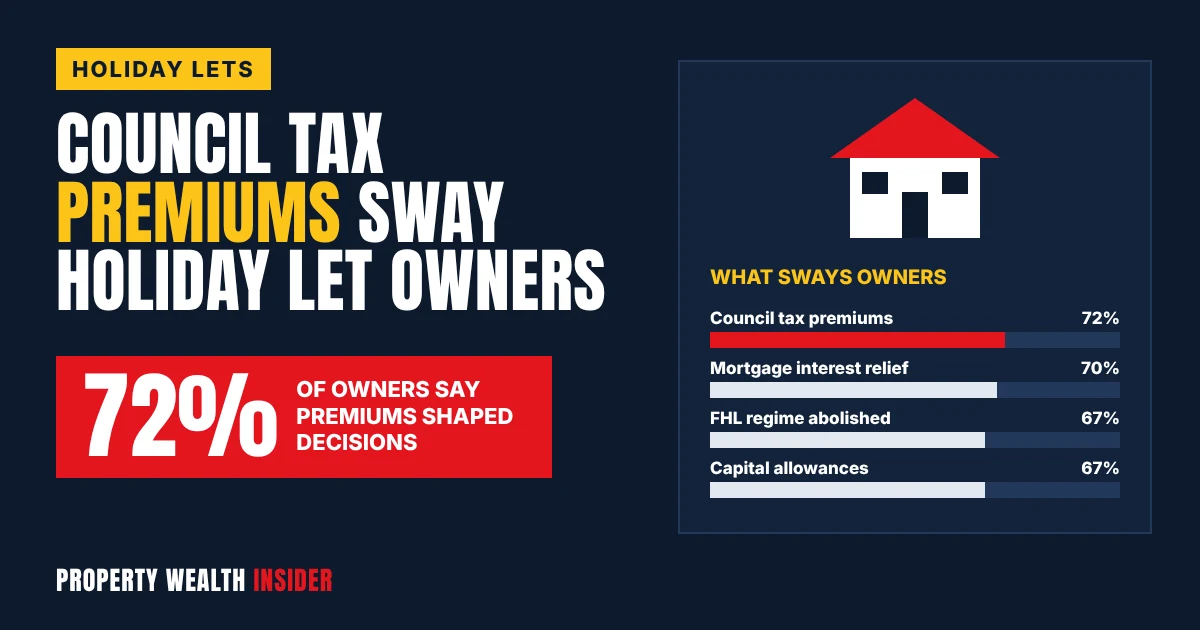
Council tax premiums are now the single biggest policy factor shaping whether holiday let owners stay in the market. In Cumberland Building Society’s first Holiday Let Index, 72% of holiday let landlords said second home council tax premiums had influenced their investment decisions, ahead of every tax change of the past two years.
It lands at a bad moment. The furnished holiday let (FHL) tax regime has gone, mortgage interest relief for holiday lets is now capped at the basic rate, and the Budget on 28 October 2026 set out plans to put property income tax rates up to 24%, 44% and 49% from April 2027.
This piece looks at what those changes do to a typical owner’s profit: what the premium adds to your bill, what the tax changes take, and whether getting your let onto business rates changes the picture. Use our calculator to run your own figures.
Key facts
- 72% of holiday let landlords surveyed said council tax premiums had influenced their decisions; 70% cited the cap on mortgage interest relief and 67% the end of the FHL regime.
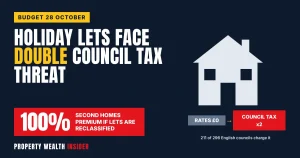
- English councils can charge up to a 100% premium on second homes from 1 April 2025, so a furnished home that isn’t anyone’s main home can pay double council tax.
- Welsh councils can charge up to 300%, so the bill can reach four times the normal charge.
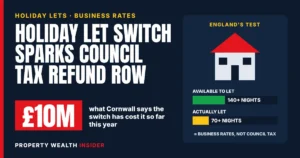
- To pay business rates instead, an English holiday let must be available for 140 nights and actually let for 70 nights in 12 months. In Wales the test is 252 and 182.
- Planned property income tax rates from 6 April 2027: 24% basic, 44% higher, 49% additional (England, Wales and Northern Ireland), subject to the Finance Bill 2026-27.
What the survey found
The research was carried out by Pegasus Insight for Cumberland Building Society, a holiday let lender, as a 10-minute online survey in May 2026. It covered 125 people: 25 mortgage brokers, 50 private landlords and 50 homeowners, each owning at least one mortgaged holiday let.
Owners were asked which policy changes had most influenced their decisions. Council tax premiums came top, but the tax changes were close behind, which tells you owners are feeling several cost increases at once rather than one.
The index also asked about higher borrowing costs. 94% of landlords said a 1 percentage point rise in mortgage rates would affect them: 40% expected a minor impact, 27% a moderate one and 15% a significant one. 7% said they would turn the property into a long-term rental and 3% would sell. Only 6% said it would make no difference.
Keep the sample size in mind. With 100 owners answering, these figures show how owners feel, but they are not a precise measure of the whole market.
Council tax premium rules: England vs Wales
In England, section 80 of the Levelling-up and Regeneration Act 2023 lets councils charge a premium of up to 100% on homes that are substantially furnished and have no resident. Councils could start charging it from 1 April 2025. It is optional, and a council has to make its first decision at least a year before the financial year the premium applies to.
Wales went further and earlier. Since April 2023, Welsh councils have been able to charge premiums of up to 300% on second homes. Both nations also set a letting test: if your let passes it, the property moves off council tax and onto business rates, so the premium stops applying.
| Rule | England | Wales |
|---|---|---|
| Maximum second homes premium | 100% (bill up to 2x) | 300% (bill up to 4x) |
| Premium available from | 1 April 2025 | April 2023 (300% maximum) |
| Who decides | Each billing council, at least 1 year ahead | Each local authority |
| Business rates test: nights available | 140 in 12 months | 252 in 12 months |
| Business rates test: nights actually let | 70 in the same 12 months | 182 in the same 12 months |
| Test in force since | 1 April 2023 | April 2023 |
| Holiday let exception (England) | Class L: seasonal homes where planning prevents year-round occupation, or that are specified for use as holiday accommodation | Wales has its own exceptions; check with your council |
England has extra details that matter. Stays of more than 28 nights don’t count towards the 70 let nights. Nights you or your family use the property, or let it at a discount to friends, don’t count either. From 24 July 2026, an owner with 5 or more self-catering units on the same property can qualify for business rates without meeting the past letting test, provided they intend to make each unit available for 140 nights. The full rules are on gov.uk.
Business rates aren’t automatically cheaper. In England, small business rate relief means no rates are payable on a property with a rateable value of £12,000 or less if it is the only property your business uses, with relief tapering away up to £15,000. If you have several lets, or a high rateable value, your rates bill could be larger than your council tax.
The tax changes hitting holiday let profits
The FHL regime was abolished from 6 April 2025 for income tax and capital gains tax, and from 1 April 2025 for corporation tax. Holiday lets are now taxed like any other residential let, and that changes four things.
- Mortgage interest: individual owners can no longer deduct it in full. Instead they get a tax reduction at the basic rate, so a higher-rate taxpayer pays 40% on profits but gets only 20% back on interest.
- Capital allowances: existing pools carry on with writing-down allowances, but new spending on furnishings comes under replacement of domestic items relief instead.
- Capital gains: trading reliefs such as Business Asset Disposal Relief are no longer available on a sale.
- Pensions: holiday let profits no longer count as relevant UK earnings for pension contribution limits.
Then there is the next rise. The Finance Act 2026 already set property income rates of 22%, 42% and 47% for 2027-28. The Budget on 28 October 2026 proposed raising them to 24%, 44% and 49% from 6 April 2027, through Finance Bill 2026-27. These rates are for England, Wales and Northern Ireland, and the Welsh Government can set its own property rates. Scotland is separate.
HMRC’s November 2025 technical note says that from 2027-28 the relief for finance costs will be given at the property basic rate, not the 20% basic rate. Our calculator applies the proposed 24% property basic rate to that relief. The October 2026 policy paper doesn’t restate that point, so check the final legislation.
Calculator: your profit after the premium and tax changes
Enter your own figures. The calculator shows your council tax bill with the premium, your tax this year and under the rates planned from April 2027, and how your profit would change if the property passed the business rates letting test.
Holiday let profit after the premium and tax changes
Guide only, not tax advice. It assumes you own the let personally (not through a company), that all of the let’s profit is taxed at the band you select, and that council tax and business rates are deductible running costs. Mortgage interest relief is a 20% tax reduction now and 24% from April 2027, if the proposed property basic rate is legislated. It ignores personal allowance tapering, losses brought forward and the limits on the finance cost reduction. Scottish taxpayers have different rates.
Worked examples
Example 1: an English cottage on a 100% premium
A higher-rate taxpayer takes £30,000 a year in bookings, spends £9,000 on running costs and pays £6,000 in mortgage interest. Normal council tax is £2,400, but the council charges a 100% premium, so the bill is £4,800.
Profit before interest is £16,200. Tax at 40% is £6,480, less the £1,200 interest credit (20% of £6,000), giving £5,280. That leaves £4,920 after tax, which is the calculator’s default result.
From April 2027 at the planned rates, the tax becomes £7,128 less a £1,440 credit, so £5,688. Profit after tax falls to £4,512. The premium has cost this owner £2,400 a year before tax, and the planned rate rise takes another £408.
Example 2: the same cottage on business rates
Suppose the cottage was available for at least 140 nights and let for at least 70, so it moves to business rates. If the rateable value is £12,000 or less and it is the owner’s only business property, small business rate relief can bring the bill to £0.
Profit before interest rises to £21,000. Tax is £8,400 less £1,200, so £7,200, and profit after tax is £7,800. That is £2,880 a year more than paying council tax with the premium.
Example 3: a Welsh let on a 300% premium
Take a let in Wales where normal council tax is £2,000. The premium level makes a big difference:
| Premium | Annual council tax | Extra cost of premium | Extra cost after 40% tax relief |
|---|---|---|---|
| 0% | £2,000 | £0 | £0 |
| 100% | £4,000 | £2,000 | £1,200 |
| 200% | £6,000 | £4,000 | £2,400 |
| 300% | £8,000 | £6,000 | £3,600 |
Escaping that £8,000 bill means passing the Welsh test: 182 let nights in 12 months, more than two and a half times England’s 70. Many owners in quieter areas won’t reach that, which is why the premium is such a big issue for owners in Wales.
The C5 planning threat
The index also asked owners about a proposed C5 planning use class for short-term lets in England. 20% said they would be very likely to sell if it came in and 36% somewhat likely. Cumberland’s report puts the combined figure at 56%.
C5 is still only a proposal. It was consulted on from 12 April to 7 June 2023 and has not been introduced. If it went ahead, homes that aren’t anyone’s main residence and are used for short-term lets would form their own use class, and councils could require planning permission for new holiday lets.
What to do now: owner checklist
Work through these steps before your next council tax bill and before April 2027.
- Step 1: Check your council’s premium. Find out what premium your council charges on second homes, if any, and whether it has already decided to change it for future years. English councils must decide a year in advance.
- Step 2: Count your nights. Add up nights available and nights actually let over the last 12 months. Leave out stays over 28 nights, your own use and discounted stays for family or friends.
- Step 3: Compare with the threshold. England needs 140 available and 70 let; Wales needs 252 and 182. If you’re close, look at pricing, minimum stays and your booking calendar.
- Step 4: Price up business rates. Check your rateable value with the Valuation Office Agency and whether small business rate relief applies, before you assume rates will cost less.
- Step 5: Check for an exception. In England, Class L covers seasonal homes where planning prevents year-round occupation. Ask your council if any exception applies to you.
- Step 6: Keep evidence. Keep booking records, availability calendars and marketing screenshots. You will need them if the Valuation Office or the council asks.
- Step 7: Run the 2027 numbers. Use the calculator above with your figures under the planned April 2027 rates, and stress-test them with a higher mortgage rate.
- Step 8: Talk to an accountant. Ask about the ownership structure, capital allowance pools from before April 2025 and the CGT position before you sell or switch to long-term letting.
FAQ
Do holiday lets pay the second home council tax premium?
They can. A holiday let that is substantially furnished, has no resident and is still on council tax counts as a second home, so the council can charge the premium. Lets that pass the business rates letting test pay business rates instead, so the premium doesn’t apply.
How many nights does a holiday let need to qualify for business rates?
In England, at least 140 nights available and 70 nights actually let in a 12-month period, plus a plan to make it available for 140 nights over the next 12 months. In Wales it is 252 nights available and 182 let.
What is the maximum council tax premium on second homes?
Up to 100% in England (double the normal bill) and up to 300% in Wales (four times the bill). Councils decide whether to charge one and at what level.
Can I still claim mortgage interest on a holiday let?
Since FHL was abolished in April 2025, individual owners get a basic-rate tax reduction on finance costs rather than a full deduction. HMRC says that from 2027-28 the reduction will be given at the property basic rate.
What will tax on holiday let income be from April 2027?
Under the Budget 2026 plans, property income will be taxed at 24% (basic), 44% (higher) and 49% (additional) in England, Wales and Northern Ireland from 6 April 2027, once Finance Bill 2026-27 is passed.
Sources
- Cumberland Building Society: Holiday Let Index, Summer 2026 (PDF)
- Levelling-up and Regeneration Act 2023, section 80
- MHCLG: guidance on council tax premiums on second homes and exceptions
- Welsh Government: new tax rules for second homes
- GOV.UK: apply for business rates for a self-catering property in England
- GOV.UK: business rates treatment of self-catering accommodation, government response
- GOV.UK: small business rate relief
- HMRC: abolition of the furnished holiday lettings tax regime
- HMRC: changes to tax rates for property and savings income (Budget 2026)
- HMRC: technical note on property income rates and finance cost relief (November 2025)
- HMRC: working out your rental income
- DLUHC: consultation on a use class for short-term lets
This article is news and general guidance only. It is not financial, legal or tax advice.