Renters Now Hand Over 32.7% of Pay as Average Rent Hits £1,375
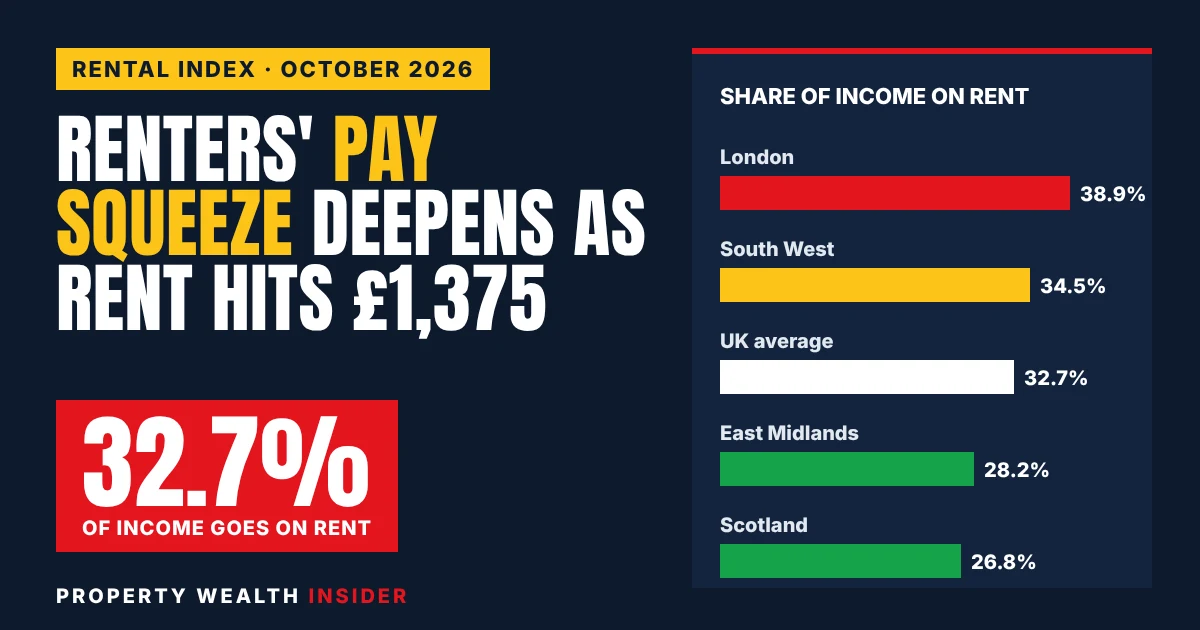
Tenants starting a new let in October handed over an average 32.7% of their gross household income in rent, up from 32.1% in September, according to the HomeLet Rental Index for October 2026. It came even though the average agreed rent actually slipped back by 0.9% in the month to £1,375.
The message for landlords is blunt: asking rents are no longer racing ahead, but tenants’ pay is not keeping up either. In London, renters now give up 38.9% of income. That squeeze shows up in referencing failures, guarantor requests, arrears risk and how far you can push a rent review.
Below we break down the verified numbers region by region, set them against the official ONS figures, and show how to price a let (and a section 13 increase in England) without pricing out a good tenant. Use our checker to test any rent against any income.
Key facts
- UK renters spent 32.7% of gross income on rent in October 2026, up from 32.1% in September (HomeLet).
- Average UK agreed rent on new tenancies: £1,375 a month, down 0.9% on the month but up 2.2% on the year.
- Greater London: £2,260 a month and 38.9% of income, up from 37.8% a year earlier.
- Official ONS figures put the average UK private rent (new and existing tenancies) at £1,406, up 3.8% in the 12 months to September 2026.
- HomeLet says tenants usually need gross income of about 2.5 times the annual rent – that is £41,250 for the UK average rent.
- In England, rent can only be increased once a year via the section 13 process, with at least 2 months’ notice on form 4A.
The October 2026 numbers
HomeLet’s index is built from agreed rents on brand-new tenancies, qualified through its tenant referencing for more than 4,500 letting agents. Its affordability ratio is worked out tenancy by tenancy from actual incomes and actual rents, not by comparing area average pay with area average rents.
The headline: the average UK rent eased 0.9% in October to £1,375, which HomeLet describes as typical after the busy summer. Outside London the average fell 1.0% to £1,164, still 2.3% higher than a year earlier.
Yet the share of income going on rent rose to 32.7%. That is 0.7 percentage points worse than October 2025 (32.0%), although still below the peak of 33.5% HomeLet recorded in May 2024. Year on year, affordability worsened in every region except the East Midlands.
Put simply: a flat or falling rent does not mean an easier tenant. If incomes of people applying for lets are not rising as fast as rents agreed over the past year, each new tenancy takes a bigger bite.
Region by region: rents and income share
The South East saw the sharpest monthly drop, with the average rent down 2.7% to £1,432. Scotland fell 2.6% on the month to £1,026 but is still up 4.8% on the year, the fastest annual growth of any region, and has the lowest income share at 26.8%. The North East remains the cheapest place to rent at £727, while the East Midlands (£925) is the only region where rents are lower than a year ago, down 0.6%.
| Region | Avg rent Oct 2026 | Monthly change | Annual change | % income on rent Oct 2026 | Oct 2025 | Income needed at 2.5x annual rent |
|---|---|---|---|---|---|---|
| Greater London | £2,260 | -0.5% | +1.9% | 38.9% | 37.8% | £67,800 |
| South East | £1,432 | -2.7% | +0.6% | 33.5% | 33.0% | £42,960 |
| East of England | £1,331 | -0.7% | +1.1% | 34.0% | 33.4% | £39,930 |
| South West | £1,258 | -1.3% | +4.5% | 34.5% | 34.2% | £37,740 |
| North West | £1,115 | 0.0% | +3.5% | 30.7% | 29.3% | £33,450 |
| West Midlands | £1,061 | +0.1% | +1.0% | 32.3% | 30.9% | £31,830 |
| Scotland | £1,026 | -2.6% | +4.8% | 26.8% | 26.2% | £30,780 |
| Northern Ireland | £1,010 | +0.1% | +3.9% | n/a | n/a | £30,300 |
| Yorkshire and the Humber | £971 | +0.6% | +3.7% | 29.1% | 28.3% | £29,130 |
| East Midlands | £925 | -1.2% | -0.6% | 28.2% | 29.1% | £27,750 |
| Wales | £921 | +0.1% | +1.1% | 33.5% | 31.5% | £27,630 |
| North East | £727 | -0.7% | +2.0% | 32.2% | 31.2% | £21,810 |
| UK | £1,375 | -0.9% | +2.2% | 32.7% | 32.0% | £41,250 |
Rents and income shares from the HomeLet Rental Index report, October 2026. HomeLet does not publish an income share for Northern Ireland. The last column is our calculation: monthly rent x 12 x 2.5.
Wales stands out. Its average rent of £921 is one of the lowest, but the income share jumped 2.0 points in a year to 33.5%, the biggest deterioration in the UK. Cheap does not automatically mean affordable for the local tenant pool.
HomeLet index vs official ONS data
The two sources measure different things, so do not expect them to match. HomeLet tracks agreed rents on new tenancies only. The ONS Price Index of Private Rents (PIPR) measures the whole privately rented stock, including existing tenancies, and became official statistics on 20 May 2026.
| Measure | HomeLet Rental Index | ONS PIPR |
|---|---|---|
| Latest period | October 2026 | September 2026 (published 21 October 2026) |
| What it covers | Agreed rents on new tenancies | New and existing tenancies |
| UK average rent | £1,375 | £1,406 (provisional) |
| UK annual change | +2.2% | +3.8% |
| London average | £2,260 | £2,338 |
| North East average | £727 | £790 |
The ONS also reported average rents of £1,466 in England (+4.0%), £848 in Wales (+4.1%) and £1,011 in Scotland (+0.7%) in the 12 months to September 2026. Its next release is due on 18 November 2026.
Why it matters: the gap between new-let growth (+2.2%) and whole-market growth (+3.8%) suggests sitting tenants’ rents are still catching up with the market even as new-let pricing cools. For a landlord reviewing an existing tenant’s rent, the new-let figure is the better guide to what the open market will bear today.
Referencing: the 2.5x annual rent rule
HomeLet’s own referencing guidance for tenants says applicants will usually need a gross income of around two and a half times the annual rent. That is the same thing as 30 times the monthly rent, and works out at a rent of no more than 40% of gross income.
Worked example (UK average): £1,375 x 12 x 2.5 = £41,250 gross household income needed. A couple earning £41,250 between them would be spending exactly 40% of gross pay on rent, well above the 32.7% UK average.
Worked example (London): £2,260 x 12 x 2.5 = £67,800. Fall short and the tenant will usually be asked for a guarantor or will need to look at a cheaper property.
Passing referencing is a floor, not a comfort zone. A tenant at 40% of gross income has much less slack for a rent review, a bill shock or a cut in hours than one at 30%. Use the checker below to see where any applicant sits.
Rent affordability checker
Guide only, not financial or legal advice. Regional figures are HomeLet Rental Index averages for new tenancies, October 2026. The 2.5x annual rent test is HomeLet’s published typical guide; individual referencing decisions also weigh credit history, employment and other factors.
Rent rises under section 13 (England)
Since 1 May 2026, all assured tenancies in England, including former assured shorthold tenancies, have been rolling periodic tenancies under the Renters’ Rights Act. The gov.uk rent increase guidance sets out the rules now in force. They apply in England only; Wales, Scotland and Northern Ireland have their own rules.
- You can only increase the rent once a year, and not in the first year of the tenancy.
- You must use form 4A (landlord’s notice proposing a new rent) and give it at least 2 months before the new rent starts.
- You must follow this section 13 process every time, even if the tenant has already agreed the increase.
- If the tenant thinks the new rent is above open market rent, they can ask the First-tier Tribunal to decide it.
Worked example: a tenant household on £40,000 gross pays £1,000 a month, which is 30.0% of income. You propose £1,050, a 5% rise. Their share climbs to 31.5%, still near the UK average of 32.7% and comfortably inside the 2.5x test (£31,500 needed). Push to £1,150 and the share hits 34.5%.
With new-let rents falling in most regions in October, a big jump is also more likely to be above what the open market would pay, which is exactly the test a tribunal applies. Evidence your figure with current comparable lets, not last spring’s peak.
The rules on setting rent at the start of a tenancy have tightened too. You must advertise a specific rent, cannot accept offers above it (fines of up to £7,000 for a first offence), and can usually take no more than one month’s rent in advance, after the tenancy agreement is signed.
Arrears risk when affordability is stretched
The higher the share of income going on rent, the smaller the cushion when something goes wrong. Under the new grounds for possession in England, the mandatory rent arrears ground (Ground 8) needs the tenant to owe at least 3 months’ rent (or 13 weeks if paid weekly or fortnightly) both when you serve notice and at the hearing, with 4 weeks’ notice.
Worked example: at the UK average rent of £1,375, a tenant would need to be £4,125 behind before Ground 8 is available, and then you face 4 weeks’ notice plus court time. In London, at £2,260 a month, that threshold is £6,780.
If arrears are caused by Universal Credit not being received, the gov.uk guidance says the tenant cannot be evicted under Ground 8. Ground 10 (any arrears) and Ground 11 (persistent late payment) are discretionary, so the court decides whether eviction is reasonable. Prevention, through realistic pricing and early contact, is far cheaper than any route to court.
What landlords should do now
- Benchmark your rent. Compare it with your region in the table above and with live comparables. If new-let rents in your area have dipped, price to let quickly rather than chase a void.
- Run the affordability numbers on every applicant. Check the 2.5x annual rent test, then the actual percentage. Over 35% of gross income is a flag, even if they pass.
- Use guarantors and rent guarantee cover where needed. Where an applicant falls short, a guarantor is the standard fix.
- Plan rent reviews a year ahead (England). Diarise the anniversary of the last increase, serve form 4A at least 2 months before, and keep evidence of open market rent.
- Model the tenant’s share before increasing. A rise that pushes a good tenant from 31% to 36% of income may cost you more in arrears or a void than it earns.
- Act on arrears early. Speak to the tenant at the first missed payment and agree a written plan, long before the 3-month Ground 8 threshold.
- Rent compared with HomeLet regional average and local comparables
- Advert shows one fixed rent (no range, no bidding)
- Applicant income checked against 2.5x annual rent
- Rent-to-income share calculated and recorded
- Guarantor or rent guarantee cover arranged if needed
- No more than one month’s rent taken in advance, after signing
- Date of last rent increase logged; next review date diarised
- Form 4A served at least 2 months before any increase (England)
- Arrears process written down: first-contact date, payment plan, escalation
FAQ
What percentage of income do UK renters spend on rent?
According to the HomeLet Rental Index, tenants starting new lets in October 2026 spent an average 32.7% of gross household income on rent, up from 32.1% in September. In Greater London it was 38.9%; in Scotland 26.8%.
How much do I need to earn to rent a property in the UK?
HomeLet says tenants usually need a gross income of around 2.5 times the annual rent. For the UK average rent of £1,375 a month that is £41,250 a year; for London’s £2,260 it is £67,800.
What is the average rent in the UK right now?
HomeLet puts the average agreed rent on new UK tenancies at £1,375 a month in October 2026. The ONS, which includes existing tenancies, puts it at £1,406 for September 2026, up 3.8% on a year earlier.
How often can a landlord put the rent up in England?
Once a year, and not in the first year of the tenancy. You must serve form 4A with at least 2 months’ notice under section 13, and the tenant can ask the First-tier Tribunal to decide the rent if they think it is above open market rent.
How many months of rent arrears before a landlord can evict?
For the mandatory Ground 8 in England, the tenant must owe at least 3 months’ rent (13 weeks if paid weekly or fortnightly) when notice is served and at the hearing, with 4 weeks’ notice. Discretionary grounds 10 and 11 can be used for smaller or persistent arrears.
- HomeLet Rental Index (regional data, October 2026)
- HomeLet Rental Index report, October 2026 (PDF)
- ONS: Private rent and house prices, UK: October 2026
- HomeLet: tips for being referenced
- GOV.UK: Assured periodic tenancies – rent increases
- GOV.UK: Assured periodic tenancies – a guide for landlords (full guide)
- GOV.UK: Grounds for possession – guidance for landlords
This article is news and general guidance only, not financial, legal or tax advice.