Landlords drive £181.8m bridging rebound as rates drop to 0.77%
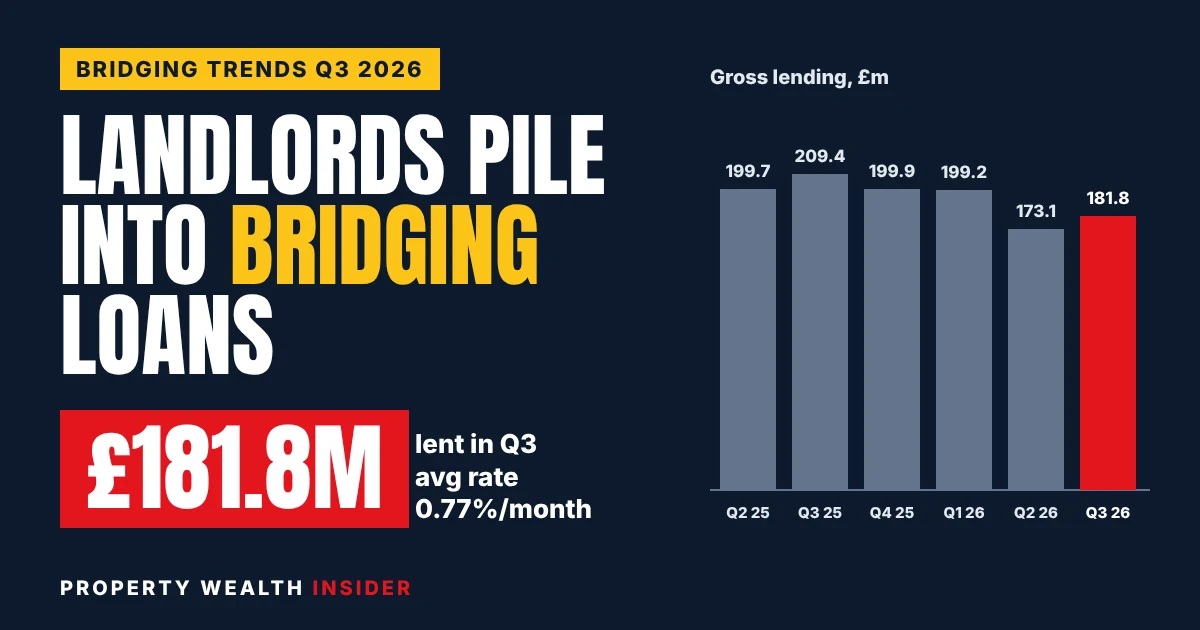
Landlords are borrowing short-term money to buy rental property again. The latest Bridging Trends figures, published on 10 November 2026, show buying an investment property was the single biggest use of bridging finance in July to September 2026, at 23% of loans.
Contributor gross bridging lending rose to £181.8m in Q3 2026, up 5% on the quarter. The average monthly interest rate dropped to 0.77%, its fourth fall in a row, and deals completed five days faster.
That sounds cheap until you add it up. 0.77% a month works out at 9.24% a year before fees, against a Bank Rate that the Bank of England has just raised to 4%. This guide explains what the numbers mean for buy-to-let investors across the UK, shows the true cost in pounds, and gives you a calculator to test your own deal.
Key facts
- Contributor gross bridging lending hit £181.8m in Q3 2026, up from £173.1m in Q2 but down from £209.4m a year earlier.
- Buying an investment property was the top use of bridging at 23% of loans, up from 18% in Q2 2026.
- Average monthly interest rate fell to 0.77% (Q2 2026: 0.81%; Q3 2025: 0.85%).
- Unregulated loans made up 55% of deals and first-charge loans 87%.
- Average loan-to-value rose to 59%; average completion took 41 days; average term was 12 months.
- The Bank of England raised Bank Rate by 0.25 points to 4% on 5 November 2026, after the quarter covered by this data.
What the Q3 bridging figures show
Bridging Trends is a quarterly snapshot produced by lender MT Finance. It pools completed-deal data from a group of specialist finance packagers (brokers), so it tracks what those contributors arranged rather than the whole UK market. It uses the FCA’s description of a bridging loan as a contract with a term of 12 months or less.
Volumes recovered slightly from a weak second quarter but remain well below last year. Pricing and speed both moved in borrowers’ favour, while lenders were willing to lend a higher share of property value.
| Measure | Q3 2026 | Q2 2026 | Q3 2025 |
|---|---|---|---|
| Contributor gross lending | £181.8m | £173.1m | £209.4m |
| Average monthly interest rate | 0.77% | 0.81% | 0.85% |
| Average loan-to-value | 59% | 55% | 55% |
| Average completion time | 41 days | 46 days | 41 days |
| Average term | 12 months | 12 months | 12 months |
| First-charge loans | 87% | 78% | 88% |
| Unregulated loans | 55% | 52% | 54% |
Put in context, Q3 2026 lending was 5.0% higher than Q2 but 13.2% lower than Q3 2025. Q2 2026 was the weakest of the six quarters charted, so it is a partial recovery rather than a return to 2025 levels.
Why landlords are using bridging to buy
Investment purchases jumped from 18% to 23% of bridging loans. Bridging Trends puts this down to landlords gaining confidence and taking advantage of a flat property market. That is their reading; the data itself only shows the share rose.
In practice, landlords typically use a bridge when a normal buy-to-let mortgage won’t work yet: the property is unmortgageable (no working kitchen, say), the deadline is too tight (auctions often require completion within weeks), or they want to add value with works before refinancing.
Two other shifts stand out. Heavy refurbishment fell from 10% to 6% of loans, while unregulated refinancing rose from 6% to 9%. Chain-break lending slipped from 18% to 16%.
What a bridging loan really costs
Bridging is priced per month, which makes it look cheaper than it is. Interest is only part of the bill: arrangement fees, sometimes exit fees, valuation, lender’s legal costs and broker fees all land on top.
Worked example: the rate cut in pounds. On a £150,000 bridge for 12 months, simple interest at 0.85% a month (the Q3 2025 average) costs £15,300. At 0.77% (the Q3 2026 average) it is £13,860. That is £1,440 less, before fees.
Worked example: why speed matters. Arrangement fees are charged once, whatever the term. The table below uses a £100,000 loan at 0.77% a month with an illustrative 2% arrangement fee and no exit fee. The shorter you hold it, the higher the annualised cost, but the lower the total bill.
| Months held | Interest | Arrangement fee (2%) | Total cost | Annualised cost on loan |
|---|---|---|---|---|
| 3 | £2,310 | £2,000 | £4,310 | 17.2% |
| 6 | £4,620 | £2,000 | £6,620 | 13.2% |
| 9 | £6,930 | £2,000 | £8,930 | 11.9% |
| 12 | £9,240 | £2,000 | £11,240 | 11.2% |
Retained vs serviced interest. With serviced interest you pay each month from your own cash flow. With retained interest the lender deducts the full term’s interest from the advance on day one. You need less monthly cash but more upfront, and if you repay early you may not get the unused interest back, so check the offer.
Bridging loan true cost calculator
Guide only, not financial advice. Uses simple monthly interest on the full loan for the full term and assumes the arrangement fee is deducted from the advance and the refurb is paid from your own cash. Real offers differ: check the APRC or cost illustration, default and extension charges, and refinance product fees.
Regulated or unregulated: why it matters
55% of loans in Q3 were unregulated. The dividing line is set in law by article 61 of the Regulated Activities Order 2001, which applies across the UK.
A loan is a regulated mortgage contract if, when it is taken out, the borrower is an individual or trustees, it is secured on land, and at least 40% of that land is used or intended to be used as a dwelling by the borrower or a related person. Related people include a spouse, civil partner or partner, parent, brother, sister, child, grandparent or grandchild. Certain exemptions in article 61A also apply.
- Buying a rental to let to unrelated tenants, or borrowing through a limited company: normally unregulated, because no borrower or family member lives there or because the borrower is not an individual.
- Bridging to buy your own home before selling your old one: normally regulated, so the lender must follow FCA mortgage rules.
- Letting to a relative: can be regulated even though you see it as an investment. Ask the broker to confirm in writing.
Unregulated does not mean illegal or unsafe. But you lose the conduct protections built for homeowners, and terms such as default interest and enforcement can be tougher. Read every clause and get independent legal advice.
Bank Rate has just gone up
The Q3 figures cover July to September 2026. On 5 November 2026 the Bank of England raised Bank Rate by 0.25 percentage points to 4%, citing higher energy prices. Inflation stands at 3.5% against a 2% target, and the next decision is due on 17 December 2026.
So don’t assume the run of falling bridging rates will continue. If you are relying on a buy-to-let refinance in 6 to 12 months, test your numbers at a higher mortgage rate than you see today, because the rent stress test will be run at whatever rates apply when you refinance.
Exit strategy: where bridging deals go wrong
A bridge is only as good as the way you repay it. The average term was 12 months, and lenders will want to see a credible exit before they lend. The common failure points are:
- Down-valuation: the refinance valuer says £250,000, not £270,000. At 75% LTV that cuts the new loan by £15,000.
- Rent stress test fails: the buy-to-let lender limits the loan to what the rent covers at its stress rate, which can be well below 75% of value.
- Works overrun: each extra month on a £118,000 loan at 0.77% costs about £909 in interest, plus any extension fee.
- Sale falls through: a flip exit depends on a buyer and their lender. Default interest after the term ends can be far higher than the headline rate.
Worked example: using the calculator defaults, a £200,000 purchase at 59% LTV with £30,000 of works and a £270,000 end value creates about £11,000 of equity after bridging costs. If you sell instead at £270,000 (£264,600 after 2% selling costs), the profit is only about £5,700. A 3% drop in price would wipe it out.
How to use bridging safely: step by step
- Decide the exit first. Get an agreement in principle for the buy-to-let refinance, or speak to agents about realistic sale prices, before you bid.
- Cost the whole loan. Ask for interest, arrangement, exit, valuation, legal, broker and extension fees in writing, then run them through the calculator.
- Check whether it is regulated. If you or a relative will live there, expect it to be regulated. If not, read the unregulated terms closely.
- Build a buffer. Plan for three extra months of interest and at least 10% on your refurb budget.
- Get your solicitor moving early. Average completion was 41 days. For auctions, have searches and funding lined up before the hammer falls.
- Start the refinance early. Apply as soon as works are finished and the property is lettable, not in the final month.
- Written exit plan with a backup (sell if refinance fails, or vice versa)
- Full fee schedule from the lender, including default and extension rates
- Confirmation of whether the loan is regulated or unregulated
- Retained or serviced interest chosen, and early repayment terms checked
- Refurb quote, schedule of works and a contingency of at least 10%
- Buy-to-let refinance stress-tested at a higher rate than today’s
- Independent legal advice on the loan documents and personal guarantees
- Cash reserve to cover at least three months’ overrun
Bridging loan FAQs
What is the average bridging loan interest rate in 2026?
Bridging Trends data puts the average monthly rate at 0.77% in Q3 2026, down from 0.81% in Q2 2026 and 0.85% in Q3 2025. Your rate depends on LTV, property type, charge position and your experience.
How much does a £100,000 bridging loan cost for 12 months?
At 0.77% a month, simple interest is £9,240. Add an illustrative 2% arrangement fee of £2,000 and the total is £11,240, before valuation, legal, broker or exit fees.
Can I use a bridging loan to buy a buy-to-let property?
Yes. It was the most common use of bridging in Q3 2026, at 23% of loans. These are usually unregulated, and lenders will want a clear plan to repay, normally a buy-to-let mortgage or a sale.
Is a bridging loan regulated by the FCA?
Only if it meets the legal test for a regulated mortgage contract: an individual or trustee borrower, secured on land, with at least 40% used as a dwelling by the borrower or a related person. Most investment bridges are unregulated.
What happens if I can’t repay a bridging loan on time?
You may face extension fees or default interest, and ultimately the lender can enforce its security and sell the property. Talk to the lender early and check these terms before you sign.
- Bridging Trends Q3 2026 infographic (MT Finance)
- Bridging Trends Q3 2025
- Bridging Trends Q4 2025
- Bridging Trends Q1 2026
- Bridging Trends methodology
- Financial Services and Markets Act 2000 (Regulated Activities) Order 2001, article 61
- Bank of England: Bank Rate
This is news and general guidance, not financial, legal or tax advice.