Landlords sell 4x faster than they buy as 38% face remortgage
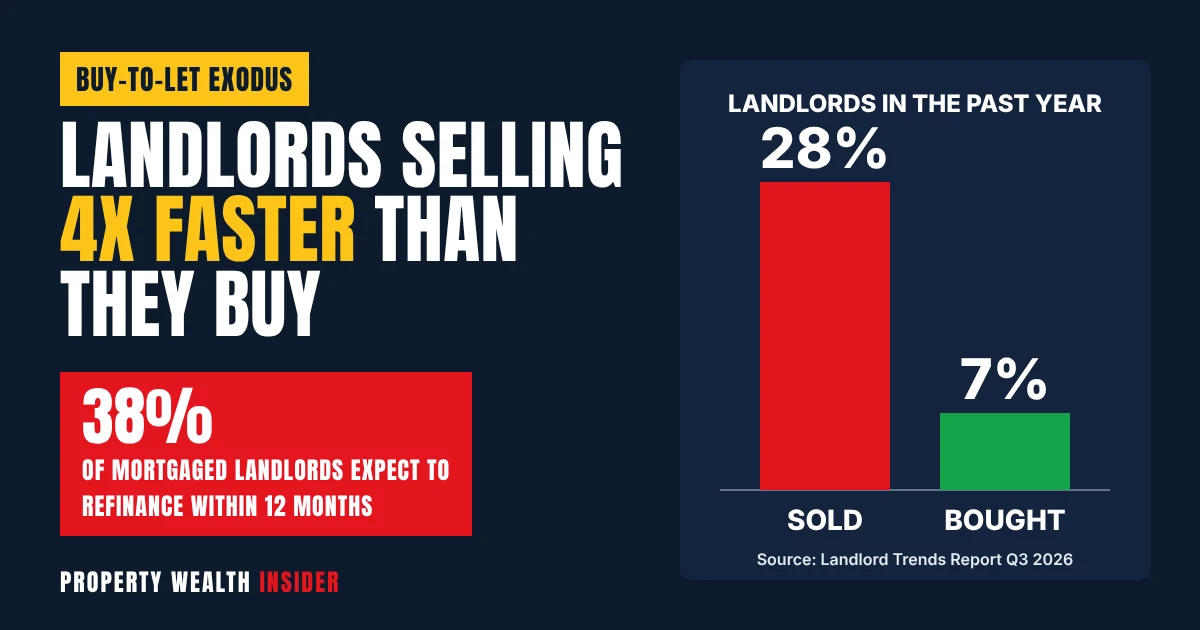
Landlords are selling rental homes about four times as often as they are buying them. New research from Pegasus Insight finds 28% of landlords sold at least one property in the past year, while just 7% bought one.
The split is sharpest by size. Smaller landlords are heading for the exit, while those with bigger mortgaged portfolios are still adding homes. And a refinancing wave is coming: almost four in ten mortgaged landlords expect to remortgage or switch deal in the next 12 months.
That remortgage wave lands just after the Bank of England raised Bank Rate to 4% on 5 November 2026. If your fixed rate ends in the next year, this article shows you how to work out the payment jump and whether your rent will still pass a lender’s stress test. Bank Rate and the PRA lending rules apply across the UK.
Key facts
- 28% of landlords sold at least one rental property in the past year, against 7% who bought.
- Looking ahead, 44% intend to sell and only 6% plan to buy.
- 16% of landlords with four or more mortgages bought in the past year, against 4% of those with one to three mortgages or none.
- 38% of mortgaged landlords expect to remortgage or take a product transfer within 12 months. That rises to 46% of those with four or more buy-to-let mortgages.
- Bank Rate rose to 4% on 5 November 2026, up from 3.75%.
- The PRA says the industry-standard minimum rental cover is 125%, tested at a rate of at least 5.5% on deals fixed for under five years.
What the research found
The figures come from the Landlord Trends Report for Q3 2026, produced by research firm Pegasus Insight and highlighted by a specialist buy-to-let lender on 16 November 2026. The full report, sample size and fieldwork dates have not been published, so treat the numbers as a survey snapshot rather than official statistics.
Even so, the direction is clear. More than one in four landlords sold in the past year, and almost half say they intend to sell. Buyers are thin on the ground on both counts.
Small landlords out, portfolio landlords in
The headline 7% buying rate hides a big gap. Among landlords with four or more mortgages, 16% bought in the past year. Among those with one to three mortgages, or no borrowing at all, just 4% did. Portfolio landlords were four times as likely to buy.
Four mortgages is not an arbitrary line. Under the Prudential Regulation Authority’s buy-to-let rules, a borrower with “four or more distinct mortgaged buy-to-let properties” is a portfolio landlord, and lenders must underwrite them with a specialist approach that looks at the whole portfolio.
Official lending data points the same way. UK Finance figures for April to June 2026 show buy-to-let lending to portfolio landlords grew roughly twice as fast as lending to smaller landlords, and lending to limited companies grew fastest of all.
| New buy-to-let lending, Q2 2026 (UK) | Value | Change on a year earlier |
|---|---|---|
| All new buy-to-let lending (58,051 loans) | £10.7bn | +25.0% |
| House purchase (16,026 loans) | £2.7bn | +27.9% |
| Remortgage (39,631 loans) | £7.5bn | +20.2% |
| Landlords with 1 to 3 mortgages | £7.4bn | +19.8% |
| Portfolio landlords (4+ mortgages) | £3.3bn | +38.5% |
| Limited company (SME) landlords | £2.6bn | +60.4% |
| Average rate on new buy-to-let loans | 4.82% | 0.18 points lower |
Source: UK Finance Buy-to-Let Mortgage Market Update, published 21 October 2026. Note that remortgages made up about 70% of new buy-to-let lending by value in that quarter.
In plain English: the people still growing are the bigger, more professional operators, often borrowing through a company. The small, one or two-property landlord is the one most likely to be selling.
The refinancing wave and the 4% Bank Rate
The research found 38% of landlords with mortgages expect to remortgage or take a product transfer in the next 12 months, covering 2.9 loans on average. For landlords with four or more buy-to-let mortgages, that rises to 46%, covering an average of 3.7 properties.
The timing matters. On 5 November 2026 the Bank of England’s Monetary Policy Committee voted 8 to 1 to raise Bank Rate by 0.25 percentage points to 4%. One member wanted a bigger rise to 4.25%. The Bank pointed to higher energy prices and said it expects CPI inflation, 3.5% in September, to rise to around 5% by the middle of 2027.
Buy-to-let rates had already been creeping up. UK Finance says the average rate on new buy-to-let loans was 4.82% in Q2 2026, 0.12 points higher than in Q1. That was before the November rise.
What this means: if you fixed when rates were far lower, your new deal could cost a lot more each month. The bigger risk for some landlords is not the payment itself but failing the lender’s rental cover test, which can cap how much you can borrow when you refinance.
How big is the payment shock? Worked examples
The rates below are illustrative, not quotes. Your actual new rate depends on your loan-to-value, product fees and lender.
Example 1: one interest-only flat. Sarah owes £180,000 interest-only and is coming off a 2.5% fix. Her payment is £180,000 × 2.5% ÷ 12 = £375 a month. At 5%, it doubles to £750. That is £375 more a month, or £4,500 a year.
| Rate on £180,000 interest-only | Monthly interest | Extra a year vs 2.5% |
|---|---|---|
| 2.5% | £375 | – |
| 4.0% | £600 | £2,700 |
| 5.0% | £750 | £4,500 |
| 5.5% | £825 | £5,400 |
| 6.0% | £900 | £6,300 |
Example 2: the same loan on repayment. On a 20-year repayment mortgage, £180,000 at 2.5% costs about £954 a month. At 5% it is about £1,188. The rise is £234 a month, about £2,809 a year. The jump looks smaller in pounds because more of the payment was already capital.
Example 3: a six-property portfolio. Dev has £900,000 of interest-only borrowing across six homes, averaging 3%. A move to 5% adds 2% × £900,000 = £18,000 a year in interest. If several deals end in the same year, that hits cash flow all at once.
For individual landlords, the tax hit adds to the pain. Mortgage interest can’t be deducted from rental profits as an expense. Instead you get a basic-rate tax reduction, currently 20%, so higher-rate taxpayers get relief on interest at a lower rate than the tax they pay on rent.
Remortgage payment shock calculator
Enter your loan, your current and expected new rate, and your rent. The tool shows your old and new payments, the yearly difference and your interest cover ratio (rent divided by interest) against common lender tests.
Remortgage payment shock calculator
Guide only, not financial advice. Rental cover is monthly rent divided by monthly interest only (not capital). Stress rate shown is the PRA minimum for deals fixed under five years: the higher of your new rate plus 2 points or 5.5%. Lenders set their own tests, often 125% to 145% or more, and may also look at your income and the wider portfolio.
Will your rent pass the lender’s stress test?
When you remortgage with a new lender, the bank checks that the rent covers the interest with room to spare. This is the interest cover ratio, or ICR: monthly rent divided by monthly interest at a test rate.
The PRA’s supervisory statement SS13/16 sets the minimum standards for banks and building societies. It says the industry standard is a minimum ICR of 125%. For the rate, lenders should assume rates rise by at least 2 percentage points over five years, and use a minimum borrower rate of 5.5%. Deals fixed for five years or more are exempt from that forward-looking stress.
Many lenders go further. Tests of 145% are common for higher and additional-rate taxpayers borrowing in their own name, because of how mortgage interest is taxed. Limited company borrowers may face a lower test. Check your lender’s own criteria.
| £180,000 loan | Test rate 5.5% | Test rate 7% |
|---|---|---|
| Monthly interest at test rate | £825 | £1,050 |
| Rent needed for 125% ICR | £1,031 | £1,313 |
| Rent needed for 145% ICR | £1,196 | £1,523 |
Back to Sarah. Her flat lets for £1,100 a month. On a five-year fix at 5%, the lender may test at the pay rate: £1,100 ÷ £750 = 147%. She passes even a 145% test. On a two-year fix at 5%, the stress rate becomes 7% (5% plus 2 points), her cover drops to 105% and she fails both tests at £180,000.
That is why fix length matters so much right now. A five-year fix can unlock more borrowing even when the headline rate is a little higher.
If you switch to a new deal with your current lender (a product transfer) without borrowing more, you may not face the same full affordability check. Ask your lender, and compare the rate carefully.
What to do now: step by step
- List every end date. Write down when each fixed or tracker deal ends, the balance, rate and early repayment charges. Ask how early your lender will let you book a new deal.
- Run the numbers. Use the calculator above for each property at a few rates, including 5.5% and your new rate plus 2 points.
- Check your rental cover. If you fall below 125% at the stress rate, look at a longer fix, a smaller loan or a rent review in line with the law and your tenancy.
- Compare a product transfer with a full remortgage. Staying put may mean a simpler application. Moving may get a better rate or release equity.
- Model the tax. If you own in your own name, remember interest only gets basic-rate relief. Higher costs can turn a small profit into a loss after tax.
- Decide keep, refinance or sell. If the property no longer pays, weigh selling against holding. Get independent mortgage and tax advice before you commit.
- Deal end dates and early repayment charges listed for every property
- Current balance and remaining term confirmed with each lender
- New payment worked out at your quoted rate and at a stress rate
- Rental cover checked against 125% and 145%
- Product transfer offer from current lender obtained
- Rent compared with local market rents
- After-tax cash flow worked out for the new rate
- Independent advice booked before deals end
FAQ
Are landlords really selling up in 2026?
Survey evidence says yes. The Landlord Trends Report Q3 2026 found 28% of landlords sold at least one property in the past year and 44% intend to sell, against 7% who bought and 6% who plan to buy.
What is the current Bank of England base rate?
Bank Rate is 4%. The Bank of England raised it from 3.75% on 5 November 2026. Buy-to-let mortgage rates are set by lenders and do not move one for one with Bank Rate.
What is the interest cover ratio for a buy-to-let mortgage?
It is monthly rent divided by monthly mortgage interest at the lender’s test rate. The PRA says the industry standard minimum is 125%. Many lenders use 145% for higher-rate taxpayers borrowing personally.
What stress rate do buy-to-let lenders use?
Under PRA rules, at least 2 points above the rate you will pay, with a floor of 5.5%, unless the rate is fixed for five years or more. Lenders can be stricter.
Who counts as a portfolio landlord?
Anyone with four or more mortgaged buy-to-let properties, counted together. Lenders must look at the whole portfolio, so expect to provide rent, debt and cash flow figures for every property.
Should I remortgage or sell my buy-to-let?
It depends on your new payment, rental cover, tax position and plans. Run the calculator above with real quotes, then get independent mortgage and tax advice before you decide.
Sources
- Bank of England: Monetary Policy Summary and minutes, November 2026
- Bank of England: Interest rates and Bank Rate
- PRA Supervisory Statement SS13/16: Underwriting standards for buy-to-let mortgage contracts
- UK Finance: Buy-to-Let Mortgage Market Update, Q2 2026 (21 October 2026)
- GOV.UK: Tax relief for residential landlords, how it’s worked out
- Report of the Pegasus Insight Landlord Trends Report Q3 2026 findings (16 November 2026)
This article is news and general guidance only, not financial, legal or tax advice.