BTL Arrears Crash 25.6% as Landlords Pile Into £10.7bn Lending
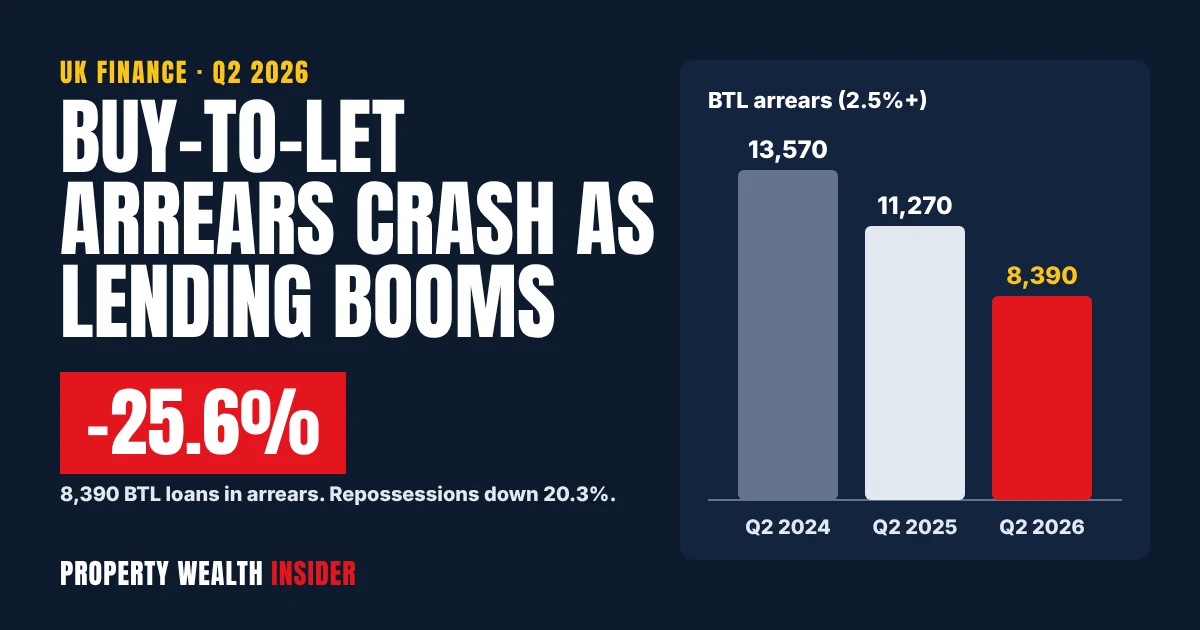
Buy-to-let arrears have fallen for the fifth quarter running and repossessions have dropped sharply, according to UK Finance figures published on 21 October 2026. At the end of June, 8,390 buy-to-let mortgages were behind by 2.5% or more of the balance, down 25.6% on a year earlier.
At the same time, lenders handed out 58,051 new buy-to-let loans worth £10.7bn between April and June. Most of that was landlords remortgaging. Lenders are clearly happy to lend to landlords again.
This matters to any landlord whose fixed rate ends in the next year or so. Below we explain what the numbers show, how lenders stress-test your rent, and how to work out whether your property will pass. There is a free calculator to check it, and a plan to keep you out of the arrears figures.
Key facts
- 8,390 UK buy-to-let mortgages were in arrears of 2.5%+ of the balance at the end of Q2 2026, down 25.6% year on year and down 570 on Q1.
- Lenders took 630 buy-to-let properties into possession in Q2 2026, down 20.3% on Q2 2025’s 790.
- 58,051 new buy-to-let loans worth £10.7bn were advanced, up 20.6% by number and 25% by value. Remortgages made up 39,631 of them.
- The average rate on new buy-to-let loans was 4.82%. The average interest cover ratio was 217% and the average gross rental yield was 7.27%.
- UK Finance says the yearly growth looks bigger than it is because Q2 2025 was artificially low after the stamp duty changes.
The Q2 2026 buy-to-let numbers
UK Finance publishes quarterly buy-to-let data for the whole UK. The Q2 2026 release covers April to June and compares it with the same quarter in 2025 and with Q1 2026.
| Measure (UK) | Q2 2026 | Change |
|---|---|---|
| BTL mortgages in arrears (2.5%+ of balance) | 8,390 | -25.6% y/y; -570 on Q1 |
| BTL possessions | 630 | -20.3% y/y (790 in Q2 2025) |
| All new BTL loans | 58,051 / £10.7bn | +20.6% number; +25% value |
| Remortgages | 39,631 / £7.5bn | +17.6% number; +20.2% value |
| House purchase loans | 16,026 / £2.7bn | +23% number; +27.9% value |
| Average rate on new BTL loans | 4.82% | +0.12 points on Q1; -0.18 points y/y |
| Average interest cover ratio | 217% | 221% in Q1; 210% in Q2 2025 |
| Average gross rental yield | 7.27% | 7.26% in Q2 2025 |
| BTL loans outstanding | 1.46m fixed; 450,000 variable | Fixed -0.7% y/y |
To put the arrears figure in context: 8,390 loans out of roughly 1.91 million outstanding is about 0.44%, or around 1 in 228 buy-to-let mortgages. That is our calculation from UK Finance’s own figures. It is still small, but each of those cases is a landlord facing serious money trouble.
Arrears and repossessions: the trend
Buy-to-let arrears more than doubled during the rate shock of 2023. The count went from 6,070 at the end of 2022 to 13,570 by Q4 2023, as fixed rates taken out at around 2% ran out. They stayed at that level until mid-2024 and have fallen every quarter since.
Possessions follow arrears, but with a lag. They kept rising long after arrears peaked and hit 900 in Q3 2025. The 630 recorded in Q2 2026 is the lowest since Q1 2024 and 22% below the 810 in Q1 2026.
Arrears are still well above where they were in late 2022. Rates have come down from the peak but have not gone back to pandemic-era levels. Landlords who borrowed at the bottom are still adjusting to that.
Why lending jumped, and the catch
The 20.6% rise looks dramatic, but UK Finance’s Head of Analytics, James Tatch, warns that activity in the same period last year “was artificially low” after the stamp duty changes. He also says “higher borrowing costs are likely weighing down on buy-to-let demand” and expects lending growth to flatten over 2026.
Look at the quarter-on-quarter figures and the picture is calmer. House purchase lending actually fell by 845 loans compared with Q1. Remortgaging rose by only 470 loans. The new money is mostly landlords refinancing, not new buyers coming into the market.
Borrowing costs are also rising again. The average new buy-to-let rate went up 0.12 percentage points to 4.82% in the quarter, and the average interest cover ratio fell from 221% to 217%. Bank Rate is 3.75%. The Bank of England held it in June, July and September, and its next decision is due on 5 November 2026.
Worked example: A landlord with a £200,000 interest-only loan fixed at 2% paid about £333 a month in interest. Remortgaging at the Q2 average of 4.82% costs about £803 a month. That is £470 a month (£5,640 a year) more, before tax.
How lenders stress-test your rent
Your lender will not only check that the rent covers the mortgage. Under the Prudential Regulation Authority’s buy-to-let underwriting standards (supervisory statement SS13/16), they must check the rent still covers the interest with room to spare if rates rise.
- Interest cover ratio (ICR): monthly rent divided by monthly interest. The PRA notes the industry minimum is 125%.
- Tax: lenders must take your tax into account. The Bank of England says most lenders test higher-rate taxpayers against a stressed ICR of around 145%.
- Stress rate: lenders should allow for buy-to-let rates rising by at least 2 percentage points, and assume a rate of at least 5.5%.
- Five-year fixes: if the rate is fixed for five years or more, lenders do not have to apply the five-year rate-rise test. That is why many lenders accept a lower stress rate on five-year fixes. Each lender sets its own criteria.
Worked example: rent is £1,250 a month and the loan is £200,000. At a 5.5% stress rate, the stressed interest is £916.67 a month, which gives a stressed ICR of 136%. A basic-rate landlord passes at 125%. A higher-rate landlord fails at 145%. The most the rent supports at 145% is about £188,000, so that landlord would need to find around £12,000 or switch to a product with a lower stress rate.
Tax rules on rental income are also changing. Individual landlords already get mortgage interest relief only as a basic-rate tax reduction. From 6 April 2027, the government’s new property income rates are 22%, 42% and 47%, and the finance cost reduction will be given at 22%. They are set for England, Wales and Northern Ireland, and the government plans to give Scotland and Wales the power to set their own property rates. Ask your lender whether it has changed how it treats tax in its affordability checks.
Calculator: will your remortgage pass?
Enter your own figures. The calculator shows your interest cover at the new rate, applies a lender-style stress test and works out the largest loan your rent supports.
BTL remortgage stress test
Guide only, not financial advice. Assumes an interest-only loan and ignores tax on your profit. Lenders set their own ICRs, stress rates and fees, so speak to a qualified mortgage broker before you act.
If the rate you enter is higher than the stress rate, the calculator tests at your actual rate. A lender would never assume a rate below the one you are paying.
What to do now if your fix is ending
Arrears usually build up when a landlord rolls onto a variable rate or misses a payment while waiting for a remortgage. These steps help you avoid both.
- Find your end date. Check the date your fixed rate expires and any early repayment charges. Many lenders let you secure a new deal months in advance.
- Run the stress test above at a 5.5% stress rate and at your expected new rate. If you fail at 145% but pass at 125%, ask a broker which lenders and products suit your tax position.
- Check your rent against the market. The rent in the lender’s valuation is what counts. Get evidence of what similar homes let for before the valuation.
- Compare a product transfer with a full remortgage. Your current lender may offer a product transfer with little or no new affordability check. That can help if your stressed ICR has slipped.
- Build a cash buffer. Keep at least three months of mortgage payments and costs set aside to cover empty periods or repairs.
- Call your lender early if a payment looks at risk. You have more options before arrears reach 2.5% of the balance, which is the point where you appear in these statistics.
- Fixed-rate end date and early repayment charges noted
- Stress test run at 5.5% and at your new rate
- Rental evidence gathered for the valuation
- Product transfer offer compared with the whole market
- Three months’ buffer in a separate account
- 2027 property income tax rates factored into your cash flow
- Broker booked at least three months before expiry
Buy-to-let arrears and remortgage FAQs
How many buy-to-let mortgages are in arrears in the UK?
UK Finance says 8,390 buy-to-let mortgages were in arrears of 2.5% or more of the balance at the end of June 2026. That is down from a peak of 13,570 in 2023 and 2024.
Are buy-to-let repossessions going up or down?
Down. There were 630 buy-to-let possessions in Q2 2026, compared with 810 in Q1 2026 and 790 in Q2 2025. The recent peak was 900 in Q3 2025.
What ICR do buy-to-let lenders use?
The PRA notes that the industry minimum is 125%. According to the Bank of England, most lenders test higher-rate taxpayers against a stressed ICR of around 145%. Lenders set their own criteria, and some use different ratios for limited company borrowers.
What stress rate do lenders use for buy-to-let?
PRA rules expect lenders to allow for rates rising by at least 2 percentage points, with a minimum assumed rate of 5.5%. Loans fixed for five years or more are exempt from that rate-rise test, which is why five-year fixes often pass more easily.
What is the average buy-to-let mortgage rate now?
UK Finance puts the average rate on new buy-to-let loans in Q2 2026 at 4.82%. That is up 0.12 points on Q1 2026 and down 0.18 points on a year earlier.
Sources
- UK Finance: Buy-to-Let Update Q2 2026 (21 October 2026)
- UK Finance: Buy-to-Let Lending data
- UK Finance: BTL Market Update Q2 2026 (PDF)
- UK Finance: Arrears and possessions data
- UK Finance: Mortgage Arrears and Possessions Update, 13 August 2026 (PDF)
- UK Finance: Mortgage Arrears and Possessions Update, 12 February 2026 (PDF)
- Bank of England: Bank Rate
- PRA SS13/16: Underwriting standards for buy-to-let mortgage contracts
- Bank of England: How lenders account for tax in BTL affordability
- GOV.UK: Change to tax rates for property, savings and dividend income
- GOV.UK: Tax relief for residential landlords
This article is news and general guidance only. It is not financial, legal or tax advice.