630 landlords repossessed as BTL arrears fall to 8,390
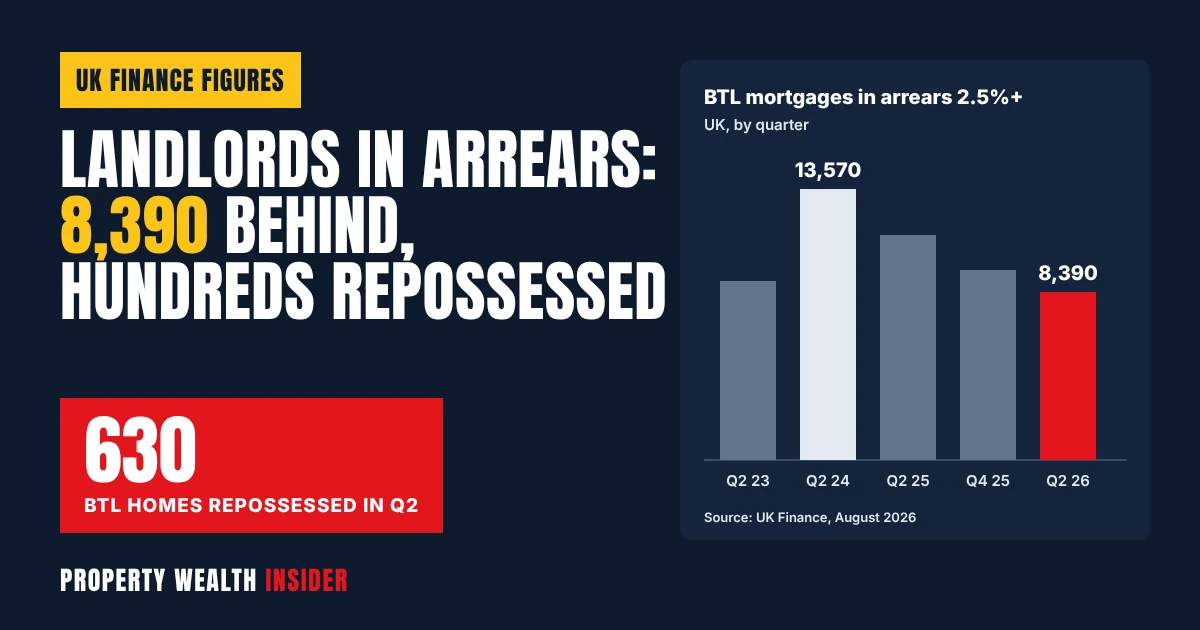
Some 8,390 buy-to-let mortgages across the UK were at least 2.5% of their balance behind on payments at the end of June 2026, and lenders took 630 rental properties into possession in the same three months, according to UK Finance.
The good news is that landlord arrears have now fallen for eight quarters in a row and are down almost two-fifths from their late-2023 peak. The bad news is that hundreds of landlords a quarter are still losing properties, and anyone whose cheap fix is about to run out is not in the clear yet.
Below we break down the official numbers, show you how to stress test your own mortgage in 30 seconds, and set out exactly what to do (and what protections you do and do not have) if you start falling behind.
Key facts
- 8,390 buy-to-let mortgages were in arrears of 2.5% or more of the balance in Q2 2026, down 6% on the quarter and 26% on the year.
- That is 0.44% of the 1.91 million buy-to-let mortgages outstanding, roughly 1 in 227.
- 630 buy-to-let properties were taken into possession in Q2 2026, down 22% on the quarter and 20% on the year.
- 3,070 landlord loans are in the deepest band, more than 10% of the balance behind: 37% of all BTL arrears cases.
- Bank Rate has been held at 3.75% since 18 December 2025; the next decision is due on 5 November 2026.
- The average interest cover ratio on buy-to-let lending was 217% in Q2 2026, with an average gross yield of 7.27%.
The numbers: arrears down, possessions still in the hundreds
UK Finance’s latest mortgage arrears and possessions update, published on 13 August 2026 and covering April to June, shows buy-to-let arrears at their lowest level in at least three years.
At the peak, in Q4 2023 and again in Q2 2024, 13,570 landlord mortgages were 2.5% or more behind. The Q2 2026 figure of 8,390 is 38% lower and also below the 8,960 recorded in Q2 2023.
Possessions tell a less tidy story. They climbed from 470 a quarter in Q2 2023 to a high of 900 in Q3 2025. The 630 recorded in Q2 2026 is the lowest since Q1 2024, but over the last four quarters 3,110 landlord properties were repossessed.
| Buy-to-let, UK | Q2 2025 | Q1 2026 | Q2 2026 |
|---|---|---|---|
| Arrears 2.5%–5% of balance | 4,100 | 3,220 | 2,980 |
| Arrears 5%–7.5% | 2,070 | 1,540 | 1,410 |
| Arrears 7.5%–10% | 1,450 | 1,000 | 930 |
| Arrears over 10% | 3,650 | 3,200 | 3,070 |
| All arrears 2.5%+ | 11,270 | 8,960 | 8,390 |
| Share of BTL mortgages in arrears | 0.58% | 0.47% | 0.44% |
| Properties taken into possession | 790 | 810 | 630 |
| BTL mortgages outstanding | 1.94m | 1.92m | 1.91m |
The figures are UK-wide; UK Finance does not split them by nation or English region. They cover first-charge mortgages only, so second-charge loans and bridging finance are not included. UK Finance says more than two-thirds of all possessions involve mortgages taken out at least ten years ago. The next update, for July to September, is due on 12 November 2026.
What “2.5% in arrears” means in pounds
UK Finance measures arrears as a share of the outstanding loan, not as a number of missed payments. That makes the threshold much deeper than it sounds for an interest-only landlord.
Worked example: a £180,000 interest-only loan at 5% costs £750 a month. To be 2.5% in arrears you would owe £4,500, which is six missed payments. To reach the “over 10%” band you would be £18,000 behind, or two years of payments.
So the 3,070 landlord loans in the deepest band are not borrowers who slipped up for a month. These are long-running problems, and they are the cases most likely to end in possession. They have fallen by only 16% in a year, compared with 27% for the lightest band.
BTL mortgage stress test calculator
Put in your own numbers to see your monthly interest, your interest cover ratio (rent divided by interest), your real cash position after costs and voids, and the mortgage rate at which the property stops paying for itself.
BTL mortgage stress test
Guide only, not financial advice. Interest-only basis, before tax, ignoring fees, insurance, ground rent and service charges unless you include them in costs. Lenders use their own stressed rates and ICR thresholds.
Here is how the default property (£1,100 rent, £180,000 interest-only loan, 15% costs, two weeks’ voids a year) looks as rates change. These rates are illustrative, not market quotes.
| Mortgage rate | Monthly interest | Interest cover (rent ÷ interest) | Monthly cash after costs and voids |
|---|---|---|---|
| 4% | £600 | 183% | +£299 |
| 5% | £750 | 147% | +£149 |
| 6% | £900 | 122% | −£1 |
| 7% | £1,050 | 105% | −£151 |
The lesson: a property can look comfortable on gross rent and still lose money once real costs and empty weeks are counted. At 6% this example breaks even almost to the pound, before any income tax.
Why the pressure has eased, and where it has not
The Bank of England has cut Bank Rate six times since 1 August 2024, taking it to 3.75% on 18 December 2025. It was held there again on 17 September 2026, and the next decision is due on 5 November.
UK Finance’s separate buy-to-let lending data, published on 21 October 2026, shows the market reviving. There were 58,051 new BTL loans worth £10.7bn in Q2 2026, up 20.6% by number on a year earlier. Of these, 39,631 were remortgages and 16,026 were for purchases.
The average interest cover ratio was 217%, up from 210% a year earlier but down from 221% in Q1 2026. The average gross rental yield was 7.27% UK-wide, with England at 7.11% and London at 6.14%.
Under the Prudential Regulation Authority’s buy-to-let underwriting rules (SS13/16), lenders test affordability at a stressed rate of at least 5.5%, unless the rate is fixed for five years or more, and the PRA describes 125% cover as the current industry standard. Landlords coming off a cheap fix may still fail that test when they try to switch lender, even if they can afford today’s payments.
What protection landlords really have
Many landlords assume the safety nets for homeowners apply to them. Most do not.
- The Mortgage Charter does not cover buy-to-let. The government’s Mortgage Charter, which includes the 12-month wait before a home is repossessed without consent, states that its commitments “do not apply to Buy-to-Let mortgages”.
- The FCA’s arrears rules are for regulated mortgages. MCOB 13 in the FCA Handbook covers payment difficulties on regulated mortgage contracts. Most buy-to-let loans are not regulated mortgages because the borrower does not live in the property.
- “Consumer buy-to-let” gets a basic forbearance duty. If you are an accidental landlord (for example, you inherited the property or let your former home) your loan may be consumer buy-to-let. Under the Mortgage Credit Directive Order 2015, the lender must “exercise reasonable forbearance before initiating possession proceedings” and must try to get the best price on sale. A loan is treated as business, not consumer, if you bought to let and never lived there, or you own other let property.
- Your contract and the lender’s own policy matter most. For business buy-to-let, the mortgage terms decide what the lender can do. Many lenders still offer payment plans or term changes. UK Finance says asking your lender about support will not affect your credit score.
What happens to tenants if the lender steps in
Buy-to-let lenders often appoint a receiver (usually called an LPA receiver) instead of, or before, taking possession. Under section 109 of the Law of Property Act 1925 the receiver can collect the rent. The receiver is treated as acting as the landlord’s agent, so you stay responsible for what they do.
The rent pays outgoings, the receiver’s commission, insurance and repairs, then mortgage interest, before anything comes back to you. In practice your tenants are told to pay the receiver, and you lose control of the property while the debt is still yours.
In England, a lender wanting vacant possession to sell can rely on Ground 2 of Schedule 2 to the Housing Act 1988. Since 1 May 2026, under the Renters’ Rights Act 2025, that ground needs at least four months’ notice. It also no longer requires the mortgage to have been granted before the tenancy began.
If you let without the lender’s consent, your tenants may be “unauthorised” and not bound into the lender’s plans. In England and Wales, the Mortgage Repossessions (Protection of Tenants etc.) Act 2010 lets such tenants ask the court to postpone possession for up to two months. Scotland and Northern Ireland have their own rules.
Falling behind? What to do now
- Run the numbers today. Use the calculator above with your real rent, costs and the rate you will move to when your current deal ends.
- Call your lender before you miss a payment. Ask what it can offer: a temporary payment plan, a term extension, a switch to interest-only, or a product transfer. Get any agreement in writing.
- Check what type of loan you have. Find out whether it is business buy-to-let, consumer buy-to-let or (rarely) regulated, because that decides which rules protect you.
- Book a product transfer early. Switching with your existing lender often avoids a fresh affordability test. Compare the result with a whole-of-market broker quote.
- Review the rent. If the rent is below market, look at a lawful increase using the correct statutory process for your nation and tenancy type.
- Cut leakage. Re-tender letting fees, insurance and maintenance contracts. Every 1% of rent saved goes straight into your cushion.
- Consider a controlled sale. Selling on your own terms almost always beats a receiver or forced sale. Talk to the lender before you put the property on the market.
- Get free debt advice. Free, impartial help is available through MoneyHelper, alongside your broker and accountant.
- I know my current rate, when my deal ends and the reversion rate
- I have run the stress test at my likely new rate
- My interest cover is above 125% at a 5.5% stressed rate
- I have three months of mortgage payments set aside
- I know whether my loan is business or consumer buy-to-let
- I have my lender’s consent to let and the tenancy is on record
- I have spoken to a broker about a product transfer
- I have a plan if a tenant stops paying or the property is empty
FAQ
How many buy-to-let mortgages are in arrears in the UK?
UK Finance says 8,390 buy-to-let mortgages were in arrears of 2.5% or more of the balance in Q2 2026. That is 0.44% of the 1.91 million outstanding.
How many buy-to-let properties were repossessed in 2026?
UK Finance recorded 810 buy-to-let possessions in Q1 2026 and 630 in Q2 2026, a total of 1,440 in the first half of the year. Figures for July to September are due on 12 November 2026.
Does the Mortgage Charter protect landlords?
No. The Charter applies to regulated residential mortgage borrowers and says its commitments do not apply to buy-to-let mortgages. Some lenders may offer similar help voluntarily, so ask.
What is a good interest cover ratio for buy-to-let?
The PRA describes 125% as the industry standard minimum, tested at a stressed rate of at least 5.5% unless the rate is fixed for five years or more. The UK average on BTL lending was 217% in Q2 2026, according to UK Finance.
Can my lender take the rent from my tenants?
Yes, if your mortgage gives the lender power to appoint a receiver. The receiver collects the rent and uses it for outgoings and mortgage interest first. Tenants should pay the receiver once properly notified.
Will asking my lender for help hurt my credit score?
UK Finance says contacting your lender to ask about support will not affect your credit score. Missed payments and any arrangement that changes your payments may still be recorded, so ask how it will be reported.
Sources
- UK Finance: Arrears and possessions data (Q2 2026 update, 13 August 2026)
- UK Finance: Mortgage arrears and possessions, Q2 2026 (press release)
- UK Finance: Buy-to-let lending, Q2 2026 (21 October 2026)
- Bank of England: Bank Rate
- PRA Supervisory Statement SS13/16: buy-to-let underwriting standards
- HM Treasury: Mortgage Charter
- FCA Handbook: MCOB 13
- Mortgage Credit Directive Order 2015, Schedule 2
- Law of Property Act 1925, section 109
- Housing Act 1988, Schedule 2 and section 8
- Mortgage Repossessions (Protection of Tenants etc.) Act 2010, section 1
This article is news and general guidance only. It is not financial, legal or tax advice.