CCJs Rocket 34.5%: Landlords Must Rethink Tenant Referencing
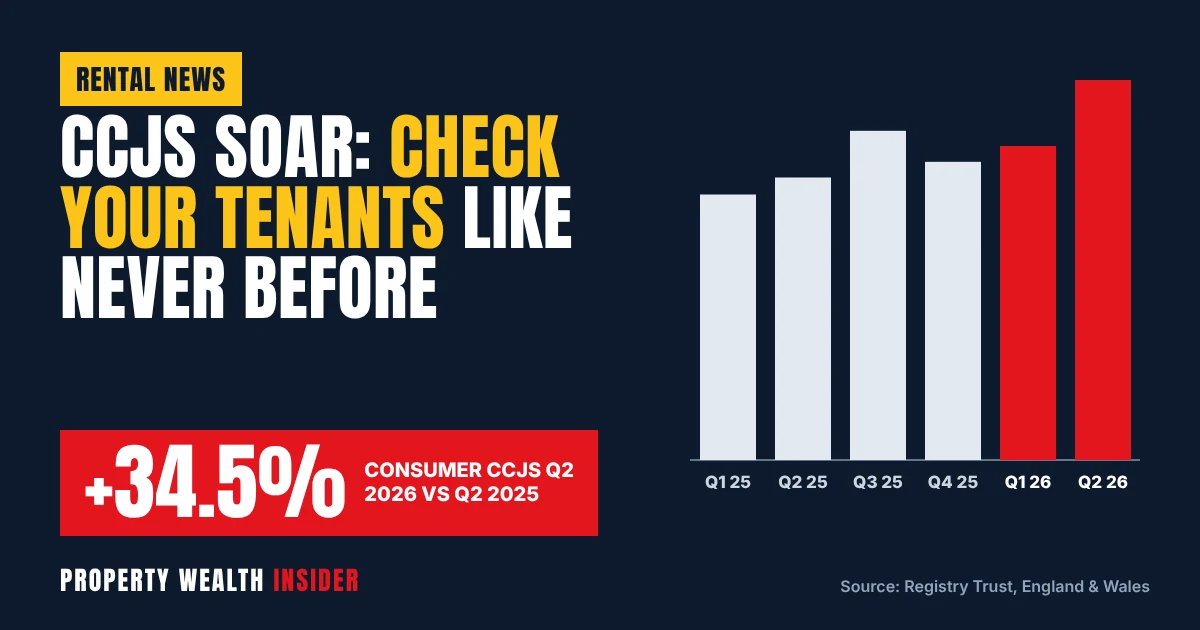
County court judgments against consumers are climbing at the fastest pace in years. Registry Trust, which runs the official Register of Judgments, recorded 322,076 new consumer CCJs in England and Wales in the second quarter of 2026, up 34.5% on the same quarter of 2025.
That lands at the worst possible moment for landlords in England. Since 1 May 2026, the Renters’ Rights Act has capped rent in advance at one month, abolished section 21 and stopped you turning away applicants because they have children or claim benefits. The big upfront cushion that once papered over a weak reference has gone.
So referencing is now the main line of defence. Below we set out the verified numbers, what you can and cannot lawfully check, how the common “30 times the rent” test works in pounds, and a calculator to run any applicant through in seconds.
Key facts
- 322,076 new consumer CCJs in England and Wales in Q2 2026, up 34.5% year on year and 21.0% on Q1 (Registry Trust).
- Full-year 2025: 996,261 consumer CCJs in England and Wales, up 11.8% on 2024.
- Around 4.1 million consumer judgments in England and Wales remain unsatisfied; median new judgment in Q2 2026 was £602.
- In England, rent in advance is now limited to one month (or 28 days’ rent if not paid monthly), and only after the tenancy agreement is signed. In force since 1 May 2026.
- Refusing tenants because they have children or receive benefits can bring a civil penalty of up to £7,000. You can still apply an income test, as long as all income counts equally.
The CCJ surge in numbers
A county court judgment is a court’s formal decision that someone owes money, usually after they failed to respond to a claim. Registry Trust publishes quarterly totals, and the trend over the last 18 months is steeply upward.
Consumer CCJs in England and Wales rose 11.8% in 2025 to 996,261. Then 2026 accelerated: 266,120 in Q1 (up 18.3% year on year) and 322,076 in Q2. The first half of 2026 totals 588,196, against 464,463 in the first half of 2025, a rise of roughly 26.6%.
Most of these debts are small. In Q2 2026, 45% of new consumer judgments were for less than £500 and the median was £602. The most common single amount was £283. Only 12% were above £3,000, but those made up 61% of the £565.9m total value.
Scale matters too. Analysis published by LexisNexis Risk Solutions in October 2025 found 3.14 million UK adults, about 6%, had at least one negative financial event such as a CCJ on file. A CCJ on an applicant’s report is no longer rare. You need a consistent way to deal with it.
Why the one-month cap changes the maths
Under the government’s landlord guidance for England, you must not ask for, encourage or accept rent before the tenancy agreement is signed. After signing and before the tenancy starts, you can usually take a maximum of one month’s rent, or 28 days’ rent if rent is not paid monthly.
That applies even if the tenant offers more. The guidance says you can still be reported if the tenant volunteered the payment. Exceptions are narrow: tenancies agreed by a council for someone legally homeless, and social or supported housing.
Worked example: on a £1,200-a-month let, a landlord who once took six months up front held £7,200 of protection. Now the most you can hold at the start is one month’s rent (£1,200) plus a deposit capped at five weeks’ rent (£1,384 where annual rent is under £50,000). Arrears beyond that come out of your pocket while you pursue possession, and with section 21 gone that means a court process under the new grounds.
Scope: the rent-in-advance cap, section 21 abolition and the children/benefits discrimination rules are England-only. Wales and Scotland have their own tenancy laws. CCJ figures above cover England and Wales.
What you can lawfully check
Referencing is legal and expected. What has changed is how you apply it. The government’s rental discrimination guidance says anyone acting for you, including a letting agent or referencing company, counts as you.
| Check | Allowed? | The rule (England) |
|---|---|---|
| Income / affordability test | Yes | Set the same requirement for everyone and count all income equally, including benefits and pensions. |
| Evidence of income | Yes | Do not unreasonably refuse bank statements, benefit letters or payslips. |
| Right to Rent | Required | Check all adults 18+ before the tenancy starts. Checking only people you think are not British is unlawful. |
| Guarantor | Yes, if consistent | Can be required of all applicants. Demanding one only from benefit claimants was found discriminatory in the guidance examples. |
| Holding deposit | Yes | Up to one week’s rent, to reserve while you run checks. |
| Rent in advance before signing | No | Banned. Max one month (or 28 days) after signing. |
| “No DSS” or “no children” | No | Penalty up to £7,000. A child restriction is only lawful if it is a proportionate means of achieving a legitimate aim. There is no such exception for benefits. |
| Accepting offers above advertised rent | No | Rental bidding ban; fine up to £7,000 for a first offence. |
One point catches out many landlords. The guidance gives the example of a referencing firm that ignores benefit income when calculating affordability. The council found discrimination, because benefits were treated unequally. Check your agent’s or referencing provider’s rules before you rely on them.
The 30x affordability test in pounds
Most agents and referencing firms use a rule of thumb: combined annual income of at least 30 times the monthly rent. A guarantor is often expected to earn 36 times. These are market conventions, not law. You can set your own figure, but it must be the same for every applicant.
| Monthly rent | Tenant income at 30x | Guarantor income at 36x | Rent as % of income at 30x |
|---|---|---|---|
| £900 | £27,000 | £32,400 | 40% |
| £1,200 | £36,000 | £43,200 | 40% |
| £1,500 | £45,000 | £54,000 | 40% |
| £2,000 | £60,000 | £72,000 | 40% |
Worked example: a couple apply for a £1,400 flat. One earns £28,000, the other £10,000 from part-time work and Universal Credit. Combined £38,000 is 27.1 times the rent, below 30x. Under a 30x policy, they could afford up to £1,267 a month. A guarantor at 36x would need £50,400. Run your own numbers below.
Tenant affordability & referencing checker
Guide only, not legal or financial advice. 30x and 36x are industry conventions, not legal rules. In England you must apply the same income test to every applicant and count benefit and pension income equally.
How to read a CCJ on a reference
Not every CCJ means the same thing. Under gov.uk rules for England, Wales and Northern Ireland, a judgment stays on the Register of Judgments, Orders and Fines for six years. If it is paid in full within one month, it can be removed altogether.
If paid later, it is marked “satisfied” and stays visible for the full six years, but anyone searching sees it was paid. The debtor can get a certificate of satisfaction from the court for £19.
- Amount: a £283 judgment over a disputed phone bill is a different risk from a £4,000 judgment for unpaid rent.
- Age: one judgment five years ago, with a clean record since, tells a different story from three in the last year.
- Status: satisfied shows the debt was cleared. Unsatisfied means money is still owed. Ask whether a payment plan is in place.
- Explanation: judgments can be set aside if the person never received the claim. Give applicants the chance to explain, and record what they say.
Whatever line you take, apply it the same way to every applicant and write it down. A written policy is your best evidence if a refusal is ever challenged.
What to do now: step-by-step referencing
This order keeps you within the rules in England and avoids taking money you are not allowed to take.
- Write your criteria down first: income multiple, guarantor policy and how you treat CCJs. Same rules for every applicant.
- Advertise a single, specific rent. No price ranges, and do not invite or accept higher offers.
- Do not screen out anyone for having children or receiving benefits, in adverts, viewings or shortlisting.
- Take a holding deposit of no more than one week’s rent if you want to reserve the property while checking.
- Tell applicants what checks you will run, including credit checks, and get their details in writing.
- Verify income from all sources: payslips, bank statements, benefit or pension letters. Count every pound equally.
- Run a credit check and Register of Judgments search; ask for an explanation of any CCJ before deciding.
- Do Right to Rent checks on all adults 18+ before the tenancy starts, the same way for everyone.
- Get a previous landlord reference, focusing on rent payment history.
- If a guarantor is required under your policy, reference them to the same standard and use a written deed.
- Sign the tenancy agreement, then take no more than one month’s rent (or 28 days’) before the start date.
- Protect any deposit (max five weeks’ rent if annual rent is under £50,000) in an approved scheme.
- Keep records of every decision and the reason for it.
FAQ
Can a landlord refuse a tenant with a CCJ?
A CCJ is not a protected characteristic, so it can be a lawful reason to refuse. Apply your policy consistently and make sure it is not used as cover for rejecting people on benefits or with children.
How much rent can a landlord ask for in advance in 2026?
In England, from 1 May 2026, nothing before the tenancy agreement is signed, then usually a maximum of one month’s rent (or 28 days’ rent if not paid monthly) before the tenancy starts.
Is the 30 times rent rule a legal requirement?
No. It is an industry convention. The law lets you apply an income test, but it must be the same for everyone and count benefits and pensions as income.
Can I ask only benefit claimants for a guarantor?
No. Government guidance gives this as an example of discrimination. If you want guarantors, require them from every applicant who misses the same income test.
How long does a CCJ stay on a tenant’s record?
Six years on the Register of Judgments, unless paid in full within a month, in which case it can be removed. Paid later, it shows as satisfied.
Sources
- Registry Trust: Q2 2026 summary
- Registry Trust: Q1 2026 summary
- Registry Trust: Q4 2025 summary
- Registry Trust: Q3 2025 statistics
- Registry Trust: Q2 2025 summary
- Registry Trust: Q1 2025 summary
- GOV.UK: Assured periodic tenancies, a guide for landlords
- GOV.UK: Rental discrimination under the Renters’ Rights Act 2025
- GOV.UK: Renters’ Rights Act overview for tenants
- GOV.UK: Check your tenant’s right to rent
- GOV.UK: County court judgments for debt
- LexisNexis Risk Solutions: financial stress analysis (October 2025)
This article is news and general guidance, not financial, legal or tax advice.