EPC C by 2030: The £10,000 Bill Facing 2.4m Rentals
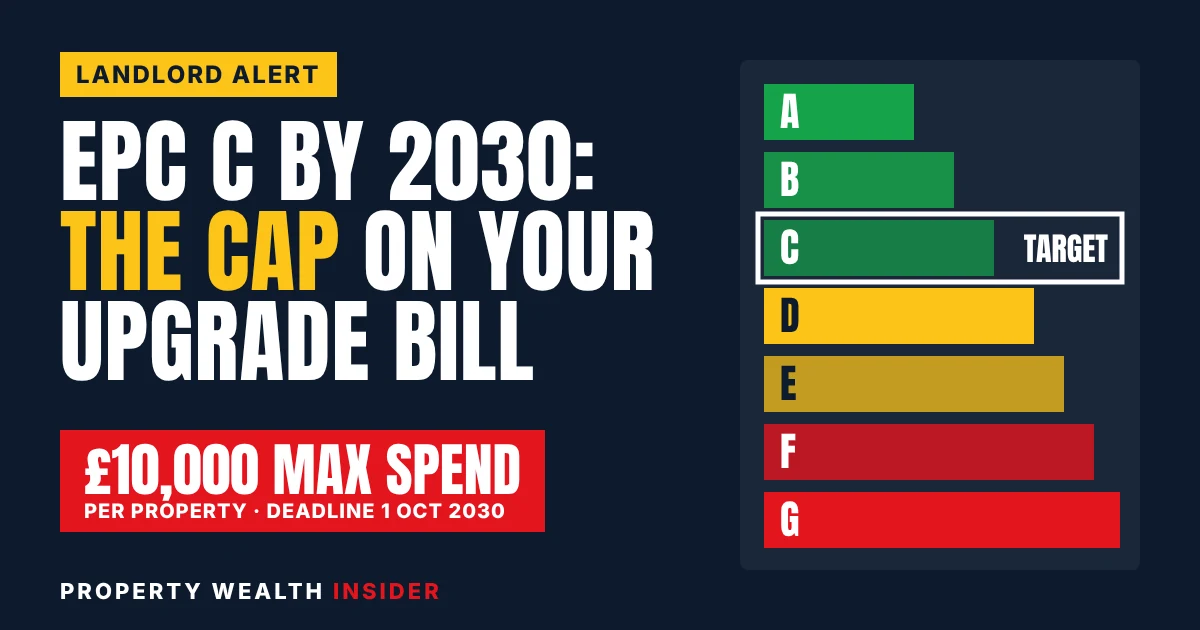
Around 2.4 million privately rented homes in England were still rated below EPC band C in the government’s latest housing survey, and every one of them is now on a countdown to 1 October 2030. That is the date ministers have confirmed for a new minimum standard of EPC C, with landlords expected to spend up to £10,000 per property to get there.
Fresh analysis doing the rounds this week suggests a sizeable chunk of rentals may not reach band C even after every recommended upgrade. Whatever the exact number, the rules that decide what happens to those homes are already written down in the government’s January 2026 consultation response, and most landlords have not yet worked through them.
This guide covers landlords in England and Wales, where the Minimum Energy Efficiency Standards (MEES) apply. Scotland and Northern Ireland have their own separate regimes. Below: what is law today, what is confirmed but not yet in force, how the £10,000 cap actually works, and a calculator to test your own property.
Key facts
- The law today is still EPC E minimum, with a maximum spend of £3,500 (inc. VAT) per property.
- Government has confirmed a new EPC C standard for all private tenancies, new and existing, from 1 October 2030.
- The new cost cap is £10,000 per property, or 10% of value for homes worth under £100,000. Spending from 1 October 2025 counts.
- Homes rated C on an EPC lodged before 1 October 2029 count as compliant until that certificate expires.
- In 2024, 49% of private rented homes in England (about 2.4 million) were rated D to G.
- Proposed fines rise to a maximum of £30,000 per property per breach, up from £5,000 today.
What is law now and what is coming
The rules in force today come from the Energy Efficiency (Private Rented Property) (England and Wales) Regulations 2015. Since 1 April 2020 you cannot let, or continue to let, a home rated F or G unless you have registered a valid exemption.
The EPC C standard is confirmed government policy, set out in the consultation outcome published on 21 January 2026. It is not yet law. Ministers said they will seek new powers through an Act of Parliament, then lay regulations aiming to come into force in 2027, with landlords required to comply from 1 October 2030.
| Rule | In force now (2015 Regulations) | Confirmed for 2030 (not yet law) |
|---|---|---|
| Minimum rating | EPC E | EPC C, measured on new EPC metrics |
| Who it covers | All qualifying private tenancies | All tenancies from 1 October 2030, no earlier date for new lets |
| Spending cap | £3,500 inc. VAT | £10,000, or 10% of value if worth under £100,000 |
| Spend that counts | Since 1 October 2017 (rules apply) | From 1 October 2025, including grant funding |
| Cost cap exemption length | 5 years | 10 years |
| Maximum fine | £5,000 per property | £30,000 per property per breach |
| Where exemptions go | PRS Exemptions Register | PRS Exemptions Register, cross-checked with the new PRS Database |
The new standard is not a straight “get a C on today’s certificate” test. Homes will need to meet a primary fabric performance standard first (insulation, glazing and so on), then a secondary standard of the landlord’s choice: either smart readiness (for example solar panels) or a heating system standard (for example a heat pump). Government says no landlord will be forced to rip out a working boiler.
Exactly what scores a C on those new metrics is still being finalised through the Home Energy Model EPC work. That is the single biggest unknown for landlords right now.
How many rentals are below band C?
The best official measure is the English Housing Survey 2024 to 2025, which covers England only. It found 51% of private rented homes were rated A to C in 2024, more than double the 25% in 2014. The flip side: around 2.41 million rentals sat in bands D to G.
Within that, an estimated 436,000 rentals were band E and around 142,000 were F or G, which is below the legal minimum today unless exempt. The government’s impact assessment says 20,200 properties had an exemption on the PRS Exemptions Register as of June 2025.
The same survey modelled what it would cost to lift homes to band C on the current rating system. Older, bigger and lower-rated homes cost far more.
| Home type (England, 2024) | Average cost to reach band C |
|---|---|
| Private rented home (all) | £7,040 (median £8,825) |
| Any home currently band D | £6,002 |
| Any home currently band E | £12,430 |
| Any home currently band F or G | £17,354 |
| Built before 1919 | £10,728 |
| Purpose-built low-rise flat | £4,193 |
Those averages are only for homes the survey judged could be improved to C. Separately, the government’s own impact assessment estimates average spend per property under the new rules at £5,400, once the £10,000 cap is taken into account.
How the £10,000 cap really works
The cap is a ceiling on what you can be required to spend, not a grant and not a target. The consultation had floated £15,000; the final figure is £10,000 per property, including VAT, over a 10-year period.
- Spending from 1 October 2025 counts. Work you have already done on measures recommended on your EPC, or by a relevant expert, goes towards the cap.
- Grants count too. Funding from schemes such as Warm Homes: Local Grant, ECO4 and other third-party money counts towards the £10,000, even though you did not pay it.
- Boiler Upgrade Scheme money does not count. Government excluded it so a heat pump can fit inside the cap.
- Fabric comes first. Spending on the secondary standard (heating or smart measures) does not count until the fabric standard is met or exempted.
- EPC costs count. The pre-works and post-works EPCs you will need can be included when registering a cost cap exemption.
- Low-value homes get a lower cap. If the property is worth under £100,000, the cap is 10% of its value.
If the home is still below standard once you have spent up to the cap, or the next cheapest measure would take you over it, you can register a cost cap exemption lasting 10 years. When it expires, a fresh round of improvements is required.
The new exemptions, explained
This is where homes that “can’t reach C” end up. Exemptions are registered on the PRS Exemptions Register and let you keep letting legally. The confirmed list for 2030 is:
- High cost: even the cheapest recommended measure would exceed the cap.
- All relevant improvements made: nothing more can be done and the home is still below standard.
- Cost cap (10 years): you have spent up to £10,000, or the next measure would breach it.
- Property value adjustment (10 years): the 10%-of-value cap for homes under £100,000.
- Solid wall insulation (new): you can choose not to install it, with no evidence needed.
- Negative impacts (10 years): merges today’s devaluation and wall insulation exemptions; evidence that a measure would harm the property.
- Third-party consent: a tenant, superior landlord or planning authority refuses consent.
- New landlord: six months’ grace after you take over a tenanted property.
Exemptions are measure-specific. An exemption for solid wall insulation does not excuse you from loft insulation or glazing that fits within the cap.
Calculator: will you hit the cap?
Enter your property value and the quotes you have (or expect) for each measure. The tool applies the confirmed cap, orders fabric measures first and cheapest first, and shows where you would stop and whether a cost cap exemption looks likely.
EPC C upgrade cost and cap checker
Guide only, not advice. Based on the government’s January 2026 policy, which is not yet law; final rules and the new EPC scoring may differ. The tool assumes your quotes are for recommended measures and that fabric measures are fitted before heating or solar. Only an EPC assessor can tell you whether a home will reach C.
Worked examples in pounds
1. Band D terrace worth £180,000. Quotes: loft £600, cavity wall £2,500, windows £4,000, heating £3,000. Fabric goes first: £7,100. Adding heating would take the total to £10,100, over the £10,000 cap. If the home is still below standard after the fabric work, the landlord could register a 10-year cost cap exemption rather than pay for the heating.
2. Flat worth £75,000. The property value adjustment applies, so the cap is 10% of value: £7,500, not £10,000. Spend up to £7,500 on recommended measures, then the exemption route opens.
3. Early mover. A landlord spent £4,000 on loft and cavity wall insulation in spring 2026. Because it was after 1 October 2025, all £4,000 counts. Their remaining obligation is capped at £6,000.
4. Grant-funded work. A £5,000 Warm Homes: Local Grant pays for insulation. That £5,000 counts towards the cap, so the landlord’s own maximum outlay drops to £5,000.
5. What it means for rent. £7,100 of works spread over five years is about £118 a month, or 11.8% of a £1,000 rent. Over 10 years, it is about £59 a month. Whether the market will bear that is another question: the impact assessment’s own example found a D-to-C upgrade could take around 12 years to pay back through higher rent alone.
Already at C? If your home is rated C or better on an EPC lodged before 1 October 2029, it is treated as compliant until that certificate expires or is replaced. An EPC is currently valid for 10 years, so a C lodged in 2029 could carry you well into the 2030s.
What to do now: step by step
- Check today’s compliance. Look up every property on the EPC register. Anything rated F or G must be fixed or exempted now under the current E rule.
- Sort your portfolio into three piles: already C (protect it), D (likely within the cap) and E to G (likely to need big spend or an exemption).
- Bank the C ratings. If a home is borderline C, consider a fresh EPC before 1 October 2029 to lock in grandparenting.
- Do fabric first. Loft, wall and floor insulation and glazing count towards the primary standard. Heating and solar only count after that.
- Chase grants before you pay. Ask your council about Warm Homes: Local Grant eligibility. It counts towards the cap and reduces what you pay.
- Keep every invoice from 1 October 2025. You will need proof of spend, including VAT, to claim a cost cap exemption.
- Time the work. The zero rate of VAT on energy-saving materials is due to run until March 2027, and works are easiest between tenancies.
- Watch for the final scoring. Do not commit large sums to measures until you know how they score on the new EPC metrics.
- EPC rating and expiry date checked for every rental
- No F or G homes let without a registered exemption
- Property values noted (under £100,000 lowers the cap)
- Invoices since 1 October 2025 filed, with VAT shown
- Grant eligibility checked with the local council
- Borderline C homes flagged for a new EPC before 1 October 2029
- Tenant and superior landlord consents requested where works need them
- Diary note to recheck guidance when regulations are laid
FAQ
Do rented homes need EPC C by 2030?
In England and Wales, government has confirmed that all private tenancies must meet the new standard by 1 October 2030, unless exempt. It still needs Parliament to pass the powers and regulations, so it is policy, not yet law.
What is the EPC C cost cap for landlords?
£10,000 per property including VAT, or 10% of value if the home is worth under £100,000. Today’s legal cap under the EPC E rule is £3,500.
Does money I spend now count towards the £10,000?
Yes, if it was spent from 1 October 2025 on relevant measures recommended on your EPC or by a relevant expert. Third-party grants count too, but Boiler Upgrade Scheme funding does not.
What happens if my rental can’t reach band C?
You can keep letting it if you register a valid exemption, for example a 10-year cost cap exemption once you have spent up to the cap, or an all relevant improvements made exemption.
My property is already EPC C. Do I need to do anything?
If the C is on an EPC lodged before 1 October 2029, the home counts as compliant until that EPC expires or is replaced. You will need to meet the new standard after that.
What is the fine for breaking EPC rules?
Today, up to £5,000 per property in total. Under the confirmed reforms, councils will be able to fine up to £30,000 per property per breach.
Sources
- DESNZ: Improving the energy performance of privately rented homes, consultation outcome (21 January 2026)
- DESNZ: Government response
- DESNZ: Impact assessment
- GOV.UK: Energy Performance Certificates
- Energy Efficiency (Private Rented Property) (England and Wales) Regulations 2015
- GOV.UK: Domestic private rented property minimum energy efficiency standard, landlord guidance
- MHCLG: English Housing Survey 2024 to 2025, Chapter 2 energy efficiency
- MHCLG: English Housing Survey 2024 to 2025 annex tables
This article is news and general guidance only, not financial, legal or tax advice.