Emailed Your Section 8? Landlords Risk Losing 4 Months
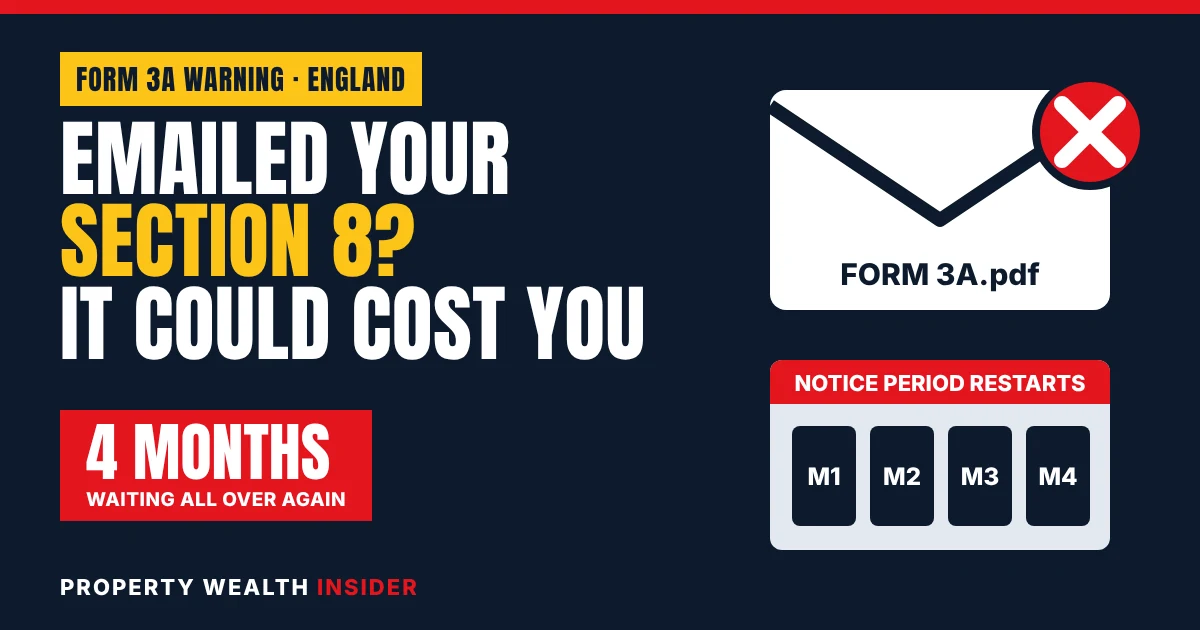
Landlords in England who email a section 8 notice to their tenant could be throwing away months. Government guidance on Form 3A, the notice seeking possession under the new tenancy system, says it should only go by email if the written tenancy agreement clearly makes email an agreed way of serving notices.
If yours doesn’t, you may not be able to prove the notice was validly served. That could mean serving it again and starting the notice period from day one. For a sale or move-in claim under Grounds 1 or 1A, that’s another four months.
This affects every private landlord and letting agent in England using Form 3A since section 21 was abolished on 1 May 2026. Wales has its own system under the Renting Homes (Wales) Act 2016, and none of this applies there, or in Scotland or Northern Ireland.
Key facts
- Form 3A guidance: only serve by email if the written tenancy agreement is clear that email is an agreed method of service.
- Methods the guidance names: in person (described as the most reliable), through the letterbox at the property, or registered post.
- Notice periods run from the date of service: 4 months for Grounds 1, 1A and 6; 4 weeks for rent arrears Grounds 8, 10 and 11; none for antisocial behaviour Grounds 7A and 14.
- Court proceedings must begin within 12 months of the date of service, or the notice lapses.
- For Grounds 1 and 1A, the date in the notice cannot fall in the first 12 months of the tenancy.
- Record service on court form N215 (certificate of service), or write “served by [your name] on [the date]” on the notice.
Why an emailed Form 3A can fail
Under section 8 of the Housing Act 1988, a court can’t hear a possession claim unless the landlord has served a valid notice on the tenant. Since 1 May 2026, private landlords in England have to use Form 3A for that notice.
The government’s Form 3A guidance for private landlords is blunt: “Only serve the notice of possession by email if the written tenancy agreement is clear that email is an agreed method of service.”
It also says: “It is important that you can evidence that you served the notice of possession correctly.” When you apply for possession, the court will want to see that you gave notice correctly and gave the right amount of it.
The trap is assuming that because you and your tenant always talk by email, email must be fine for legal notices too. The guidance doesn’t treat everyday contact as consent to service. What counts is what the written agreement says.
Same idea in the court rules. For documents served in court proceedings, Civil Procedure Rules Practice Direction 6A (para 4.1) says the person being served must already have said in writing that they will accept service by electronic means, and given the address to use. A judge looking at an emailed notice will be used to that test.
How to serve Form 3A validly
Start with your tenancy agreement. The guidance says that if the written agreement sets out how notices are to be served, you should use that method. If it doesn’t, it lists three options.
| Method | What the guidance says | Proof to keep |
|---|---|---|
| Hand to the tenant in person | “the most reliable method” | N215, plus a witness or a dated photo of the handover if you can |
| Deliver to the property yourself | If the tenant isn’t in, you can post it through the letterbox | N215, a time-stamped photo of the notice going through the door, and ideally an independent witness |
| Registered post to the property | Listed as an accepted method | Royal Mail receipt and tracking or signature record, plus N215 |
| Only if the written tenancy agreement is clear that email is an agreed method of service | The agreement clause, the sent email with the attachment, and N215 |
Note that the guidance names registered post, not ordinary first class post. Keep the original notice and give a copy to every tenant named on the agreement. A notice served on only one of two joint tenants invites a challenge.
Then record how and when you served it. The guidance gives two options: fill in the certificate of service form N215, or write “served by [your name] on [the date]” on the notice. N215 is the better choice. It’s the court’s own form, and the guidance says you can rely on it, together with the notice, when you apply for possession.
Form 3A notice periods by ground
The minimum notice periods are set out in section 8(4AA) of the Housing Act 1988, as amended by the Renters’ Rights Act 2025. Each period runs from, and includes, the date of service. That’s why proving the service date matters so much.
If you rely on more than one ground, you have to wait for the longest notice period to end. The exception is antisocial behaviour (Grounds 7A and 14). If either is included, you can apply to court straight after serving, even alongside grounds with longer periods.
The date you write at question 2.1 of Form 3A must be the day after the notice period ends. The government’s own example: a notice under Grounds 8 and 7 served on 1 June 2026 means you wait until 1 August 2026 to apply.
For Grounds 1 (you or family moving in) and 1A (sale) there’s an extra rule. The grounds for possession guidance says you can give notice during the first 12 months of a new tenancy, but “it cannot expire before the 12 months has ended”. The legislation tests this against the date given in the notice.
There’s also a deadline at the other end. Section 8(3)(c) says proceedings can’t begin later than twelve months from the date of service. Form 3A says that after this, “the notice will no longer be valid”, although the deadline can be extended if the tenant enters a debt breathing space.
Form 3A notice date calculator
Choose your ground and service method, then enter the dates. The calculator gives you the date to put at question 2.1, the last safe date to start court proceedings, and a warning if your service method is risky.
Form 3A notice date calculator
Guide only, not legal advice. For registered post we treat the notice as served two working days after posting. That’s our cautious assumption, not a legal rule, and it ignores bank holidays. The 12-month check for Grounds 1 and 1A uses the tenancy anniversary as a safe floor. “Start proceedings by” is one day inside the 12-month limit in s.8(3)(c). Breathing space extensions are not included.
What a botched service costs: worked examples
Example 1: rent arrears under Ground 8
Rent is £1,200 a month and the tenant owes three months, £3,600, which meets the Ground 8 threshold for monthly rent. On 20 October 2026 the landlord emails Form 3A, but the tenancy agreement says nothing about email.
Six weeks later an adviser flags the problem. The landlord re-serves by hand on 1 December 2026, so the four-week period starts again and the earliest court date moves from 17 November to 29 December 2026.
That’s six weeks lost. If nothing is paid in that time, the arrears grow by about £1,662 (£1,200 x 12 ÷ 52 x 6). The total reaches roughly £5,262 before the claim can even be issued.
Example 2: selling under Ground 1A
A landlord whose tenancy is well past its first year emails a Ground 1A notice on 20 October 2026. The earliest court date would be 20 February 2027. In March they find out the email may not count, and re-serve by hand on 1 March 2027.
The new earliest date is 1 July 2027, more than four months later. If the landlord was paying £650 a month in mortgage interest while waiting to sell, that’s around £2,600 in extra holding costs, before counting a buyer who won’t wait.
Example 3: the protected period
A tenancy began on 1 June 2026 and the landlord serves a Ground 1A notice by hand today, 20 October 2026. Four months takes you to 20 February 2027. But the date in the notice can’t fall in the first 12 months, so it must be no earlier than 1 June 2027. Serving early is allowed. Putting the wrong date at question 2.1 is not.
Adding email service to your tenancy agreement
To use email, you need a written term that clearly makes it an agreed method of service. Vague wording like “the parties may communicate by email” leaves room for argument. A clear clause should cover:
- That notices under the tenancy, including notices seeking possession under section 8 of the Housing Act 1988, may be served by email.
- The exact email address for each tenant and for the landlord or agent.
- That each party will tell the other in writing if their address changes.
- Whether notices can be sent as attachments (for example PDF), and when an emailed notice is treated as received.
For new lets, put this in the agreement before it’s signed. For existing tenants, you’ll need their written agreement to vary the terms. You can’t add it on your own, and if the tenant won’t agree you’ll have to serve by hand or post.
It works both ways. Form 3A’s own note 5.7 says that if the landlord gives an email address on the form, “you agree that the tenant and the court may use this address to serve documents on you”. Only give an inbox you check. Have a solicitor or your landlord association review any clause before you rely on it.
Already emailed a notice? What to do now
- Read your agreement’s service clause. If it clearly lets notices be served by email to the address you used, you’re probably fine. Complete N215 and keep the sent email.
- If it doesn’t, re-serve now. Every day you wait is another day added to the end. Hand the notice over in person if you can, since the guidance calls this the most reliable method.
- Fill in a new Form 3A. Recalculate the date at question 2.1 from the new service date using the calculator above. Copying the old date across is a classic mistake.
- Check the legal wording. The guidance warns that missing or inaccurate legal wording for a ground at question 4.2 may make the notice invalid.
- Serve every named tenant and complete N215 the same day.
- Diary the deadlines: the earliest court date and the 12-month cut-off for starting proceedings.
- Tenancy agreement checked for a service clause
- Current Form 3A downloaded from GOV.UK (not the old Form 3)
- Every ground ticked, with full legal wording at question 4.2
- Question 2.1 date worked out from the service date, including the 12-month floor for Grounds 1 and 1A
- Breathing space checked (don’t use arrears grounds without court permission if the tenant is in one)
- Copy served on every named tenant
- N215 completed, with photos, receipt or witness details attached
- Original notice and evidence filed together
- Earliest court date and 12-month deadline in the diary
FAQ
Can I serve a section 8 notice by email?
In England, only if the written tenancy agreement is clear that email is an agreed method of service. That’s what the government’s Form 3A guidance says. Otherwise, serve in person, through the letterbox or by registered post.
How long is the notice period on Form 3A?
It depends on the ground: four months for Grounds 1, 1A and 6, two months for Grounds 5, 7 and 9, four weeks for rent arrears Grounds 8, 10 and 11, two weeks for Grounds 12, 13, 15 and 17, and no notice period for Grounds 7A and 14.
How do I prove I served a section 8 notice?
Complete form N215, the certificate of service, or write “served by [your name] on [the date]” on the notice. Keep any photos, post office receipts, tracking records and witness details with it.
How long is a Form 3A notice valid for?
Court proceedings must begin no later than 12 months from the date of service. This can be extended if the tenant is in a debt breathing space and the notice relies on rent arrears.
Can I serve notice to sell in the first year of a tenancy?
You can serve it, but the date in the notice cannot fall within the first 12 months of the tenancy. With a four-month notice period, that means serving no earlier than around month eight if you want the dates to line up.
Does this apply in Wales?
No. Form 3A and the Renters’ Rights Act possession rules apply to private tenancies in England. Wales uses occupation contracts under the Renting Homes (Wales) Act 2016, with its own notices.
Sources
- GOV.UK – Assured tenancy forms (Form 3A and guidance)
- GOV.UK – Form 3A: Completing the notice seeking possession – guidance for private landlords
- GOV.UK – Form 3A notice seeking possession
- GOV.UK – Form 3A: Legal wording for possession grounds
- GOV.UK – Grounds for possession guidance for landlords and letting agents
- GOV.UK – Repossessing your privately rented property on or after 1 May 2026
- GOV.UK – Giving notice to evict tenants
- GOV.UK – Certificate of service in civil cases: Form N215
- legislation.gov.uk – Housing Act 1988, section 8
- legislation.gov.uk – Housing Act 1988, Schedule 2 Part 5 (meaning of “relevant date”)
- Civil Procedure Rules – Practice Direction 6A, Service of documents
This article is news and general guidance only, not legal, financial or tax advice. Take independent legal advice before serving a possession notice.