Landlord fined £3,600 for serving banned Section 21 notice
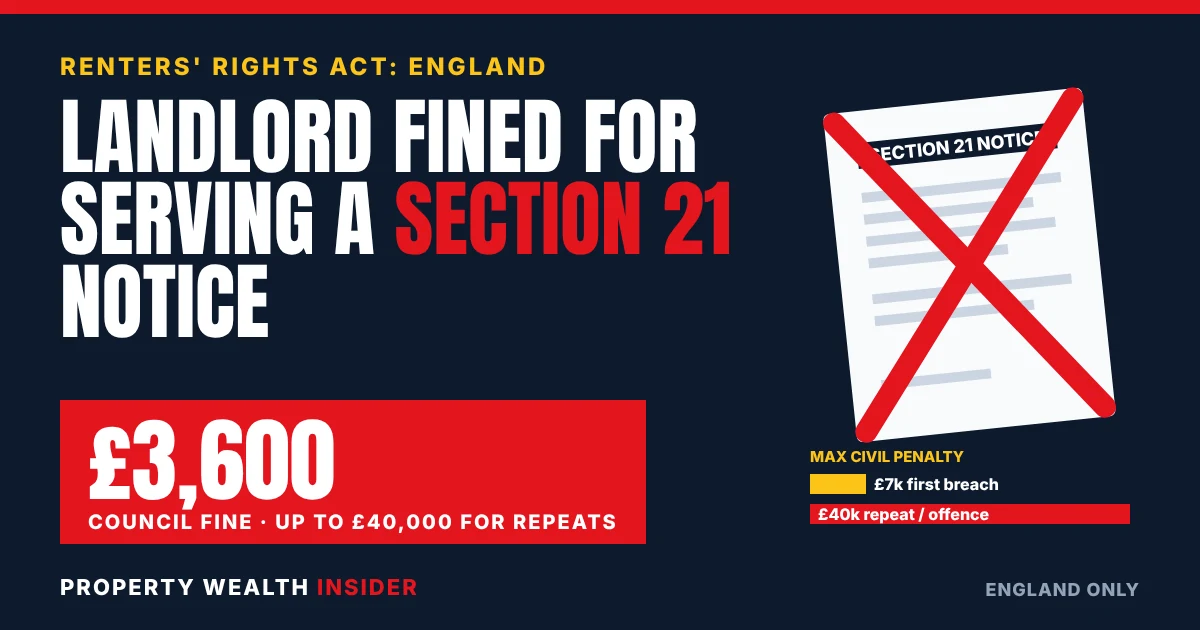
A landlord in Gateshead has been fined £3,600 for serving a Section 21 notice on a tenant after 1 May 2026, the date no-fault evictions were abolished in England. It is the first penalty Gateshead Council has concluded under the Renters’ Rights Act 2025, and it will not be the last: the council says other cases are already being considered.
The landlord paid within 28 days, took a 15% early-payment discount and handed over £3,060. Small change next to what the law allows. Councils can fine up to £7,000 for a first breach and up to £40,000 where a breach is repeated or a possession ground is knowingly misused.
If you let property in England on an assured tenancy, this case is your warning. A Section 21 notice now gets you nothing in court and can still cost you thousands. Below: what the law says, which section 8 ground fits your situation, how much notice to give, and a checker that works out your earliest lawful date and your penalty risk.
Key facts
- Gateshead Council fined a landlord £3,600 for serving a Section 21 notice after 1 May 2026. The landlord paid £3,060 after a 15% prompt-payment discount.
- Serving any notice that tries to end a tenancy outside the section 8 process is a breach. The maximum civil penalty is £7,000.
- Repeat breaches within 5 years, carrying on for 28 days after a fine, or knowingly misusing a ground are offences. Councils can impose a penalty of up to £40,000 instead of prosecuting.
- Government guidance sets a £6,000 starting point for a purported notice of possession. The starting point for knowingly or recklessly misusing a ground is £30,000.
- Selling or moving in (Grounds 1A and 1) needs 4 months’ notice and can’t take effect in the first 12 months of a tenancy. Rent arrears (Ground 8) needs 4 weeks’ notice.
- These rules apply to England only. Wales and Scotland have their own systems.
What happened in Gateshead
According to Gateshead Council’s announcement of 20 October 2026, its Private Sector Housing team contacted the landlord and explained that the law had changed. It told the landlord the notice was invalid and pointed them to the correct legal routes to possession.
The council then followed the statutory process. First came a notice of intent setting out the proposed fine, which gave the landlord the chance to respond. The final notice followed on 24 August 2026, and the council received payment on 8 September.
The council has not named the landlord or the property. It says money from fines will go back into its private rented sector work, including standards checks, complaint investigations and enforcement.
Why a Section 21 notice is now a breach
Part 1 of the Renters’ Rights Act 2025 came into force on 1 May 2026. Since then, gov.uk guidance says, landlords cannot use section 21 of the Housing Act 1988. The only way to start possession proceedings is a section 8 notice (Form 3A) relying on a specific ground.
The Act added a list of banned conduct to the Housing Act 1988 at section 16E. Landlords, agents and anyone acting for them must not:
- claim to let on a fixed term
- try to end the tenancy with a notice to quit, or end it (or demand it is ended) orally
- serve a “purported notice of possession”
- rely on a ground they don’t reasonably believe will succeed in court
- use certain grounds without having given the tenant written warning at the start of the tenancy.
Under section 16M, a purported notice of possession is any written document that is not a valid section 8 notice but claims to be one, or claims to end the tenancy. Section 21 notices served after 1 May 2026 fall squarely into this category. The government’s enforcement guidance for councils adds that texts and WhatsApp messages count too.
Watch out for “harmless” messages. A text saying “I need the flat back by the end of March, please find somewhere else” can count as a purported notice of possession. Before you send anything about ending the tenancy, make sure it is a valid Form 3A with a ground and the correct notice period.
There is some protection for honest mistakes. The guidance says councils should not usually take action where a notice would have been a valid section 8 notice apart from a simple slip, such as a spelling error.
How big can the fine get?
There are two tiers. Under section 16I, a breach of section 16E carries a civil penalty of up to £7,000. Section 16J sets out the criminal offences, and under section 16K the council can impose a penalty of up to £40,000 instead of prosecuting.
An offence is committed where a landlord:
- relies on a ground knowing it will fail, or being reckless about it, and the tenant leaves within 4 months without a court order
- re-lets or re-markets within 12 months of using the selling or moving-in grounds
- carries on a breach more than 28 days after being fined for it
- commits a further breach within 5 years of an earlier penalty or conviction.
The civil penalties guidance gives councils a starting figure for each breach, which they then adjust up or down for culpability, harm and track record. For repeat or continuing breaches, the starting point is double the two breaches’ starting levels added together. Councils can offer a prompt-payment discount of up to one-third.
By our calculation, Gateshead’s £3,600 is 60% of the £6,000 starting point. That suggests the council gave credit for mitigation, possibly including the landlord’s response once contacted. Other councils may not be as lenient.
The section 8 grounds and notice periods you must use
Every possession claim now needs a ground from Schedule 2 of the Housing Act 1988 and the right notice period from section 8. If you specify more than one ground, the longest notice period applies. These are the grounds most private landlords will use:
| Your reason | Ground | Type | Minimum notice | Key condition |
|---|---|---|---|---|
| Selling the property | 1A | Mandatory | 4 months | Notice date can’t fall in first 12 months of tenancy |
| You or close family moving in | 1 | Mandatory | 4 months | Notice date can’t fall in first 12 months of tenancy |
| Redevelopment | 6 | Mandatory | 4 months | Tenant can’t stay during works; conditions vary |
| Serious arrears | 8 | Mandatory | 4 weeks | 3 months’ rent (monthly) or 13 weeks’ (weekly/fortnightly) unpaid at notice and hearing |
| Any arrears | 10 | Discretionary | 4 weeks | Court decides if reasonable |
| Persistent late payment | 11 | Discretionary | 4 weeks | Court decides if reasonable |
| Breach of tenancy terms | 12 | Discretionary | 2 weeks | Not rent-related |
| Damage to the property | 13 | Discretionary | 2 weeks | Condition has deteriorated |
| Antisocial behaviour | 14 | Discretionary | None: can issue straight away | Court can’t order possession within 14 days of notice |
| Serious ASB or conviction | 7A | Mandatory | None: can issue straight away | Strict time limits after conviction or closure order |
Sources: Housing Act 1988 s.8(4AA) and Schedule 2, plus the gov.uk grounds for possession guidance. Wanting a new tenant or a higher rent is not a ground. If your reason isn’t on the list, you cannot lawfully seek possession.
Possession route and penalty risk checker
Choose your reason, the date the tenancy started and the date you plan to serve notice. The checker shows the ground, the minimum notice and the earliest date you can put in the notice. It also shows the starting-point penalty if you get it wrong.
Possession route and penalty risk
Guide only, England, private assured tenancies. Based on Housing Act 1988 s.8 and Sch. 2 as amended, and MHCLG civil penalty starting points. Councils set their own penalties within the legal maximums. Dates assume the notice is served on the date shown, so allow extra days for deemed service. This is not legal advice: check the full ground wording on Form 3A or take advice before serving.
Worked examples in pounds
1. The Gateshead case
Fine: £3,600. A 15% discount for paying within 28 days saved £540, so the bill was £3,060. The notice itself was worthless, so the landlord still had to start again with a valid section 8 notice, and the clock restarted from scratch.
2. The seller who tried a shortcut
Sam’s tenancy started on 1 March 2026 and he wants to sell. On 26 October 2026 he sends a Section 21 notice. It is invalid, and at the £6,000 starting point he could be fined up to £7,000.
Had Sam served a Ground 1A notice that day instead, 4 months’ notice would run to 26 February 2027. The 12-month protected period ends on 1 March 2027, so his notice would need a date of 1 March 2027 or later. Doing it properly from the start costs nothing extra in time.
3. Arrears: when Ground 8 bites
Rent is £950 a month, paid monthly. Ground 8 needs at least 3 months’ rent (£2,850) unpaid both when you serve notice and at the hearing. At £1,900 owed you can only use Ground 10, and the court decides whether eviction is reasonable. Many landlords cite Grounds 8, 10 and 11 together on one 4-week notice so that they are covered if the tenant pays some of the arrears before the hearing.
4. Second strike
A landlord fined for an invalid notice serves another invalid notice on a different tenant two years later. That is now a criminal offence. The guidance starting point is double the two £6,000 breaches added together, which is £24,000, and the penalty can go up to £40,000. The council could prosecute instead.
What to do now: step by step
- Bin any old Section 21 templates. Delete them from your files, and if you use an agent, make sure the agent has deleted theirs too. People acting for you can be fined as well.
- Identify your genuine ground. Use the table above. If none fits, you have no lawful route to possession.
- Check deposit compliance. For most grounds, the court won’t order possession unless the deposit is protected and the prescribed information has been given, or the deposit has been returned.
- Check prior-notice grounds. Some grounds can only be used if you warned the tenant in writing at the start of the tenancy.
- Complete Form 3A properly. Write out the full ground wording, set out your reasons, and give the correct notice period. Use the longest period if you cite more than one ground.
- Keep proof of service. Keep a copy of the notice and complete form N215 (certificate of service).
- If the tenant stays, go to court. Use PCOL for rent-only claims or forms N5 and N119 for other grounds. The gov.uk guidance lists the possession claim fee as £415.
- After Ground 1 or 1A, don’t re-let. Do not re-let or advertise the property to let during the 12-month restricted period. Doing so is an offence.
- No Section 21 notice, notice to quit or informal “please leave” message served since 1 May 2026
- Information Sheet given to existing tenants (deadline was 31 May 2026)
- Deposit protected and prescribed information served
- Correct ground identified and evidence gathered
- Prior-notice requirement checked for the ground
- Form 3A completed with full ground wording and the correct notice period
- 12-month protected period checked for Grounds 1 and 1A
- Copy of notice and certificate of service (N215) kept
- Agent briefed in writing on the new rules
FAQ
Can I still serve a Section 21 notice in England?
No. Section 21 cannot be used for private assured tenancies in England from 1 May 2026. A notice served after that date is invalid and can lead to a civil penalty of up to £7,000.
How much is the fine for serving an invalid eviction notice?
Up to £7,000 for a first breach, with a government starting point of £6,000. Repeat or continuing breaches become offences, with penalties of up to £40,000 or prosecution.
How much notice do I need to give to sell my rental property?
Four months under Ground 1A. The date in the notice also can’t fall within the first 12 months of the tenancy.
Does a text message count as an eviction notice?
It can. Government guidance says texts and WhatsApp messages can be a notice to quit or a purported notice of possession if they try to end the tenancy.
Can my letting agent be fined too?
Yes. The rules apply to landlords and anyone acting, or claiming to act, on their behalf. Legal representatives are exempt in most cases.
Do these rules apply in Wales or Scotland?
No. This part of the Renters’ Rights Act applies to England. Wales and Scotland run separate tenancy systems.
Sources
- Gateshead Council: Council issues first fine for illegal eviction notice under new renters’ laws (20 October 2026)
- Renters’ Rights Act 2025, section 15 (inserting Housing Act 1988 ss.16I to 16L)
- Renters’ Rights Act 2025, section 16 (penalty procedure and appeals)
- Renters’ Rights Act 2025, section 17 (definition of purported notice of possession)
- Housing Act 1988, section 16E
- Housing Act 1988, section 8 (notice periods)
- Housing Act 1988, Schedule 2 (grounds for possession)
- MHCLG: Enforcement of the tenancy system under the Renters’ Rights Act 2025
- MHCLG: Civil penalties under the Renters’ Rights Act 2025 and other housing legislation
- MHCLG: Grounds for possession, guidance for landlords and letting agents
- MHCLG: Repossessing your privately rented property after 1 May 2026
This article is news and general guidance only. It is not legal, financial or tax advice.