Emailed your Section 8 notice? It could cost 4 months
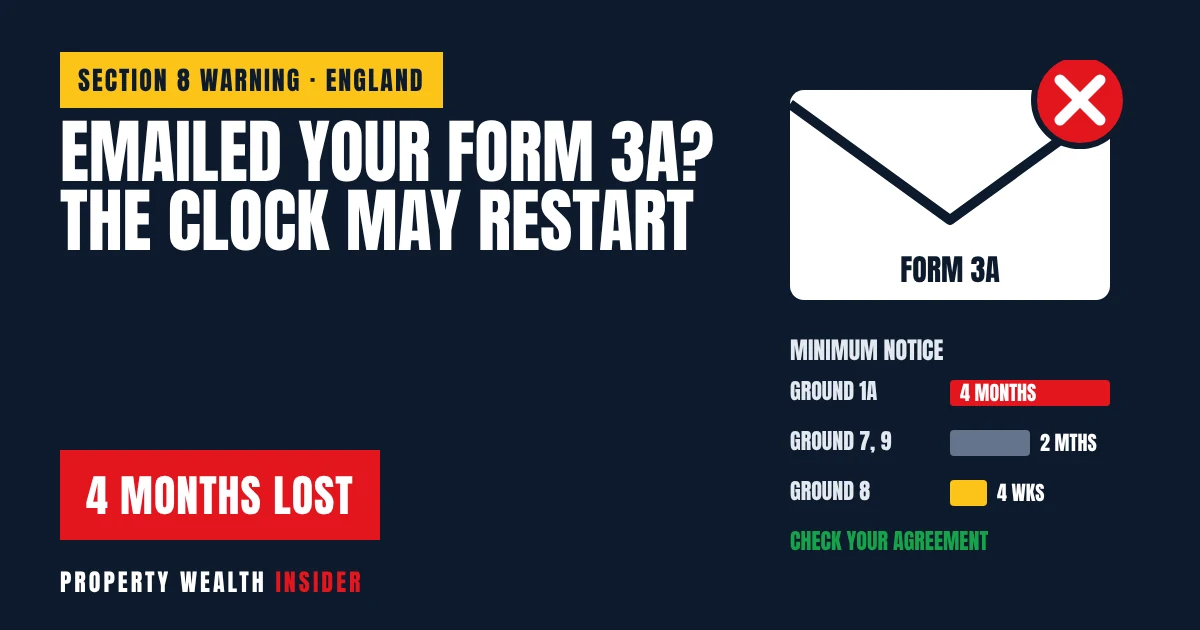
Landlords who fire off a Section 8 notice by email could be throwing away months of their possession timetable. Under the new possession regime that started in England on 1 May 2026, the government’s own Form 3A guidance says you should only serve the notice by email if your written tenancy agreement is clear that email is an agreed method of service.
That matters because Section 21 is gone for private landlords in England, so Form 3A is now the only route to possession. If the notice was not served properly, the court can dismiss your claim and you start again. On a sale under Ground 1A, that means another four months’ notice before you can go back to court.
It affects every private landlord and letting agent in England with an assured tenancy, especially anyone who handles everything with tenants over email and has never looked at the notices clause in their agreement.
Key facts
- Official Form 3A guidance: serve by email only if the written tenancy agreement is clear email is an agreed method.
- If the agreement sets out how to serve notices, follow that method. If not, gov.uk lists hand delivery, the letterbox at the property, or registered post.
- Grounds 1 (moving in) and 1A (selling) need 4 months’ notice, beginning with the date of service.
- Grounds 8, 10 and 11 (rent arrears) need 4 weeks’ notice. Ground 8 needs at least 3 months’ arrears for monthly rent.
- A Form 3A notice lasts 12 months from service. After that you cannot use it to go to court.
- For Grounds 7A, 7B and 8, the court cannot waive the notice requirement, so a badly served notice cannot be rescued. England only.
What the rules say about serving Form 3A
Since 1 May 2026, a Section 8 notice for a private assured tenancy in England must be on Form 3A (or a form substantially to the like effect). This is set by the Assured Tenancies (Private Rented Sector) (Prescribed Forms and Transitional Provisions) (England) Regulations 2026, which came into force that day.
The gov.uk Form 3A guidance for private landlords sets out how to serve it, in this order of priority:
- First, the agreement. If your written tenancy agreement says how notices should be served, follow that method.
- Otherwise, one of three methods: give it to the tenant in person (which the guidance calls the most reliable), deliver it to the property yourself and post it through the letterbox if they are not in, or send it by registered post to the property.
- Email only with clear agreement. Only serve by email if the written tenancy agreement is clear that email is an agreed method of service.
Ordinary first class post is not on that default list. Many agreements bring in the notice rules in section 196 of the Law of Property Act 1925. These treat a notice as served if it is left at the tenant’s last known home, or sent by registered letter (now including recorded delivery) that is not returned undelivered. If you want to use plain first class post, your agreement needs to allow it.
The trap on the form itself: section 5.7 of Form 3A asks for your email address. The note says that by giving it, you agree that the tenant and the court can use it to serve documents on you. That does not work the other way round. Putting your email on the form does not give you the right to email the notice to the tenant.
Notice periods for every common ground
The minimum notice periods are in section 8(4AA) of the Housing Act 1988, as amended by the Renters’ Rights Act 2025, and are repeated in the gov.uk guidance. Each period runs beginning with the date of service. The earliest date you can apply to court is the day after it ends.
| Ground | What it covers | Minimum notice |
|---|---|---|
| 1 | Occupation by landlord or family | 4 months |
| 1A | Sale of the property | 4 months |
| 2, 6, 6A, 6B | Mortgage lender, redevelopment, enforcement | 4 months |
| 7, 9 | Death of tenant, suitable alternative accommodation | 2 months |
| 8 | Rent arrears (3 months’ rent / 13 weeks’ rent) | 4 weeks |
| 10, 11 | Any rent arrears, persistent arrears | 4 weeks |
| 12, 13, 15, 17 | Breach of tenancy, deterioration, furniture, false statement | 2 weeks |
| 7B | No right to rent | 2 weeks |
| 7A, 14 | Severe antisocial or criminal behaviour, antisocial behaviour | None: apply on the day of service |
Grounds 1 and 1A cannot be used during the first 12 months of a tenancy, and the date in the notice must fall after that point. If you rely on more than one ground, you have to wait for the longest notice period to run out. The exception is Grounds 7A or 14, which let you apply straight away.
Why an emailed notice can cost you months
The gov.uk possession guide for landlords says you have to show the court that you gave the notice correctly and gave the right amount of notice. It also warns that claims can be dismissed or delayed where procedure was not followed.
If a tenant argues that an email was never valid service, you may struggle to prove the notice was ever served at all. If you lose that argument, you serve a fresh Form 3A, and the clock starts again from the new date of service.
For rent arrears it is worse. Section 8(5) of the Housing Act 1988 says the court cannot use its “just and equitable” power to waive the notice for Grounds 7A, 7B or 8. A Ground 8 claim built on a bad notice cannot be saved.
Another catch is the timing of service. We could not find a fixed statutory “deemed served” rule for Form 3A sent by post. Section 196 treats a registered letter as served when it would normally be delivered. The well-known “second business day” rule for first class post comes from Civil Procedure Rule 6.26, and that rule covers court documents, not this notice. The safe approach is to add a few days’ buffer before the date you put in box 2.1.
Calculator: earliest court date and cost of a restart
Pick your ground and how you plan to serve. The tool works out the earliest date you could apply to court, the last date the notice is valid, and what it could cost if the notice has to be served again.
Form 3A notice date calculator
Guide only, not legal advice. Month periods are worked out to the matching calendar date. Where that date does not exist (for example 31st to a 30-day month), we move it to the 1st of the next month to be safe. The buffer is our cautious allowance, not a legal rule. Check your own agreement and take advice if you are unsure.
Worked examples in £
Example 1: selling up under Ground 1A
Sarah wants to sell a flat let at £1,250 a month. The tenancy started more than 12 months ago. She hands Form 3A to her tenant on 19 October 2026. The four months begin that day and end on 18 February 2027, so the earliest date she can apply to court is 19 February 2027.
Suppose she emails the notice instead and her agreement says nothing about email. She issues her claim, and at a hearing on 16 April 2027 (eight weeks after her earliest date) the tenant disputes service. She serves a fresh notice by hand that day, so her new earliest court date is 16 August 2027. That is about 5.9 months lost. If the delay costs her £1,250 a month, for example in mortgage payments she wanted to clear on sale, the restart costs about £7,350, before any wasted court fees.
Example 2: rent arrears under Ground 8
Rent is £1,200 a month and the tenant owes £3,600, which is three months and so meets the Ground 8 threshold. The arrears must still be at that level at the hearing. Served by hand on 19 October 2026, the four-week notice means the earliest court date is 16 November 2026.
Now suppose the notice was emailed without a clause, and the tenant challenges service at a hearing on 11 January 2027, eight weeks after that date. The court cannot waive the notice on Ground 8. A fresh notice served by hand that day gives a new earliest court date of 8 February 2027. That is about 2.8 months lost, or roughly £3,300 more in unpaid rent at £1,200 a month.
What to do now: serving checklist
Work through this before every Form 3A you serve. It takes ten minutes and protects months of timetable.
- Get the current Form 3A from gov.uk. Older Form 3 versions do not apply to private tenancies from 1 May 2026.
- Check the ground fits: for 1 or 1A, the date in the notice must fall after the first 12 months. For Ground 8, check the arrears are at least 3 months (monthly rent) or 13 weeks (weekly or fortnightly).
- Copy the full legal wording for each ground into question 4.2, using the gov.uk legal wording document. Incomplete wording can make the notice invalid.
- Read the notices clause in your tenancy agreement. Write down exactly which methods and addresses it allows, and whether it clearly names email.
- Check you have not been told the tenant is in a debt “breathing space” before using Grounds 8, 10 or 11.
- Choose your method. With no email clause, use hand delivery to the tenant, the letterbox at the property, or registered post.
- Work out box 2.1: the day after the longest notice period ends, plus a safety buffer if you are posting.
- Serve a copy on every tenant named in the agreement and keep the original.
- Record service: fill in form N215 (certificate of service) or write “served by [name] on [date]” on your copy. Take a dated photo if you use the letterbox.
- Diary the earliest court date and the 12-month expiry, and issue your claim within that window.
Updating your tenancy template? Ask your solicitor or agent to add a clear email-service clause naming the tenant’s email address, so future notices can go electronically. It does not fix notices you have already emailed under an agreement that does not allow it.
FAQ
Can I serve a Section 8 notice by email in England?
Only if your written tenancy agreement is clear that email is an agreed method of service. That is what the government’s Form 3A guidance for landlords says. Without that, serve by hand, through the letterbox, by registered post, or by whatever method the agreement sets out.
How much notice do I need to give to sell my rental property?
Ground 1A needs four months’ notice, beginning with the date of service. You cannot use it in the first 12 months of the tenancy. The earliest court date is the day after the four months end.
What is the notice period for rent arrears under Ground 8?
Four weeks. The tenant must owe at least three months’ rent (if rent is monthly) or 13 weeks’ rent (if weekly or fortnightly), both when you serve the notice and at the hearing. Grounds 10 and 11 also carry four weeks’ notice.
Can I still use a Section 21 notice?
No. For private landlords in England, gov.uk guidance says you cannot use section 21 to seek possession under the system that started on 1 May 2026. Possession now goes through Section 8 on Form 3A.
How long is a Form 3A notice valid for?
You must start court proceedings within 12 months of the date of service. This can be extended where the tenant enters a debt breathing space on a rent arrears notice.
Do I need form N215 for a Section 8 notice?
It is not the only option, but it is the cleanest proof. The guidance says you can either fill in the N215 certificate of service or write “served by [your name] on [the date]” on the notice. You then rely on it with the notice when you apply for possession.
- MHCLG – Form 3A: completing the notice seeking possession, guidance for private landlords
- GOV.UK – Assured tenancy forms for privately rented properties from 1 May 2026
- GOV.UK – Form 3A (PDF)
- GOV.UK – Form 3A legal wording for possession grounds
- Housing Act 1988, section 8 (legislation.gov.uk)
- SI 2026/354 – Assured Tenancies (Private Rented Sector) (Prescribed Forms and Transitional Provisions) (England) Regulations 2026
- Law of Property Act 1925, section 196
- Civil Procedure Rules Part 6 (rule 6.26 deemed service)
- GOV.UK – Form N215 certificate of service
- GOV.UK – Repossessing your privately rented property on or after 1 May 2026
- GOV.UK – Guide to the Renters’ Rights Act
This article is news and general guidance only, not financial, legal or tax advice.