Landlord CGT at 24%: NRLA Wants Inflation Stripped Out in Budget
The UK’s biggest landlord body has told the Treasury to stop charging Capital Gains Tax on inflation. With the Autumn Budget due on 28 October 2026, the National Residential Landlords Association (NRLA) has put CGT reform at the top of its Budget submission.
It wants the price you paid, your Stamp Duty and your improvement costs to be raised in line with inflation before any gain is taxed. It also wants more relief the longer you have let the property. A sale within three years would get nothing.
These are proposals only. Today a landlord who sells pays CGT at 18% or 24% on the whole nominal gain, after a tax-free allowance of just £3,000. They must also report and pay within 60 days of completion. Below we set out what the NRLA is asking for, what the rules are now, and what the numbers mean for your next sale. Our calculator works out your bill.
Key facts
- The Budget is on 28 October 2026, according to Chancellor John Healey’s letter to the Treasury Select Committee.
- Under the NRLA’s plan, the base cost (price, Stamp Duty, acquisition costs and improvements) would be indexed to CPI, with relief graded by how long you owned the property.
- Properties sold within three years would get no relief. The relief could never create a loss or exceed actual inflation.
- CGT on residential gains for 2026-27 is 18% within the basic-rate band and 24% above it. The annual exempt amount is £3,000.
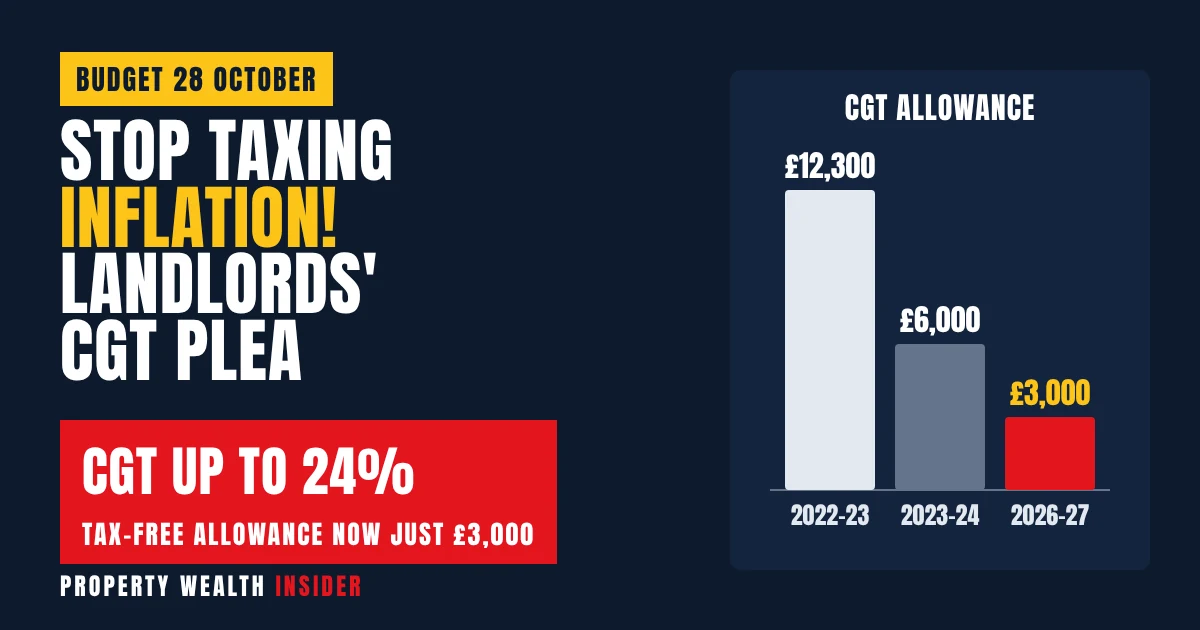
- The annual exempt amount has fallen from £12,300 (2022-23) to £6,000 (2023-24) and then to £3,000 (2024-25 onwards).
- UK residents must report and pay CGT on a UK residential sale within 60 days of completion.
What the NRLA is asking for
The NRLA’s Budget 2026 submission says it is not asking for special treatment of genuine gains. Its complaint is that CGT taxes nominal gains, so part of every bill is a tax on inflation.
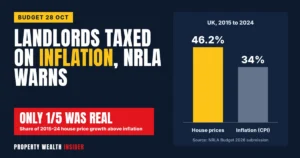
Its evidence is that average UK house prices rose 46.2% between 2015 and 2024. Over the same period, ONS consumer prices rose about 34% (the CPI index went from 100.0 to 133.9). The NRLA calculates that real house price growth was just 9.1%, so only around one-fifth of the rise was a real gain.
The submission makes two linked proposals, which it says should go ahead whether or not headline rates change:
- Index the base cost to CPI. This covers the purchase price, Stamp Duty, other acquisition costs and qualifying improvements, each indexed from the date the money was spent.
- Grade the relief by holding period. A sale within three years gets no relief. The maximum relief then rises the longer the property has been held.
Two safeguards come with it. The relief must never create or increase an allowable loss, and it must never exceed the inflation that actually happened. The NRLA’s own modelling puts the static cost at roughly £0.81bn to £1.23bn a year, depending on the scenario. This is before counting any extra sales the change might trigger.
On rates, the NRLA says it does not recommend aligning CGT with Income Tax. If the Government did align residential CGT with the new property income rates, the NRLA says it would accept that only as part of a package that reforms the tax base at the same time. Those property income rates are 22%, 42% and 47% for 2027-28, set by section 7 of the Finance Act 2026.
The submission also asks for Local Housing Allowance to be unfrozen and re-linked to the cheapest 30% of rents. It also wants energy-efficiency upgrades treated as revenue expenses that can be deducted in the year they are paid for.
Important: none of this is law. The NRLA is lobbying, and HM Treasury has not said it will adopt any of it. The Government has confirmed only the Budget date. Everything else will be known on 28 October.
How landlord CGT works today
CGT applies across the whole UK. When you sell a buy-to-let, your gain is the sale price minus what you paid. You can deduct buying and selling costs and the cost of improvements, such as an extension. Normal maintenance, such as decorating, cannot be deducted.
HMRC’s manual lists the incidental costs you can deduct. They include surveyor, valuer, estate agent and legal fees, Stamp Duty Land Tax and advertising costs. If you own jointly, you work out the gain on your share only.
| Rule (2026-27) | Current position |
|---|---|
| Annual exempt amount | £3,000 per person |
| Rate on gains within your unused basic-rate band | 18% |
| Rate on gains above the basic-rate band | 24% |
| Basic-rate band | £37,700 (the UK band is used for CGT, including for Scottish and Welsh taxpayers) |
| Personal allowance (England, Wales, NI) | £12,570, reduced by £1 for every £2 of income over £100,000 |
| Deadline to report and pay | Within 60 days of completion (UK residents with tax to pay) |
| Inflation relief / holding-period relief | None. This is what the NRLA proposes. |
Your rate depends on your income. You add the taxable gain (after the £3,000 allowance) to your taxable income. The part that fits inside the £37,700 basic-rate band is taxed at 18%, and the rest at 24%. Rental profit counts as income, so a busy portfolio can use up the band quickly.
Private Residence Relief only helps if the property was your home at some point. In that case the final 9 months of ownership always qualify. Letting relief now applies only if you lived in the property while letting part of it. It does not apply if the whole property was let.
Landlord CGT calculator
Enter your figures to estimate the CGT due on a buy-to-let sale under the 2026-27 rules. The calculator also shows your 60-day deadline and what you keep after the sale.
Landlord CGT calculator 2026-27
Guide only, not tax advice. This calculator uses the 2026-27 rates (18%/24%), the £3,000 annual exempt amount, the £37,700 basic-rate band and the £12,570 personal allowance (with the taper above £100,000). It ignores losses, Private Residence Relief, Gift Aid or pension band extensions, and any Budget changes. It cannot model the NRLA plan because no indexation tables or holding-period scale have been set out.
Worked examples: today vs the NRLA plan
Example 1: a sole-owner sale under today’s rules
Sarah bought a flat for £180,000 and paid £5,000 in Stamp Duty and legal fees. She later spent £15,000 on an extension. She sells for £310,000 and pays £6,000 in agent and legal fees. Her gain is £104,000.
After the £3,000 allowance, £101,000 is taxable. Her other taxable income is £35,000, which leaves £15,270 of her basic-rate band unused. That part is taxed at 18% (£2,749). The remaining £85,730 is taxed at 24% (£20,575). Her bill is about £23,324, and it is due within 60 days of completion.
Example 2: the same sale, owned jointly
If Sarah and her husband own the flat 50/50, each has a £52,000 gain and their own £3,000 allowance. Her share costs about £10,844. His share costs about £9,944, because his £20,000 income leaves more of his basic-rate band free. The total is about £20,788, roughly £2,500 less than if Sarah owned it alone.
Moving ownership to a spouse before a sale has its own rules and needs proper advice. It should not be done at the last minute.
Example 3: what indexation could mean (illustration only)
Take a £200,000 property bought in 2015 that rose with the NRLA’s 46.2% average to about £292,400 by 2024. The nominal gain is £92,400. If the £200,000 cost were indexed by the ONS CPI rise (index 100.0 to 133.9), the cost would become £267,800. The real gain would then be about £24,600.
For a higher-rate taxpayer, today’s bill is (£92,400 − £3,000) × 24% = £21,456. Taxed on the real gain alone, it would be about £5,184. But the NRLA plan caps relief by holding period, and no scale has been published. So the actual saving under any reform could be well below that.
| £200,000 bought 2015, sold 2024 (illustration) | Today’s rules | Full CPI indexation (NRLA principle) |
|---|---|---|
| Sale price | £292,400 | £292,400 |
| Allowable cost | £200,000 | £267,800 |
| Gain | £92,400 | £24,600 |
| Taxable after £3,000 | £89,400 | £21,600 |
| CGT at 24% | £21,456 | £5,184 |
The shrinking tax-free allowance
As well as taxing inflation, landlords have lost most of their tax-free allowance. The annual exempt amount was £12,300 in 2022-23 and has been £3,000 since 2024-25. That change alone adds £2,232 to a higher-rate landlord’s bill (£9,300 × 24%).
What to do now if you are thinking of selling
- Do not rush a sale on rumour. The only confirmed Budget fact is the date, 28 October 2026. The NRLA plan is a proposal, and press speculation about rates is not policy.
- Rebuild your base cost. Find your completion statement, SDLT return, legal and survey invoices and every receipt for improvements. Any reform based on indexation would also need the dates you spent the money.
- Separate improvements from repairs. An extension or loft conversion counts. Decorating and like-for-like repairs do not.
- Run the numbers both ways. Use the calculator for sole and joint ownership. Check how much of your basic-rate band your salary and rental profit already use.
- Plan the 60-day window. Have the cash set aside before completion. If you have a mortgage, your net proceeds after redemption may be tight.
- Get advice before changing ownership. Transfers between spouses, incorporation and timing a sale across tax years all have knock-on effects.
- Check the Budget documents on 28 October. Read the HM Treasury and HMRC publications themselves, not the headlines.
- Completion statement and purchase price found
- SDLT, legal and survey costs totalled
- Improvement invoices (with dates) filed, repairs excluded
- Selling costs estimated (agent, legal)
- Other income for the tax year estimated
- Ownership split confirmed on the title
- CGT cash reserved for the 60-day deadline
- Government Gateway account ready for the UK property return
FAQ
Is the NRLA’s CGT inflation relief going to happen?
Nobody knows yet. It is a lobbying proposal in a Budget submission. The Government has not said whether it will adopt it, and nothing changes unless it is announced and then legislated.
What is the CGT rate on buy-to-let property in 2026-27?
The rate is 18% on the part of your taxable gain that falls within your unused basic-rate band and 24% on the rest, after the £3,000 allowance. Higher and additional-rate taxpayers pay 24% on all of it.
When do I have to pay CGT after selling a rental property?
UK residents must report the sale and pay any CGT due within 60 days of completion, using HMRC’s online Capital Gains Tax on UK property service. Late reporting or payment can mean interest and penalties.
Can I deduct Stamp Duty from my capital gain?
Yes. HMRC treats Stamp Duty Land Tax as an incidental cost of acquisition, along with legal, surveyor and estate agent fees. Improvement costs count too, but normal maintenance does not.
Does joint ownership reduce CGT on a rental property?
Often, yes. Each owner is taxed on their own share, with their own £3,000 allowance and their own basic-rate band. In our example, a 50/50 split saved about £2,500.
When is the Autumn Budget 2026?
It is on Wednesday 28 October 2026, alongside a forecast from the Office for Budget Responsibility, according to the Chancellor’s letter to the Treasury Select Committee.
Sources
- NRLA: Budget 2026 submission (PDF)
- NRLA press release, 16 October 2026
- HM Treasury: Chancellor’s letter to the Treasury Select Committee on the Budget 2026 date
- GOV.UK: Capital Gains Tax rates
- HMRC: CGT rates and annual tax-free allowances
- GOV.UK: Report and pay CGT on UK property
- GOV.UK: Tax when you sell property, work out your gain
- HMRC Capital Gains Manual CG15250: incidental costs
- HMRC Capital Gains Manual CG21204: available basic rate band
- GOV.UK: Income Tax rates and Personal Allowances
- HMRC HS283: Private Residence Relief (2026)
- Finance Act 2026, section 7: property rates of income tax
- ONS: CPI index (D7BT)
This article is news and general guidance, not financial, legal or tax advice.