Landlord losses soar 32% to £1.15bn: don’t waste yours
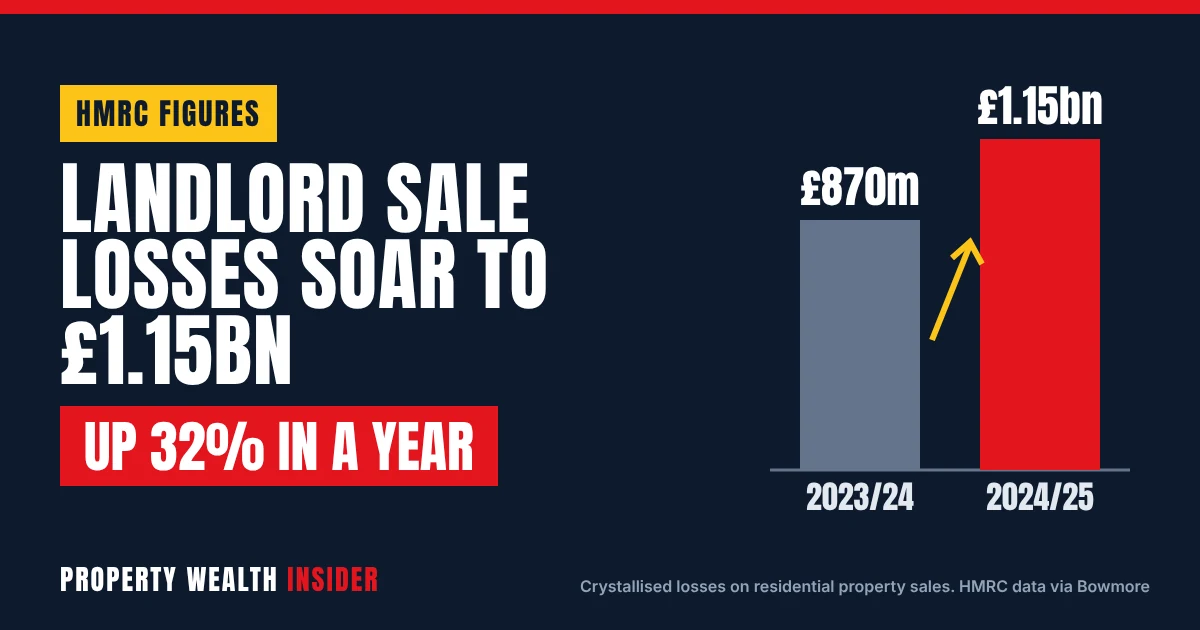
Landlords who sold residential property at a loss crystallised £1.15bn of losses in the 2024/25 tax year, up 32% on £870m the year before, according to HMRC figures obtained by Bowmore Wealth Group through a Freedom of Information request.
Those are real losses, locked in at completion, not paper falls. And Bowmore warns the true picture is worse: the figures leave out every landlord still sitting on a property worth less than they paid.
If you sold at a loss, you can turn that loss into a tax shield worth thousands, but only if you tell HMRC in time. Plenty of landlords never do. Here is how it works, with a calculator, worked examples and the claim-by dates.
Key facts
- Losses on residential property sales hit £1.15bn in 2024/25, up from £870m in 2023/24 (HMRC figures obtained by Bowmore).
- That is a rise of 32% in one year, and it only counts completed sales.
- You have 4 years from the end of the tax year of sale to claim a capital loss. A 2022/23 loss must be claimed by 5 April 2027.
- A claimed loss carries forward to cut CGT on future gains. At the 24% higher rate, every £10,000 of loss can save up to £2,400.
- The CGT tax-free allowance is just £3,000 for 2026/27, down from £12,300 in 2022/23.
Budget day warning: this article was written on Wednesday 28 October 2026, before the Chancellor delivers today’s Autumn Budget. The tax rules described are those in force before the Budget and may change. Check for updates before you act.
What the £1.15bn figures show
Bowmore says the HMRC data captures losses realised through completed sales of residential property by buy-to-let investors. Unrealised losses on homes still held are not included, so the scale of paper losses across the market “may be considerably greater”.
The figures also show only one side of the ledger. They say nothing about how many landlords sold at a profit in the same years, so they are not a verdict on buy-to-let as a whole.
Bowmore links the rise to flat or falling prices, higher mortgage costs and the Renters’ Rights Act. David Floyd, head of private clients at Bowmore Financial Planning, said the Act “may have prompted buy-to-let investors to sell up even if it means taking a loss.”
The latest official numbers back up the price squeeze. The ONS says average UK house prices rose just 0.9% to £273,000 in the 12 months to August 2026. London fell 2.2%, with the average London flat down 5.0%.
How HMRC works out your gain or loss
Capital Gains Tax (CGT) is a UK-wide tax, so the same rules apply to individual landlords in England, Scotland, Wales and Northern Ireland. Property developers and limited companies are taxed differently and are not covered here.
Your gain or loss is broadly the sale price minus what you paid, minus allowable costs. Many landlords who think they broke even have actually made a loss once costs are added back in.
| Cost | Allowable for CGT? | Notes |
|---|---|---|
| Stamp Duty Land Tax paid on purchase | Yes | HMRC treats it as a cost of acquisition |
| Solicitors’ and conveyancing fees (buying and selling) | Yes | Must relate to that purchase or sale |
| Estate agent fees and advertising to find a buyer | Yes | Includes auctioneer fees |
| Surveyor and valuation fees for the deal | Yes | Including valuations needed for the CGT sum |
| Improvements, such as an extension or loft conversion | Yes | Must still be reflected in the property when sold |
| Redecorating, repairs, routine maintenance | No | These are revenue costs, claimed against rent |
| Mortgage interest and arrangement fees | No | Not a cost of buying or selling the property itself |
Worked example: you bought a flat for £250,000, paid £12,000 in stamp duty and legal fees, and spent £15,000 on an extension. You sell for £255,000 and pay £6,000 in agent and legal fees. Your total cost is £283,000, so you have a capital loss of £28,000, even though the price went up £5,000.
Calculator: your gain, loss and CGT
Enter your figures to see whether you made a gain or a loss, how much loss you can carry forward, and the estimated CGT using 2026/27 rates and allowances.
Property sale gain/loss and CGT calculator
Guide only, not tax advice. Uses 2026/27 rules in force before the 28 October 2026 Budget: £3,000 annual exempt amount, 18% on gains within the £37,700 basic rate band and 24% above it. Assumes a UK-resident individual selling a let property with no Private Residence Relief and no sale to a connected person. Take professional advice before you sell or file.
Why claim the loss even if you have no gains now
An unclaimed capital loss is worth nothing. HMRC’s own manual is clear that a loss only becomes “allowable” once you have notified it in a quantified amount, within the time limit. Claim it and it sits on your record until you need it.
Example 1: the future sale. Sarah sells a flat in 2024/25 with a £28,000 loss and no other gains. She claims it. Later she sells another buy-to-let with a £60,000 gain as a higher-rate taxpayer. Without the loss, her CGT at today’s rates would be (£60,000 − £3,000) × 24% = £13,680. With the £28,000 brought forward, her taxable gain falls to £29,000 and the bill to £6,960. One claim saved her £6,720.
Example 2: same-year losses come first. If you have a £2,000 gain on shares in the same year as a £28,000 property loss, the loss must be set against that £2,000 first, even though the allowance would have covered it. You carry forward £26,000.
Example 3: brought-forward losses protect your allowance. Losses from earlier years are only used to bring gains down to the £3,000 allowance, not below it. With £10,000 brought forward and an £8,000 gain, you use just £5,000 and keep £5,000 for later. You pay no CGT.
Example 4: a basic-rate taxpayer. With taxable income of £30,000 and a £20,000 gain, £17,000 is taxable. The first £7,700 fits in the basic rate band at 18% (£1,386) and £9,300 is taxed at 24% (£2,232), a total of £3,618. A £17,000 loss brought forward would have wiped it out.
The shrinking allowance makes losses more valuable than they used to be.
| Tax year | CGT annual exempt amount (individuals) |
|---|---|
| 2021/22 | £12,300 |
| 2022/23 | £12,300 |
| 2023/24 | £6,000 |
| 2024/25 | £3,000 |
| 2025/26 | £3,000 |
| 2026/27 | £3,000 |
The 4-year deadline: claim-by dates
You can claim a capital loss up to 4 years after the end of the tax year in which you disposed of the property. Tax years end on 5 April.
| Sold (completed) in tax year | Tax year ended | Claim the loss by |
|---|---|---|
| 2022/23 | 5 April 2023 | 5 April 2027 |
| 2023/24 | 5 April 2024 | 5 April 2028 |
| 2024/25 | 5 April 2025 | 5 April 2029 |
| 2025/26 | 5 April 2026 | 5 April 2030 |
| 2026/27 | 5 April 2027 | 5 April 2031 |
If you sold at a loss in 2021/22, the window closed on 5 April 2026. Anyone who sold in 2022/23 and never claimed has a little over five months left.
How to register a loss with HMRC: step by step
- Work out the loss properly. Sale price, minus selling costs, minus purchase price, buying costs and improvements. If you owned jointly, work out the loss on your own share only.
- Check it is an allowable loss. You cannot claim a loss on a sale or gift to your spouse or civil partner. A loss on a sale to a family member or other connected person can only be set against gains on disposals to that same person.
- Know you do not need a 60-day return. UK residents only report on the Capital Gains Tax on UK property service when there is tax to pay. Non-UK residents must report every UK property sale within 60 days, even at a loss.
- If you file Self Assessment, enter the disposal and the loss on the capital gains pages of your tax return for the year of sale. There is no separate claim form.
- If you have never made a gain and are not in Self Assessment, you can write to HMRC to claim the loss instead, as set out on GOV.UK.
- Missed a past return? If the 4-year window is still open, speak to HMRC or an accountant about notifying the loss now.
- Track your losses year by year. Keep a running total of losses claimed, used and carried forward so you can apply them on your next sale.
If you make a gain instead, you must report and pay any CGT due on UK residential property within 60 days of completion, or face interest and penalties. Sellers in Self Assessment also include the sale on their annual return.
Records checklist: what to keep
- Completion statements for the purchase and the sale
- The date you acquired the property, the exchange date on sale and the completion date
- Your SDLT return and proof of the stamp duty paid
- Solicitor, conveyancer, surveyor and valuation invoices for both ends of the deal
- Estate agent or auctioneer fees and any advertising costs
- Invoices, plans and planning or building control papers for each improvement
- Your share of ownership if the property was held jointly
- Your loss calculation and a copy of the return or letter used to claim it
- A running log of losses claimed, used and carried forward
FAQs
Can I claim a loss on selling a buy-to-let property?
Yes. A loss on a let property is an allowable capital loss if you would have paid CGT on a gain. You must claim it within 4 years of the end of the tax year of sale.
Can I offset a property loss against rental income?
No. A capital loss reduces capital gains, not income. Rental losses are a separate system and are dealt with under income tax rules.
Do I need to report a property sale to HMRC if I made a loss?
UK residents do not need to file a 60-day return when there is no tax to pay, but you should still claim the loss through Self Assessment or by writing to HMRC, or you cannot use it later. Non-residents must report every UK property sale within 60 days.
How long can I carry forward a capital loss?
Once claimed, unused losses stay available for later tax years until they are used. They are set against future net gains above the annual exempt amount.
Is stamp duty deductible for Capital Gains Tax?
Yes. HMRC treats stamp duty land tax as an incidental cost of acquisition, alongside legal, survey and agent fees.
What is the CGT rate on a buy-to-let sale?
For 2026/27 it is 18% on gains that fall within the basic rate band and 24% above it, after the £3,000 allowance. These are the rules before today’s Budget and may change.
Sources
- Bowmore Wealth Group: Buy-to-let property sale losses rise 32% to £1.1bn (27 October 2026)
- GOV.UK: Capital Gains Tax, if you make a loss
- GOV.UK: Capital Gains Tax rates
- HMRC: Capital Gains Tax rates and allowances
- GOV.UK: Tax when you sell property, work out your gain
- GOV.UK: Report and pay Capital Gains Tax on UK property
- HMRC Capital Gains Manual CG15800: allowable losses
- HMRC Capital Gains Manual CG21500: losses, order of set-off
- HMRC Capital Gains Manual CG15180: enhancement (improvement) expenditure
- HMRC Capital Gains Manual CG15250: incidental costs of acquisition and disposal
- ONS: Private rent and house prices, UK: October 2026
This article is news and general guidance only, not financial, legal or tax advice. Rules described are those in force before the 28 October 2026 Budget.