£30k rent? Making Tax Digital is coming for you in April 2027
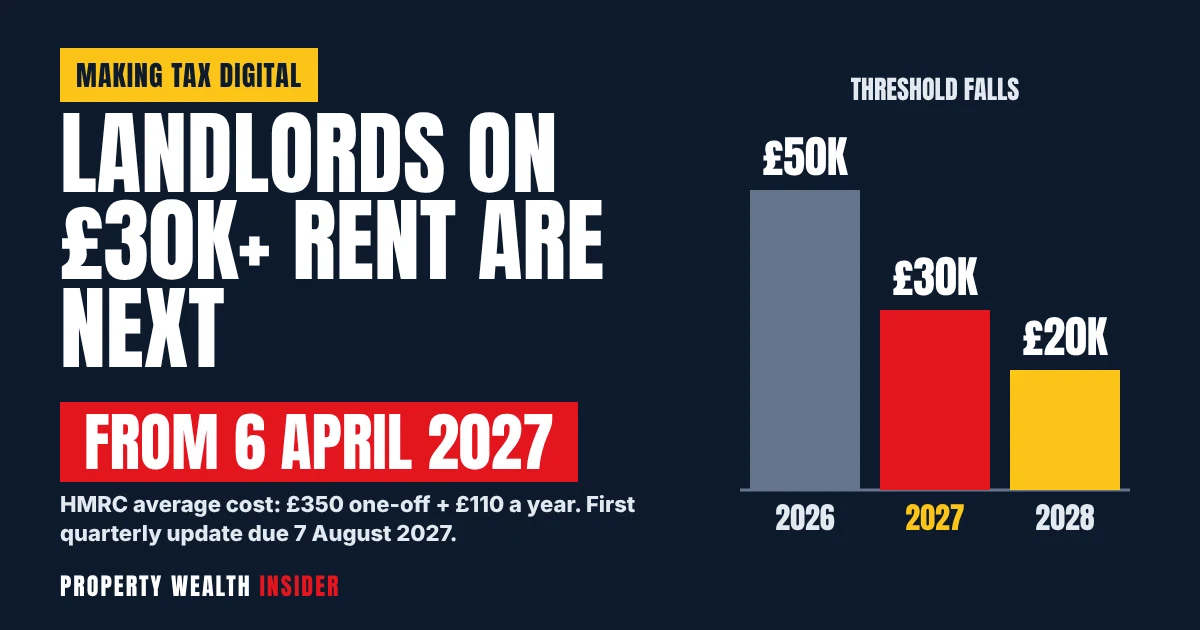
Landlords collecting more than £30,000 a year in rent have under six months left before Making Tax Digital for Income Tax applies to them. From 6 April 2027 they must keep digital records and send HMRC a summary every quarter. On 14 October 2026 the Treasury confirmed it will keep measuring what the scheme costs the people it pulls in.
The confirmation came in a written parliamentary answer from Treasury minister James Murray. He was replying to Liberal Democrat MP Monica Harding, who had asked about the extra software and accountancy costs facing sole traders and landlords. He pointed her to HMRC’s published impact note, which puts the average cost for the £30,000 to £50,000 group at £350 one-off plus £110 a year.
Here is the catch many landlords miss. The income that decides whether you are in from April 2027 is your 2025-26 income, and that tax year ended on 5 April 2026. If you are caught, you are already caught. The next six months are for getting ready.
Key facts
- MTD for Income Tax applies from 6 April 2027 if your qualifying income was over £30,000 in the 2025-26 tax year.
- Qualifying income is gross rent plus self-employment turnover, before expenses. Joint owners count only their own share.
- HMRC expects about 970,000 people to join from April 2027, on top of about 780,000 who joined in April 2026.
- HMRC’s average cost for the £30,000 to £50,000 group is £350 one-off and £110 a year.
- Quarterly updates are due 7 August, 7 November, 7 February and 7 May. For 2027-28, a missed update earns a penalty point and 4 points means a £200 fine.
- The threshold is already set in law to fall to £20,000 from April 2028, based on 2026-27 income.
Will you be caught? The £30,000 test
HMRC defines qualifying income as your total income from self-employment and property before expenses, which is your turnover. Profit is not the test. A landlord with £34,000 of rent and £28,000 of mortgage interest, repairs and agent fees is still over the line.
Some income doesn’t count towards the threshold. Wages taxed through PAYE, dividends (including those from your own property company), state and private pensions, and your share of a partnership’s profit are all excluded. So is income from REITs and property authorised investment funds. UK and foreign rental income both count if you are UK resident.
For jointly owned property, only your share counts. If you only ever see your share after expenses have been taken off, HMRC will use that net figure. Property held in a limited company pays Corporation Tax, not Income Tax, so it is outside this regime. Partnerships are not included yet.
HMRC checks the threshold against your tax return for the year before. For the April 2027 group, that means the 2025-26 return, due by 31 January 2027. If you are over the threshold, HMRC says it will write to you. But if no letter arrives, it is still your job to check and sign up. MTD for Income Tax is run by HMRC, so it applies to landlords in England, Scotland, Wales and Northern Ireland alike.
Key dates for the April 2027 group
| Date | What happens |
|---|---|
| 6 Apr 2025 to 5 Apr 2026 | The 2025-26 tax year. Qualifying income over £30,000 in this year puts you in MTD from April 2027. |
| 31 January 2027 | File your 2025-26 Self Assessment return the usual way and pay what you owe. The old penalty rules still apply to this return. |
| 6 April 2027 | MTD starts. Every rent receipt and expense from now on goes into compatible software. |
| 7 August 2027 | First quarterly update (6 April to 5 July 2027). |
| 7 November 2027 | Second update (6 April to 5 October, so the year to date). |
| 7 February 2028 | Third update (6 April to 5 January). |
| 6 April 2028 | Threshold falls to £20,000, based on 2026-27 income (6 April 2026 to 5 April 2027). |
| 7 May 2028 | Fourth update (the full year to 5 April 2028). |
| 31 January 2029 | Submit your 2027-28 tax return through MTD software and pay the balance. |
If your accounts run from 1 April to 31 March, you can choose calendar update periods instead (1 April to 30 June and so on). The deadlines stay the same. You have to pick this in your software before you send your first update, because you can’t switch afterwards that tax year.
Worked examples: four landlords
1. Sole owner, £38,000 rent. Priya owns three flats in her own name and collected £38,000 of gross rent in 2025-26. After interest and costs her profit was about £11,000, but that makes no difference. £38,000 is over £30,000, so she is in MTD from 6 April 2027 and her first update is due 7 August 2027.
2. Married couple, £56,000 rent split 50/50. Tom and Sarah jointly own a portfolio that brought in £56,000 in 2025-26. Each has a qualifying income of £28,000, which is under £30,000, so neither is in from April 2027. But if their shares are still above £20,000 in 2026-27, which is the tax year we are in now, both join from 6 April 2028. That gives them an extra year, not a way out.
3. Landlord with a side business. Dave has £18,000 of rent and £14,000 of self-employed turnover from his decorating work. Together that is £32,000 of qualifying income, so he is in from April 2027. He runs two businesses, so he sends four updates for each one, eight a year in total, plus one tax return. Penalty points are counted per deadline, not per business.
4. Employed landlord. Helen earns £70,000 through PAYE and gets £24,000 of rent. Her salary doesn’t count, so her qualifying income is £24,000. She misses the April 2027 group, but on current rents she joins in April 2028.
Am I in MTD? Checker and cost estimator
Enter your figures for the tax year you want to test. The tool works out your qualifying income, when MTD would start for you, your first deadline, how many submissions you would make each year and HMRC’s average cost for your income band.
Am I in Making Tax Digital?
This is a guide only, not tax advice. The costs are HMRC’s averages from its impact notes, not a quote, and your own will depend on your software, your records and whether you use an agent. For the £20,000 to £30,000 band, HMRC only publishes totals (£380m one-off and £101m a year across about 970,000 people), so the figures shown are PWI’s average worked out from those totals. To confirm your position, use HMRC’s own checker.
What HMRC says it will cost you
HMRC’s tax information and impact note estimates the costs for each group. People in the £30,000 to £50,000 band face an average one-off cost of £350 and an extra £110 a year. That is more up front than the over-£50,000 group (£285 one-off and £115 a year). HMRC notes that less digitally capable businesses are likely to feel the one-off costs most. Across both groups, HMRC puts the total one-off cost at about £561m and the extra running cost at about £196m a year.
What that means in pounds: using HMRC’s averages, Priya from example 1 would pay £460 in her first year (£350 plus £110), and £680 over her first three years. HMRC says software and agent costs for business purposes are tax deductible, so as a basic-rate taxpayer her first-year cost would come down to about £368 after 20% relief. As a higher-rate taxpayer it would be about £276.
These are averages. A landlord who already keeps a tidy spreadsheet and adds bridging software could spend far less. Someone whose agent charges for each quarterly update could spend a lot more. HMRC also says free software exists for the simplest cases.
Penalties: no grace year for quarterly updates
People who joined in April 2026 got a soft start. HMRC’s penalty guidance says there are no penalties for missing quarterly updates in 2026-27. There is no equivalent for the April 2027 group. Points apply to quarterly updates “for tax years after 2026 to 2027”, so a late update is penalised from your very first deadline.
- Late submission: one point for each missed quarterly update or tax return deadline. At 4 points you get a £200 penalty, and another £200 every time you miss a deadline after that. You only get one point per deadline, however many businesses you run.
- Example: miss 7 August 2027, 7 November 2027, 7 February 2028 and 7 May 2028, and the fourth miss brings a £200 fine. Miss the 31 January 2029 return as well and that’s another £200.
- Clearing points: below the threshold, each point expires after 24 months. Once you hit 4, you need 12 months of on-time submissions, plus anything outstanding from the last 24 months, before the slate is wiped.
- Late payment for 2027-28 tax: nothing if you pay within 15 days. After that, 4% of the tax still owed at day 15 and another 4% of what’s owed at day 30, then 10% a year charged daily from day 31. In your first year you get 30 days to pay or agree a payment plan before any penalty applies. Late payment interest is charged on top.
Thinking of volunteering early? You can sign up for 2026-27 now and practise without penalties for missed quarterly updates. But HMRC’s volunteer rules are strict. You can’t go back to the old penalty regime once you agree to the new one, you would have to file your 2026-27 return through MTD software, and you lose the 30-day first-year payment window. Weigh it up carefully, or ask your accountant.
Your six-month plan
- October to November 2026: check your number. Add up your share of gross rent and any self-employed turnover for 6 April 2025 to 5 April 2026, then run HMRC’s checker. If you are close to £30,000, check the exact figure, because only income over £30,000 counts.
- November to December 2026: choose your tools. Use HMRC’s software finder. Tell it you have UK property income (and foreign property or self-employment if you have them) and whether you want to keep using spreadsheets. If you have an agent, agree who will send the quarterly updates and what it will cost.
- By 31 January 2027: file your 2025-26 return. File it the usual way and on time. This is the return HMRC uses to decide your status, so make sure the income figures are right.
- February to March 2027: sign up and set up. Use the sign-up service (you need to be registered for Self Assessment and have filed a return in the last two years). Keep a separate bank account for your lets, set up expense categories, and choose standard or calendar update periods.
- From 6 April 2027: record as you go. Enter rent and costs every month rather than in a rush every three months. Joint owners can include just income in their quarterly updates and add their expenses at the year end.
- If you can’t use digital tools: apply for an exemption. HMRC accepts digital exclusion on grounds such as age, health, disability, religious belief or having no internet access where you live. It will refuse an application that only says you are used to paper returns or that MTD will cost you time or money.
- Worked out my 2025-26 qualifying income (my share of gross rent plus self-employed turnover)
- Ran HMRC’s “if and when” checker
- Filed my 2025-26 Self Assessment return by 31 January 2027
- Chosen MTD-compatible software (or bridging software for my spreadsheet)
- Agreed with my agent who sends the updates, and the fee
- Signed up for MTD for Income Tax before 6 April 2027
- Opened a separate bank account for my rental income
- Chosen standard or calendar update periods
- Put 7 Aug, 7 Nov, 7 Feb, 7 May and 31 Jan in my calendar
- Applied for an exemption, if I genuinely can’t use digital tools
FAQ
Is the £30,000 Making Tax Digital threshold based on rent or profit?
It’s based on rent. Qualifying income is gross property income plus self-employment turnover, before any expenses are taken off.
Do joint owners each count the full rent for MTD?
No. Each owner counts only their own share. A property earning £56,000 split 50/50 gives each owner £28,000, which is under the April 2027 threshold but over the £20,000 threshold that applies from April 2028.
Which tax year decides if I need MTD from April 2027?
The 2025-26 tax year, from 6 April 2025 to 5 April 2026. HMRC checks the return for that year, which is due by 31 January 2027.
How much will Making Tax Digital cost a landlord?
For the £30,000 to £50,000 group, HMRC estimates an average one-off cost of £350 and an extra £110 a year. Your own cost depends on your software and whether you use an agent, and business software and agent costs are tax deductible.
Does Making Tax Digital apply in Scotland, Wales and Northern Ireland?
Yes. It’s part of HMRC’s Self Assessment system, so it applies to landlords and sole traders across the UK who are over the threshold.
What happens if I miss a quarterly update in 2027-28?
You get one penalty point. When you reach 4 points you get a £200 penalty, and another £200 for each missed deadline after that.
- UK Parliament: written question UIN 29778, answered by James Murray on 14 October 2026
- HMRC: MTD for Income Tax tax information and impact note
- HMRC: Reduction of the threshold from £30,000 to £20,000 from April 2028 (impact note)
- The Income Tax (Digital Obligations) Regulations 2026 (SI 2026/336)
- HMRC: Find out if and when you need to use MTD for Income Tax
- HMRC: Work out your qualifying income
- HMRC: Send quarterly updates
- HMRC: Penalties for MTD for Income Tax
- HMRC: Penalties for MTD volunteers
- HMRC: Exemptions from MTD for Income Tax
- HMRC: Sign up for MTD for Income Tax
- HMRC: Find software that works with MTD for Income Tax
This article is news and general guidance only. It is not financial, legal or tax advice.