£2,400 a year wiped off: rent tribunal punishes £50 rise
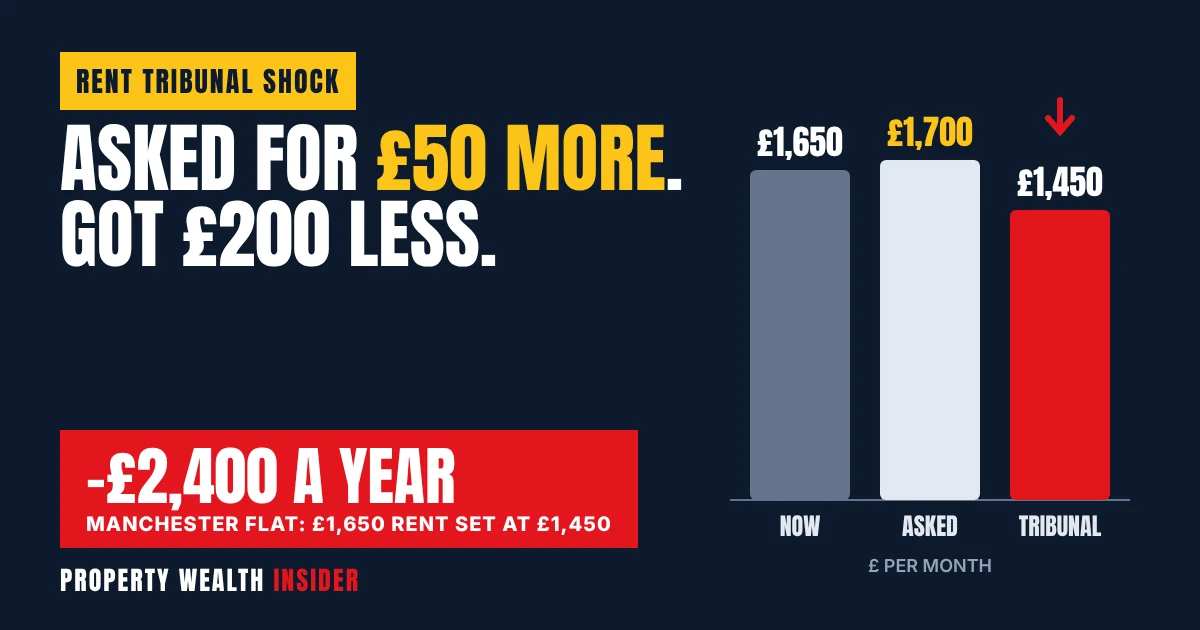
A Manchester landlord who asked for an extra £50 a month has instead been ordered to accept £200 a month less than the tenant was already paying. The First-tier Tribunal (Property Chamber) set the rent on a city-centre two-bed flat at £1,450, down from £1,650, after the tenant challenged a £1,700 Form 4A notice.
It is one of the first clear examples of the new rent-challenge rules in England biting hard. Since 1 May 2026 the tribunal can no longer push the rent above the figure the landlord proposed, but nothing stops it going below the current rent.
If you let privately in England and plan to serve a rent increase notice, this decision changes the maths. A modest, below-inflation rise is no protection if your current rent is already above what the evidence says the property would let for.
Key facts
- Landlord proposed £1,700 a month, up from £1,650; the tribunal set £1,450 (case MAN/00BN/MRA/2026/0043, decided 17 September 2026).
- Result for the landlord: £2,400 a year less rent, instead of the £600 a year more he asked for.
- Under the Housing Act 1988 as amended from 1 May 2026, the new rent is the open-market rent if that is lower than the proposed rent, otherwise the proposed rent. It can fall below the current rent.
- Landlords must use Form 4A, give at least 2 months’ notice, and can raise rent only once every 52 weeks.
- Tenants pay a £47 tribunal fee to challenge, and often the case is decided on paper with no hearing.
- Rules apply to private assured tenancies in England only.
The Manchester case: how £50 up became £200 down
The property is a furnished sixth-floor flat in Manchester city centre (M1) with two double bedrooms, two bathrooms including an en-suite, an open-plan living room and kitchen, and a balcony. The tenancy started on 18 August 2025 at £1,650 a month.
By a notice dated 17 June 2026, the landlord proposed £1,700 from 18 August 2026, a rise of about 3%. The tenant challenged it and asked the tribunal to set the market rent.
The tenant argued the flat was worth about £1,400, and produced adverts for flats in the same building and neighbouring developments at roughly £1,400 to £1,500. The landlord said it was the largest flat in the building, on the top floor with light and views, and relied on comparables from across central Manchester.
The tribunal sided with the tenant on which evidence mattered most: flats in the same building, or immediately neighbouring blocks of similar age, character and specification. It noted the £1,400 example looked smaller than the subject flat and that it was unclear whether the £1,500 one was in the same building, then settled on £1,450.
Two other details matter. The landlord asked for a hearing and an inspection, but a legal officer ruled an inspection disproportionate and the case was decided on the papers. And because the rent went down, the tribunal did not need to consider the tenant’s hardship request. The £1,450 rent took effect from 18 September 2026, the first rental period after the decision.
The £ damage: the landlord sought +£50 x 12 = £600 a year. He got -£200 x 12 = -£2,400 a year. Against what he asked for, that is a £3,000 a year swing (£250 a month), and the lower rent becomes the new base for any future increase.
The new rent increase rules in England
The Renters’ Rights Act 2025 rewrote sections 13 and 14 of the Housing Act 1988 and added new sections 14ZA and 14ZB, in force from 1 May 2026. These apply to assured tenancies in England’s private rented sector. Social housing let by registered providers is carved out, and Wales, Scotland and Northern Ireland have their own systems.
| Rule | What the law says now | Where |
|---|---|---|
| How to raise rent | Serve the prescribed notice, Form 4A. Rent review clauses in a tenancy have no effect; rent can rise only by notice, tribunal decision or written agreement. | HA 1988 s.13(2), s.13(4A) |
| Notice period | New rent cannot start until at least two months after the notice is served (one month for notices given before 1 May 2026). | s.13(2)(a) |
| How often | No earlier than 52 weeks after the tenancy began, or after the last increase took effect. | s.13(2)(b)-(c), (3A) |
| Tenant challenge | Tenant can apply to the tribunal before the new rent’s start date. Fee £47. | s.14(A3); gov.uk guidance |
| What the tribunal sets | The rent the home might reasonably be expected to let for on the open market, by a willing landlord, on the same terms. | s.14(1) |
| Ceiling | The new rent is the open-market rent if lower than the proposed rent; otherwise the proposed rent. No floor at the current rent. | s.14ZB(5) |
| When it starts | The date in the notice if that is on or after the decision; otherwise the first rental period after the decision. | s.14ZB(3)(a)-(b) |
| Hardship | If the tenant would suffer undue hardship, the tribunal can set a later start date, but within two months of its decision. | s.14ZB(3)(c), (4) |
| New tenancies | A tenant can challenge the starting rent within the first six months. The rent payable is the lower of the open-market rent and the current rent. | s.14(A1)-(A2), s.14ZA |
That six-month starting-rent challenge was not used in Manchester; the tenant challenged the increase notice instead. But the Manchester decision shows the same risk applies: a rent agreed in a hot market can be reset downwards the moment you serve a notice.
Under the old rules, a tribunal could set a rent higher than the landlord asked for, which put tenants off challenging. That deterrent has gone. A tenant risks £47 and some paperwork; the landlord risks the whole gap between the current rent and the evidence.
Four 2026 decisions: what the tribunal actually does
We read recent Northern-region decisions published on gov.uk. They show a tribunal that gives most weight to close, like-for-like evidence, prefers agreed lets to asking prices, and deducts for defects.
| Case (area) | Current | Proposed | Decided | Why |
|---|---|---|---|---|
| MAN/00BN/MRA/2026/0043 (Manchester M1, 2-bed flat) | £1,650 | £1,700 | £1,450 | Same-building and neighbouring adverts at about £1,400-£1,500 beat wider city-centre comparables. |
| MAN/00DA/MRA/2026/0019 (Leeds LS15, 3-bed semi) | £950.50 | £1,300 | £1,200 | Three agreed lets averaged £1,216; asking-price guides “of limited assistance”. Start deferred to 1 October 2026 for hardship. |
| MAN/00DA/MRA/2026/0045 (Calverley LS28, 2-bed terrace) | £895 | £950 | £925 | Market rent in good order £1,000, less £75 for drainage problems. |
| MAN/00BT/MNR/2026/0212 (Ashton-under-Lyne OL7, 2-bed terrace) | £850 | £900 | £850 | Tribunal saw a house on the same street being shown at £850 asking; rent left unchanged. Notice served before 1 May 2026. |
Three lessons stand out. First, the Leeds LS15 landlord still won a big rise, from £950.50 to £1,200 (+26%), because the evidence supported it. Asking for £1,300 cost £100 a month against the notice, but the rise itself stood.
Second, condition is priced in pounds. In Calverley the tribunal started at £1,000 for the house in good order and knocked £75 off for drainage, landing between the old and proposed rents.
Third, the tribunal uses its own knowledge. In Ashton-under-Lyne the landlord’s agent listed adverts up to £1,100, but the tribunal gave weight to what it saw in the street on the day.
Rent increase tribunal-risk checker
Enter your current rent, the rent you plan to propose, and the median of at least three genuinely comparable lets (same building or street if possible, agreed lets ahead of adverts). Then knock off a percentage for anything that makes your home worse than those comparables. The defaults are the Manchester case.
Rent increase tribunal-risk checker
Guide only, not legal or financial advice. The “likely range” is an illustrative band of 5% either side of your condition-adjusted evidence; real tribunals weigh evidence quality, use their own market knowledge and can land anywhere up to your proposed rent.
Worked example: a landlord at £1,200 a month wants £1,260 (+5%). Three nearby agreed lets average £1,300, but the boiler is old and the kitchen dated, so they knock off 4%: evidence of £1,248. The notice sits about 1% above the evidence, a borderline case. Asking for £1,240 instead gives up £240 a year but makes a challenge far less likely to succeed.
How to set a rent increase that survives a challenge
Gov.uk tells tenants exactly what evidence the tribunal wants. Build the same pack before you pick a number, not after the tenant applies.
- Check your dates. At least 52 weeks since the tenancy began or the last increase took effect, and at least two months between serving Form 4A and the new rent starting on the first day of a rental period.
- Find close comparables first. Same building or street, same bedrooms and bathrooms, similar age and spec. The Manchester tribunal favoured these over wider city-centre evidence.
- Prefer agreed lets to adverts. Gov.uk says evidence from actual lettings is stronger than Rightmove or Zoopla listings. Ask your agent for recent let-agreed figures with dates.
- Take the median, then adjust honestly. Deduct for defects, poorer furnishings, missing parking or smaller rooms. The tribunal will do it anyway, as the £75 drainage deduction in Calverley shows.
- Fix repairs before serving. A repaired defect cannot be priced against you. Keep invoices and dated photos.
- Propose at or slightly below the evidence. The tribunal cannot go above your figure, so overreaching gains nothing and a weak case can lose you rent you already have.
- Talk to the tenant. The law lets you agree a lower rise than the notice, or no rise. A negotiated figure beats a tribunal lottery.
- If challenged, respond. You have 28 days to respond on form MR2. Send your full pack and ask for an inspection if the photos undersell the property.
- Tenancy start date and date of last increase noted
- Correct Form 4A, signed, with the tenant’s correct names and address
- New rent date at least two months after service and on a rental period start
- Floor plan or rough layout, plus room sizes
- Recent photo of every room and the front of the property
- List of features: heating, glazing, appliances, furniture (and who supplied them)
- Records of repairs and improvements, who did them and who paid
- 3-6 comparables: address, beds, baths, rent, let-agreed or asking, date
- Notes on local amenities and transport
- Your adjusted evidence figure and the reasoning behind it
Rents are still rising, so why the cuts?
Official figures show rents still climbing. The ONS Price Index of Private Rents puts the average UK rent at £1,400 a month, up 3.8% in the 12 months to August 2026. In England the average was £1,459 (+4.0%), and the North West tied with the North East for the fastest growth at 5.8%.
So the Manchester landlord asked for roughly 3%, below the regional trend, and still lost. The tribunal does not apply inflation to your current rent. It asks what this specific home would let for today, and if you signed a tenant at a premium, that premium is exposed.
The next ONS rent release is due on 21 October 2026. Treat regional averages as background only; they are not comparable evidence for a single property.
FAQ
Can a tribunal lower my rent below what the tenant pays now?
Yes. In England, if a tenant challenges a Form 4A notice, the new rent is the open-market rent if that is lower than your proposed figure. There is no floor at the current rent, as the Manchester £1,450 decision shows.
Can the tribunal set a higher rent than I asked for?
Not for challenges under the rules in force from 1 May 2026. The rent payable is capped at the figure in your notice, even if the tribunal thinks the market rent is higher.
How much notice do I need to give for a rent increase?
At least two months, using Form 4A, and no earlier than 52 weeks after the tenancy began or the last increase took effect. Notices given before 1 May 2026 needed one month.
When does a tribunal-set rent start?
From the date in your notice if the decision comes first; otherwise from the first rental period after the decision. If a rise would cause the tenant undue hardship, the tribunal can delay it by up to two months from its decision.
How much does it cost a tenant to challenge a rent increase?
The application fee is £47, with help available for tenants on low incomes or certain benefits. Many cases are decided on paper without a hearing.
Can I appeal a rent tribunal decision?
Only on a point of law, to the Upper Tribunal (Lands Chamber), and you must first ask the First-tier Tribunal for permission in writing within 28 days of the reasons being issued.
Sources
- GOV.UK: Tribunal decision MAN/00BN/MRA/2026/0043 (Manchester M1)
- GOV.UK: Tribunal decision MAN/00DA/MRA/2026/0019 (Leeds LS15)
- GOV.UK: Tribunal decision MAN/00DA/MRA/2026/0045 (Calverley LS28)
- GOV.UK: Tribunal decision MAN/00BT/MNR/2026/0212 (Ashton-under-Lyne OL7)
- legislation.gov.uk: Housing Act 1988, section 13
- legislation.gov.uk: Housing Act 1988, section 14
- legislation.gov.uk: Housing Act 1988, section 14ZA
- legislation.gov.uk: Housing Act 1988, section 14ZB
- GOV.UK: Apply for an open market rent determination
- GOV.UK: Assured tenancy forms (Form 4A)
- GOV.UK: Renters’ Rights Act, an overview for landlords
- ONS: Private rent and house prices, UK (16 September 2026)
This article is news and general guidance only, not financial, legal or tax advice.